
The OSCAR Coaching Model: How It Drives Results Faster Than Ever
Coaching loses momentum when clients discuss the same obstacle repeatedly without defining success, comparing realistic choices, or committing to measurable action. The OSCAR coaching model prevents that drift through five connected stages: Outcome, Situation, Choices and Consequences, Actions, and Review. It combines behavior-change science, client accountability, constructive feedback, and habit formation in a structure that turns reflection into implementation. Used skillfully, OSCAR helps clients identify the right outcome, choose deliberately, act with ownership, and learn from results before unproductive patterns regain control.

1. Why the OSCAR Coaching Model Produces Faster, Clearer Progress
Karen Whittleworth and Andrew Gilbert developed the OSCAR coaching model in 2002 as an extension of the earlier GROW framework. OSCAR stands for Outcome, Situation, Choices and Consequences, Actions, and Review. The Open University describes it as a solution-focused model designed to connect long-term outcomes with action milestones, while Worth Learning identifies Gilbert and Whittleworth as its developers.
The model’s efficiency comes from the order of its questions. Outcome establishes direction before the session becomes consumed by problems. Situation identifies the current reality without allowing diagnosis to dominate the conversation. Choices and Consequences expose genuine alternatives and their trade-offs. Actions convert the selected route into observable commitments. Review creates a feedback loop that reveals whether the plan is working.
This structure connects naturally with transformational coaching, accountability coaching, micro-coaching, and client expectation management. Each stage prevents a different form of coaching waste.
Outcome prevents activity without direction
Clients often enter coaching with complaints rather than outcomes. “My team ignores me,” “I have no motivation,” or “My business feels stuck” describes discomfort without defining the change required. A coach who immediately explores the history of the problem may conduct an insightful session that leaves the client unsure what success should look like.
The Outcome stage converts pain into a usable destination. Coaches can draw on life visioning, life-purpose coaching, strengths-based coaching, and the life-balance wheel to clarify the result at several levels.
A high-quality outcome explains:
What the client wants to be different
What evidence will demonstrate progress
Why the result deserves attention now
Which parts remain within the client’s control
How the outcome connects with wider values
What a successful coaching session must produce today
“Improve delegation” remains too broad. “Transfer ownership of three recurring operational decisions to department heads within six weeks while maintaining agreed quality standards” gives the coach and client something concrete to develop, test, and review.
Situation separates evidence from interpretation
Clients frequently describe interpretations as facts. “My manager has no confidence in me” may be based on one excluded meeting. “I cannot maintain habits” may overlook several routines the client already performs consistently. “My team resists accountability” may conceal unclear ownership, changing expectations, or delayed feedback.
The Situation stage establishes an accurate baseline through emotional intelligence, emotional agility, client-anxiety coaching, and safe coaching conversations. The coach helps the client distinguish events, assumptions, emotions, behaviors, resources, and constraints.
Useful Situation questions include:
What is happening in observable terms?
How frequently does it occur?
Who is involved?
What have you already attempted?
Which part is working better than you initially suggested?
What evidence supports your interpretation?
What evidence could challenge it?
Which resources are already available?
What are you currently avoiding?
How are your own actions maintaining the situation?
A disciplined baseline stops the client from solving an exaggerated, incomplete, or misidentified problem.
Choices and Consequences create decision quality
Clients sometimes see only two options: continue suffering or make an extreme change. A dissatisfied professional may believe they must tolerate their role or resign immediately. A coach may feel trapped between keeping an unsuitable client and issuing a full refund. A leader may believe they must micromanage or accept poor work.
The Choices stage expands the decision space through mindset shifts, resilience coaching, positive psychology, and holistic coaching. The Consequences component then protects the client from selecting an attractive option without considering its cost.
The coach can explore:
What could you do?
What could you stop doing?
What could you simplify?
Who could support you?
Which option have you dismissed too quickly?
What would a smaller experiment look like?
What is the likely benefit of each choice?
What time, energy, money, or relationship cost could follow?
Which consequence can you tolerate?
Which option best serves the stated outcome?
This stage increases ownership because the client evaluates routes rather than receiving a directive disguised as coaching.
Actions eliminate vague commitment
Clients can leave an energizing conversation with intentions that disappear within 24 hours. “I will communicate more,” “I will prioritize myself,” and “I will work on my confidence” lack a trigger, behavior, deadline, and completion standard.
The Actions stage applies habit stacking, health behavior change, structured accountability, and coaching automation. The coach helps the client produce a plan that remains usable when motivation drops.
Every action should define:
The exact behavior
The first step
The start time
The completion deadline
The frequency
The required resources
The likely obstacle
The recovery response
The evidence of completion
The accountability method
A strong commitment sounds like: “Before Wednesday at 3 p.m., I will send each department head a draft decision-rights map and schedule a 20-minute review with them before Friday.”
Review turns action into learning
Review keeps coaching from becoming a series of disconnected conversations. The client examines completion, results, resistance, unintended consequences, and required adjustments. A missed action becomes useful evidence rather than a reason for shame or superficial encouragement.
The Review stage integrates client feedback, habit-formation analysis, constructive feedback, and exceptional client experiences. It also determines whether the coach should continue the current strategy, redesign the action, revisit the outcome, or refer the client for different support.
High-value Review questions include:
What did you complete?
What result followed?
Which assumption proved accurate?
Which assumption proved misleading?
What became easier?
Where did resistance appear?
What helped you follow through?
What will you repeat?
What needs adjustment?
What is the next review point?
OSCAR accelerates progress because each cycle produces information that improves the next cycle.
Hello, World!
2. How to Master Every Stage of an OSCAR Coaching Conversation
A coach can follow OSCAR mechanically and still produce shallow results. Mastery depends on choosing questions that deepen thinking without turning the framework into an interrogation. The stages should feel connected, flexible, and responsive to the client’s emerging awareness.
Outcome: define the destination and today’s purpose
The coach should clarify both the long-term outcome and the session outcome. A client may want to become a more confident leader over six months while needing to prepare for one difficult meeting today.
This distinction strengthens life-purpose coaching, life visioning, self-actualization coaching, and client expectation management. It also protects the session from drifting into every issue connected with the larger goal.
Ask:
What would make this session valuable?
What needs to be clearer before we finish?
What outcome are you ultimately working toward?
Why is that outcome important at this point?
How would achieving it affect other areas?
What would you notice first?
What would other people observe?
Which result would justify the required effort?
How will we know today’s conversation has moved you forward?
A coach should test whether the outcome reflects the client’s values, current capacity, and actual sphere of influence. The client may pursue a goal shaped by comparison, family pressure, employer expectations, or fear. Positive psychology coaching, emotional agility, mindset development, and holistic coaching help determine whether the destination deserves the client’s commitment.
Situation: diagnose enough to act
The Situation stage needs depth and restraint. Excessive exploration consumes session time and can reinforce helplessness. Insufficient exploration creates actions based on assumptions.
A useful Situation diagnosis covers five areas:
Facts: Events that could be observed or documented
Interpretations: Meaning assigned to those events
Emotions: Internal responses influencing behavior
Patterns: Repeated triggers and reactions
Resources: Strengths, support, information, time, and authority already available
This process can integrate emotional-intelligence coaching, stress-coaching strategies, strengths-based coaching, and safe coaching practice.
The coach should listen for absolute language such as “always,” “never,” “everyone,” “impossible,” and “nothing works.” These words may signal emotional intensity, incomplete evidence, or a belief that has escaped examination.
Ask:
When did this last happen?
What did each person say or do?
What occurred immediately before it?
Which pattern repeats?
What are you assuming?
What are you reluctant to acknowledge?
How have you contributed?
What is already working?
What have you learned from earlier attempts?
Which constraint is real, and which remains untested?
The stage is complete when the client understands the current position well enough to generate informed choices.
Choices and Consequences: expand before evaluating
Coaches sometimes evaluate each idea as soon as the client mentions it. Early evaluation reduces creativity because the client begins censoring possibilities. Separate option generation from option assessment.
During generation, use transformational coaching strategies, positive psychology, mindset shifts, and resilience coaching to broaden the client’s thinking.
Ask:
What else could you do?
What would you attempt with greater confidence?
What would a trusted expert consider?
What can be reduced, delegated, delayed, or removed?
What option uses strengths you already possess?
What is the safest useful experiment?
What would you choose with half the available time?
What support could change the feasibility of an option?
During evaluation, assess:
Alignment with the outcome
Expected benefit
Likely downside
Time and financial cost
Emotional difficulty
Effect on other people
Reversibility
Required support
Ethical implications
Probability of follow-through
A commercially impressive option can damage health, relationships, professional boundaries, or long-term credibility. Career-burnout coaching, self-care coaching, economic-change coaching, and the life-balance wheel help clients evaluate the full cost.
Actions: create implementation certainty
The Actions stage should produce a commitment the client can repeat accurately without looking at the coach’s notes. Ask the client to state the action in their own words. This quickly reveals confusion, reluctance, or unrealistic ambition.
Build the plan using habit stacking, behavior-change principles, accountability coaching, and micro-coaching.
Confirm:
What will you do?
When will you begin?
Where will it happen?
How frequently?
What must be prepared first?
Who needs to be informed?
What obstacle is most likely?
What will you do when it appears?
How confident are you from 1 to 10?
What would raise that confidence by one point?
How will completion be recorded?
When will we review it?
A confidence rating below seven often signals that the action is too large, unclear, poorly timed, or externally imposed. Redesigning the commitment protects momentum more effectively than pushing the client toward a promise they already expect to break.
Review: examine behavior without creating shame
Review should be curious, accurate, and demanding. Excessive reassurance can make accountability meaningless. Harsh judgment encourages concealment.
Use constructive feedback, client-feedback systems, emotional agility, and safe coaching environments to create an honest review.
A five-part review covers:
Completion: What happened?
Impact: What result followed?
Learning: What did the attempt reveal?
Adjustment: What should change?
Continuation: What happens next?
The client who completed 40% of a plan may have learned more than the client who completed an easy action that tested nothing. Review the quality of the learning alongside completion.
3. How to Apply OSCAR Across Different Coaching Niches
OSCAR remains useful because its stages can support many client contexts without forcing every problem into the same intervention. The coach adapts the depth, language, measures, and ethical boundaries while preserving the model’s underlying sequence.
Leadership and executive coaching
An executive may want to improve delegation. Outcome defines the level of decision ownership required. Situation reveals where work returns to the executive and why. Choices examines decision-rights maps, manager development, checkpoints, and quality standards. Actions assigns one real decision. Review measures whether ownership remained delegated.
This application draws on accountability coaching, constructive feedback, emotional intelligence, and transformational coaching. Business indicators may include approval volume, escalation frequency, manager-generated solutions, and strategic time recovered.
Career and burnout coaching
A professional considering resignation may initially treat departure as the only route. OSCAR clarifies the desired career and wellbeing outcome, examines workload and workplace evidence, generates internal and external options, evaluates financial and emotional consequences, and creates a low-risk next action.
The coach can combine career-burnout coaching, resilience coaching, life-purpose coaching, and life visioning. Actions might include a boundary conversation, workload audit, role redesign proposal, skills-gap analysis, or carefully planned job search.
Health and lifestyle coaching
A client who wants better health may arrive with ten simultaneous goals. OSCAR identifies the outcome with the greatest relevance, establishes the behavioral baseline, compares feasible interventions, selects one action, and reviews adherence alongside effect.
This process aligns with lifestyle medicine coaching, preventive health coaching, habit stacking, and health behavior change. Coaches must stay within appropriate scope and refer medical, nutritional, or mental-health needs requiring licensed treatment.
Relationship and communication coaching
A couple may want to reduce recurring conflict. Outcome defines the desired communication behavior. Situation maps the trigger-response cycle. Choices identifies pause agreements, structured check-ins, clearer requests, and repair protocols. Actions select one practice for the coming week. Review examines usage, emotional effect, and remaining friction.
The process benefits from emotional-intelligence coaching, constructive feedback, safe coaching environments, and handling difficult situations. Coaches should screen for violence, coercive control, severe distress, and clinical needs before proceeding.
Business and practice-growth coaching
A coach with inconsistent sales may assume the solution is more social-media activity. OSCAR can define the revenue outcome, examine lead sources and conversion data, compare partnerships, referrals, content, paid acquisition, and offer redesign, then create a measurable action sprint.
Relevant business resources include high-ticket coaching offers, financial forecasting, professional networking, and coaching-business automation. Review should track qualified conversations, conversion, acquisition cost, delivery capacity, and margin.
Accountability and habit coaching
Clients who know what to do often need a stronger implementation system. OSCAR helps determine the meaningful outcome, identify the exact point where follow-through collapses, compare environmental and behavioral supports, create a small commitment, and review adherence without relying on memory.
The model works especially well with habit formation, accountability coaching, micro-coaching, and coaching automation. A weekly session can contain one full OSCAR cycle while brief check-ins reinforce only Actions and Review.
4. A Practical OSCAR Session Plan Coaches Can Use Immediately
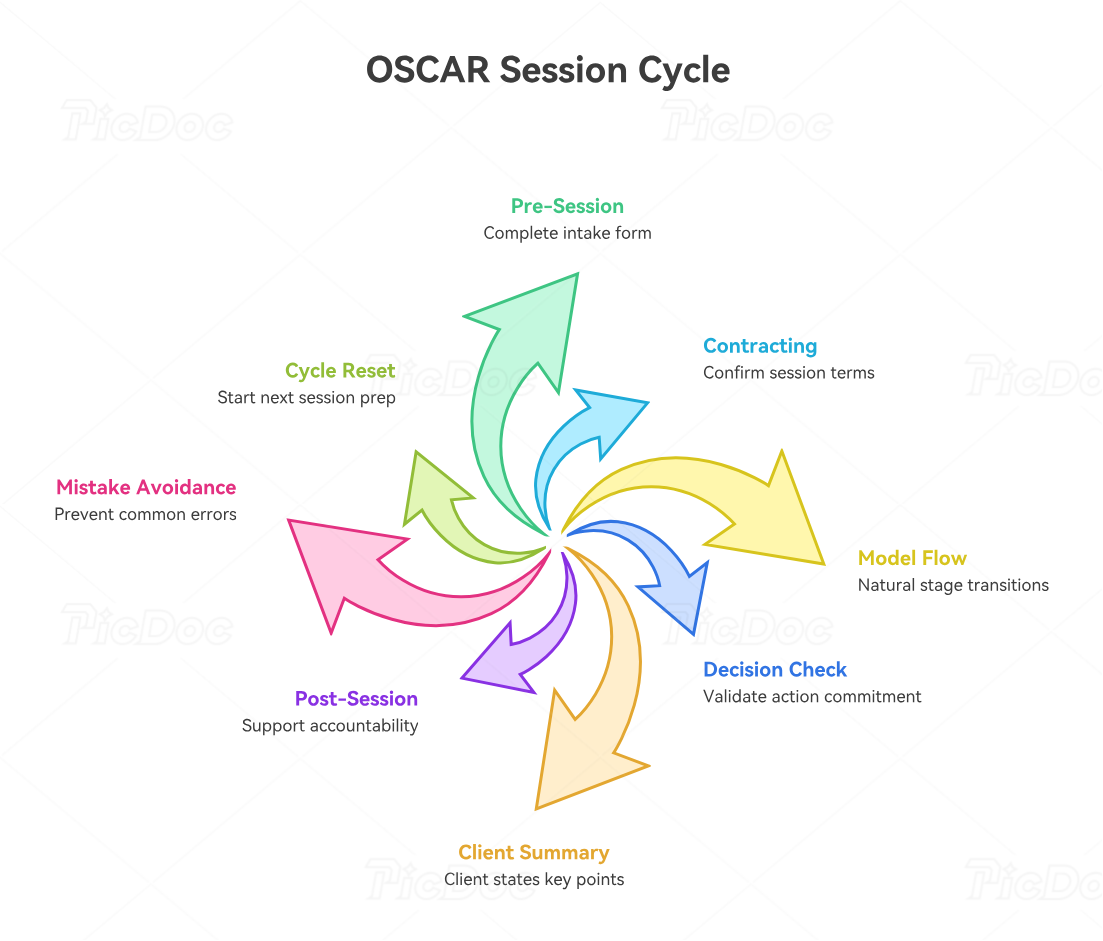
A structured session protects time while preserving flexibility. A 60-minute OSCAR conversation can allocate approximately 10 minutes to Outcome, 15 minutes to Situation, 15 minutes to Choices and Consequences, 10 minutes to Actions, and 10 minutes to Review or summary. Returning clients may begin with Review before defining the next Outcome.
Before the session
Use a short intake or pre-session form asking:
What result requires attention?
What has changed since the previous session?
Which commitment was completed?
What obstacle appeared?
What decision needs to be made?
What would make the next session valuable?
A consistent preparation process can use coaching automation, must-have coaching tools, technology-enabled coaching, and exceptional client-experience systems. The form should remain short enough to complete and secure enough for the information collected.
Open with contracting
Confirm confidentiality, session focus, available time, and the client’s desired result. When coaching is funded by an employer or another party, clarify what information can be shared.
Professional contracting should reflect the ICF Code of Ethics, legal requirements for coaches, credentialing best practices, and safe coaching standards. Clear contracting prevents confusion when sensitive information, sponsor expectations, or referral needs emerge.
Move through the model without announcing every letter
The coach does not need to say, “We are now entering the Situation stage.” Natural transitions preserve conversational flow:
“Let us make the result more specific.”
“What is happening currently?”
“Which options have you considered?”
“What could each route create or cost?”
“Which action are you willing to own?”
“How and when will we review it?”
The framework should support listening rather than replace it. Coaches can deepen their presence through emotional intelligence, strengths-based coaching, constructive feedback, and transformational coaching skills.
Use a decision checkpoint before Actions
Before converting a choice into action, ask the client to explain why the selected route deserves commitment. This checkpoint reveals compliance, uncertainty, or a hidden preference.
Ask:
Why this option?
Which outcome does it support?
What consequence are you accepting?
What concern remains unresolved?
How committed are you?
What could cause you to abandon it?
The answers improve accountability, expectation management, emotional agility, and behavior-change planning. They also stop the coach from treating verbal agreement as genuine readiness.
Close with a client-generated summary
Ask the client to state:
The outcome
The key insight
The selected action
The deadline
The likely obstacle
The recovery response
The review date
The coach should correct ambiguity before the session ends. A shared note, secure client portal, or automated reminder can support between-session accountability, habit reinforcement, micro-coaching support, and business automation.
Avoid the most common OSCAR mistakes
Rushing Outcome: The coach accepts “be happier” or “grow my business” and builds actions on an unstable target.
Overexploring Situation: The session becomes a detailed retelling of the problem, leaving insufficient time for choices and action.
Suggesting options too early: The coach’s expertise takes over before the client has generated or evaluated their own possibilities.
Ignoring Consequences: An exciting option receives approval without examining capacity, risk, cost, relationships, or scope.
Accepting motivational language as action: The client promises to “try harder” without defining a behavior.
Treating Review as compliance policing: The coach checks whether homework was completed and misses the learning contained in resistance.
These errors can be reduced through client-expectation management, constructive feedback, handling difficult client situations, and continuing professional development.
5. How to Build a High-Value Coaching Offer Around OSCAR
OSCAR can become more than a session framework. Coaches can use it to structure assessments, programs, progress reports, client resources, and case studies. The commercial value comes from applying the model to a defined problem rather than selling an acronym.
Position OSCAR around an urgent outcome
Examples include:
An OSCAR-based leadership transition program
An OSCAR accountability sprint for entrepreneurs
An OSCAR habit-change program for health clients
An OSCAR career-decision intensive
An OSCAR communication reset for teams
An OSCAR goal-clarity program for new managers
An OSCAR business-growth planning package
An OSCAR burnout-recovery coaching pathway
Defined positioning connects with high-ticket offer design, practice scaling, professional networking, and credible case-study development.
Clients buy help with a painful decision, repeated behavior, leadership gap, or stalled goal. OSCAR provides the delivery architecture that makes the promise more systematic.
Build the program around repeated cycles
A six-session offer could follow this structure:
Outcome architecture: Define goals, measures, motivation, and boundaries
Situation diagnosis: Establish the baseline, patterns, resources, and constraints
Choice generation: Develop options and test assumptions
Consequence analysis: Evaluate trade-offs and select a route
Action implementation: Build habits, accountability, and obstacle plans
Review and maintenance: Measure progress, capture learning, and plan continuation
Clients will move through smaller OSCAR cycles inside each session. The larger program cycle creates coherence across the entire engagement.
The offer can be strengthened through client-retention planning, payment systems, financial forecasting, and coaching-business automation.
Create OSCAR-based client tools
Useful resources include:
Outcome-definition worksheet
Situation evidence audit
Assumption-testing form
Choices and Consequences matrix
Action-design checklist
Obstacle-response planner
Weekly Review scorecard
Coaching progress dashboard
Session preparation form
Graduation and maintenance plan
Technology can deliver these through coaching automation, must-have coaching tools, technology-enabled coaching, and micro-coaching systems. Every tool should serve a defined behavioral purpose and collect only information the coach genuinely needs.
Measure results at three levels
A credible OSCAR program tracks:
Implementation measures: Actions completed, frequency, consistency, and recovery after disruption.
Behavioral measures: Delegation, communication, routines, decision-making, boundaries, or other target behaviors.
Outcome measures: The meaningful result the client originally defined.
For leadership coaching, implementation may involve conducting weekly delegation conversations. Behavioral change may appear as clearer decision ownership. The outcome may involve reducing executive bottlenecks. For health coaching, implementation may involve a daily routine, behavioral change may appear as adherence, and the outcome may involve improved energy or another appropriately defined client goal.
Measurement supports accountability coaching, client-feedback analysis, coaching case studies, and exceptional client experiences.
Protect scope and ethics
OSCAR can organize a coaching conversation without making every client issue suitable for coaching. Coaches should refer needs involving clinical diagnosis, trauma treatment, suicidality, addiction, domestic abuse, regulated financial advice, medical treatment, or legal representation.
Professional safeguards should draw on supporting clients during emotional crises, coaching legal requirements, ICF ethical principles, and credentialing discipline. Intake screening, informed consent, confidentiality policies, recordkeeping, referral procedures, and insurance should support the model.
Turn outcomes into ethical proof
An OSCAR case study can document:
The client’s initial outcome
The baseline situation
The options considered
The choice and its trade-offs
The action plan
The review evidence
The measurable result
The maintenance strategy
This format produces clearer proof than a testimonial saying the coach was supportive. Coaches can refine evidence through successful transformation case studies, client-feedback systems, case-study credibility, and exceptional client experiences.
6. Frequently Asked Questions About the OSCAR Coaching Model
-
OSCAR stands for Outcome, Situation, Choices and Consequences, Actions, and Review. Outcome defines the destination. Situation clarifies the current reality. Choices and Consequences compare available routes and trade-offs. Actions establish implementation. Review measures progress and captures learning.
The stages work effectively with behavior-change science, accountability coaching, habit formation, and constructive feedback.
-
Karen Whittleworth and Andrew Gilbert developed the OSCAR coaching model in 2002. The model was designed to build on GROW while giving greater attention to outcomes, choices and consequences, action milestones, and ongoing review.
Coaches can apply it alongside transformational coaching, strengths-based coaching, positive psychology, and client accountability.
-
GROW commonly moves through Goal, Reality, Options, and Will or Way Forward. OSCAR uses Outcome, Situation, Choices and Consequences, Actions, and Review. OSCAR gives explicit attention to the consequences of each choice and establishes Review as a dedicated stage.
These additions make the model especially practical for habit coaching, micro-coaching, accountability programs, and behavior-change coaching.
-
OSCAR reduces several causes of slow progress: unclear outcomes, inaccurate assumptions, limited options, vague commitments, and missing review. Each stage produces a required output before the conversation moves forward.
Faster progress still depends on client readiness, goal complexity, coaching competence, available resources, and appropriate scope. Coaches can improve implementation through habit stacking, coaching automation, expectation management, and structured accountability.
-
A person can use OSCAR independently by writing one clear outcome, documenting the current situation, generating several choices, assessing their consequences, selecting a specific action, and scheduling a review.
Self-coaching works best when the issue remains within the person’s ability to assess safely. External support may be valuable when strong emotions, blind spots, clinical needs, or high-stakes decisions affect judgment. Helpful complementary approaches include emotional agility, life visioning, resilience coaching, and the life-balance wheel.
-
OSCAR can support leadership, career, business, health, lifestyle, relationship, accountability, performance, and personal-development coaching. The questions, measures, safeguards, and referral thresholds should match the client context.
Examples include career-burnout coaching, health behavior change, emotional-intelligence coaching, and high-ticket business coaching
