
An ICF certification study schedule works best when it protects three things at once: your application timeline, your coaching judgment, and your exam-day stamina. Many coaches study the ICF certification process like a glossary, then freeze when the exam asks what a coach should actually do inside a difficult client moment. A strong plan connects ICF credentialing skills, effective coaching communication, ethical coaching standards, and client trust-building into one weekly rhythm.

1. Start With the Exact ICF Exam You Are Preparing For
Your study schedule should begin with the credential path you are actually pursuing. ICF currently separates exam preparation by credential level: the ACC Exam has 60 multiple-choice questions, uses a 200–600 scaled score, and requires 460 to pass, while the PCC/MCC credentialing exam focuses on scenario-based judgment tied to ICF competencies, ethics, and coaching practice. That means an ACC candidate needs a tighter foundation plan, while PCC and MCC candidates need heavier work around applied judgment, best-worst response selection, and professional decision-making. Build your plan around ICF exam mistakes, ICF application requirements, credentialing skill development, and coaching integrity.
The second mistake is studying before your timeline is mapped. ICF says candidates who have submitted and received approval for the PCC or MCC credentialing exam receive an invitation and then have 60 days to schedule and complete the exam. This creates pressure because a coach who waits for the invitation to begin studying loses the most useful preparation window. Your schedule should start while you are organizing credentialing documentation, reviewing common credentialing mistakes, sharpening coaching boundaries, and building case study confidence.
| # | Study Block | What To Do | Time Needed | Pain Point It Solves | Best ANHCO Resource |
|---|---|---|---|---|---|
| 1 | Credential path review | Confirm whether you are preparing for ACC, PCC, MCC, or a future upgrade path. | 45 minutes | Studying for the wrong exam structure. | ICF Certification Application Process |
| 2 | Exam format mapping | Write down question count, testing style, scoring pressure, and your target date. | 30 minutes | Walking into prep with vague expectations. | ICF Exam Mistakes |
| 3 | ICF Core Competencies audit | Rate your confidence across each competency before studying deeply. | 60 minutes | Overstudying strengths while avoiding weak areas. | Essential Coaching Skills |
| 4 | Ethics baseline | Review confidentiality, conflicts, scope, referrals, consent, and contracting. | 90 minutes | Missing the hidden ethics issue in scenario questions. | Ethical Responsibilities |
| 5 | Coaching vs advising drill | Rewrite advice-heavy responses into coach-like responses. | 45 minutes | Choosing expert answers instead of coaching answers. | Avoid This Coaching Trap |
| 6 | Listening practice | Review client statements and identify what is said, unsaid, emotional, and values-based. | 45 minutes | Answering from content while missing the client’s meaning. | Coaching Success Skill |
| 7 | Powerful question practice | Convert closed, leading, and fixing questions into open coaching questions. | 45 minutes | Sounding supportive while quietly directing the client. | Client Breakthrough Technique |
| 8 | Contracting review | Study session agreements, goals, boundaries, sponsor expectations, and client ownership. | 60 minutes | Missing what should be clarified before coaching continues. | Set Coaching Boundaries |
| 9 | Client autonomy drill | Practice choosing responses that return choice and responsibility to the client. | 45 minutes | Accidentally rescuing, convincing, or pushing clients. | Empower Clients |
| 10 | Values and meaning review | Practice spotting values, identity tension, motivation, fear, and self-belief cues. | 60 minutes | Treating every client issue like a task problem. | Transformational Coaching |
| 11 | Scenario ranking practice | Choose the best and weakest response, then explain why in one sentence. | 60 minutes | Getting fooled by answers that sound polite but violate coaching logic. | ICF Exam Pitfalls |
| 12 | Scope-of-practice review | Separate coaching, therapy, consulting, training, mentoring, and medical advice. | 60 minutes | Picking answers that cross professional lines. | Coaching Standards |
| 13 | Emotional consent study | Review how to ask permission before deep emotional exploration. | 45 minutes | Assuming depth is always helpful. | Emotional Consent |
| 14 | Feedback language practice | Turn judgmental feedback into clean observations and permission-based sharing. | 45 minutes | Sounding insightful while making the client defensive. | Constructive Feedback |
| 15 | Accountability review | Study how to support accountability without pressure, shame, or control. | 60 minutes | Confusing responsibility with compliance. | Accountability In Coaching |
| 16 | Behavior change review | Connect readiness, habits, motivation, barriers, relapse, and action planning. | 75 minutes | Using motivational language without understanding change. | Behavior Change Science |
| 17 | Practice session reflection | Review one recorded or remembered session and identify missed coaching opportunities. | 60 minutes | Studying theory without improving actual coaching presence. | Session Recording Tools |
| 18 | Case-study writing | Write short coaching cases that include client context, choice points, and ethical tension. | 60 minutes | Failing to recognize patterns under exam pressure. | Case Study Templates |
| 19 | Wrong-answer analysis | Study why tempting answers are weak, directive, rushed, or boundary-breaking. | 45 minutes | Repeating the same mistake across different scenarios. | Exam Mistake Prevention |
| 20 | Timed quiz round | Answer questions under time pressure without pausing for notes. | 60 minutes | Knowing content slowly but losing confidence during the exam. | Pass Your Life Coach Exam |
| 21 | Mentor coaching integration | Turn mentor feedback into two specific study priorities. | 45 minutes | Receiving feedback emotionally but failing to operationalize it. | How Coaches Reach Mastery |
| 22 | Credential application check | Review whether documents, hours, mentor coaching, and application path match your goal. | 60 minutes | Studying hard while the paperwork remains fragile. | Credential Application Guide |
| 23 | Confidence audit | Score your readiness by competency, ethics, scenarios, timing, and emotional steadiness. | 30 minutes | Using hope as a study metric. | Certification Confidence |
| 24 | Final ethics pass | Revisit confidentiality, consent, sponsor dynamics, referrals, and dual relationships. | 60 minutes | Letting one ethics blind spot damage an otherwise strong score. | Coaching Integrity |
| 25 | Exam-day routine | Plan sleep, food, setup, identification, timing, breaks, and stress control. | 30 minutes | Letting logistics steal mental bandwidth. | Coaching Success Mindset |
| 26 | Last-week review | Use short drills, ethics refreshers, wrong-answer notes, and light timed practice. | 3–5 hours total | Burning out right before the exam. | Last-Minute Exam Mistakes |
| 27 | Post-exam positioning | Prepare resume, bio, LinkedIn, and client-facing credential language. | 60 minutes | Passing the exam but failing to communicate value. | List Credentials On Resume |
| 28 | Long-term development plan | Choose the next skill, niche, credential, or continuing education priority. | 45 minutes | Treating certification as the finish line. | Continuous Coaching Education |
2. Build an 8-Week ICF Study Schedule That Matches Real Coaching Pressure
An 8-week schedule gives most candidates enough time to study without turning preparation into panic. Week one should define the exam target, gather official resources, review the credential path, and identify your weakest areas. This is where coaches must be brutally honest. A coach who has strong rapport but weak ethics should study differently from a coach who understands ethics but struggles with client autonomy. Start with ICF credentialing skills, ICF application planning, communication foundations, and coaching standards.
Weeks two and three should focus on competencies, ethics, and coaching distinctions. Your goal is to recognize the difference between coaching, consulting, therapy, teaching, mentoring, and rescuing. Many wrong answers on coaching exams sound warm, wise, and helpful, but they quietly take ownership away from the client. Study ethical responsibilities, professional boundaries, coaching integrity, and client empowerment until your instinct becomes cleaner.
Weeks four and five should move into scenarios. Read each situation like a coach listening inside a session: What has the client said? What is emotionally present? What agreement exists? What ethical issue is hidden? What would preserve autonomy? What would rush, fix, diagnose, advise, or over-direct? This is where constructive feedback, client anxiety coaching strategies, emotional consent, and handling difficult client situations become exam tools, not soft-skills decoration.
Weeks six and seven should use timed practice, wrong-answer review, and targeted repair. Do not simply count how many questions you got right. Track why you missed each one: ethics confusion, rushing, choosing advice, ignoring the agreement, missing sponsor dynamics, or reading too fast. That mistake log becomes your real study guide. Pair it with common ICF exam mistakes, coaching mastery habits, client accountability strategy, and behavior change science.
Week eight should be controlled, light, and confidence-focused. This is where candidates often sabotage themselves by cramming every concept, downloading new resources, and studying until their judgment becomes noisy. Use short review blocks, ethics refreshers, scenario warmups, and exam logistics. Strengthen your final week with mindset shifts for coaching success, career-ending mistake prevention, client trust strategies, and credential communication guidance.
3. Study the ICF Core Competencies Like a Working Coach, Not a Memorizer
The ICF exam rewards applied judgment. ICF describes the PCC/MCC credentialing exam as measuring a candidate’s ability to apply the ICF definition of coaching, Core Competencies, and Code of Ethics in real coaching scenarios. Your schedule should therefore turn each competency into a practical question: How would this change what I say, what I notice, what I avoid, what I clarify, and what I return to the client? Build that practical lens through essential coaching skills, the communication secret behind successful coaching, trust-centered coaching, and safe coaching environments.
A useful weekly competency block has four parts. First, read the competency slowly. Second, translate it into coach behaviors. Third, identify what a weak version looks like in a session. Fourth, answer two or three scenarios where that competency changes the best response. This method prevents shallow familiarity. It also exposes the painful truth: many coaches “know” the competency language but still default to advice, interpretation, reassurance, or expert positioning under pressure. Repair that gap with solution-focused brief coaching, appreciative inquiry, strength-based coaching, and transformational coaching strategies.
Your schedule should include one ethics block every week, even when you feel strong there. Ethics questions rarely announce themselves with obvious danger. They hide inside sponsor pressure, confidentiality requests, dual roles, client dependency, mental health concerns, cultural assumptions, and the coach’s desire to be useful. If you only review ethics once, you may miss how it connects to every coaching choice. Protect that area with ethical coaching responsibilities, emotional consent in coaching, coaching integrity, and non-negotiable coaching standards.
You should also study through real client patterns. A client who says “I know what to do but I never do it” may need reflection, values exploration, or barrier discovery. A client who wants advice may need clarification of the coaching agreement. A client in visible distress may need permission, support, or referral awareness. Build that muscle with habit formation coaching, client anxiety coaching, accountability in coaching, and client expectation management.
4. Use Weekly Study Blocks That Build Judgment, Speed, and Calm
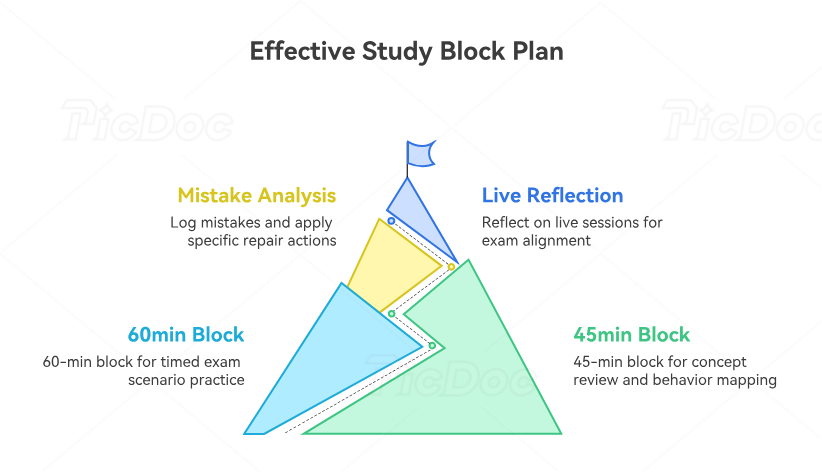
A study schedule fails when every session looks the same. Reading notes for six weeks creates recognition, but the exam needs judgment. Divide your week into four different blocks: concept review, scenario practice, mistake analysis, and live coaching reflection. This gives your brain multiple ways to learn the same principle. Use client session recording tools, surveys and feedback tools, goal tracking tools, and custom coaching dashboards to turn study into evidence.
For concept review, set a 45-minute block. Choose one competency or ethics area, read it, summarize it in plain language, and write three coach behaviors it should produce. Then write three red-flag behaviors that violate it. This keeps you from admiring the language while missing the action. Strengthen this block with coaching communication strategy, positive psychology coaching, neuroscience-based coaching, and positive change models.
For scenario practice, set a 60-minute block. Answer questions under light time pressure and force yourself to explain why the best answer is better and why the weakest answer is weakest. The explanation is where the learning happens. Most candidates lose points when they choose an answer because it feels nice, confident, or client-friendly. Better exam logic asks whether the answer respects the agreement, supports autonomy, honors ethics, and keeps the client as the expert. Train this through ICF exam mistake prevention, handling difficult clients, client motivation management, and coaching accountability.
For mistake analysis, keep a brutal but useful log. Create columns for missed concept, wrong instinct, correct principle, and next repair action. If you missed three questions because you wanted to offer solutions, your repair is not more reading; your repair is coaching-vs-advising drills. If you missed sponsor questions, your repair is agreement and confidentiality review. Use common credentialing mistakes, career-ending coaching mistake prevention, professional boundaries, and coaching integrity as your correction map.
For live coaching reflection, use your own sessions as study material. After each session, ask: Where did I listen well? Where did I lead? Where did I miss emotion? Where did I rescue? Where did I support client ownership? These questions make your study practical and force the exam material into your actual coaching body. Review your growth with case study templates, client journaling tools, client feedback systems, and exceptional client experience strategies.
5. Protect Your Final Two Weeks From Cramming, Confusion, and Burnout
The final two weeks should sharpen judgment, not create chaos. Many coaches damage their readiness by adding too many resources, joining too many groups, and asking everyone for last-minute tips. That floods the mind with conflicting language right when your decision-making should become calm. Use the final stretch for targeted review, timed practice, ethics refreshers, and logistical control. Keep your focus tight with ICF certification exam guidance, coaching certification portfolio strategy, credential listing guidance, and coaching mindset shifts.
Your second-to-last week should include three timed blocks and two repair blocks. In timed blocks, answer questions without notes and stop when the timer ends. In repair blocks, study only the patterns you missed. This keeps preparation honest. A candidate who reviews everything equally avoids the discomfort of fixing weak points. A candidate who tracks mistakes becomes dangerous in the best way: precise, calm, and less easily fooled by polished wrong answers. Support this week with ICF exam mistake guidance, coaching mastery practices, behavior change science, and constructive feedback methods.
Your final week should use short daily sessions. Spend 20 minutes on ethics, 20 minutes on scenarios, and 10 minutes reviewing your mistake log. Then stop. Overstudying the night before can make every answer look complicated. A rested coach reads the scenario better, notices the client’s need faster, and avoids the urge to overthink. This is especially important for PCC and MCC candidates because the exam’s judgment format requires choosing responses that align with ICF competencies and ethical standards, not simply choosing what feels personally helpful. Maintain that steadiness with safe coaching environment guidance, emotional consent tools, client trust strategy, and coaching standards.
Your exam-day plan should be written before exam day. Confirm the date, time, test setup, identification, internet or location requirements, snacks, water, and recovery window afterward. Decide how you will handle a question that feels confusing: breathe, identify the coaching agreement, check ethics, protect client autonomy, eliminate directive answers, then choose the best available option. This simple process keeps panic from becoming strategy. Build your final routine around coaching business organization, stress coaching strategies, goal tracking discipline, and long-term coaching career growth.
6. FAQs About Creating Your ICF Certification Study Schedule
-
Most coaches benefit from six to eight structured weeks, especially if they are balancing clients, business work, family, and application tasks. A shorter timeline can work for candidates with strong competency fluency, but rushed preparation often creates shallow confidence. Build your plan around ICF application steps, ICF exam mistakes, essential coaching skills, and coaching ethics.
-
Start with the exam format, your credential path, the ICF Core Competencies, and the Code of Ethics. Then move into scenario practice once the foundation is clear. ICF’s credentialing exam materials emphasize applying coaching knowledge, competencies, and ethics to practice situations, so memorization should quickly become applied judgment. Support that foundation with coaching communication, coaching boundaries, client empowerment, and coaching integrity.
-
A practical target is four to seven focused hours per week. That can be split into competency review, ethics review, scenario practice, mistake analysis, and session reflection. The key is consistency because one huge weekend study block often creates fatigue without retention. Use continuous coaching education, client feedback tools, session recording tools, and coaching mastery guidance to deepen learning.
-
ACC candidates should build a foundation-first plan because the ACC Exam currently has 60 multiple-choice questions designed to test coaching essentials, with one correct answer per item. Study core concepts, ethics, definitions, coaching distinctions, and basic application before doing heavier scenario rounds. Use ICF credentialing skills, ICF exam mistake prevention, communication skills, and client trust-building.
-
PCC and MCC candidates should spend more time on situational judgment, best-worst answer analysis, ethics under pressure, and advanced coaching presence. ICF describes the PCC/MCC credentialing exam as focused on applying competencies and ethical standards through real-world coaching scenarios. Prepare with advanced coaching skills, ethical responsibilities, transformational coaching, and client accountability.
-
Do not simply mark an answer wrong and move on. Write why you chose it, what it revealed about your instinct, and which ICF principle should have guided you. Most wrong answers expose a pattern: advising, rescuing, rushing, assuming, ignoring ethics, or missing the coaching agreement. Repair those patterns through common ICF exam mistakes, professional coaching boundaries, constructive feedback, and coaching standards.
