
Navigating the ICF Certification Application Process
Applying for an ICF credential can feel like a paperwork maze, even if you are a strong coach. The forms are not the hard part. The hard part is proving your experience, your education, and your competency in a way the reviewers can verify quickly. This guide walks you through the ICF certification application process step by step, so you submit clean, avoid delays, and protect your credibility while building a coaching practice that clients trust.

1. Clarify Your Credential Path Before You Touch the Application
Most application delays happen before you even start. Coaches rush into forms without confirming the right path, the right documents, and the right evidence. That is how you end up reworking logs, scrambling for certificates, and paying in time and stress.
Start by getting brutally clear on three things.
First, what credential are you applying for, and why now. If your goal is stronger authority, higher ticket positioning, or corporate credibility, ICF can support it. But only if you treat it like a professional project, not a casual milestone. This is where the mindset in how coaches reach mastery matters, because mastery is measured by consistency and standards, not hype.
Second, what application pathway fits your education. ICF uses a credentialing process that begins by helping you identify the correct application path through their credential path survey, and that survey is positioned as the first step in the application journey. Treat this like your foundation. If you pick the wrong path, every document that follows becomes fragile.
Third, what ICF is actually evaluating. They are not awarding a credential because you call yourself a coach. They are verifying training, experience, mentor coaching, and your demonstrated competency through the performance evaluation and credentialing exam. This is a standards driven system, so align yourself with the discipline in the non negotiable standards every coach must know and the trust mindset in why trust is the most valuable asset in coaching.
Here is the simplest way to think about it.
Your education proves you learned coaching skills in a recognized structure.
Your experience log proves you coached real clients consistently.
Your mentor coaching proves you received feedback to refine your competencies.
Your performance evaluation proves you can coach at the level you claim. ICF explicitly states that all ACC, PCC, and MCC candidates must pass a performance evaluation, even though not all candidates submit a recording as part of their application.
Your credentialing exam proves you can apply coaching competencies and ethics to real scenarios. ICF’s exam pages explain that candidates submit an application, get reviewed, and then receive eligibility to take the exam.
If you want to approach this professionally, treat the application like a project plan.
Define scope: credential level, pathway, timeline.
Define deliverables: certificates, logs, mentor coaching proof, evaluation materials.
Define risks: missing documentation, unclear log entries, weak recording quality.
Define quality control: internal review before submission.
This approach is the same “system over stress” philosophy behind how to make it work every time and it also protects you from the career mistakes covered in how coaches avoid career ending mistakes.
One more truth that matters.
ICF certification is not just a credential. It is a trust signal. If you cut corners, it shows up later in client experience, referrals, and reputation. That is why you should also strengthen your client communication and boundaries while you apply, using how to set them and save your career and the communication secret behind successful coaching.
2. Build Your Documentation Like a Pro: Education, Experience, and Proof
If you want a smooth approval, think like a reviewer. Reviewers do not want stories. They want verifiable evidence in clean structure.
Your documentation usually breaks down into four buckets.
2.1 Coach specific education: make it reviewer friendly
Your certificates and training proof should be easy to read and consistent. If your program provides an ICF aligned pathway, it can simplify parts of the process. ICF even provides sample application resources for specific paths like Level 1 and Level 2, which signals how seriously they expect candidates to prepare before submitting.
Treat your education documents like assets you will reuse for years. This is the same thinking used when building scalable credibility through writing and publishing your first coaching book, and it supports authority positioning similar to how to get featured in media as a coaching expert.
2.2 Coaching experience log: stop making it vague
Vague logs create suspicion, even when you are honest. A clean log makes you look like a professional business owner. That matters because ICF certification and premium client conversion are connected. If your admin is messy, clients feel it.
Use strong operational habits from managing your time efficiently as a successful coach and business clarity from why it’s the hidden goldmine of coaching.
2.3 Mentor coaching: prove it and leverage it
Mentor coaching is not just a requirement. It is a skill upgrade. ICF’s mentor coaching guidance emphasizes that whether you need to complete the mentor coaching requirement depends on your application path, and it repeatedly references the 10 hour mentor coaching requirement for common pathways.
Do not treat mentor coaching as a checkbox. Treat it as rehearsal for performance evaluation. That is how you align with how coaches reach mastery and build the “clean coaching” style that wins evaluations.
2.4 Performance evaluation readiness: do not leave it to the last minute
ICF is clear that performance evaluation is part of credentialing, and that some paths require you to submit a recording with transcripts for review. If you wait until you are “almost ready,” you create pressure and you record a session that sounds like advice, not coaching.
If you want to avoid that, strengthen your coaching communication structure using the communication secret behind successful coaching and your client empowerment approach using how to actually empower clients real results.
The biggest mindset shift here is simple.
You are not proving you can help clients. You are proving you can coach in the ICF way.
That means your questions, your presence, your listening, your partnership, and your ethics must be consistent.
3. The Step by Step Application Workflow: From “Ready” to Submitted Without Mistakes
This is the workflow professional coaches use when they want minimal stress and maximum approval probability.
3.1 Stage one: Prepare your evidence folder before you start
Create one folder with subfolders for:
Education and certificates
Mentor coaching proof
Coaching experience log
Performance evaluation assets
Identity or name consistency notes
This is boring, but it is what professionals do. It is the same operational discipline that protects you from the trap described in why coaches must avoid this trap and it also supports scaling systems like the ultimate guide to strategically expanding your coaching practice.
3.2 Stage two: Map a realistic timeline
A realistic timeline is not about speed. It is about sequencing.
Evidence cleanup
Mentor coaching completion
Practice sessions for evaluation readiness
Final recording selection
Application submission
Review period and clarifications
Exam authorization and scheduling
ICF’s credentialing flow includes applying, preparing, tracking application status, and taking the exam after review and eligibility.
This prevents you from rushing, which is the root cause of messy submissions. It also protects your time and mental bandwidth, which you need for marketing, content, and client delivery, especially if you are building growth channels like growing your coaching practice through podcasts or networking systems like effective networking techniques for coaches.
3.3 Stage three: Quality control pass before you submit
Do a final pass with three checks.
Consistency check: do dates and names align across files
Completeness check: do you have every required proof for your path
Coaching check: does your evaluation session sound like coaching, not consulting
If you want a strong internal standard, use the mindset from the non negotiable standards every coach must know and the trust discipline from why trust is the most valuable asset in coaching.
3.4 Stage four: Submit calmly and prepare to respond
After submission, expect questions or clarifications. That is normal. The mistake is ignoring follow ups or getting defensive.
Treat clarifications like client objections in a sales call. Stay calm, answer precisely, and keep your documentation clean. This professionalism also strengthens your brand positioning for premium clients, especially if you are applying strategies from how to price your coaching services to attract clients and why its the ultimate client magnet in 2026.
4. Performance Evaluation and the Credentialing Exam: How to Prepare Like a Serious Coach
This is where many applicants panic, because it feels like someone is “grading” your coaching. The best way to handle that fear is to treat it as skill proof, not judgment.
4.1 Performance evaluation: what it is and why it matters
ICF states that all ACC, PCC, and MCC candidates must pass a performance evaluation, and for certain pathways this involves submitting a recording with transcript(s) for review by trained assessors.
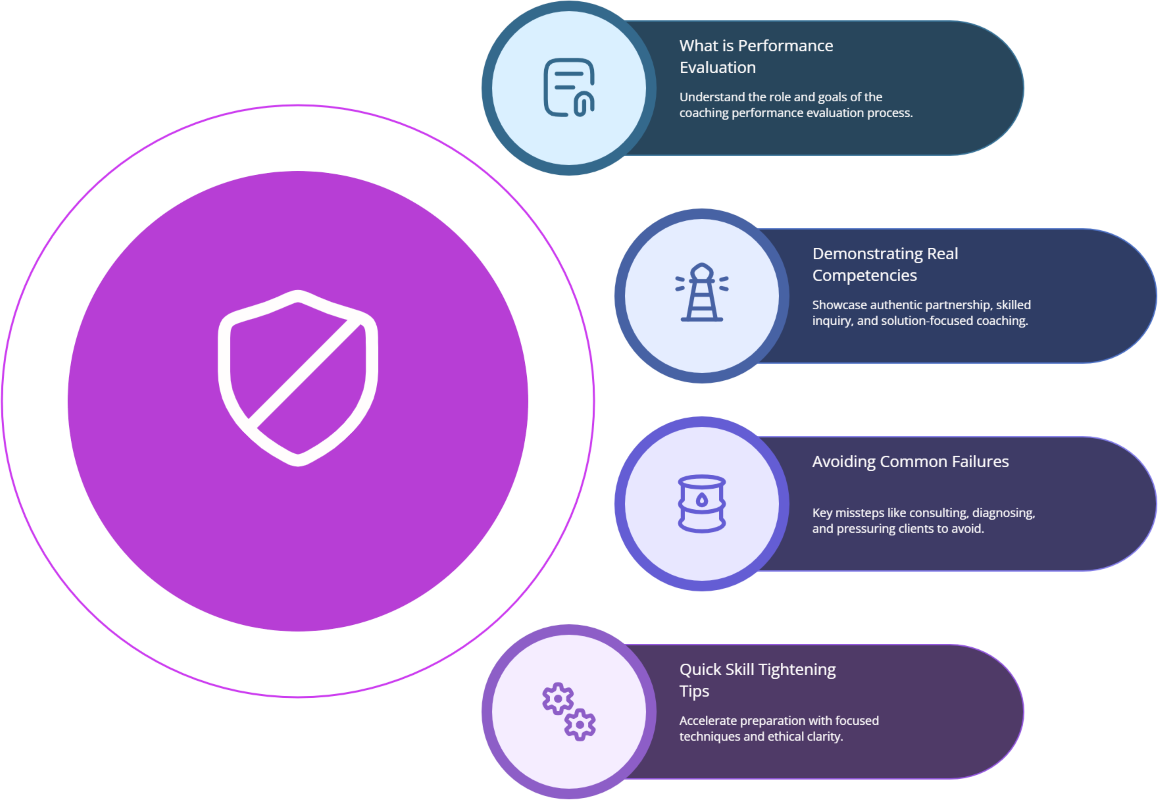
Your goal is not to sound perfect. Your goal is to demonstrate real coaching competencies consistently. That means:
You partner with the client instead of controlling the session
You ask questions that create awareness, not pressure
You avoid consulting, fixing, and diagnosing
You create a clear forward action rooted in the client’s values
If you want to tighten this fast, study and practice the core coaching behaviors using the 1 coaching technique for client breakthroughs and reinforce ethical boundaries through the non negotiable standards every coach must know.
4.2 Mentor coaching as your evaluation accelerator
Mentor coaching is not an extra requirement. It is your shortcut to a stronger recording. ICF’s mentor coaching guidance makes it clear that the mentor coaching requirement depends on your application path, and that many paths require 10 hours prior to applying.
Use mentor coaching to fix three common weaknesses.
Too much advice, not enough exploration
Leading questions that push your agenda
Weak agreement on session outcomes
This is how you move toward mastery, as described in how coaches reach mastery.
4.3 The credentialing exam: do not treat it like trivia
ICF’s exam pages describe the credentialing exam as measuring knowledge and the ability to apply the coaching definition, competencies, and ethics in real scenarios.
So study like a practitioner. Do scenario based practice. Ask yourself, “What is the most ethical and competency aligned response here.”
Also protect your business while you prepare. This is where you keep marketing consistent so you do not stall revenue. Use authority systems like leveraging linkedin to expand your coaching business and scalable income strategy from developing multiple revenue streams as a coach.
5. The Biggest Application Mistakes That Trigger Delays, Rejections, or Rework
If you want a professional outcome, avoid these mistakes aggressively.
5.1 Treating coaching hours like a last minute spreadsheet
If your log looks like it was built in one night, reviewers can tell. Clean logs are a trust signal, the same way clear boundaries are a trust signal in how to set them and save your career.
Fix: log sessions weekly. Keep consistent naming. Track paid versus pro bono cleanly. Store proof.
5.2 Submitting a recording that is actually consulting
This is the most common performance issue. Coaches who are successful in business often slip into expert mode. That kills competency alignment.
Fix: practice pure coaching sessions where you do not give solutions. Let the client generate direction. Reinforce this with how to actually empower clients real results.
5.3 Overcomplicating the process and burning out
Burnout creates sloppy submissions. Sloppy submissions create delays. Delays kill momentum.
Fix: simplify. Create a weekly application cadence and protect your schedule using managing your time efficiently as a successful coach. If you need more time back, use the delegation mindset from outsourcing secrets freeing up 20 hours weekly in your coaching business.
5.4 Ignoring the business impact of certification
Some coaches stop marketing until they get certified. That is a mistake. Your certification strengthens your positioning, but it does not replace growth systems.
Keep your visibility strong with growing your coaching practice through podcasts, build credibility assets through writing and publishing your first coaching book, and refine your offer strategy with how to price your coaching services to attract clients.
5.5 Missing the trust layer
If a client senses you are cutting corners, they do not care what credential you get. They care how safe they feel with you.
This is why why trust is the most valuable asset in coaching matters, and why professionalism in your application is also professionalism in your client delivery.
6. FAQs: Navigating the ICF Certification Application Process
-
Start by confirming your education type and then using the ICF credential path survey, since ICF positions that survey as the first step in any credential application journey. Once you know your pathway, build your documentation around it. Do not guess. Pathway mistakes create rework later, especially around mentor coaching and performance evaluation requirements. Treat the pathway decision like a project scope decision, because everything else depends on it.
-
The most common delay is incomplete or unclear documentation, especially around coaching experience logs, training proof, or performance evaluation readiness. Delays also happen when file naming and dates are inconsistent across documents. The fix is a structured evidence folder, a clean weekly logging habit, and a final quality pass before submission. You are not trying to impress. You are trying to make verification easy.
-
ICF states that all ACC, PCC, and MCC candidates must pass a performance evaluation, but not every pathway requires you to submit a recording as part of your application. Some education programs include evaluation as part of their pathway. You should confirm what your pathway requires, then prepare early so you do not record under pressure.
-
Choose a session that clearly demonstrates coaching, not teaching or consulting. The best sessions include a clear agreement on outcomes, deep exploration, client led insight, and a practical next step that the client owns. Avoid sessions where you are giving solutions or directing the conversation. Do at least two practice recordings first, review them critically, and integrate mentor feedback so your final recording reflects consistent competency.
-
ICF describes the credentialing exam as measuring both knowledge and the ability to apply coaching definition, core competencies, and ethics in real world scenarios. So prepare with scenario practice, not memorization only. Train yourself to recognize what ethical, competency aligned action looks like in ambiguous client situations.
-
Build a weekly cadence. One day for evidence cleanup, one day for log updates, one day for recording practice, one day for review. Keep a 48 hour buffer before submission so you are never rushing. Expect clarifying questions and respond quickly with precision. The application is not a test of your worth. It is a test of your documentation and competency alignment.
-
Position it as proof of standards, not as a badge. Update your messaging to emphasize trust, ethics, and structured outcomes. Use the certification process to upgrade your client onboarding, your agreements, and your tracking systems. Continue marketing during the process through content, speaking, and visibility channels, so the credential amplifies momentum instead of arriving after you stalled your growth.
