
Contracting in Coaching: How Clear Agreements Save Coaching Relationships
A coaching relationship can deteriorate long before either person admits there is a problem. Missed payments, late cancellations, hidden expectations, unlimited messaging, unclear confidentiality, and pressure for guaranteed results gradually weaken trust. Strong contracting prevents these failures by defining how the relationship will operate before tension appears. It supports a safe coaching environment, reinforces professional coaching ethics, improves client expectation management, and gives both parties a shared process for handling uncertainty, feedback, boundaries, and change.

1. Why Contracting Is the Foundation of a Healthy Coaching Relationship
Contracting is the process of establishing clear agreements about the purpose, scope, structure, responsibilities, boundaries, and commercial terms of coaching. It includes the written coaching agreement and the conversations that confirm what those terms mean in practice.
A signed document alone cannot create alignment. Clients may agree to terms they have barely read, misunderstand what coaching can provide, or assume the coach will remain available between sessions. Coaches may avoid discussing cancellation charges, referral procedures, confidentiality limits, or responsibility for results because they fear sounding rigid. That silence creates expensive ambiguity.
Clear contracting strengthens the same trust required for transformational coaching, emotional-intelligence coaching, accountability coaching, and effective client retention. Clients engage more honestly when they understand how sessions work, what information remains private, how progress will be reviewed, and what happens when the relationship needs to change
Weak contracting forces coaches to negotiate boundaries during emotionally charged moments. A client sends urgent messages at midnight. A sponsor requests private session details. A package expires with unused sessions. A client expects therapy, consulting, mentoring, or crisis support. The coach then has to introduce a boundary after the client has already built a conflicting expectation.
This is where many coaching relationships fracture. The client experiences the boundary as sudden rejection. The coach experiences the request as unreasonable pressure. Earlier contracting would have given both parties a neutral agreement to revisit.
Professional contracting also protects coaching quality. It prevents sessions from becoming directionless conversations by clarifying the client’s desired outcomes, responsibilities, success measures, and review points. It complements behavior-change science, strengthens the role of accountability, supports constructive client feedback, and improves the credibility of coaching case studies.
A strong contract should answer four levels of questions:
Relationship questions: How will coach and client work together?
Service questions: What is included, excluded, and expected?
Commercial questions: What are the fees, payment dates, cancellation terms, and package conditions?
Ethical questions: How will confidentiality, conflicts, referrals, records, and sponsor involvement be handled?
When these areas remain vague, every difficult moment becomes a fresh negotiation. When they are clear, the agreement becomes a practical reference point that helps both parties respond consistently.
2. The Three Levels of Contracting Every Coach Should Use
Formal Contracting Before Coaching Begins
Formal contracting establishes the legal, ethical, operational, and financial foundation of the engagement. The written agreement should use language the client can understand without decoding dense professional terminology. Essential clauses include fees, payment timing, scheduling, cancellation, confidentiality, records, intellectual property, termination, and dispute procedures.
The contract should align with the coach’s actual systems. A document promising 48-hour responses becomes dangerous when the coach rarely checks messages. A cancellation policy becomes difficult to defend when exceptions are granted inconsistently. A confidentiality clause loses credibility when client information is stored across unsecured tools.
Coaches can connect contracting with legal requirements for coaches, setting up a coaching LLC, secure payment systems, and responsible coaching automation. For jurisdiction-specific clauses, taxation, employment issues, and enforceability, advice from a qualified lawyer or accountant provides valuable protection.
Relational Contracting During the Discovery Process
Relational contracting clarifies how the coach and client want to work together. It explores communication preferences, challenge levels, feedback style, decision-making, accountability, emotional safety, and expectations around discomfort.
Two clients can sign the same written agreement and require very different working relationships. One client may want direct challenge and rapid action. Another may need more reflection before commitments. One may value frequent accountability. Another may experience repeated reminders as pressure.
A useful relational contract asks:
How would you like me to challenge you?
How will I know when the pace feels unhelpful?
What form of accountability supports your ownership?
How should we address disagreement?
What might cause you to withdraw or become less honest?
How would you prefer to receive difficult feedback?
These questions strengthen constructive feedback, support emotional agility, deepen strengths-based coaching, and create the conditions needed for lasting behavior change.
Session-Level Contracting
Session-level contracting gives each conversation a clear purpose. At the beginning of a session, the coach and client agree on the outcome, priority, available time, and focus. This prevents a valuable hour from being consumed by updates that never reach the client’s core decision.
A strong opening might ask: “What outcome would make this session useful?” The coach can then clarify what the client wants to understand, decide, practice, or commit to before the session ends.
This form of contracting supports micro-coaching, improves accountability conversations, helps manage client expectations, and reduces drift during transformational coaching.
The coach should also recontract when the conversation changes. A client may enter wanting a productivity plan and reveal severe exhaustion. Another may request tactical advice and discover a deeper values conflict. The coach can pause and ask whether the original session outcome remains the priority.
3. The Contracting Failures That Create Conflict, Resentment, and Client Loss
The first major failure is using a generic contract without discussing it. Templates save time, though every clause still requires alignment with the coach’s services, jurisdiction, technology, policies, and client population. Clients should receive space to ask questions before payment or coaching begins.
The second failure is hiding important boundaries inside long terms and conditions. A cancellation charge that appears only in small text may be enforceable in some settings, yet it still creates a poor client experience. Coaches build stronger trust by discussing high-impact terms openly, especially fees, refunds, privacy, response time, package expiration, and termination.
The third failure is promising outcomes. Coaching can support insight, decisions, skills, habits, resilience, and accountability. Promotions, income, weight changes, relationships, business growth, and health outcomes depend on variables beyond the coach’s control. Clear outcome responsibility protects the client from exaggerated promises and protects the coach from impossible expectations.
This boundary strengthens ethical coaching, supports realistic behavior-change coaching, improves financial forecasting, and creates more credible client transformation case studies.
The fourth failure is allowing exceptions without documenting them. A coach may waive one cancellation fee because of an emergency, extend a package, or add an extra session. Flexibility can strengthen a relationship. Repeated undocumented exceptions create a second unofficial contract. The client begins to expect flexibility, while the coach quietly feels exploited.
Any exception should be communicated clearly: what is changing, why it is changing, whether it applies once, and which original terms remain active.
The fifth failure is avoiding difficult commercial conversations. Coaches sometimes continue sessions despite unpaid invoices because they fear losing the client. Resentment grows, the quality of coaching drops, and the final conversation becomes harsher than an early payment reminder would have been.
Reliable payment systems, sensible business automation, accurate financial forecasting, and sound practice-scaling systems reduce the emotional burden of enforcing commercial terms.
The sixth failure is overlooking third-party contracts. In organizational coaching, the client, sponsor, employer, and coach may expect different outcomes. The sponsor may want performance improvement. The client may want career clarity. The coach must clarify confidentiality, reporting, attendance, goals, data ownership, and the limits of sponsor influence before sessions begin.
The seventh failure is continuing after the engagement has lost value. Coaching should include review points where both parties examine progress, fit, trust, and relevance. A respectful ending may involve completion, referral, pause, transition to another service, or termination. Clear endings preserve dignity and support future referrals.
4. How to Conduct a Professional Contracting Conversation
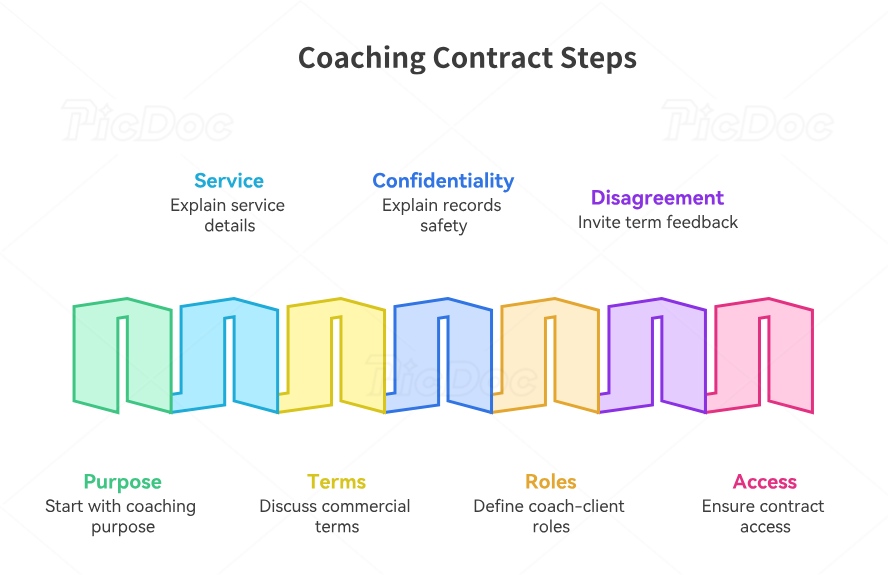
A contracting conversation should feel clear, collaborative, and specific. The coach can begin by explaining that the agreement protects the quality of the relationship and gives both parties a shared process for handling predictable situations.
Start with the purpose of coaching. Ask what the client wants to change and which outcomes would make the investment worthwhile. Clarify the difference between desired outcomes and guaranteed results. This creates a stronger foundation for life visioning, life-purpose coaching, strengths-based development, and accountability coaching.
Next, explain the service. Cover session frequency, duration, format, preparation, resources, assessments, messaging, and response time. Use examples that show how the rules operate. “Messages sent Monday through Thursday receive a response within two business days” creates greater clarity than “reasonable email support.”
Then discuss commercial terms. Review fees, payment dates, cancellations, package expiration, refunds, and termination. Invite questions before payment. A client who feels embarrassed to ask about money may remain silent and later feel trapped by a term they misunderstood.
Move into confidentiality and records. Explain how notes are stored, whether sessions may be recorded, which technology is used, and where confidentiality has limits. Organizational coaching requires additional clarity about sponsor reports, attendance information, goals, and progress summaries.
Discuss roles and responsibility. The coach provides structure, challenge, reflection, feedback, and professional care. The client controls decisions, actions, honesty, preparation, and the use of coaching. This distinction strengthens client accountability, supports habit formation, improves emotional agility, and protects against dependence during transformational coaching.
Finish by inviting disagreement. Ask: “Which term feels unclear, restrictive, or different from what you expected?” This question uncovers hesitation before it becomes resentment.
The agreement should remain accessible throughout the engagement. Clients should receive a copy, know where it is stored, and understand how changes will be documented.
5. How to Recontract When Goals, Boundaries, or Circumstances Change
Coaching relationships evolve. The client may change goals, receive a diagnosis, begin a new job, experience a family crisis, gain employer sponsorship, or require a different session frequency. The original contract may still be valid while becoming operationally outdated.
Recontracting updates the agreement so that current expectations remain explicit. It can occur at a scheduled review, after a significant change, or when either party notices tension.
Common recontracting triggers include:
Sessions repeatedly exceed their scheduled duration.
The client requests more between-session support.
Payment or cancellation patterns change.
A sponsor becomes involved.
The client’s needs move beyond the coach’s competence.
The original goal loses relevance.
The coach changes fees, technology, availability, or service format.
Trust has weakened after a misunderstanding.
The engagement is approaching completion.
The coach can begin with an observation: “Our recent sessions have required more between-session contact than the original package includes. Let’s review what support would be useful and sustainable.”
This language addresses the pattern without blaming the client. It also creates room for a revised package, clearer limit, referral, or alternative support method. Micro-coaching, coaching automation, client feedback systems, and thoughtful client retention strategies can provide practical options.
Recontracting is also valuable after a rupture. Suppose a client feels judged by feedback or discovers that the coach misunderstood a boundary. The repair should identify the impact, clarify what needs to change, and update the working agreement. A revised communication preference may become part of the relational contract.
Coaches should document material changes in writing. An email summary, signed amendment, or updated service agreement can record new fees, schedule, scope, confidentiality terms, sponsor involvement, or package duration. Verbal understanding becomes fragile when memories differ later.
Contract reviews can also strengthen progress. Every six to eight sessions, the coach can ask whether the goals remain meaningful, whether the approach supports the client, and whether the accountability structure still fits. These reviews improve exceptional client experiences, support case-study development, clarify client expectations, and help coaches maintain ethical scope-of-practice boundaries.
6. Frequently Asked Questions About Contracting in Coaching
-
A coaching contract should cover the purpose and scope of coaching, coach and client responsibilities, session frequency, duration, communication channels, response times, fees, payment terms, cancellations, refunds, confidentiality, records, technology, intellectual property, termination, conflict resolution, referrals, and outcome responsibility.
Organizational engagements should also define sponsor involvement and information sharing. These terms support ethical coaching practice, strengthen legal awareness, improve payment management, and protect the client experience.
-
Effective contracting also requires a direct conversation about the terms that can significantly affect the client. Discuss scope, confidentiality, cancellations, response times, payment, results, responsibilities, and termination before coaching begins.
Relational and session-level agreements should continue throughout the engagement. This ongoing clarity supports safe coaching relationships, strengthens constructive feedback, improves accountability, and prevents the misunderstandings often seen in difficult client situations.
-
Coaches should explain what information will remain private, how notes and recordings are stored, who can access them, and which circumstances could require or justify disclosure. The explanation should address technology, supervision, sponsor involvement, and applicable legal or safety responsibilities.
Clients should understand confidentiality before sharing sensitive information. Clear explanations support professional ethics, strengthen emotional safety, clarify NBHWC scope, and guide appropriate emotional-crisis support.
-
The coach should review the cancellation policy, explore the pattern, and determine whether the current coaching structure still fits the client’s life. Repeated cancellations may reflect scheduling pressure, weak commitment, avoidance, financial strain, health problems, caregiving, or reduced value.
The response may include a different schedule, a temporary pause, shorter sessions, private accountability, or termination. This conversation benefits from client expectation management, micro-coaching, accountability coaching, and skillful management of difficult client situations.
-
Terms can be updated through transparent recontracting. The coach should explain the proposed change, its effective date, its impact, and the client’s options. Material changes should be documented in writing and accepted by both parties.
Mid-engagement changes may involve fees, session frequency, technology, package duration, confidentiality, sponsor involvement, or communication access. Clear updates support business growth, responsible coaching automation, accurate financial forecasting, and healthy client retention.
-
A three-party agreement should clarify who the client is, who pays, the coaching goals, attendance expectations, confidentiality, reporting, progress measures, records, and termination rights. The employee should understand exactly what the sponsor will receive.
Reports can focus on agreed goals, participation, or broad progress without exposing private session content. This approach supports ethical standards, strengthens emotional-intelligence coaching, improves constructive workplace feedback, and protects the trust needed for transformational coaching.
