
Duty of Care: Why This Ethical Principle Defines Coaching Success
A client may trust a coach with career pressure, health concerns, relationship conflict, financial fear, or emotional distress. That access creates responsibility. Duty of care helps coaches protect client welfare through clear agreements, competent practice, confidentiality, secure systems, appropriate boundaries, and timely referrals. It strengthens a safe coaching environment, supports ethical scope decisions, improves client expectation management, and builds the professional trust required for meaningful coach-client transformation.

1. What Duty of Care Means in Professional Coaching
Duty of care describes the responsibility to take reasonable, competent, and ethically appropriate steps to protect a client’s interests within the coaching relationship. Its practical meaning covers far more than emergency response. It influences how a coach markets services, accepts clients, creates agreements, handles sensitive information, selects interventions, manages conflicts, uses technology, recognizes scope limitations, documents decisions, and ends an engagement.
Its exact legal interpretation depends on the coach’s jurisdiction, contract, credentials, employment setting, and services. Coaches should therefore treat this article as a professional-practice guide and seek qualified local advice when legal interpretation is required. Professional frameworks still provide clear ethical direction. The current International Coaching Federation Code took effect on April 1, 2025, and organizes ethical responsibilities around agreements, confidentiality, legal compliance, conflicts of interest, consistent value, integrity, and accountability.
Duty of care begins before the first session. A coach creates unnecessary risk when marketing suggests guaranteed transformation, therapy-level treatment, medical expertise, or outcomes the coach cannot reasonably deliver. Ethical marketing requires accurate credentials, realistic claims, transparent pricing, and clear explanations of the service. These practices connect directly with navigating legal requirements for coaches, setting up a coaching LLC, creating a certification portfolio, and avoiding credentialing-process mistakes.
A prospective client should understand what coaching involves before paying or sharing sensitive information. The coach needs to explain the intended process, roles, responsibilities, confidentiality rules, payment arrangements, cancellation terms, communication channels, record handling, and conditions for ending the relationship. The ICF Code requires these elements to be addressed before coaching begins and recognizes each party’s right to terminate the engagement under the agreement.
That agreement becomes especially important when an employer, organization, parent, healthcare provider, or other sponsor pays for the coaching. The client needs to know which information stays private, which progress indicators may be shared, who receives reports, and whether attendance or goal completion will be disclosed. Vague sponsor arrangements can destroy trust because the client may assume complete privacy while the sponsor expects detailed updates. Strong contracting protects client retention, strengthens exceptional client experiences, supports responsible coaching case studies, and prevents many difficult client situations.
Confidentiality forms another major part of duty of care. ICF standards require the strictest level of confidentiality, clear agreements about information exchange, advance discussion of possible disclosures, and secure handling of records and electronic communications. The standards also apply to databases, software, technology-assisted coaching tools, and artificial intelligence systems.
Coaches commonly focus on confidentiality during sessions while overlooking the systems surrounding them. Sensitive details can leak through calendar titles, shared computers, unprotected notes, automated transcripts, messaging previews, unsecured cloud folders, public testimonials, payment descriptions, or conversations held within earshot of other people. Ethical coaching automation, responsible use of coaching technology, carefully selected coaching-business tools, and disciplined business automation must preserve privacy across the entire client journey.
Competence is equally central. A certificate gives a coach a foundation; continued competence requires learning, reflection, supervision, feedback, and awareness of changing standards. A coach working with burnout, health behavior, grief, trauma exposure, leadership conflict, or emotional crises needs enough knowledge to recognize the limits of coaching. Relevant development may include CPD accreditation, maintaining coaching certification, studying the ICF Code of Ethics, and strengthening knowledge of mental health coaching.
Scope of practice becomes especially important in health and wellness coaching. NBHWC states that coaches working independently do not diagnose, interpret medical data, prescribe or remove medication, create meal plans, prescribe exercise, or provide psychological treatment. Coaches who hold another active professional credential may operate within that additional scope when they clearly disclose the role and document the boundaries.
A health coach can support a client in preparing questions for a physician, tracking a self-selected habit, exploring motivation, or following a treatment plan provided by a qualified professional. The coach needs additional authorization and competence to interpret laboratory results, change medication, prescribe a therapeutic diet, or treat a mental-health condition. Understanding lifestyle medicine coaching, metabolic health coaching, preventive health coaching, and the formal NBHWC scope of practice protects clients from advice that exceeds the coach’s role.
Duty of care also demands cultural humility. A coach can cause harm by treating one cultural model of independence, communication, family obligation, ambition, health, or success as universally correct. Professional care involves asking how culture, identity, language, access, disability, social conditions, power, and lived experience shape the client’s situation. NBHWC’s ethical standards specifically address culturally sensitive boundaries, equitable support, and the need to recognize power or status differences.
These considerations influence holistic coaching, emotional intelligence coaching, stress coaching, and coaching through economic changes. A client facing discrimination, unstable housing, caregiving pressure, or limited healthcare access requires a plan grounded in genuine constraints. Reducing every barrier to mindset can shift responsibility onto the person carrying the greatest burden.
Duty of care ultimately appears in ordinary professional decisions. It appears when a coach checks consent before using a tool, pauses an intervention that is increasing distress, admits a knowledge limitation, seeks supervision, offers a referral, protects data, adjusts the agreement, challenges a sponsor’s inappropriate request, and ends an engagement that no longer serves the client. Those decisions define the quality of transformational coaching, accountability coaching, positive psychology coaching, and every other coaching approach a professional chooses to use.
Duty of Care Risk Register: 30 Coaching Situations, Warning Signs, and Protective Actions
| Coaching Situation | Duty-of-Care Risk | Warning Sign | Protective Coaching Action | Documentation Needed | Related ANHCO Resource |
|---|---|---|---|---|---|
| Prospective client expects therapy | Role confusion and unsupported clinical needs | Client asks the coach to treat trauma, depression, or another condition | Explain coaching scope, assess fit, and discuss qualified support | Consultation summary and referral decision | Mental health coaching |
| Client expresses possible self-harm risk | Immediate safety concern | Direct statements, plans, intent, means, or escalating hopelessness | Follow the agreed safety protocol and applicable legal requirements | Exact words, actions taken, consultations, and referrals | Emotional-crisis support |
| Employer sponsors coaching | Confidentiality conflict | Sponsor requests session details or personal disclosures | Reconfirm the three-way agreement and share only authorized information | Signed sponsor agreement and disclosure permissions | Expectation management |
| Coach records a video session | Unauthorized capture or insecure storage | Consent is assumed or buried in generic terms | Obtain specific consent and explain purpose, access, retention, and deletion | Recording consent and retention schedule | Legal requirements |
| AI tool generates session summaries | Privacy, accuracy, and undisclosed data processing | Client data enters a system without informed consent or review | Assess the platform, obtain consent, minimize data, and verify every summary | Consent, vendor review, and correction record | Coaching technology |
| Client requests medical advice | Health-coaching scope violation | Requests to interpret tests, alter medication, or recommend treatment | Stay within scope and direct clinical questions to a qualified provider | Request, boundary explanation, and referral | NBHWC scope |
| Coach holds two credentials | Dual-role confusion | Client cannot identify which professional service is being delivered | Declare the active role and document transitions between services | Dual-role disclosure and separate service terms | Professional boundaries |
| Client shows severe functional decline | Needs exceed ordinary coaching support | Work, sleep, self-care, relationships, or daily functioning deteriorate sharply | Discuss observations and recommend appropriate professional assessment | Behavioral observations and referral conversation | Referral awareness |
| Coach feels emotionally overwhelmed | Reduced judgment and impaired presence | Rumination, dread, rescuing, irritability, or blurred boundaries | Seek supervision, reduce exposure, or transfer the client responsibly | Supervision notes without unnecessary client identifiers | Coach self-care |
| Client sends messages at all hours | Boundary erosion and dependence | Repeated crisis-style contact outside agreed availability | Restate communication rules and establish appropriate support pathways | Boundary reminder and revised agreement | Difficult situations |
| Coach promises guaranteed results | Misrepresentation and unrealistic expectations | Marketing claims imply certainty or universal outcomes | Use accurate language and explain factors affecting results | Approved marketing copy and claim evidence | Client experience |
| Client shares abuse or coercion | Safety and reporting complexity | Threats, control, violence, exploitation, or fear of retaliation | Prioritize safety, follow applicable requirements, and consult qualified resources | Exact disclosure, decisions, and actions | Crisis-sensitive coaching |
| Coach uses a testimonial | Confidentiality and power imbalance | Client feels pressured to provide praise or reveal personal outcomes | Request voluntary, informed permission and allow withdrawal | Written authorization and approved wording | Ethical case studies |
| Client misses several sessions | Unaddressed disengagement or hidden deterioration | Silence, avoidance, unpaid invoices, or sudden withdrawal | Use the agreed contact process and assess fit without harassment | Contact attempts and closure status | Client retention |
| Coach receives confidential information from a sponsor | Secret agenda | Sponsor asks the coach to influence the client without disclosure | Reject hidden objectives and clarify what can enter the coaching agreement | Sponsor communication and ethical decision | Safe coaching environment |
| Client becomes dependent on coach approval | Reduced autonomy | Client seeks permission for routine decisions | Return decisions to the client and redesign accountability | Observed pattern and revised coaching strategy | Healthy accountability |
| Coach develops a personal attraction | Conflict of interest and exploitation | Preferential treatment, secrecy, or altered boundaries | Seek ethical consultation and protect the professional relationship | Consultation and risk-management decision | ICF ethics |
| Client offers a valuable gift | Influence or perceived obligation | Gift exceeds cultural courtesy or changes expectations | Explore meaning, policy, value, and possible conflict | Gift decision and rationale | Professional conduct |
| Client reveals illegal activity | Confidentiality exception and legal uncertainty | Disclosure may trigger contractual or legal responsibilities | Avoid impulsive promises and obtain qualified ethical or legal guidance | Disclosure, consultation, and final action | Coaching law |
| Client requests nutrition instructions | Unauthorized nutrition practice | Coach is asked to prescribe meals, supplements, or therapeutic diets | Use coaching questions and refer technical nutrition needs appropriately | Scope statement and referral | Nutrition scope knowledge |
| Coach stores notes indefinitely | Excessive data retention | No documented retention or deletion policy exists | Set lawful retention periods and securely destroy expired records | Data-retention policy and deletion log | Data responsibilities |
| Client joins group coaching | Participant confidentiality cannot be guaranteed fully | Members share screenshots, recordings, or personal stories externally | Establish group rules and explain practical confidentiality limits | Participant agreement and incident process | Group safety |
| Coach uses a standardized assessment | Overinterpretation or unsuitable application | Scores are presented as diagnoses or fixed identities | Explain limitations and integrate results with client context | Consent, results, interpretation, and follow-up | Assessment context |
| Client faces cultural misunderstanding | Bias and inappropriate goal setting | Coach assumes independence, ambition, or communication should look one way | Ask culturally responsive questions and examine personal assumptions | Relevant preferences and agreed adaptations | Holistic coaching |
| Coach lacks experience with the issue | Competence gap | Coach improvises beyond training or relies on confidence alone | Disclose limits, consult, train, refer, or decline the work | Competence review and decision | Professional development |
| Client challenges the coaching process | Pressure to preserve the coach’s ego | Coach becomes defensive or blames the client | Invite specific feedback and review the agreement collaboratively | Feedback, response, and agreed changes | Client feedback |
| Coach recommends a paid affiliate product | Financial conflict of interest | Compensation is hidden from the client | Disclose the relationship and offer neutral alternatives | Affiliate disclosure and client choice | Financial transparency |
| Client needs a different professional | Delayed referral | Sessions continue without progress while risk or impairment rises | Discuss the observed gap and support access to suitable resources | Referral rationale and transition plan | Professional referrals |
| Coaching engagement stops suddenly | Abandonment and unresolved responsibilities | Coach disappears, becomes unavailable, or closes without a process | Communicate promptly, protect records, and arrange responsible closure | Termination notice and transition support | Responsible closure |
| Coach suspects an ethical violation | Silence, retaliation, or reckless accusation | Concern involves harm, exploitation, privacy, or serious misconduct | Gather facts, consult the relevant code, and use the appropriate process | Facts, consultations, and reporting decision | Code of conduct |
2. How to Build Duty of Care Into Every Coaching Engagement
Duty of care becomes reliable when it is designed into the client journey. Depending on memory or goodwill leaves too much room for inconsistency. Coaches need repeatable procedures covering intake, suitability, contracting, confidentiality, communication, session delivery, documentation, referrals, review, and closure.
Screen for suitability before accepting the engagement
An intake form should explore the client’s goals, expectations, current support, previous coaching or therapy, relevant risks, and preferred communication method. The form should avoid clinical diagnosis unless the coach is separately qualified and acting within that role. Its purpose is to identify fit, clarify expectations, and surface concerns requiring a fuller conversation.
A client seeking career burnout coaching may need coaching around boundaries, workload, values, communication, and recovery. Severe impairment may require healthcare support alongside or before coaching. A client interested in metabolic health coaching may benefit from habit support while medical symptoms remain under a clinician’s care. Suitability decisions also protect preventive health coaching and responsible lifestyle medicine coaching.
Create an informed coaching agreement
A strong agreement should explain:
The purpose and nature of coaching
The coach’s credentials and professional role
The client’s responsibilities and decision-making authority
The boundaries between coaching, consulting, therapy, and healthcare
Session length, frequency, fees, cancellations, and refunds
Communication rules between sessions
Confidentiality and its agreed exceptions
Sponsor-reporting arrangements
Record creation, storage, retention, and deletion
Technology, recording, transcription, or AI use
Complaint, termination, and referral procedures
The agreement supports client expectation management, reduces difficult client situations, improves client retention, and strengthens the legal foundation of a coaching practice. ICF requires coaches to co-create clear agreements regarding roles, responsibilities, confidentiality, finances, and other engagement terms.
Consent should remain active throughout the engagement. A signed contract from six months earlier does not automatically cover a newly introduced assessment, recording system, AI application, group format, research use, or testimonial. Each meaningful change deserves fresh explanation and agreement.
Establish a confidentiality map
The coach should identify every place client information enters, moves, rests, and leaves. This map may include intake forms, email, calendars, payment systems, video platforms, messaging apps, client portals, notebooks, recordings, transcripts, supervision, subcontractors, accountants, and marketing systems.
For each location, ask:
Which data is collected?
Why is it necessary?
Who can access it?
Where is it stored?
How long is it retained?
How is it protected?
How can it be corrected or deleted?
Which third parties process it?
Has the client received a clear explanation?
This discipline is essential when using coaching automation tools, systems for scaling a coaching practice, payment systems, and technology explored through coaching-industry transformation. ICF guidance treats confidentiality as a continuous process and recommends clear policies covering records, staff, devices, platforms, and data-protection requirements.
Create clear boundaries for access and communication
Clients need to know when the coach is available, which channel to use, expected response times, and where to seek urgent help. A message policy might state that non-urgent messages receive a response within two business days and that coaching communication is not monitored continuously.
Unlimited access can create pressure for the coach and false reassurance for the client. A client experiencing an urgent safety or medical situation needs an appropriate local service rather than waiting for a coaching reply. Clear communication supports emotional-crisis coaching boundaries, self-care coaching, effective accountability structures, and a sustainable coaching business.
Review risks during the engagement
Risk assessment should continue as circumstances change. The coach can listen for:
Significant deterioration in daily functioning
Repeated expressions of hopelessness
Threats of harm
Abuse, coercion, or exploitation
Severe sleep or appetite disruption
Substance-related concerns
Disordered eating indicators
Medical symptoms requiring assessment
Increasing dependence on the coach
Confusion about professional roles
Sponsor pressure that threatens confidentiality
Goals that create significant health, financial, or relational risk
The coach should focus on observable information and avoid unsupported diagnosis. A statement such as “You appear to have a disorder” exceeds ordinary coaching competence. “You have described three weeks of severe sleep disruption, missed work, and difficulty caring for yourself; I am concerned about the level of impact and recommend contacting a qualified healthcare professional” communicates the concern responsibly.
Use supervision and ethical consultation
Coaches should have a pathway for discussing difficult cases while protecting identifying information. Supervision can reveal blind spots, emotional reactions, cultural assumptions, conflicts, boundary drift, and competence gaps. NBHWC’s current ethical standards encourage regular self-reflection, supervision or peer review, continuing education, and staying current with laws and professional standards.
Supervision strengthens constructive feedback skills, supports continued coaching certification, improves coaching portfolio evidence, and reduces credentialing mistakes. It also helps coaches separate a client’s needs from the coach’s desire to rescue, impress, retain, or prove competence.
Document decisions proportionately
Professional records should capture enough information to support continuity, accountability, and ethical reasoning. Useful notes may include the date, session focus, client-selected actions, relevant risk observations, boundaries discussed, referrals offered, consent changes, and follow-up responsibilities.
Notes should avoid gossip, speculative diagnoses, insulting labels, or personal commentary that serves no professional purpose. Detailed sensitive information creates greater exposure when it adds no practical value. Good documentation supports accountability coaching, ethical client transformation stories, carefully created coaching case studies, and consistent client experiences.
3. Recognizing Scope Limits, Risk, and Referral Thresholds
Referring a client requires judgment. Automatic referrals can feel dismissive, while delayed referrals can leave the client without the level of support their situation requires. The coach needs to consider severity, duration, functional impact, immediate danger, professional competence, existing support, and the client’s capacity to engage productively in coaching.
A referral becomes increasingly important when the concern:
Requires diagnosis or clinical treatment
Creates imminent or likely danger
Significantly impairs daily functioning
Falls outside the coach’s training or credential
Continues worsening despite appropriate coaching
Prevents the client from engaging in goal-directed work
Requires legal, medical, financial, or therapeutic expertise
Activates the coach beyond their ability to remain effective
ICF guidance states that coaches have an ethical responsibility to help clients access other resources when needs fall outside coaching expertise or services. It also emphasizes clearly communicating the distinction between coaching and other support professions.
Referral conversations should use specific observations. “You need therapy” can sound abrupt and judgmental. A more useful approach could be:
“Over the past three sessions, you have described increasing panic, missing work, and being unable to complete basic daily tasks. These concerns deserve support from a professional trained to assess and treat them. I would like us to discuss how you can access that support and whether coaching should pause or continue alongside it.”
This approach preserves dignity while supporting mental health coaching boundaries, responsible crisis support, a safe coaching environment, and careful expectation management.
A referral does not always require ending coaching. Collaborative support may work when the client has appropriate professional care and the coaching goals remain suitable. For example, a therapist may address a clinical anxiety condition while the coach supports values-based career actions. A physician may manage metabolic disease while a health coach supports self-selected routines and appointment preparation. Boundaries, consent, and communication permissions need to be clear.
Health coaches must apply particular discipline when clients request technical advice. NBHWC’s scope allows coaches to provide evidence-based resources from nationally recognized authorities and support treatment plans provided by qualified professionals. Independent coaches remain outside diagnosis, medical-data interpretation, prescribing, therapeutic nutrition planning, exercise prescription, and psychological treatment.
A coach can ask, “Which question do you want to take to your physician?” during lifestyle medicine coaching. A coach can help a client design an environment for habit formation. A coach can support health behavior change and habit stacking. Clinical decisions remain with appropriately qualified professionals.
Coaches also need a referral network before urgent situations occur. A useful resource directory may include licensed mental-health professionals, physicians, registered dietitians, legal professionals, financial advisers, domestic-violence services, crisis services, addiction support, employee-assistance programs, and community resources. The coach should verify credentials and avoid guaranteeing another provider’s quality.
Duty of care also applies when a client declines a referral. The coach should explore the reasons, clarify concerns, explain the limits of continued coaching, and decide whether the engagement can proceed safely and ethically. A client has decision-making autonomy, while the coach retains responsibility for their own professional participation. Continuing solely to avoid losing revenue can compromise ethical business growth, damage client trust, weaken professional credibility, and create preventable risk.
Poll: Which Duty-of-Care Challenge Creates the Greatest Risk in Your Coaching Practice?
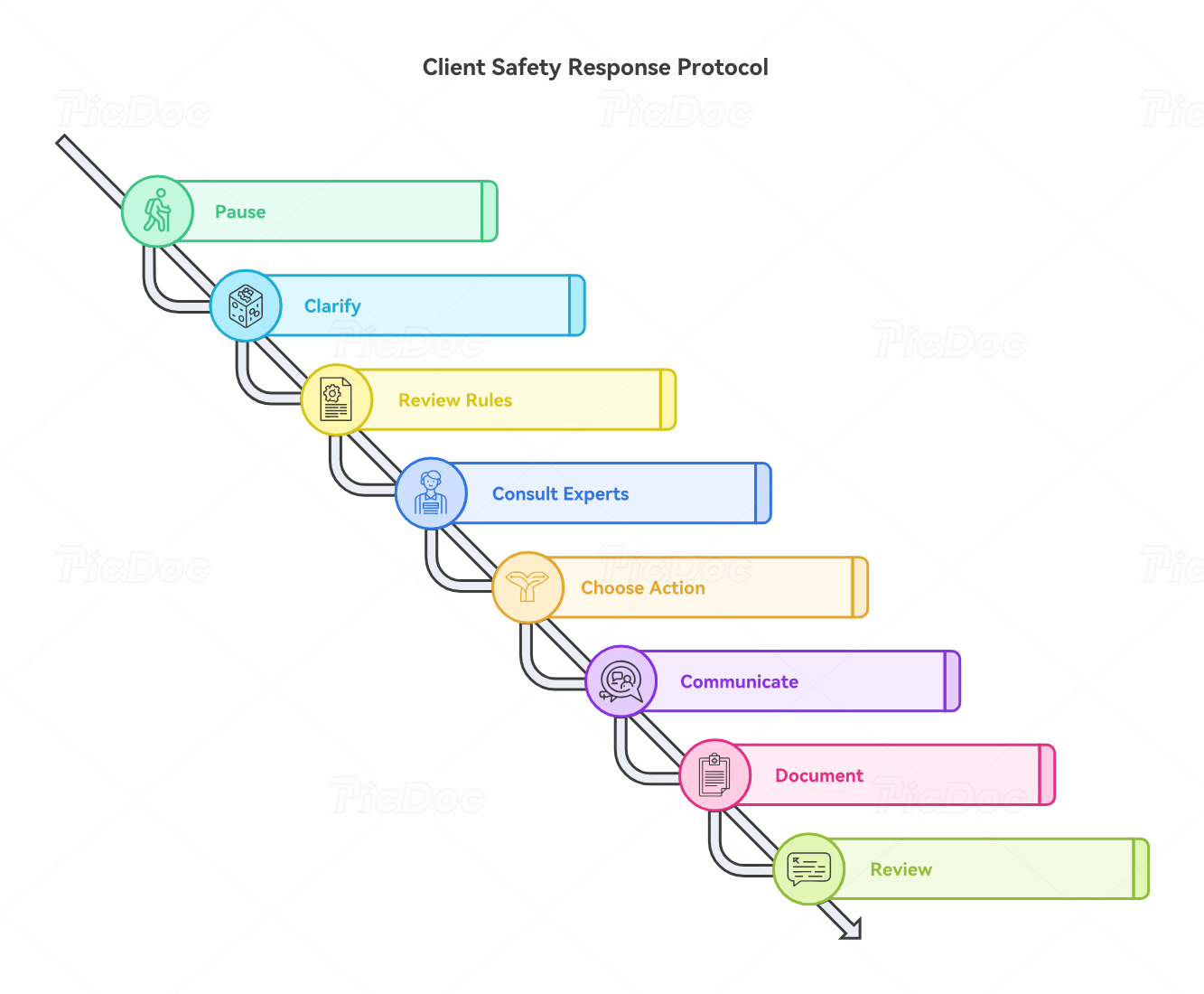
4. A Practical Response Protocol When Client Safety or Ethics Are at Risk
Coaches need a response process that remains usable under pressure. Panic can lead to overreaction, silence, vague reassurance, unsupported promises, or disclosures made without sufficient thought. The following framework creates a disciplined path through difficult situations.
Step 1: Pause and remain present
The coach should slow the conversation, listen carefully, and avoid rushing to interpretation. A calm response helps the client communicate accurately. The coach can use principles from emotional agility, emotional intelligence coaching, resilience coaching, and safe coaching practice.
A useful response could be: “I want to slow down and understand what you are describing.” This creates space without minimizing the concern or making promises the coach may be unable to keep.
Step 2: Clarify observable information
Ask direct, relevant questions based on the concern. Clarification should establish what happened, when it happened, whether it is continuing, who is involved, which consequences exist, and whether immediate danger may be present. Avoid interrogating the client or asking questions outside the coach’s competence.
For scope concerns, ask:
How is this affecting your daily functioning?
Which professional support do you currently have?
Has the concern become more severe or frequent?
Which help have you already sought?
What kind of support are you expecting from coaching?
For confidentiality concerns, ask:
Who currently has access to this information?
Which disclosure has been requested?
Which agreement applies?
Is the client giving informed permission?
Does an agreed or legally required exception apply?
Step 3: Review the agreement, code, scope, and applicable rules
Duty-of-care decisions should draw from four layers:
The coaching agreement
The relevant professional code
The coach’s credential and scope
Applicable law and organizational policy
The ICF Code requires clear confidentiality agreements and advance discussion of circumstances that may require disclosure, including legal requirements and imminent or likely danger to the client or others. It also requires secure handling of records and responsible use of technology.
Coaches should avoid assuming that one universal reporting rule applies everywhere. Local laws, professional licenses, contracts, client age, setting, and facts can alter obligations. Qualified legal or ethical consultation may be necessary.
Step 4: Consult without creating unnecessary exposure
A coach may need guidance from a supervisor, ethics body, insurer, lawyer, safeguarding lead, or other qualified professional. Share the minimum information required for useful advice. Remove identifying details where practical and document the consultation.
Consultation supports professional coaching conduct, continued CPD development, stronger certification portfolios, and ethical client feedback systems. It gives the coach access to perspectives that may be difficult to generate while emotionally involved.
Step 5: Select the least harmful effective action
The coach should consider client welfare, autonomy, confidentiality, proportionality, and professional obligations. Possible actions include:
Continuing coaching with clarified boundaries
Revising the coaching agreement
Pausing a technique or assessment
Consulting a supervisor
Referring to another professional
Coordinating care with written consent
Pausing the coaching engagement
Ending the engagement responsibly
Following an applicable emergency or reporting process
The action should address the actual risk. Disclosing extensive client information when a narrow consultation would suffice can create additional harm. Continuing ordinary coaching during a serious safety concern can leave the client without appropriate support.
Step 6: Communicate transparently
Explain the concern, the coach’s responsibility, the proposed action, and the client’s options whenever circumstances allow. This transparency protects trust even during difficult decisions.
A coach might say:
“I respect the confidentiality of our work. Our agreement also explains the limited circumstances in which information may need to be shared because of serious safety or legal concerns. I want to explain what I am considering, who may need to be contacted, and the information that would be relevant.”
Transparent communication supports constructive feedback, client expectation management, exceptional client experiences, and strong coaching accountability.
Step 7: Document facts, decisions, and follow-up
Record the client’s relevant words as accurately as possible, observable behavior, questions asked, guidance consulted, decisions made, actions taken, and follow-up required. Separate facts from interpretation.
A weak note might say: “Client was unstable and dramatic.”
A stronger note might say: “Client stated they had missed four workdays, slept approximately three hours nightly for the previous week, and felt unable to complete routine self-care. Discussed the limits of coaching and recommended prompt assessment by a qualified healthcare professional.”
Step 8: Review the case and improve the system
After the immediate situation, examine which procedure worked and where the practice needs improvement. The review may reveal missing intake questions, unclear contract language, inadequate referral resources, weak technology controls, insufficient training, or personal triggers requiring supervision.
This reflection strengthens coaching-business systems, supports coaching automation governance, improves client retention systems, and turns experience into useful professional development.
5. Duty-of-Care Mistakes That Damage Clients and Coaching Businesses
Treating a signed waiver as complete protection
A contract can clarify risks and responsibilities, yet careless or unethical practice remains careless or unethical. Coaches still need competence, reasonable procedures, current knowledge, responsible technology, secure data handling, and appropriate referrals. A template downloaded from the internet cannot replace advice suited to the coach’s jurisdiction and business model.
This mistake frequently appears alongside weak legal preparation, rushed coaching-business setup, poor payment-system policies, and unmanaged coaching automation.
Promising complete confidentiality without explaining limits
Clients deserve clear, accurate information before sensitive disclosure occurs. Absolute promises can become impossible to honor when applicable law, court orders, agreed sponsor arrangements, or serious safety concerns arise. ICF standards require coaches to establish in advance what confidential information may need to be disclosed in specified circumstances.
A strong confidentiality explanation supports client trust, emotional-crisis preparation, ethical coaching conduct, and professional expectation management.
Allowing revenue pressure to influence scope decisions
A coach may continue an unsuitable engagement because the package is valuable, the client is influential, or ending the relationship feels like failure. This creates a direct conflict between commercial interest and client welfare.
Ethical growth depends on offers the coach can deliver competently. High pricing increases expectations and responsibility. Coaches building high-ticket coaching offers, scalable coaching practices, joint ventures, or a franchised coaching method need stronger quality controls as reach expands.
Using therapy language without therapy competence
Terms such as trauma healing, diagnosis, treatment, recovery, nervous-system regulation, or clinical anxiety can imply specialist expertise. Coaches should use language that accurately reflects their role and training. They can support goals, awareness, habits, communication, values, accountability, and behavior change within scope.
Understanding mental health coaching, client anxiety and stress, emotional agility, and positive intelligence coaching can improve coaching competence. These topics never erase the boundaries of clinical practice.
Assuming good intentions prevent harm
A coach can care deeply and still use an inappropriate technique, overlook a cultural issue, miss a referral threshold, expose client data, or become overly involved. Professional care requires systems that remain effective when the coach is busy, emotionally activated, uncertain, or under financial pressure.
The 2025 ICF Code frames ethical practice as ongoing reasoning, education, difficult decision-making, and accountability. The revised Global Code of Ethics launched by EMCC Global in February 2026 similarly emphasizes integrity, trust, excellence, cultural diversity, and evolving professional needs.
Letting AI make sensitive professional decisions
AI can organize notes, draft questions, summarize themes, or support administrative work. It may produce errors, miss context, expose information, reinforce bias, or create false confidence. Decisions about safety, referral, diagnosis, consent, confidentiality, and scope require accountable human judgment.
Responsible use of coaching technology, coaching automation, business-growth automation, and must-have coaching tools starts with purpose, informed consent, data minimization, security review, human verification, and a clear method for correcting mistakes.
Ending coaching carelessly
An engagement may need to end because goals are complete, progress has stalled, payment has stopped, boundaries have broken down, risk has increased, competence is insufficient, or another professional would serve the client better. Responsible closure includes clear communication, review of progress, handling of outstanding records or payments, appropriate referrals, and confirmation of any remaining responsibilities.
ICF recognizes each party’s right to terminate the relationship according to the agreement. Its ethics guidance also recommends supporting clients in finding another coach or professional resource when a change would benefit them.
A thoughtful ending strengthens client retention and referrals, protects exceptional client experiences, supports credible coaching case studies, and preserves trust during difficult client situations.
6. FAQs About Duty of Care in Coaching
-
Every professional coach should take reasonable steps to protect client welfare, maintain competence, respect confidentiality, clarify boundaries, and work within the agreed service. Specific legal duties differ across jurisdictions, credentials, contracts, and professional settings. Coaches should study applicable rules, carry suitable insurance where appropriate, and seek qualified advice for local legal questions.
Professional frameworks make the ethical responsibility clear. ICF requires ethical practice, clear agreements, confidentiality, legal compliance, consistent value, integrity, and accountability. NBHWC requires certified health and wellness coaches to follow its scope and ethical standards. Coaches can strengthen these foundations through legal-requirements training, ICF ethics study, CPD accreditation, and ongoing certification maintenance.
-
Confidentiality concerns the protection and authorized disclosure of client information. Duty of care covers the wider professional responsibility surrounding the entire engagement. It includes competence, informed consent, contracting, privacy, boundaries, referrals, conflicts, technology, documentation, client welfare, and responsible closure.
A confidentiality decision can become part of duty of care when a serious safety or legal issue arises. Coaches should establish agreed confidentiality exceptions before coaching begins and revisit them when circumstances change. This supports a safe coaching environment, responsible crisis coaching, clear expectation management, and ethical client relationships.
-
Referral should be considered when the concern requires expertise outside the coach’s scope, creates serious safety concerns, substantially impairs daily functioning, or prevents productive coaching. Referral may also be appropriate when the coach lacks sufficient competence, objectivity, or emotional capacity.
Use observable evidence, explain the scope boundary, and support the client in identifying suitable resources. ICF guidance describes referral awareness and access to other resources as part of ethical coaching practice. Relevant preparation includes mental health coaching knowledge, emotional-crisis support, stress coaching strategies, and strong professional boundaries.
-
Coaching and therapy can sometimes operate alongside each other when their purposes remain clear. The therapist may address clinical symptoms or treatment, while the coach supports suitable goals, habits, accountability, communication, or values-based action. The client should understand each professional’s role.
Any communication between providers requires appropriate consent and should serve a defined purpose. Coaches need to monitor whether the client can engage safely and productively in coaching. This arrangement may support health behavior change, habit formation, resilience coaching, and accountability coaching.
-
Documentation should be timely, factual, proportionate, secure, and professionally relevant. Record the client’s significant statements, observable impact, questions asked, boundaries explained, consent obtained, consultations sought, referrals offered, actions taken, and follow-up responsibilities.
Avoid unsupported diagnoses, emotional labels, speculation, or unnecessary personal details. Store records according to the coaching agreement and applicable privacy requirements. ICF requires records and electronic communications to be maintained, stored, and disposed of in ways that promote confidentiality, security, privacy, and legal compliance. Good records also strengthen client accountability, coaching case studies, client feedback, and consistent coaching experiences.
-
Begin with the current ethical code connected to your credential, then strengthen contracting, confidentiality, data protection, risk awareness, referral skills, cultural competence, supervision, and documentation. Review every new service, assessment, technology platform, partnership, and marketing claim through a client-welfare lens.
Ongoing development can include maintaining CPD certification, preparing a professional certification portfolio, avoiding credentialing mistakes, and studying the coaching Code of Conduct. NBHWC’s current standards also emphasize self-assessment, peer review or supervision, continuing education, responsible technology use, and staying current with changing laws and professional guidance.
