
Coaching Code of Conduct: The Professional Guidelines Every Coach Follows
A coaching code of conduct protects clients, strengthens professional judgment, and gives coaches a reliable standard for handling situations that cannot be solved through technique alone. It shapes confidentiality, informed consent, boundaries, recordkeeping, conflicts of interest, referrals, marketing claims, and responsible use of technology. Coaches who understand legal requirements, maintain a safe coaching environment, manage client expectations, and respect their scope of practice create relationships built on clarity rather than assumption.
1. Why Every Professional Coach Needs a Clear Code of Conduct
A coaching code of conduct is a written set of behavioral and professional standards that guides how a coach serves clients, represents qualifications, manages information, communicates limitations, and responds to ethical concerns. It creates consistency across routine sessions and difficult decisions. A coach may have strong listening skills, an effective methodology, and excellent testimonials, yet still expose clients to harm when confidentiality terms, boundaries, referral criteria, or conflicts of interest remain unclear. Professional conduct therefore supports client trust, strengthens constructive feedback, improves difficult-client management, and protects the integrity of transformational coaching.
The code should govern the entire client journey. It begins before the first session, when the coach explains services, fees, qualifications, communication channels, cancellation terms, confidentiality limits, and expected responsibilities. It continues through goal setting, progress reviews, documentation, referrals, testimonials, termination, and post-engagement contact. This structure supports accurate client expectation management, reduces preventable disputes through stronger payment systems, helps coaches meet legal business requirements, and strengthens the documentation needed for a credible certification portfolio.
A code of conduct also helps coaches distinguish coaching from therapy, medical treatment, legal advice, financial advice, consulting, and crisis intervention. Clients may discuss trauma, anxiety, burnout, health conditions, workplace conflict, or financial pressure during sessions. The coach needs a defined process for staying within competence, identifying elevated risk, and referring the client to an appropriately qualified professional. This becomes especially important in mental health coaching, emotional-crisis support, health behavior change, and lifestyle medicine coaching.
Professional standards protect coaches from impulsive decisions when commercial pressure becomes intense. A coach trying to fill a program may exaggerate outcomes, use testimonials without adequate consent, accept an unsuitable client, or continue an engagement that should be referred elsewhere. A written code creates a decision filter before revenue, urgency, or personal attachment influences judgment. This is essential when developing high-ticket coaching offers, building joint ventures, scaling a coaching practice, or creating client case studies.
A strong code should be operational. Broad statements such as “act professionally” provide limited help when the coach faces a real dilemma. The code should explain what information is collected, who may access it, when confidentiality may be limited, how dual relationships are assessed, how complaints are handled, and when services should end. Specific procedures make coaching automation safer, strengthen client feedback systems, improve retention practices, and support more consistent client experiences.
| Professional Situation | Main Risk | Required Conduct | Document or Safeguard | Escalation Trigger |
|---|---|---|---|---|
| Starting a new engagement | The client misunderstands the service or expected outcome | Explain the coaching process, responsibilities, limitations, fees, communication rules, and review points | Signed coaching agreement | The client expects diagnosis, treatment, or guaranteed results |
| Scope-of-practice concern | The coach performs work requiring another qualification | Stay within training, credentials, and lawful professional boundaries | Scope statement and referral directory | The client requests medical, therapeutic, legal, or financial advice |
| Confidentiality discussion | The client assumes absolute secrecy | Explain privacy practices and any legal, safeguarding, supervision, or platform-related limitations | Privacy and confidentiality notice | Risk of harm, abuse disclosure, court order, or legal duty |
| Emotional crisis | The client requires support beyond coaching competence | Pause goal-focused coaching, assess immediate safety within competence, and activate referral procedures | Crisis-response protocol | Threats of harm, severe impairment, or inability to remain safe |
| Mental health disclosure | Coaching begins functioning as unlicensed treatment | Clarify boundaries, avoid diagnosis, and encourage appropriate clinical support where needed | Referral notes and scope reminder | Symptoms disrupt functioning or require clinical assessment |
| High client anxiety | Pressure-based coaching worsens distress | Reduce intensity, use client-led pacing, and avoid presenting coaching as treatment | Adjusted goal plan | Anxiety prevents informed participation or routine functioning |
| Hostile or abusive communication | Safety and professional boundaries deteriorate | State the behavioral boundary, document the incident, and follow the termination policy when necessary | Communication policy and incident record | Threats, harassment, discrimination, or repeated abuse |
| Sensitive feedback | Feedback becomes judgmental or coercive | Ask permission, use observable evidence, and preserve the client’s right to disagree | Session notes and feedback framework | The feedback could shame, manipulate, or exceed the coach’s role |
| Accountability process | Accountability becomes surveillance or punishment | Agree on the method, frequency, data collected, and response to missed actions | Accountability agreement | The client feels pressured, monitored, or unable to withdraw consent |
| Collecting client feedback | The client feels obligated to praise the coach | Request voluntary feedback and separate service evaluation from testimonial consent | Feedback form with consent options | Feedback is linked to access, discounts, or continued support |
| Publishing a case study | Private details reveal the client’s identity | Obtain informed written consent, anonymize carefully, and allow review before publication | Case-study release form | The story contains identifiable health, career, family, or financial details |
| Using transformation claims | Marketing implies predictable or guaranteed results | Represent outcomes accurately and explain that individual results vary | Evidence file and claim-review checklist | The claim promises income, healing, certainty, or rapid transformation |
| Selling a premium package | Urgency tactics impair informed choice | State price, deliverables, exclusions, refund terms, and qualification criteria clearly | Offer document and sales script | The client expresses financial distress or confusion about obligations |
| Payment disagreement | Unclear fees damage trust | Apply written terms consistently and communicate before charging additional amounts | Invoice, payment policy, and transaction record | Chargeback, repeated non-payment, or disputed authorization |
| Data collection | Personal information is gathered without a valid purpose | Collect only necessary data, explain its use, and apply appropriate privacy safeguards | Privacy policy and data inventory | Sensitive information is stored without adequate protection |
| AI-assisted coaching | Client data enters an external system without informed consent | Disclose tool use, review privacy terms, minimize data, and maintain human oversight | Technology consent clause | The tool produces harmful advice or processes confidential information insecurely |
| Automated messages | Automation sends private or inappropriate content | Use secure systems, test workflows, and allow clients to control communication preferences | Automation map and message log | A message reaches the wrong person or reveals sensitive information |
| Recorded sessions | Recordings create privacy and storage risks | Obtain specific consent, explain access and retention, and offer a non-recorded option | Recording consent form | The client withdraws consent or the recording is compromised |
| Communication between sessions | The client expects unlimited availability | Define channels, hours, response times, emergency limitations, and message boundaries | Communication policy | Messages become urgent, excessive, abusive, or clinically concerning |
| Renewal conversation | The coach pressures the client to continue unnecessarily | Review progress, remaining needs, alternatives, and the client’s independent choice | End-of-program review | The client has achieved the goal or requires another type of service |
| Referral partnership | Financial incentives distort recommendations | Disclose referral fees, assess suitability, and preserve client choice | Conflict-of-interest disclosure | The referral benefits the coach more than the client |
| Professional networking | Private client information is shared casually | Discuss cases only with lawful authority, consent, or appropriate anonymization | Networking confidentiality rule | A listener could identify the client |
| Business structure | Administrative gaps expose the coach and client | Maintain appropriate registrations, contracts, insurance, financial records, and business separation | Business compliance checklist | Services expand into new jurisdictions or regulated areas |
| Financial recordkeeping | Inaccurate records create tax and payment problems | Maintain complete records and use qualified financial professionals for specialist advice | Income, expense, and invoice records | Complex tax, payroll, or cross-border obligations arise |
| Credential representation | Titles imply qualifications the coach does not hold | Describe credentials, memberships, training, and accreditation status accurately | Credential verification file | A qualification expires, changes, or is under review |
| Continuing development | Skills become outdated while services expand | Complete relevant education, supervision, reflection, and competence reviews | CPD log and development plan | The coach begins serving a new niche or higher-risk population |
| Ethical dilemma | The coach relies solely on personal instinct | Identify stakeholders, duties, risks, conflicts, options, and consultation needs | Ethical decision record | Potential harm, legal uncertainty, or unresolved conflict remains |
| Dual relationship | Personal, financial, or workplace roles affect objectivity | Disclose the overlap, assess power differences, and decline or restructure when necessary | Conflict assessment | The client cannot freely consent or challenge the coach |
| Client financial hardship | The client continues an unaffordable program under pressure | Discuss options transparently and avoid using fear to secure payment | Payment-adjustment policy | Participation threatens the client’s essential financial stability |
| Ending an engagement | Termination becomes abrupt, punitive, or unclear | Explain the reason, follow contractual terms, protect records, and provide appropriate referrals | Termination summary | Safety risks, persistent boundary breaches, non-payment, or lack of suitability |
2. The Core Principles That Belong in a Coaching Code of Conduct
Informed consent means the client understands what they are agreeing to before coaching begins. The agreement should explain the service, coaching approach, session format, fees, cancellation terms, confidentiality limits, data practices, communication boundaries, complaint procedures, and termination rights. The client should have enough information to make a voluntary decision without pressure. This process supports realistic expectations, strengthens the client experience, reduces payment disputes, and helps the coach meet relevant legal obligations.
Confidentiality requires more than promising discretion. Coaches need secure storage, careful communication, controlled access, appropriate retention periods, and clear procedures for deletion or disclosure. The coach should explain whether information may be discussed during supervision, stored on third-party platforms, processed through artificial intelligence, or disclosed under legal or safeguarding duties. These safeguards become especially important when using coaching technology, deploying automated coaching systems, handling mental health discussions, or supporting clients through emotional crises.
Competence requires coaches to accept work they are adequately prepared to perform. A certificate alone does not establish competence for every client, population, or problem. Coaches should assess whether their education, supervised experience, cultural awareness, risk-management ability, and current knowledge match the engagement. Professional development through CPD certification, ongoing certification maintenance, ethical study through the ICF Code of Ethics, and accurate understanding of coaching scope support responsible practice.
Client autonomy means the client retains ownership of goals, decisions, pacing, and consent. Coaches can challenge assumptions, offer observations, and introduce structured tools while preserving the client’s right to decline an exercise, disagree with feedback, revise a goal, or end the engagement. This principle is central to accountability coaching, strengths-based coaching, emotional-agility work, and transformational behavior change. Consent should remain active throughout the relationship rather than appearing only in the initial contract.
Non-exploitation protects clients from financial, emotional, sexual, social, and professional misuse of the coaching relationship. Coaches hold influence because clients share vulnerabilities, ambitions, fears, and private information. A code should prohibit harassment, discrimination, romantic or sexual relationships that compromise professional judgment, manipulative sales practices, and misuse of client dependence. Clear standards also guide premium offer sales, ethical client retention, responsible referral partnerships, and transparent business growth.
Fair representation applies to credentials, titles, experience, testimonials, success rates, and promised outcomes. Coaches should distinguish completed certifications from memberships, pending applications, short courses, and formal accreditation. Marketing should describe the service accurately and avoid claims that imply guaranteed income, healing, diagnosis, or predictable transformation. This protects the credibility of coaching case studies, supports accurate credentialing, strengthens the coach’s certification portfolio, and prevents trust from being built on claims the coach cannot substantiate.
3. How Coaches Apply Professional Conduct During Real Client Work
Professional conduct begins with contracting. Before exploring goals, the coach should confirm the client’s understanding of the service, privacy terms, responsibilities, communication limits, and financial obligations. Contracting should be revisited when the engagement changes. A client who moves from individual coaching into a sponsored workplace arrangement may face different confidentiality expectations. A health client who begins discussing severe psychological distress may require a fresh scope conversation. This ongoing contracting process strengthens safe coaching relationships, improves expectation management, supports legal compliance, and protects ethical health coaching practice.
During sessions, the coach should monitor power, consent, emotional intensity, and the distinction between challenge and pressure. A direct question may help one client reach clarity and cause another to feel cornered. Ethical practice requires attention to the client’s verbal and nonverbal responses, cultural context, previous disclosures, and right to slow down. Permission-based methods improve constructive feedback, strengthen emotional intelligence, support anxiety-sensitive coaching, and maintain a healthier accountability relationship.
Session notes should be accurate, relevant, secure, and limited to a legitimate professional purpose. Coaches should avoid writing speculative diagnoses, insulting descriptions, unnecessary personal details, or unsupported conclusions. Notes can document agreed goals, actions, consent decisions, referrals, boundary concerns, incidents, and review outcomes. A consistent documentation system supports coaching automation, improves client feedback analysis, provides evidence for case-study development, and helps the coach evaluate patterns during difficult client situations.
Referral is a professional intervention rather than a sign of coaching failure. A coach should maintain a network of qualified therapists, physicians, dietitians, legal professionals, financial advisers, safeguarding resources, and crisis services relevant to the client population. The coach should explain the reason for referral without diagnosing or alarming the client. This process is especially important in mental health coaching, food-sensitivity coaching, detoxification coaching, and metabolic health coaching, where unsupported claims can create significant health risks.
Between-session communication should follow defined rules. Clients need to know which channel to use, when responses are likely, what information should remain outside messaging apps, and where to seek urgent help. Coaches should avoid creating an expectation of continuous personal availability unless the service explicitly includes structured access. Clear boundaries protect the coach’s capacity, reduce client dependence, and improve the reliability of micro-coaching, automated reminders, habit accountability, and client retention systems.
4. The Boundary Failures That Put Coaches and Clients at Risk
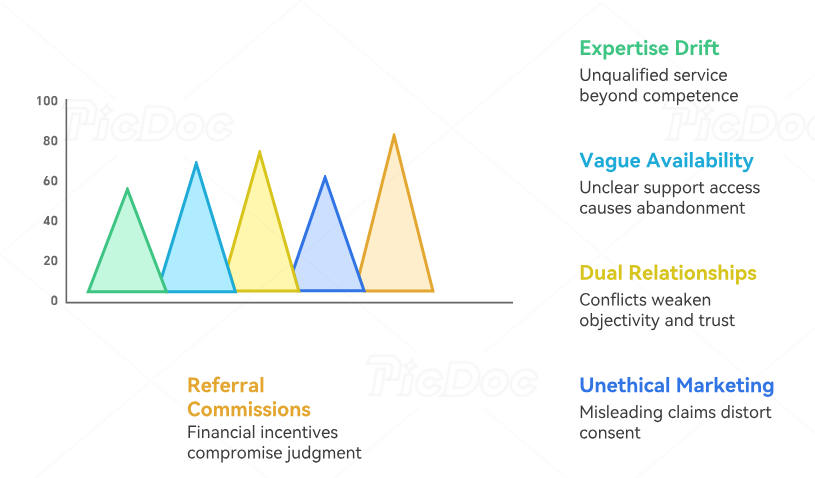
One major failure occurs when a coach allows expertise to drift beyond actual competence. A coach with personal experience of anxiety, weight loss, career change, or financial recovery may feel qualified to prescribe solutions to others. Personal experience can inform empathy while formal competence determines professional limits. Coaches should use scope-of-practice guidance, study professional ethics, maintain continuing development, and understand legal coaching requirements before offering services in higher-risk niches.
Another failure involves vague availability. A client who receives immediate late-night replies may reasonably assume that emergency support is part of the service. The coach may later withdraw that access abruptly, leaving the client feeling abandoned. Communication rules should be established before dependence develops. This is critical when supporting client anxiety, providing emotional-crisis support, using micro-coaching tools, or delivering automated client communication.
Dual relationships require careful assessment. Coaching a close friend, employee, romantic partner, business partner, or someone whose approval affects the coach’s income can weaken confidentiality and free choice. The client may withhold information because the coach occupies another powerful role. The coach may struggle to challenge the client objectively or protect private disclosures outside sessions. A structured conflict review supports a safe coaching environment, improves difficult-situation management, protects client trust, and strengthens ethical professional networking.
Marketing creates another high-risk area. A dramatic testimonial may omit the client’s prior experience, external support, financial resources, or individual circumstances. A coach who presents exceptional results as typical can distort informed consent. Ethical marketing uses accurate language, verifiable evidence, explicit permission, careful anonymization, and clear limitations. These practices strengthen case-study credibility, improve client transformation stories, support ethical high-ticket sales, and reduce the pressure that can damage client relationships.
Referral commissions and partnerships can also compromise judgment. A coach may recommend a course, practitioner, supplement, platform, or certification because the referral generates revenue. The client should be told about any financial relationship and retain access to alternatives. The recommendation should be based on suitability, competence, and client need. Transparent disclosure strengthens ethical joint ventures, protects coaching business growth, improves client experiences, and prevents commercial incentives from weakening professional credibility.
5. How to Build and Enforce a Code of Conduct in Your Practice
Begin by mapping every point where professional judgment affects the client. Include marketing, discovery calls, screening, contracting, payment, assessments, session delivery, between-session contact, technology, recordkeeping, referrals, complaints, testimonials, renewals, and termination. For each stage, identify the client risk, the required behavior, the responsible person, and the document that proves the procedure was followed. This exercise improves business automation, strengthens legal preparation, supports a reliable client experience, and makes practice scaling safer.
Your written code should include professional competence, informed consent, confidentiality, data protection, scope of practice, conflicts of interest, equality and respectful treatment, financial integrity, marketing accuracy, technology use, recordkeeping, referrals, complaints, supervision, continuing development, and termination. Each section should contain an actionable standard. A rule such as “maintain confidentiality” should be supported by storage controls, access restrictions, disclosure limits, retention periods, and breach procedures. This level of precision complements credentialing preparation, strengthens CPD compliance, supports certification interviews, and improves the quality of a coaching portfolio.
The code should connect to operational documents. These may include a coaching agreement, privacy notice, informed-consent form, scope statement, communication policy, recording consent, testimonial release, referral protocol, complaint process, incident form, data-retention schedule, and termination checklist. Templates should reflect the coach’s actual service rather than generic wording copied from another business. Reliable documentation strengthens payment administration, improves client expectation management, supports coaching automation, and reduces confusion during difficult client situations.
Coaches also need an ethical decision process. When a dilemma appears, identify the relevant facts, affected people, professional duties, legal concerns, power differences, possible harms, conflicts, available options, and consultation needs. Document the reasoning and review the outcome. Supervision, peer consultation, legal advice, clinical referral, or specialist support may be required when the risk exceeds the coach’s competence. This process supports ICF ethics preparation, reinforces safe coaching practice, improves responses to emotional crises, and strengthens professional accountability.
Review the code at least annually and whenever services, laws, technology, team structure, client populations, or jurisdictions change. A coach introducing artificial intelligence, group programs, international clients, health coaching, sponsored workplace coaching, or subcontractors will face new risks. Regular reviews should use complaints, near misses, client feedback, supervision notes, and industry developments as evidence. This keeps technology-enabled coaching, business automation, international practice growth, and continuing professional development aligned with current operations.
6. Frequently Asked Questions About Coaching Codes of Conduct
-
The requirement depends on the coach’s location, professional membership, accreditation, service type, contract, and client population. A professional body may require members to follow its ethical code, while privacy, consumer protection, safeguarding, advertising, business-registration, and recordkeeping laws may create separate obligations. Coaches should review relevant legal requirements, establish an appropriate business structure, understand credentialing expectations, and obtain qualified legal advice for jurisdiction-specific questions.
A voluntary written code still provides substantial value when no single law mandates it. It defines expected conduct, supports consistent decisions, improves complaint handling, and demonstrates that the coach has considered foreseeable risks. The code should complement contracts, privacy policies, insurance, professional standards, and scope-of-practice rules.
-
A code of conduct describes the standards the coach follows across the entire practice. A coaching agreement defines the specific relationship between the coach and an individual client. The code may address integrity, competence, confidentiality, discrimination, conflicts of interest, marketing, referrals, and professional development. The agreement covers service details, scheduling, fees, goals, communication, cancellation, privacy, and termination.
The two documents should align. A coach who promises strict privacy in the agreement while using insecure coaching technology creates a conflict between policy and practice. Strong alignment improves client expectations, supports reliable payment systems, and strengthens the overall client experience.
-
Confidentiality limits depend on applicable law, professional standards, safeguarding duties, contractual terms, and the nature of the risk. Coaches should explain these limits before coaching begins and maintain a written procedure for handling urgent disclosures. During a serious concern, the coach should follow the established protocol, document decisions, consult qualified professionals where appropriate, and contact relevant services when legally or ethically required.
Coaches working around emotional crises, mental health concerns, or severe client anxiety need referral pathways before accepting clients. Crisis management should never depend on improvisation during the incident.
-
The coach should acknowledge the request, explain the professional limitation, and help the client identify the appropriate source of qualified support. A health coach can help a client prepare questions for a physician while avoiding diagnosis or treatment instructions. A career coach can help the client organize concerns for an employment lawyer while avoiding legal conclusions. A business coach can support decision-making around finances while referring tax questions to a qualified professional.
Clear scope-of-practice boundaries, appropriate legal awareness, and relevant continuing education help coaches respond confidently without abandoning the client.
-
Client stories can be used when the coach has valid, informed, written permission and the material is represented accurately. The client should understand where the story will appear, which details will be included, whether their identity will be visible, how long the content may remain public, and whether they can withdraw consent before publication. Anonymization requires more than removing a name because employers, locations, diagnoses, family details, and unusual circumstances may still reveal identity.
Ethical case-study creation, accurate transformation stories, and voluntary client feedback protect trust while supporting credible marketing.
-
Review the code annually and whenever a material change occurs. Material changes include new services, certifications, jurisdictions, staff, subcontractors, technology platforms, data practices, referral relationships, client populations, or professional memberships. Complaints, privacy incidents, boundary problems, and near misses should also trigger immediate review.
A useful review compares written standards with actual practice. Check whether automated systems follow the privacy policy, whether client retention practices respect autonomy, whether qualifications remain current through CPD maintenance, and whether growth plans preserve the standards required for a safe, credible coaching practice.
