
Cultural Competence: Why Inclusive Coaching Is Essential in 2026–2027
Coaching clients across cultures requires more than goodwill. Every conversation is shaped by language, family expectations, faith, social class, gender norms, disability, migration history, workplace power, and access to support. Coaches who overlook these forces can misread caution as resistance, family loyalty as weak boundaries, or indirect communication as low confidence. Cultural competence strengthens safe coaching relationships, improves emotional-intelligence coaching, sharpens constructive feedback, and helps clients pursue change without abandoning identities, relationships, or realities that matter deeply to them.
1. Why Cultural Competence Has Become a Core Coaching Skill
Cultural competence is the ability to coach respectfully and effectively across differences while examining how identity, environment, social expectations, privilege, discrimination, and lived experience influence the client’s choices. It requires curiosity, self-awareness, adaptation, ethical judgment, and the humility to recognize where the coach’s understanding remains incomplete.
This capability has become central to professional coaching because clients increasingly work, study, relocate, lead teams, and build relationships across cultural boundaries. A coach may support an immigrant executive managing a multinational team, a first-generation professional negotiating family obligations, a client with a disability requesting workplace accommodations, or a health-coaching client whose traditional foods carry emotional and communal significance.
Generic advice can fail these clients quickly. Telling someone to “set stronger boundaries” may ignore financial dependence, multigenerational caregiving, community expectations, or safety concerns. Encouraging direct confrontation may create unnecessary risk in a high-power workplace. Recommending an individualized wellness routine may conflict with the client’s family meals, prayer schedule, transportation access, or caregiving workload.
Inclusive coaching examines the entire context before defining the intervention. That approach strengthens transformational coaching, improves client expectation management, supports emotional agility, and reduces avoidable conflict in difficult client situations.
Cultural competence also improves diagnostic accuracy. A client who pauses before answering may be showing respect, translating internally, assessing psychological safety, or following a communication norm that values reflection. A client who consults family members before making a decision may be practicing relational responsibility. A client who avoids self-promotion may come from a culture where modesty protects credibility.
Without cultural awareness, a coach can pathologize these behaviors. The client then receives advice designed to correct a misunderstanding. Trust weakens, goals become less authentic, and the coaching process may reward cultural conformity over meaningful development.
Professionally inclusive coaches use strengths-based coaching, positive-psychology principles, life-purpose exploration, and holistic coaching to understand which cultural values give the client resilience, belonging, identity, and direction. The coach helps the client expand choices while respecting the systems in which those choices must function.
2. The Core Capabilities Every Inclusive Coach Needs
Cultural Self-Awareness
Every coach brings assumptions into the room. These assumptions influence which behaviors seem confident, healthy, professional, ambitious, respectful, or emotionally mature. Cultural self-awareness helps the coach identify those interpretations before turning them into advice.
A coach may value independence because their own environment rewarded individual decision-making. Another may interpret frequent family consultation as hesitation. A coach accustomed to direct communication may see indirect language as evasive. These interpretations can feel objective while reflecting the coach’s own cultural conditioning.
Regular reflective practice should ask:
Which client behaviors make me impatient?
Which communication styles do I reward?
Which definitions of success do I present as universal?
When do I assume that my preferred solution is the healthiest one?
Which identities and communities do I understand mainly through secondhand information?
This reflection strengthens ethical coaching practice, supports a safe coaching environment, improves client feedback, and protects the trust required for transformational change.
Cultural Humility
Cultural humility means approaching the client as the primary authority on their lived experience. The coach brings process expertise, questioning skills, behavioral knowledge, and professional boundaries. The client brings knowledge of their identity, community, constraints, values, and risks.
Inclusive coaches avoid assuming expertise after reading about a culture or completing one diversity course. Communities contain enormous differences in age, class, education, migration history, region, generation, disability, religion, sexuality, and personal experience. Two clients from the same country may hold opposing values and face entirely different pressures.
Cultural humility supports emotional agility, improves constructive feedback, strengthens client expectation management, and reduces avoidable rupture during difficult coaching conversations.
A high-value question is: “What would I misunderstand about this situation without knowing your cultural or personal context?”
Contextual Listening
Contextual listening examines the meaning surrounding the client’s words. When a client says, “I cannot disappoint my parents,” the coach should explore financial, emotional, cultural, and relational consequences. When a client says, “I need to be more confident,” the coach should investigate who defined the current behavior as inadequate and whether greater visibility creates additional risk.
This listening style improves emotional-intelligence coaching, deepens life-purpose work, supports resilience coaching, and strengthens positive-psychology interventions.
Adaptive Communication
Inclusive coaches adapt pace, vocabulary, directness, examples, feedback style, technology, and session design. Adaptation preserves the coaching goal while making the process usable for the client.
A multilingual client may need more processing time. A neurodivergent client may prefer written agendas and clear transitions. A client with limited internet access may benefit from low-bandwidth resources. A client from a high-context communication culture may respond better to careful framing before direct feedback.
Adaptation can draw on micro-coaching, thoughtful coaching automation, accessible coaching technology, and carefully designed accountability systems.
3. How Cultural Blind Spots Damage Client Outcomes
The most damaging cultural coaching errors often sound reasonable. A coach encourages independence, confidence, openness, boundaries, visibility, directness, or personal ambition. Each concept can support growth. Problems develop when the coach applies one cultural definition of that concept to every client.
Consider boundary coaching. A client may live with extended family, contribute to household income, care for older relatives, and rely on family members for childcare. Advice to “say no more often” lacks the detail required for a workable intervention. The client needs to identify which obligations are essential, which are negotiable, how family authority operates, and what consequences might follow.
A culturally responsive approach might involve timed boundaries, shared responsibility, advance notice, indirect negotiation, or support from an influential family member. This approach uses emotional-intelligence coaching, emotional agility, habit formation, and realistic client expectation management.
Career coaching creates similar risks. Advice about speaking up, negotiating salary, challenging authority, or building a personal brand can affect clients differently according to gender, race, disability, immigration status, class, age, and workplace culture. The coach should assess the environment before assuming that greater visibility carries equal rewards for everyone.
Inclusive career coaching separates four questions:
What skill or behavior does the client want to develop?
How is that behavior interpreted within the client’s environment?
What risks accompany the change?
Which strategy increases influence while protecting credibility and safety?
This analysis supports career-burnout coaching, networking development, constructive feedback, and mindset coaching.
Health coaching also requires cultural precision. Food, sleep, movement, body image, family meals, fasting, caregiving, and health beliefs carry cultural meaning. A rigid plan can produce shame, conflict, financial pressure, or isolation. Sustainable health coaching works with the client’s environment through lifestyle-medicine coaching, preventive health coaching, health-behavior change, and practical habit stacking.
Cultural blind spots also damage trust when the coach uses stereotypes, mispronounces names repeatedly, makes assumptions about faith or family, treats discrimination as a mindset issue, or expects the client to provide constant cultural education. A single mistake can be repaired through accountability. Repeated defensiveness tells the client that protecting the coach’s comfort has become more important than understanding their experience.
4. A Practical Framework for Culturally Responsive Coaching Sessions
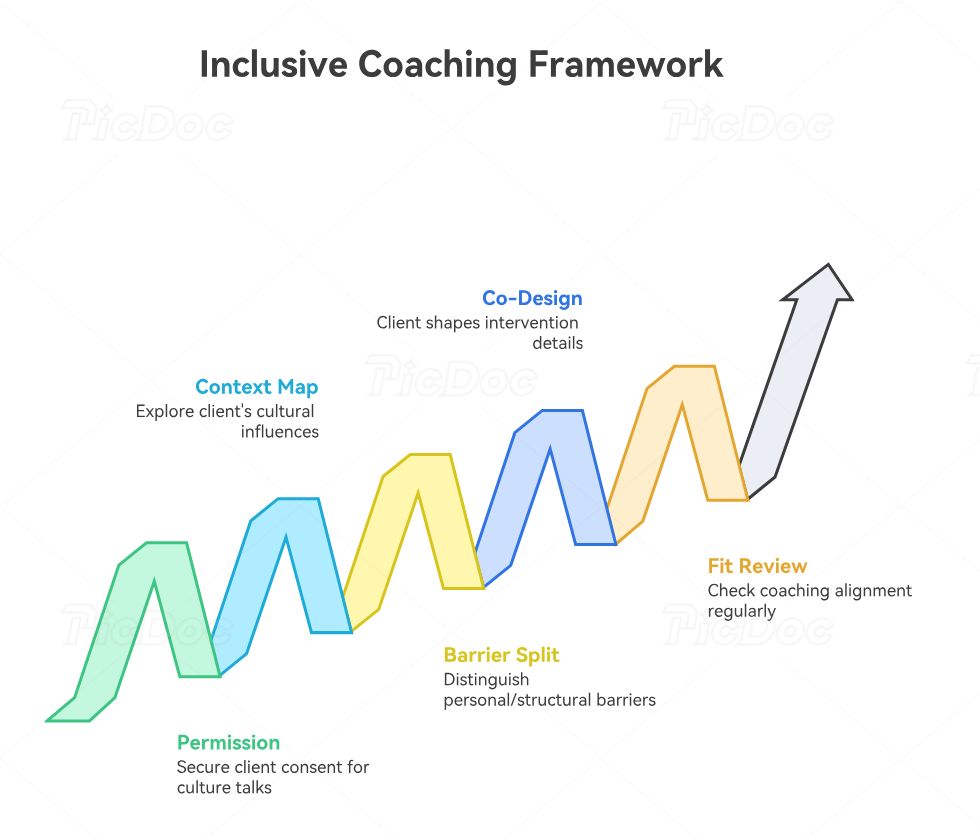
Inclusive coaching becomes more reliable when cultural inquiry is built into the coaching process instead of reserved for moments of conflict. The following framework helps coaches explore identity and context without making the client feel examined or categorized.
Step 1: Establish Cultural Permission
Coaches should explain that culture, identity, relationships, access, and environment may influence the coaching goal. The client can decide which areas feel relevant. This preserves consent and reduces the feeling that the coach is gathering personal information without purpose.
A useful statement is: “People’s goals are shaped by family, culture, work, health, faith, identity, and access to resources. We can explore any of those areas when they affect your choices.”
This foundation supports safe coaching environments, ethical coaching practice, appropriate scope-of-practice boundaries, and stronger client experiences.
Step 2: Map the Client’s Cultural Context
The coach can explore which identities, communities, relationships, and systems influence the goal. Relevant questions include:
Which people will be affected by this change?
Which expectations feel supportive?
Which expectations create pressure?
What would success mean within your family or community?
Which risks might someone outside your situation overlook?
Which traditions or values should the plan protect?
Where do you have influence, and where is your control limited?
These questions deepen life visioning, clarify life purpose, strengthen holistic coaching, and improve the accuracy of behavior-change planning.
Step 3: Separate Personal Barriers From Structural Barriers
A client may need confidence, knowledge, practice, or accountability. They may also face discrimination, limited healthcare access, economic insecurity, inaccessible technology, immigration restrictions, workplace hierarchy, or family dependence.
Coaching becomes harmful when every barrier is turned into a mindset problem. Positive thinking cannot remove an inaccessible building, biased hiring process, unaffordable service, or unsafe manager. The coach can still help the client identify options, document patterns, prepare conversations, find resources, strengthen coping, and determine when specialist support is appropriate.
This distinction protects the credibility of mindset coaching, strengthens resilience coaching, improves emotional-crisis support, and preserves clear professional scope.
Step 4: Co-Design the Intervention
The client should help determine the language, pace, accountability method, communication strategy, and measures of progress. Co-design prevents the coach from imposing a technically correct plan that cannot survive the client’s real life.
A client balancing religious fasting with a wellness goal may need changes in timing and intensity. A client with family financial obligations may need a gradual career transition. A client who experiences public accountability as shame may prefer private tracking. A multilingual client may benefit from written summaries after sessions.
Co-designed interventions can use habit formation, habit stacking, micro-coaching, and flexible coaching automation.
Step 5: Review Cultural Fit
At regular intervals, ask whether the coaching approach fits the client’s values and circumstances. The coach should evaluate usefulness alongside comfort, because productive coaching may involve challenge. Cultural fit means the challenge remains relevant, respectful, and realistically actionable.
Useful review questions include:
Which parts of this process feel aligned?
Where does the plan conflict with your reality?
Have I made any assumptions that need correction?
Is our accountability method supportive?
Which voices or perspectives are missing?
What should we adapt before the next step?
Regular review strengthens client feedback systems, supports client retention, improves constructive feedback, and creates more credible coaching case studies.
5. How Coaches Can Build Cultural Competence Into Their Practice
Cultural competence develops through repeated professional practice. Reading, training, supervision, client feedback, community engagement, ethical reflection, and exposure to diverse perspectives all contribute. A single certification cannot prepare a coach for every identity or cultural context.
Start by auditing the client journey. Review website language, intake forms, images, payment systems, scheduling practices, accessibility, pronoun fields, family-status assumptions, examples, policies, and technology. A coaching practice can promote inclusion while its systems quietly exclude clients through inaccessible forms, rigid scheduling, culturally narrow visuals, or assumptions about income and household structure.
This operational review connects cultural competence with exceptional client experiences, accessible payment systems, thoughtful coaching automation, and the right business tools.
Next, improve intake questions. Give clients space to share pronunciation, pronouns, accessibility needs, languages, important religious observances, communication preferences, and contextual factors that may affect coaching. Every question should have a clear coaching purpose and an option to decline.
Coaches should also develop a referral network that includes culturally responsive therapists, dietitians, physicians, legal professionals, disability specialists, financial advisers, interpreters, and community resources. Strong referrals demonstrate professional maturity and support ethical boundaries, NBHWC scope awareness, legal compliance, and responsible emotional-crisis support.
Supervision and peer consultation are equally valuable. Coaches need confidential spaces to examine cultural misunderstandings, countertransference, power dynamics, and difficult ethical decisions. Client confidentiality must remain protected, and identifying details should be minimized.
Ongoing professional development can be documented through CPD accreditation, CPD certification maintenance, stronger certification portfolios, and reflective preparation for certification interviews.
Coaches should also measure inclusion. Useful indicators include client retention across demographic groups, accessibility requests fulfilled, complaints, session adaptations, referral patterns, client-reported safety, and whether goals reflect the client’s own definition of success. Data should be interpreted carefully and collected with informed consent.
The most reliable cultural competence signal is behavioral. Inclusive coaches change how they ask questions, design programs, respond to mistakes, choose examples, structure accountability, and evaluate success. Their clients spend less energy translating themselves and more energy working on the change that brought them to coaching.
6. Frequently Asked Questions About Cultural Competence in Coaching
-
Cultural competence is the ability to coach effectively across differences in identity, values, communication, family structure, religion, disability, social class, nationality, race, gender, and lived experience. It combines self-awareness, cultural humility, adaptive communication, contextual listening, ethical practice, and continued learning.
A culturally competent coach considers how the client’s environment shapes choices and risks. This approach strengthens holistic coaching, supports emotional-intelligence development, improves behavior-change planning, and protects the coaching environment.
-
Cultural competence focuses on the skills and knowledge needed to work across differences. Cultural humility emphasizes continuous self-examination, openness, and recognition that the coach will never possess complete knowledge of another person’s culture or experience.
The two concepts work together. Competence supports effective action, while humility prevents certainty from becoming stereotyping. Both strengthen ethical coaching, constructive feedback, client feedback processes, and difficult-client conversations.
-
A coach can ask when the information has a clear connection to the coaching goal and the client has meaningful choice about disclosure. Questions should be respectful, open-ended, and free from assumptions. The coach should explain why the topic may be relevant and allow the client to decline.
For example: “Are there cultural, family, religious, accessibility, or identity-related factors that should shape this plan?” This approach supports safe coaching relationships, respects professional scope, aligns with ethical standards, and strengthens client trust.
-
The coach should acknowledge the mistake clearly, listen to the impact, apologize without defending intent, correct the behavior, and ask what would help restore safety. The client should never be pressured to comfort or educate the coach.
A useful repair statement is: “I made an assumption that did not reflect your experience. I understand that it may have affected your trust. I am sorry. I will correct how I approach this.”
Effective repair draws on constructive-feedback skills, emotional intelligence, difficult-situation management, and continuous client feedback.
-
Coaches should treat cultural information as a possibility to explore rather than a conclusion about the client. Use individualized questions, verify interpretations, and remain attentive to differences within cultural groups.
Instead of saying, “Your culture values family loyalty,” ask, “How does your family or community influence this decision?” This keeps the client’s experience central and supports life-purpose coaching, strengths-based practice, life visioning, and emotional agility.
-
Health behaviors are closely connected to food traditions, family routines, religious observance, caregiving, body image, income, transportation, healthcare access, and community beliefs. Plans that ignore these factors frequently become impractical or emotionally costly.
Culturally responsive health coaches adapt recommendations around the client’s resources and values while maintaining professional scope. This strengthens lifestyle-medicine coaching, preventive health coaching, health-behavior change, and sustainable habit formation.
