
Health coaching still offers a viable career path in 2026, although the strongest opportunities sit in very specific parts of the market. Coaches who combine health behavior change, evidence-based SMART goal setting, rigorous coaching ethics, and a commercially useful specialty have considerably stronger prospects than candidates relying on certification alone. The Reddit frustration is real: low-paid contract roles, weak benefits, difficult client acquisition, and inflated six-figure promises coexist with healthcare, digital-health, corporate, and private-practice opportunities that reward the right skill stack.

1. Is Health Coaching Still Worth It in 2026? The Career Has Split Into Very Different Markets
The most important career question in 2026 is who will pay for your coaching and why. Someone studying self-care coaching, mastering the Wheel of Life, learning Positive Intelligence, and becoming excellent at life visioning can become a capable coach while still struggling commercially if no employer, healthcare program, corporate buyer, referral partner, or private client has a compelling reason to purchase that capability.
The profession's own workforce data captures this tension unusually well. NBHWC's 2025 survey, published in 2026, found that 41% of respondents worked in private practice, 22% primarily in healthcare, and only 28% worked full-time. Part-time, contract, and hybrid arrangements therefore form a major part of the occupation rather than an unusual transitional phase. Among all surveyed NBC-HWCs, 36% earned under $10,000 annually from coaching while 7% earned $100,000 or more.
Those numbers explain why two people can complete similar training and give completely different answers to “Is health coaching worth it?” A clinician adding behavior-change coaching to an established patient-facing career is solving a different economic problem from a new graduate attempting to build a general-wellness business from zero. A professional entering career burnout coaching through employer contracts has a different customer-acquisition model from someone selling generic accountability sessions. A coach using strong contracting practices, defined duty-of-care boundaries, and a specialist referral network can also operate more credibly inside healthcare than somebody whose positioning never moves beyond “I help you become your best self.”
Certification carries meaningful employer value, though its value depends on the employer. In the 2025 NBHWC workforce report, 24% of surveyed coaches said their employer required NBC-HWC and another 16% said it was encouraged or highly valued. NBHWC also reported in 2026 that the board-certified workforce had grown beyond 14,000 coaches.
The practical interpretation is useful for anyone comparing health coaching certification routes. Credentialing can help you pass an employer's screening threshold, demonstrate competency, and build trust. Your earning power usually depends on what sits beside that credential: nursing, dietetics, public health, exercise physiology, psychology, corporate wellness, chronic-disease experience, business development, or another defensible specialty.
That distinction should shape your training budget. Spending heavily on another generic program because you lack confidence may deliver less career return than strengthening self-confidence as a coach, learning a structured framework such as the CLEAR coaching model, improving cultural competence, and deliberately building 50–100 real coaching conversations within a market you want to serve.
2. What Reddit Health-Coaching Career Stories Reveal That Course Marketing Usually Leaves Out
Reddit's 2026 health-coaching discussions repeatedly expose the same economic fault line: people may enjoy the work while struggling with the employment model. One August thread criticized a bilingual NBC-HWC role paying roughly $20–$25 an hour without benefits. Another commenter reported finding $30-per-hour 1099 work and viewed coaching as more realistic as a side income until better full-time opportunities emerge.
That experience deserves attention because emotionally demanding coaching requires stronger boundaries than many beginners anticipate. Knowing duty of care, using a clear coaching code of conduct, establishing professional coaching contracts, and maintaining cultural competence become career-protection skills when companies expect high client volume, detailed documentation, retention metrics, and emotionally complex conversations.
Another 2026 Reddit discussion came from a former coach who described starting at $16.50 per hour, later earning around $20 per hour after NBC-HWC certification, and eventually leaving because income never reached the desired level. A different contributor described having previously operated a viable coaching business alongside personal training and corporate-wellness work. The contrast is important: diversified expertise and multiple revenue channels can materially change the economics.
A separate Reddit discussion offers the other side. One commenter reported earning about $70,000 in a community-hospital wellness coordinator role, where coaching was combined with employee wellness, community programs, diabetes prevention, CPR programming and related responsibilities. That job resembles where durable demand increasingly sits: coaching embedded inside a broader health outcome rather than coaching sold as an isolated conversation.
This is why someone with expertise in leadership coaching, career burnout, self-care coaching, and Positive Intelligence might build a stronger corporate proposition than someone marketing “wellness coaching” broadly. Employers buy reduced friction around a defined workforce problem; they rarely budget because a coach possesses an interesting toolkit.
Private-practice stories produce the same lesson. One long-running Reddit AMA, updated in 2026, came from a self-employed coach with roughly 14 years across startups, corporate wellness, consulting and private practice. The contributor specifically emphasized the value of thousands of hours accumulated in corporate settings before building an independent business.
That pathway is materially different from graduating on Friday and trying to sell $2,000 packages on Monday. A coach who has spent years applying the OSCAR coaching model, understanding Immunity to Change, supporting health behavior change, and mastering SMART goals has accumulated pattern recognition that is difficult to reproduce through branding alone.
The painful private-practice stories are equally instructive. A UK coach writing in April 2026 said the NHS coaching role itself was enjoyable, while part-time hours were financially insufficient and the private practice had struggled to attract paying clients. Client acquisition is therefore a separate professional competency. Excellent life-purpose coaching, sophisticated life visioning, a strong T-GROW coaching process, or advanced transactional-analysis knowledge does not automatically create distribution.
The Reddit pattern therefore gives prospective coaches a useful rule: evaluate the business model before evaluating the coaching curriculum.
3. The Income Reality: Why $100 Sessions, $25 Jobs and Six-Figure Coaches Can All Exist at Once
The income debate becomes clearer when wages, private-practice fees and annual earnings are separated.
The 2025 NBHWC survey reported an average coaching wage of $54.42 per hour and a median of $40. Full-time coaches averaged $44.69 per hour, while part-time coaches averaged $58.90. Those hourly figures should never be multiplied mechanically by 40 hours and 52 weeks because many coaches lack 40 paid coaching hours every week, especially in contract and private-practice models.
Annual income tells the stronger story. Sixty-seven percent of full-time coaches reported earning between $50,000 and $99,999, and 34% of full-time coaches earned $75,000 or more. Across the entire sample, however, only 34% reported annual income of at least $50,000.
That gap is exactly why aggressive “become a six-figure coach” marketing can mislead beginners. Learning money mindset coaching, improving self-confidence, applying ADKAR, and using CLEAR coaching may improve your effectiveness. Revenue still depends on paid hours, utilization, acquisition cost, churn, taxes, benefits, administrative time, cancellations and customer lifetime value.
Private-practice rates illustrate the distinction even more sharply. NBHWC's 2025 survey found a median private-practice session rate of $100 an hour, with most rates clustering around $75–$150. A coach charging $120 does not personally “earn $120 an hour” in the same sense as an employee receiving $120 for every compensated hour. Marketing, discovery calls, bookkeeping, insurance, technology, continuing education, content production, follow-up, scheduling and empty calendar space all consume the gross rate.
Current employment listings show the other end of the market. As of early September 2026, a remote Cadence role for an NBHWC-certified health coach listed roughly $22–$26 per hour and involved Medicare patients with chronic conditions, proactive outreach, goal setting, care coordination and documentation. A Sharecare remote listing showed $21.50 per hour or $25 with NBC-HWC/CHES certification.
At the same time, current remote listings included a Vida Health role around $30 per hour and a Future role around $30–$40. An RN health-coaching position from Evernorth displayed a much higher annual range of approximately $77,500–$129,100, illustrating the financial power of stacking coaching on top of a licensed clinical credential. Job listings change quickly, so these figures are snapshots of September 2026 rather than permanent market rates.
For career planning, that credential-stacking effect may be more important than collecting multiple coaching certificates. The NBHWC survey found that additional coaching certifications were not associated with higher wages, while holding at least one non-coaching certification was associated with higher earnings. Someone already working in nursing, exercise science, healthcare operations or nutrition may therefore generate more return from adding behavior-change expertise, motivational goal structures, ethical boundaries, and inclusive coaching skills than from collecting several overlapping coach-training certificates.
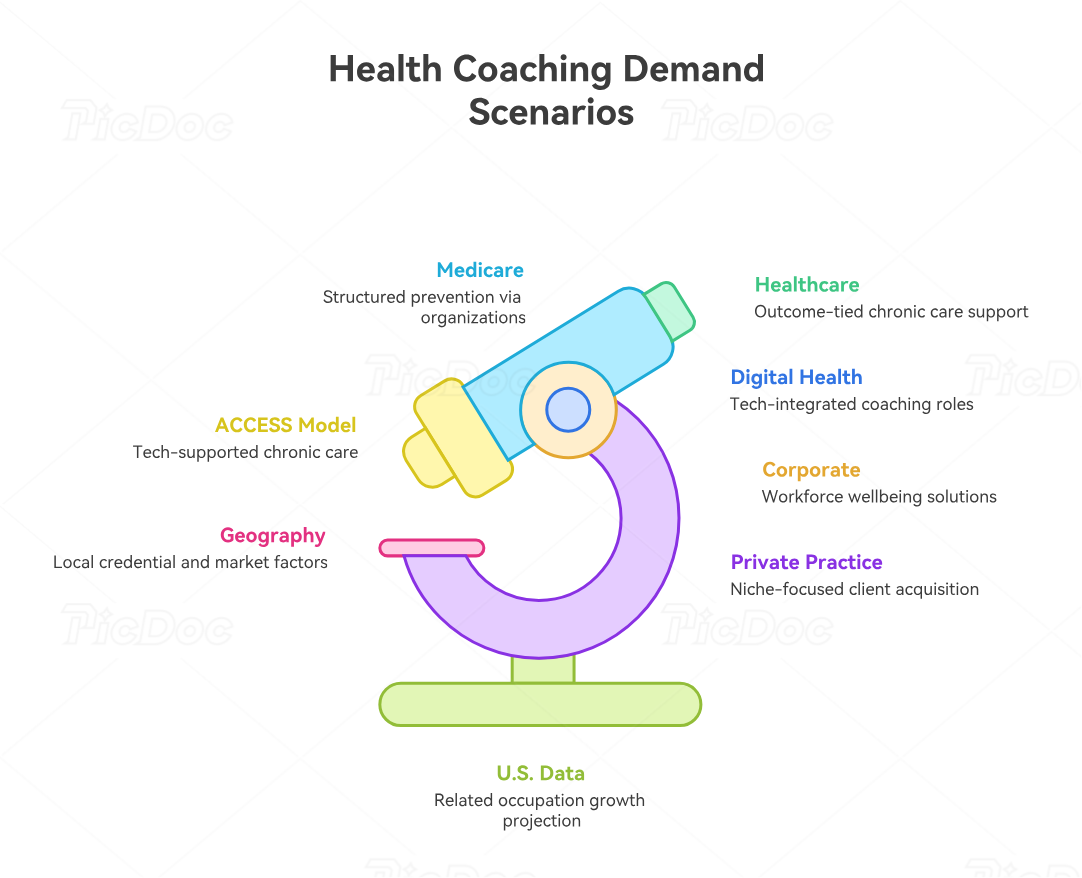
4. Where Health-Coaching Demand Actually Exists in 2026
The strongest demand increasingly appears where behavior change is attached to a measurable healthcare or organizational outcome.
Chronic disease and prevention are particularly important. The CDC's National Diabetes Prevention Program relies on trained Lifestyle Coaches to help participants improve nutrition, physical activity, stress management, goal execution and long-term adherence. Programs can operate in person or virtually. Coaches who understand health behavior change, SMART goals, Immunity to Change, and ADKAR-based change fit more naturally into these environments than coaches whose training centers primarily on inspirational conversation.
Medicare policy also shows where the healthcare system is experimenting with coaching. CMS's Medicare Diabetes Prevention Program allows trained coaches to deliver structured prevention interventions through enrolled supplier organizations, while 2026 policy expanded online delivery arrangements. Individual coaches do not independently enroll and bill Medicare as MDPP suppliers; the organizational structure matters.
CMS's ACCESS Model, available from July 2026, provides another demand signal. The 10-year model focuses on technology-supported chronic care for conditions including hypertension, diabetes, chronic musculoskeletal pain and depression, with services that can include lifestyle support, remote monitoring and coaching. It does not guarantee health-coach employment, yet it demonstrates where healthcare purchasing is heading: accountable, technology-enabled behavior support tied to outcomes.
Digital health follows the same pattern. Current roles involve chronic-condition engagement, adherence, documentation, risk escalation, motivational interviewing and care coordination. A coach who can combine CLEAR coaching, T-GROW, Positive Intelligence, and disciplined coaching contracts with clinical workflows, CRM/EHR documentation and performance metrics becomes more employable than someone who sees technology as unrelated to coaching.
Corporate demand operates differently. Companies tend to buy solutions around burnout, retention, leadership, wellbeing, stress and workforce performance. This makes career burnout coaching, conscious leadership, leadership coaching, and public-speaking coaching potentially valuable extensions for coaches who understand organizational buyers.
Private practice remains the largest single employment setting in NBHWC's survey, at 41%, but it is also where client acquisition becomes unavoidable. A useful private-practice niche usually combines a defined population, an expensive recurring problem, credibility to serve that population, and access to referral channels. Self-care coaching, money mindset, self-confidence coaching, and life-purpose coaching become commercially stronger when connected to a precise buyer rather than sold as broad transformations for everyone.
Geography also changes the equation. Someone researching certification and employment in the UK, Germany, Saudi Arabia, India, or Singapore should examine local credential expectations, private-pay purchasing power, healthcare regulation and employer structures rather than importing U.S. salary claims.
Even U.S. occupational data requires careful interpretation. Health coaching has no perfectly equivalent standalone BLS category. The adjacent occupation of health education specialists is projected to grow 6% between 2025 and 2035, with approximately 6,900 openings per year, which supports broader demand for health-behavior education while remaining distinct from health coaching itself.
5. How to Enter Health Coaching in 2026 Without Betting Your Financial Future on Hope
A low-risk career transition begins by deciding which job you want before selecting the education.
If your target is U.S. healthcare or digital health, examine 30–50 current job descriptions and count how often employers request NBC-HWC, clinical experience, bachelor's or master's degrees, documentation ability, motivational interviewing, chronic-condition knowledge, bilingual capability, care coordination and related credentials. Then compare those requirements with your current profile. This exercise frequently prevents somebody from spending $8,000 solving a certification gap when the real gap is healthcare experience.
NBHWC currently requires candidates pursuing board certification to complete an approved training program, satisfy the education requirement and complete 50 health-coaching sessions before sitting for the board examination. Those sessions should be treated as portfolio development rather than paperwork. Practice SMART goal development, T-GROW conversations, OSCAR coaching, and ethical coaching contracting until you can explain what changed for clients without making exaggerated clinical claims.
The safest financial transition is often hybrid. Keep your primary income while building supervised experience, a referral network and a narrow offer. A nurse might combine clinical work with cardiometabolic coaching. A personal trainer could pair exercise expertise with health behavior change. An HR professional may connect career-burnout coaching with conscious leadership. A psychologist or health-psychology professional operating within appropriate scope may use coaching alongside existing specialist knowledge.
The 2025 NBHWC data strongly supports this “stacking” logic. Higher annual earnings were associated with experience, full-time work, healthcare employment and employers recognizing the NBC-HWC credential. The career becomes more defensible when your résumé answers three questions simultaneously: Can you coach? Do you understand this population? Can you operate inside the buyer's environment?
Private-practice candidates need an additional question: Where will the clients come from? “Instagram” is a channel rather than an acquisition strategy. Better engines include physician referrals, physical-therapy relationships, employer partnerships, fitness communities, alumni networks, specialist clinics, workshops, existing professional audiences, local organizations and carefully chosen digital content. Coaches using life visioning, Wheel of Life assessments, Positive Intelligence, or transactional analysis still need repeatable distribution.
Calculate your break-even point before enrolling. If training, exam preparation, certification, insurance, technology and initial business costs total $7,500, and your realistic post-expense contribution is $75 per paid session, you need 100 paid sessions simply to recover that investment. That calculation forces far better decisions than relying on advertised “income potential.”
Finally, investigate working conditions as aggressively as salary. Ask prospective employers about compensated documentation time, clients per shift, outbound-call expectations, cancellation policies, performance metrics, escalation procedures, benefits, PTO, continuing education, supervision and emotional-support structures. Duty of care, professional conduct, cultural competence, and clear client agreements protect the coach as well as the client.
Health coaching in 2026 can therefore be worth entering when you approach it as a specialized behavior-change profession with a business model, especially within healthcare, chronic-disease programs, digital health, established professional practice, corporate wellbeing or a referral-driven specialty. The greatest career danger is purchasing credentials faster than you build market value.
6. FAQs About Health Coaching Careers in 2026
-
General wellness coaching is crowded because the title “health coach” can be used broadly, creating competition from people with very different levels of training. Specialist demand behaves differently. Healthcare organizations, digital-health companies, diabetes-prevention programs, corporate-wellness teams and niche practices hire around defined outcomes. Building expertise in health behavior change, SMART goal coaching, duty of care, and a commercially relevant population gives you substantially stronger differentiation.
-
Requirements vary. The 2025 NBHWC survey found 24% of respondents worked for employers requiring the credential and another 16% worked where it was encouraged or highly valued. Candidates targeting structured healthcare careers should therefore inspect actual job requirements before choosing training. Someone comparing programs in the United States or internationally should also assess local expectations alongside coaching ethics and professional contracting.
-
There is no responsible single figure because W-2 employment, 1099 work and private practice have completely different economics. NBHWC's 2025 survey reported a median hourly wage of $40, while 67% of full-time coaches reported annual earnings between $50,000 and $99,999. At the same time, current entry and digital-health listings can sit in the $20s per hour. Developing leadership capability, a specialist health background, and behavior-change expertise can materially improve the roles you can compete for.
-
Yes, the NBHWC survey includes coaches earning $100,000 or more, and private-practice session fees commonly cluster around $75–$150. Six figures requires considerably more than multiplying your listed session rate by 40 hours. Client acquisition, retention, unpaid administration, cancellations, expenses and available selling capacity determine actual income. Strong self-confidence coaching, money mindset, and life-purpose work can enrich an offer; they still need a commercially viable audience and acquisition engine.
-
Yes. NBHWC's 2025 survey found 87% of coaches used video conferencing, making virtual delivery the most common modality. Remote employment can also attract more applicants because geography creates fewer barriers. Coaches who combine digital fluency with CLEAR coaching, OSCAR coaching, excellent cultural competence, and rigorous professional boundaries are better positioned for distributed client populations.
-
Choose the buyer first, select the role second, identify the missing skills third, and purchase training fourth. Build real coaching hours while retaining financial stability, then combine your credential with an adjacent specialty that employers or clients already value. Learn health behavior change, structured SMART goals, a practical framework such as T-GROW, and professional coaching ethics. That sequence minimizes the risk of becoming highly trained for a job market you never validated.
