
A health coach certificate can prove that you completed training. The NBHWC pathway can position you for an independently assessed national credential after additional eligibility steps and the board exam. That distinction becomes expensive when candidates discover it too late. Someone planning preventive health coaching, health behavior change, lifestyle medicine coaching, or metabolic health coaching should choose training around the jobs they want, because board eligibility matters dramatically more in some career paths than others.
1. Health Coach Certification vs NBHWC: Understand What Employers Are Actually Comparing
“Certified health coach” can describe someone who completed a certificate program offered by a school, training company, university, wellness organization, or other provider. The rigor, instructional hours, skills assessment, admission criteria, and recognition of those certificates can vary substantially. For someone building an independent self-care coaching practice, teaching habit formation, supporting emotional agility, or working within an existing holistic coaching business, an appropriate standalone program may provide useful skills without the graduate pursuing national board certification.
The NBHWC route has another layer. Every candidate for the National Board Certified Health & Wellness Coach credential must complete an NBHWC-approved training program, satisfy the required education or work-experience criterion, document 50 qualifying coaching sessions, and pass the NBHWC Board Exam. Passing earns the NBC-HWC credential. NBHWC describes board certification as evidence to employers, healthcare professionals, patients, and educators that the individual has demonstrated defined health-and-wellness coaching knowledge and competencies.
This produces a distinction candidates routinely miss:
Program certification → training completion.
NBHWC-approved program completion → one component of board-exam eligibility.
NBC-HWC → board credential earned after satisfying eligibility requirements and passing the examination.
A coach therefore needs to ask whether a program supports the intended destination before enrolling. Someone pursuing food-sensitivity coaching, preventative health coaching, resilience coaching, or positive psychology coaching may care primarily about coaching competence and private-client positioning. Someone targeting hospital wellness, digital health, employer wellness, care-management-adjacent work, or jobs explicitly advertising NBC-HWC will care much more about the pathway status of the training itself.
That distinction becomes painful when a candidate finishes an attractive program and later discovers that it does not make graduates eligible for the board examination. NBHWC currently states that every board candidate must complete an approved training program and that completing a program before it became NBHWC-approved does not retroactively create eligibility. Advanced degrees, healthcare licenses, and previous coaching experience also do not replace this approved-training requirement.
This is why certification shopping should begin with career architecture rather than course marketing. A coach attracted to mental health coaching, career burnout coaching, emotional intelligence coaching, or life-purpose coaching should decide whether future employment inside healthcare or organizational wellness is likely. Paying slightly more for an eligible pathway can be rational when it prevents retraining later. Paying substantially more solely because “board certified sounds better” can be poor capital allocation when target clients and employers never ask for it.
| Career Scenario | Standalone Health Coach Certificate | Value of NBHWC Eligibility | Employer Reality | Best Move |
|---|---|---|---|---|
| Launching a solo general wellness practice | Can provide foundational coach training | Useful, not automatically essential | Clients may care more about trust, specialization, results, and professionalism | Choose strong training; preserve NBHWC eligibility if future employment is possible |
| Preventive health coaching | Useful for basic coaching competence | High when working around healthcare systems | Clinical-adjacent employers may prefer independently validated credentials | Favor an NBHWC-approved pathway |
| Hospital wellness coach | May be insufficient alone | Very high | Employers may request NBC-HWC alongside healthcare, wellness, or degree qualifications | Plan for board eligibility from day one |
| Digital health coach | Can qualify for some entry roles | High for stronger credential filters | Requirements vary significantly between platforms | Analyze 20-30 target postings before enrolling |
| Corporate wellness contractor | Often usable | Moderate to high | Some contracts accept equivalent coaching credentials; others prefer NBC-HWC | Choose based on target employers |
| Self-care coach | Often sufficient for private practice positioning | Moderate | Private clients rarely use the same screening process as healthcare employers | Prioritize excellent training and business execution |
| Habit-change coach | Can provide practical methodology | Moderate | Employers may value behavioral coaching competence plus experience | Preserve board option if employment is likely |
| Metabolic health coach | Training value depends heavily on scope quality | High in multidisciplinary settings | Medical environments may layer coaching credentials with licensed clinicians | Choose rigorous scope-aware training |
| Registered dietitian adding coaching | Can strengthen counseling skills | Career-dependent | Some RD roles value NBC-HWC; others prioritize the RD credential and experience | Reverse-engineer desired roles before paying |
| RN moving into health coaching | Useful but may duplicate existing competencies | Potentially high | Many clinical coaching roles combine nursing credentials with coaching qualifications | Search RN-coach roles before choosing the program |
| Therapist adding wellness coaching | May support a separate coaching service | Depends on business model | Clinical license usually carries separate authority and obligations | Clarify role separation and scope first |
| Fitness professional adding behavior change | Often immediately useful | Moderate | Gyms and private clients may accept broader credentials | Board path becomes more useful if moving toward healthcare |
| Career changer with no health background | Provides initial structure | High for standardized credibility | Employers may also want relevant experience, degree, or adjacent healthcare exposure | Select an approved pathway and start building experience early |
| No college degree | Available from many providers | Still possible | Some employers separately require degrees | Remember NBHWC permits a qualifying work-experience route |
| Experienced independent coach | May already have sufficient client-facing skills | Useful if employment plans change | Board status may help pass formal employer filters | Calculate the opportunity unlocked before retraining |
| Coach targeting insurance-related programs | May have limited signaling strength | High | Credentialing standards tend to matter more around payer and clinical structures | Board pathway is strategically stronger |
| Community health program coach | May qualify for some roles | Moderate to high | Public-health experience and degrees can matter alongside certification | Compare credential requirements across local employers |
| Employee wellness coordinator | Potentially sufficient | Moderate | Program-management experience may matter as much as coaching certification | Build measurable wellness-program experience |
| Lifestyle medicine coaching | Useful with appropriate scope education | High around medical teams | Healthcare organizations value clearer competency boundaries | Choose an NBHWC-compatible route |
| Food sensitivity coaching | Requires careful scope selection | Board credential adds coaching credibility | Coaching credentials do not create dietetic or diagnostic authority | Prioritize scope-of-practice discipline |
| Private nutrition-and-wellness business | Can be commercially useful | Moderate | Market positioning may matter more than formal employer screening | Invest in both competence and client acquisition |
| Remote employee health coach | Accepted by some employers | Often valuable | Remote roles can attract large applicant pools and tighter credential filters | Board eligibility can improve screening competitiveness |
| Low-cost entry coaching platform | May satisfy minimum qualifications | Mixed | Credential requirements do not guarantee strong pay or benefits | Evaluate compensation before investing for one employer |
| Health educator transitioning to coaching | Adds direct coaching methodology | Career-dependent | Existing education and public-health experience may already carry substantial value | Identify the exact qualification gap first |
| Coach hoping certification alone creates clients | Provides skills, not demand | Board status does not solve acquisition | Self-employment still requires positioning, referrals, sales, and retention | Build a client-acquisition system alongside training |
| Coach seeking higher pay | May improve qualification profile | Potentially useful | Pay depends on employer, license, role complexity, geography, and employment type | Compare salaries before assuming credential ROI |
| Coach planning international private practice | Potentially usable | Recognition varies | Local regulation and employer recognition differ by jurisdiction | Research destination-market rules separately |
| Coach wanting maximum future flexibility | Choose carefully | High strategic value | An approved program preserves the option to pursue NBC-HWC later | Select an approved program even if the exam is postponed |
| Coach certain they will remain self-employed | Can be sufficient with rigorous education | Optional depending on positioning | No employer credential filter exists | Compare board-route cost with other business investments |
| Applicant repeatedly filtered out for NBC-HWC | Existing certificate is failing a real hiring requirement | Very high | The market has supplied direct evidence of the credential gap | Pursue board eligibility if those roles remain the target |
2. The NBHWC Path in 2026: Every Requirement, Cost and Timing Trap That Matters
The first step is completing an NBHWC-approved training program. NBHWC currently lists more than 138 approved programs and states that its program standards require at least 75 instructional hours, including defined synchronous instruction and practical skills development. Approval signals that the program has met NBHWC educational standards; NBHWC explicitly says approval does not amount to endorsement of every piece of curriculum, faculty opinion, business practice, or associated product.
That final point matters. “NBHWC-approved” tells you something important about eligibility and minimum training standards. Candidates should still compare teaching quality, faculty access, mentoring, live practice, alumni support, price, scheduling, and specialization. Someone preparing for health behavior change, habit coaching, positive psychology coaching, and emotional intelligence coaching needs practical skill formation as much as eligibility paperwork.
The second component is the education/work requirement. Candidates currently need an associate degree or higher, in any field, or 4,000 hours of work experience. The degree does not need to be health related, and NBHWC states that qualifying work experience can also be in any field. This creates a viable pathway for experienced professionals moving from another career into preventative health coaching, self-care coaching, lifestyle medicine, or resilience coaching.
The third component creates one of the biggest practical bottlenecks: 50 qualifying health-and-wellness coaching sessions. According to NBHWC's 2026 exam materials, each logged session must last at least 20 minutes, at least 75% must involve coaching facilitation rather than education, and sessions must be synchronous. Paid and pro bono sessions can qualify. The sessions begin only after the candidate passes the applicable practical skills assessment within the approved program.
That timing rule deserves attention. A candidate may already have dozens of previous client sessions and discover that they cannot simply place historical work onto the required log. NBHWC states that coaching-log sessions completed before the approved start point cannot count. It also excludes sessions with current classmates and says friends and family should not be used for the required experience.
This requirement is one reason prospective coaches should consider client acquisition during their education rather than after it. A candidate who understands coaching automation, builds exceptional client experiences, practices constructive feedback, and develops strong accountability coaching can use the 50-session phase to create genuine professional readiness rather than treating it as an administrative hurdle.
The final stage is the board examination. The 2026 exam is 150 multiple-choice questions within a 4.5-hour total testing appointment, and the content areas include coaching presence and sessions, behavior-change theories, coaching skills and strategies, ethics and professional practice, and health and wellness. The current application fee is $100 and the examination registration fee is $400, making the board application/exam component $500 before considering the cost of training.
Program tuition therefore represents only one part of the board pathway. Candidates should budget for training, exam fees, study materials where needed, the time required to accumulate sessions, and the opportunity cost of practice coaching. Someone comparing programs purely by headline tuition can underestimate the real investment. The decision should be evaluated alongside potential gains in coaching credibility, access to stronger professional networks, future practice scaling, and suitability for more structured health-coaching employment.
3. What Reddit Experiences and Current Job Listings Reveal About the Hiring Market
Reddit exposes a useful contradiction in health coaching: people report that NBC-HWC can open employer doors while simultaneously describing a labor market where certification alone does not guarantee attractive employment.
One 2025 poster with a dietetics degree and four years of self-employment expressed frustration because employers were requesting NBHWC certification despite extensive prior education and experience. Another coach reported that certification had helped. A separate discussion from an independently trained coach seeking corporate employment observed that many jobs they encountered requested NBHWC or ICF credentials. These experiences reflect a common pain point: candidates sometimes discover formal credential filters only after deciding they want to leave self-employment.
Other Reddit experiences show why the credential should never be treated as a guaranteed salary multiplier. In a late-2025 discussion, one NBC-HWC reported earning about $70,000 in a community-hospital wellness-coordinator role, while other participants described difficulty finding attractive work. In 2026 threads, coaches complained about part-time roles, limited benefits, hourly compensation around the low-to-mid-$20 range, and high application friction despite certification. One August 2026 discussion described an NBC-HWC-required bilingual role advertising $20–$25 per hour, while another commenter described $30-per-hour contractor work with no employee benefits. These are anecdotes rather than representative salary data, yet they reveal the economic question candidates need to investigate before paying for another credential.
There is also an experience problem. Reddit discussions repeatedly describe candidates trying to enter coaching with education but little direct coaching history. One poster had accumulated 27 of the 50 sessions and was already worrying about employment. Another career changer with a public-health degree asked how to obtain the first coaching role and was told by a respondent that many jobs require certification while jobs without it often want prior experience.
That creates a familiar hiring loop: employers want credentialed coaches with experience, while emerging coaches need opportunities to create experience. The solution is to build proof while completing training. Candidates can document supervised practice, pro bono work, client retention, behavior-change outcomes, structured coaching case studies, client feedback, application of habit-formation science, and measurable health behavior change. Certification gets stronger when accompanied by evidence that the candidate can actually coach.
Current employer-facing evidence supports the idea that NBC-HWC has meaningful recognition without making it universally mandatory. NBHWC's own employer resources state that healthcare systems, wellness programs, and digital health organizations often require or prefer NBC-HWC because it provides a standardized signal around training, competence, ethics, and scope. Its current career center includes roles across healthcare, workplace wellness, remote health coaching, universities, and health-engagement programs.
Current public job listings also show mixed requirements. Indeed listings include jobs explicitly describing NBHWC board certification as preferred while accepting equivalent certifications, alongside health-coaching roles tied to additional credentials such as registered-dietitian qualifications. A current LinkedIn listing from The Alliance of Hormonal Health specifically seeks National Board-Certified Health and Wellness Coaches.
This is the hiring reality candidates need to understand: NBC-HWC frequently acts as one qualification layer, particularly in structured health environments. Employers may still screen for an RN or RD license, bachelor's or master's degree, disease-management experience, motivational interviewing skills, care-navigation knowledge, multilingual ability, technology competence, or previous coaching volume. A candidate entering metabolic health coaching, preventive health, mental health coaching, or lifestyle medicine coaching should treat the credential as part of a professional stack.
4. Who Actually Needs NBHWC Board Eligibility?
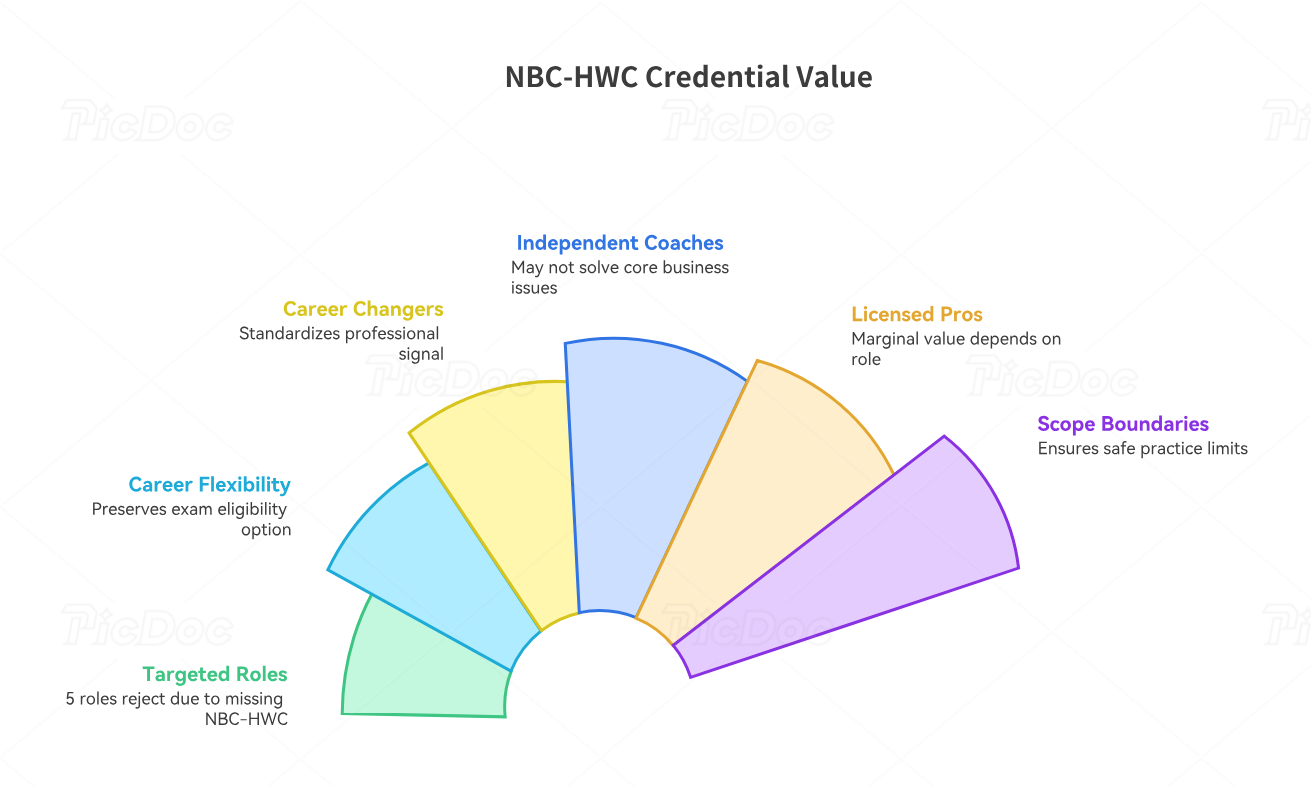
The strongest case belongs to candidates targeting employers that explicitly list NBC-HWC required. At that point, the credential question becomes concrete. If five attractive hospital, digital-health, corporate-wellness, or health-management roles reject your existing qualification profile because NBC-HWC is missing, completing another generic health-coach certificate does little to solve the hiring barrier. Someone committed to preventive health coaching, lifestyle medicine, structured behavior-change coaching, or metabolic health inside healthcare should strongly consider an approved pathway.
The second strong case involves candidates who do not know where their career will lead. Choosing an NBHWC-approved training program preserves the option to sit for the board exam later, provided the candidate meets the other requirements. Choosing a non-approved program can mean repeating formal coach training if the career later shifts toward employers requesting NBC-HWC. That optionality has value for people moving from self-care coaching toward corporate health, from resilience coaching toward employee wellness, or from independent habit coaching toward multidisciplinary healthcare.
A third group includes career changers who need a standardized professional signal because their résumé contains little health-coaching experience. Board certification cannot replace experience, although it can reduce uncertainty about foundational coaching education and examination standards. These candidates should build client accountability, behavior-change competence, strong client feedback systems, and credible case-study evidence while accumulating qualifying sessions.
Independent coaches have a different calculation. Someone whose revenue depends on direct clients has no HR system automatically rejecting the résumé for lacking NBC-HWC. Their commercial problems may involve weak positioning, insufficient referrals, unclear offers, poor retention, or ineffective lead generation. Spending thousands on additional education while the practice lacks a workable high-ticket coaching offer, reliable client retention, useful coaching automation, or scalable business systems may solve the wrong constraint.
Licensed healthcare professionals should perform a marginal-value analysis. An RN, RD, physician, therapist, physical therapist, or another regulated professional may already qualify for roles that an entry-level health coach cannot access. NBC-HWC can still add formal coaching-specific competence and employer signaling, especially where behavior-change coaching is central. Yet it should be evaluated against the role. Reddit discussions among dietitians illustrate this division: some describe board training as valuable for counseling skill development, while others question whether it improves pay or management prospects when an advanced healthcare credential and substantial experience already exist.
There is another group that should care deeply about board eligibility: coaches working close to medical issues who need disciplined scope boundaries. NBHWC emphasizes an established scope of practice and ethics framework, and its employer materials present this as one reason organizations value board-certified coaches. That can be particularly relevant around food sensitivity coaching, controversial detoxification coaching, mental health coaching, and health-related emotional crisis support, where professional boundaries carry genuine safety consequences.
5. Use This Decision Framework Before Spending Money on Either Path
Start with 20 to 30 job postings you would realistically accept. Record whether each asks for NBC-HWC, another coaching certification, ICF credentials, a bachelor's degree, RN/RD licensure, previous coaching hours, disease-specific experience, motivational interviewing, care-management experience, bilingual ability, or software familiarity. This converts vague career anxiety into a qualification-gap analysis. Someone developing financial forecasting for a coaching business should apply the same discipline to education spending: purchase the credential that resolves a measurable bottleneck.
Next, separate eligibility value from certification value. You can choose an NBHWC-approved training program because you want to preserve the board route while delaying the examination decision. This can be especially sensible for emerging coaches developing positive psychology skills, emotional agility coaching, habit-change expertise, or self-care coaching who want flexibility without rushing into every available credential.
Then calculate total pathway cost, including tuition, board fees, preparation, coaching-log time, and lost working hours. Compare that cost with realistic opportunities unlocked. If the target role pays only marginally more than your current work, requires part-time contractor status, and offers no benefits, the credential may take a long time to repay. Recent Reddit frustration around low-paying certified-coach roles shows why prospective students should examine employment economics alongside educational marketing.
Evaluate your proof gap separately from your credential gap. A résumé can fail because you lack NBC-HWC. It can also fail because you have never coached outside classroom simulations, cannot demonstrate client retention, lack healthcare exposure, or have no evidence of behavior-change outcomes. Use the required 50 sessions to develop high-quality coaching case studies, refine constructive client feedback, demonstrate accountability systems, and document meaningful client transformations.
Finally, examine the program itself. Verify its current NBHWC approval status directly before enrolling if board eligibility matters. Then compare live skills practice, assessment quality, faculty expertise, support for obtaining practice clients, exam preparation, alumni outcomes, niche relevance, scheduling, refund terms, and total price. A coach studying NBHWC scope of practice, preparing around nutrition and lifestyle topics, strengthening professional conduct, and learning evidence-informed behavior change needs training that produces competence after the tuition transaction ends.
The best career sequence is therefore simple: target role → qualification gap → training choice → practice evidence → board decision. Starting with a certificate because it is heavily marketed, discounted, short, prestigious sounding, or popular on social media reverses the logic. Reddit's strongest recurring lesson is that additional credentials have the highest ROI when candidates can explain exactly which opportunity the credential unlocks.
6. Frequently Asked Questions About Health Coach Certification and the NBHWC Path
-
The rules governing titles and health-coaching practice vary by jurisdiction and employment setting, so candidates should check applicable local requirements. NBC-HWC is a specific board credential. A graduate of another health-coach program should represent that training accurately rather than implying board certification.
Professional credibility also depends on scope. Someone practicing health behavior coaching, preventive health coaching, lifestyle medicine coaching, or food-sensitivity coaching should understand which activities belong to coaching and which require licensed medical, nutrition, or mental-health professionals.
-
Completing an approved program satisfies one part of the eligibility pathway. You must also meet NBHWC's education/work requirement, complete the required 50 qualifying coaching sessions, apply successfully, and pass the board examination before earning the NBC-HWC credential.
This distinction should also be represented accurately on résumés and marketing materials. Coaches developing certification portfolios, preparing for credentialing interviews, avoiding credentialing mistakes, and studying professional scope of practice benefit from describing every credential precisely.
-
NBHWC currently requires an associate degree or higher or 4,000 hours of work experience, and either can be in any field. A bachelor's degree in health sciences is therefore not a universal NBHWC eligibility requirement.
Employer requirements remain separate. A company may independently require a bachelor's degree, nursing license, RD credential, public-health background, or other qualification. Candidates interested in mental health coaching, metabolic health coaching, preventative health, or organizational wellness should distinguish NBHWC eligibility from employer hiring criteria.
-
Its value depends on what is currently limiting the practice. Board certification can strengthen professional signaling, provide a standardized credential, and preserve access to future employment. It cannot create demand, positioning, referrals, or recurring revenue by itself.
A coach struggling commercially may gain more immediate leverage from stronger client experiences, better client retention, sharper premium coaching offers, and effective practice scaling. Board certification becomes easier to justify when it serves a specific credibility, competency, referral, or career objective.
-
Current Reddit accounts and job listings show why candidates should avoid that assumption. Some coaches describe NBC-HWC as helpful in obtaining employment, while others report prolonged searches, part-time work, contractor arrangements, or disappointing compensation despite board credentials.
Employability comes from a stack: certification, actual coaching competence, direct experience, relevant education, healthcare exposure where applicable, communication ability, and proof of outcomes. Building behavior-change expertise, client accountability skills, strong coaching case studies, and credible client feedback makes the credential materially more useful.
-
Check the program's approval history and current NBHWC rules before assuming previous training counts. NBHWC currently states that candidates must complete an approved training program while it holds approval; a program completed before it obtained approval does not create board eligibility.
Before paying for additional education, identify whether NBC-HWC is genuinely required for the career you want. Coaches pursuing independent holistic coaching, resilience coaching, self-care coaching, or life-balance work may reach a different conclusion from someone applying to hospital or digital-health roles.
