
Choosing between ICF and NBHWC becomes much easier once you stop comparing the letters and start examining the career door each credential is designed to open. An ICF credential aligns strongly with leadership coaching, life-purpose coaching, organizational work, and broad professional coaching. NBC-HWC aligns directly with health and wellness practice, health behavior change, healthcare employers, and digital-health roles. The expensive mistake is choosing from prestige alone instead of employer requirements, client type, scope, and long-term positioning.

1. ICF vs NBHWC: Understand What Each Credential Actually Proves
The International Coaching Federation operates a tiered professional credentialing system spanning ACC, PCC, and MCC. Its standards are built around coaching competencies, ethical practice, client-led conversations, experience, mentor coaching, observed coaching skill, and assessment. That framework works across leadership coaching, career burnout coaching, self-confidence coaching, life visioning, executive coaching, organizational development, and many other specialties.
For the entry-level ICF ACC, candidates currently need at least 60 hours of coaching education, 100 hours of coaching experience including 75 paid hours, 10 hours of mentor coaching, a performance evaluation, and a passing ACC Exam score. The PCC raises that threshold to 125 education hours and 500 coaching hours, including at least 450 paid hours. MCC requires 200 education hours and 2,500 coaching hours, including 2,250 paid hours, plus prior PCC status.
Those experience requirements tell you something important about ICF's professional signal. Someone applying SMART goals, the CLEAR coaching model, T-GROW, or the OSCAR coaching model eventually has to demonstrate substantial real coaching experience as they progress through ICF levels. The credential becomes progressively stronger evidence of professional coaching depth.
NBHWC operates differently. The organization awards the National Board Certified Health & Wellness Coach, or NBC-HWC, credential after candidates satisfy health-and-wellness-specific eligibility requirements and pass its board examination. Applicants must complete an NBHWC Approved Training Program, complete 50 qualifying health and wellness coaching sessions, and meet an education requirement through an associate degree or higher, or qualify through 4,000 hours of work experience.
NBHWC-approved programs themselves must deliver at least 75 instructional hours, including training in coaching relationships, behavior-change theory, practical coaching strategies, professional ethics, and health and wellness. Programs also incorporate practical coaching sessions, faculty feedback, and a scored Practical Skills Assessment.
That health-specific architecture connects naturally with health behavior change, self-care coaching, responsible duty of care, and a clearly defined coaching code of conduct. NBC-HWC therefore communicates a more specific proposition to a healthcare or wellness employer: this coach has completed standardized health-coaching education, demonstrated practical skill, accumulated coaching experience, and passed a national board examination.
The distinction matters because employers purchase different capabilities. A multinational company hiring executive coaches for senior leaders may care greatly about ICF status. A digital-health company supporting patients with chronic conditions may place greater weight on NBC-HWC. A corporate wellness organization blending conscious leadership, career burnout coaching, Positive Intelligence, and health behavior support may recognize either credential or value both.
That is why asking which credential is “better” produces so much contradictory advice. The useful question is which credential makes your intended buyer more comfortable hiring you.
2. Choose by Career Goal, Client Type and Employment Path
Your career goal should make the first cut.
If you want to coach executives, managers, founders, professionals, career changers, or organizational teams, ICF provides the cleaner professional signal. The ecosystem around leadership coaching, conscious leadership, public-speaking coaching, and career burnout coaching fits naturally with a credential built for professional coaching across industries.
ICF itself describes internal coaching, external organizational coaching, and entrepreneurial practice as distinct career settings. Its 2025 Global Coaching Study reports an estimated 122,974 coach practitioners worldwide, while 73% of coaches agreed that clients and organizations expect certification or credentialing. That global footprint becomes useful if you expect to coach across employers, countries, leadership populations, and multiple non-health specialties.
A health-centered career changes the calculation. Someone who wants to coach people around sustainable lifestyle change, exercise adherence, stress management, weight-related behavior, chronic-condition self-management, or preventive wellbeing benefits from a credential whose curriculum explicitly addresses health and wellness. Pairing NBC-HWC preparation with health behavior change, self-care coaching, SMART goals, and Immunity to Change creates a coherent professional profile.
The client type creates the second cut.
A consumer hiring a private life-purpose coach may care about rapport, reputation, testimonials, specialization, experience, and professional credentials. A hospital or digital-health company can screen candidates against standardized qualifications before anyone reaches an interview. A corporation hiring senior leadership coaches can likewise use ICF level as a procurement filter.
That difference explains why a credential can have limited marketing power with ordinary consumers while retaining substantial career value with institutional buyers.
The employment path creates the third cut.
NBHWC's 2025 workforce survey found that 41% of NBC-HWCs worked in private practice, 22% in healthcare, 10% in for-profit digital health, and 7% in corporate wellness. Among coaches working for employers, 24% said NBC-HWC was required and another 16% said it was encouraged or highly valued.
Those figures make NBC-HWC especially relevant for someone seeking healthcare-adjacent employment. They also show why professional contracting, cultural competence, duty of care, and a strong coaching code of conduct become career skills rather than abstract ethical concepts.
A coach building private practice faces another reality: neither credential automatically creates distribution. You still have to decide whether your offer centers on self-confidence coaching, money mindset coaching, self-care coaching, life visioning, chronic health behavior, executive performance, or another identifiable problem people actively pay to solve.
Credential choice therefore comes after market choice.
3. What Reddit Gets Right About ICF vs NBHWC — and Where the Confusion Starts
Reddit discussions reveal a recurring frustration: people complete coach training, discover another credentialing layer afterward, and then struggle to work out whether the extra time and money will create a meaningful return.
One 2025 discussion came from someone who had already completed an ICF-accredited coaching program and was debating whether pursuing the formal ACC credential was worthwhile. Their concern was highly practical: independent clients appeared far less interested in ICF letters than institutions and companies.
That concern makes sense. A consumer seeking life-purpose coaching, self-confidence coaching, Wheel of Life coaching, or Positive Intelligence may never search specifically for “ACC.” An HR department building an approved coaching panel may evaluate credentials systematically.
ICF's own consumer research supports the broader value of credentialing. Its 2022 Consumer Awareness Study found that 65% of people who had previously participated in coaching said their coach held a certification or credential, while credentialed coaches were associated with greater reported satisfaction.
Health-coaching Reddit discussions surface a different anxiety. One poster with a dietetics degree and four years of self-employment described frustration at encountering employers requesting NBC-HWC despite substantial prior education and experience. The problem is familiar to experienced professionals: another credential can feel like paying to prove competence you believe your career has already established.
Employers may be solving a standardization problem. A dietitian, nurse, fitness professional, therapist, wellness practitioner, and career changer can all arrive at health coaching through radically different educational routes. NBC-HWC gives employers a common coaching competency baseline alongside those different backgrounds.
Reddit also shows why “either ICF or NBHWC” appears in some coaching environments. One coach describing work with employee-assistance and digital coaching companies reported that one employer accepted either ICF or NBHWC, and that networking was extremely important in obtaining opportunities. The same discussion also highlighted a painful employment reality: being accepted onto a coaching platform did not guarantee a full schedule because clients still had to select and book the coach.
That distinction can save thousands of dollars.
A credential can improve eligibility.
Experience can improve interview performance.
A strong professional niche can improve selection.
Relationships and referrals can improve access.
Client acquisition can improve calendar utilization.
A compelling offer can improve private-practice revenue.
Coaches who study the CLEAR model, OSCAR coaching, T-GROW, and ADKAR can become technically capable while still having no reliable customer-acquisition channel. Credential strategy and business strategy solve different problems.
Another Reddit discussion captures that tension particularly well. A health coach who had launched a private practice reported insufficient clients to generate a full-time salary and began considering corporate employment and NBC-HWC. Responses ranged from coaches who said the credential had produced little job traction to an experienced former hiring manager who reported preferring NBC-HWC candidates when recruiting health coaches.
Conflicting stories often reflect different résumés, employers, locations, networks and target roles rather than unreliable advice.
A nurse with NBC-HWC, a public-health graduate with NBC-HWC, an ICF PCC executive coach, and a first-time coach with an ACC are selling very different professional profiles. Their results cannot be meaningfully compared without accounting for everything surrounding the credential.
4. Which Credential Gives You the Better Career ROI?
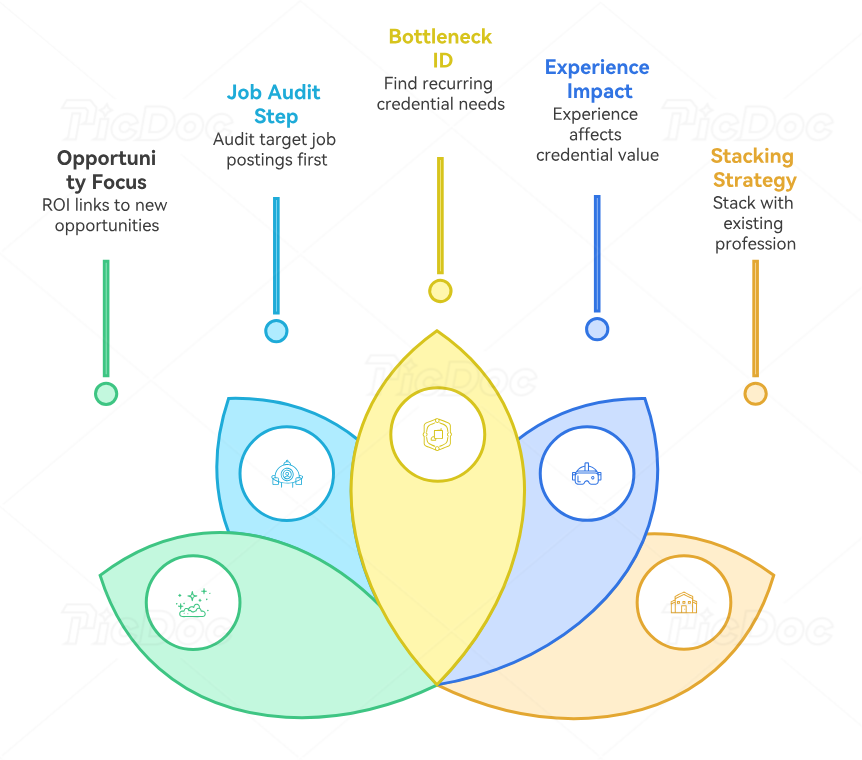
Credential ROI should be calculated from new opportunities unlocked, rather than course price alone.
Imagine a coach spends several thousand dollars reaching NBC-HWC eligibility but wants to build a general executive-coaching consultancy. The training may still improve skills, especially around health behavior change, SMART goal setting, professional ethics, and duty of care. Commercial ROI remains weak if prospective buyers consistently screen for ICF.
Reverse the scenario. Someone spends heavily pursuing ICF credentials while targeting hospital-based health coaching positions whose listings repeatedly request NBC-HWC. Their coaching capability may be excellent while their résumé repeatedly misses the employer's preferred health-specific signal.
The safest method is a job-posting audit before enrollment.
Collect 30–50 roles you would genuinely accept. Record required credentials, preferred credentials, education, licenses, experience, software skills, patient populations, coaching methods, compensation structure, documentation duties, and whether the role is employee or contractor based.
Then identify the recurring bottleneck.
If NBC-HWC appears in 24 of 30 desirable roles, your evidence is strong.
If ICF ACC or PCC dominates the organizational roles you want, your direction becomes clearer.
If employers repeatedly accept either, additional factors such as your existing background and future niche become decisive.
If almost none require a coaching credential and most demand nursing, dietetics, counseling, exercise physiology, HR experience, sales ability, or management experience, another coaching credential may solve a relatively small part of the hiring problem.
This type of analysis is especially important for coaches building specialized offers around career burnout, couples coaching, self-care, public speaking, or money mindset. The commercial buyer determines which professional signal matters.
Experience thresholds also change ROI.
An ACC candidate needs 100 coaching hours, while PCC demands 500. Someone with only 20 completed sessions may gain more immediate value from becoming excellent at coaching contracts, practicing CLEAR coaching, learning transactional analysis, and building legitimate client hours than obsessing over an eventual PCC badge.
NBHWC creates a different runway. Its required 50 qualifying sessions begin only after the candidate successfully completes the relevant Practical Skills Assessment within an approved program. Someone choosing this route should confirm eligibility rules before casually accumulating “practice hours” and discovering afterward that the sessions cannot be logged.
The strongest ROI frequently comes from credential stacking with an existing profession.
A nurse can combine NBC-HWC with clinical experience and health behavior change. An HR leader can combine ICF with leadership coaching and conscious leadership. A dietitian can use NBC-HWC to strengthen behavior-change competence while retaining the distinctive value of dietetics. A senior executive with years of management experience can add ICF coaching capability and turn existing credibility into an executive-coaching proposition.
The credential amplifies something valuable that already exists.
5. When Pursuing Both ICF and NBHWC Actually Makes Strategic Sense
Holding both credentials can be powerful when your intended market genuinely sits at the intersection of health, behavior change and professional coaching.
Consider a coach working with senior executives on energy management, sustainable performance, stress, health habits and leadership behavior. Their work might draw on leadership coaching, career burnout coaching, Positive Intelligence, and health behavior change. ICF can strengthen the organizational coaching signal while NBC-HWC strengthens health-and-wellness positioning.
A corporate wellness professional represents another legitimate crossover. One client conversation might involve sustainable self-care, another may center on SMART goals, another could involve career burnout, and another may involve conscious leadership. A career spanning employee wellness and leadership development can legitimately benefit from both professional ecosystems.
Dual credentialing can also help coaches who want flexibility between healthcare employment and independent professional coaching. NBHWC data shows meaningful employment concentration in healthcare and digital health, while ICF's global research reflects a broad international professional-coaching market.
The sequencing matters.
First, define your most likely paid role for the next two years. Someone targeting digital health should investigate NBC-HWC first. Someone targeting executive leadership work should examine ICF first.
Second, build paid experience. Your ability to handle difficult conversations, preserve professional boundaries, use rigorous coaching contracts, demonstrate cultural competence, and move clients through structured behavior change becomes more commercially meaningful with every genuine coaching engagement.
Third, inspect the doors that remain closed. If your first credential already qualifies you for your desired roles and clients are buying your service, another credential needs a specific justification.
Fourth, add the second credential when it expands your addressable market. Examples include moving from health coaching into executive wellbeing, adding corporate leadership work to a wellness practice, entering healthcare after years in general coaching, or building an international practice that serves both health and organizational buyers.
International coaches should be particularly careful with assumptions. Someone planning practice in Saudi Arabia, the United Kingdom, Germany, Singapore, or Australia-facing international markets should investigate local employer expectations, healthcare regulation, scope requirements and consumer awareness individually.
The final decision can be reduced to one test:
If your ideal employer disappeared and you had to find another ten organizations offering the same work, which credential would appear most frequently in their requirements?
That answer is considerably more useful than a hundred anonymous opinions about which logo looks more prestigious.
6. FAQs About ICF vs NBHWC for Coaches
-
For a career centered specifically on health and wellness, NBC-HWC usually aligns more directly with employer language, standardized health-coaching competencies, health behavior change, self-care coaching, professional duty of care, and health-specific scope. NBHWC's own workforce research shows coaches working substantially across private practice, healthcare, digital health and corporate wellness. ICF becomes particularly valuable when the coach also works across leadership, career, life or organizational coaching.
-
ICF is strongly aligned with the professional, executive and organizational coaching market. Coaches building expertise in leadership coaching, conscious leadership, public-speaking coaching, and career burnout coaching can progress from ACC toward PCC and eventually MCC as their coaching experience grows.
-
Yes. Coaching platforms, wellness companies and employee-assistance providers can use broader credential requirements depending on the role. Reddit career accounts include examples of employers accepting either ICF or NBHWC. Candidates should inspect the exact job market they plan to enter because healthcare roles, corporate wellness, leadership development, and private coaching practices can apply very different filters.
-
Completing coaching education and earning an ICF credential are separate milestones. ACC eligibility currently involves education, qualifying coaching experience, mentor coaching, a performance evaluation and the ACC Exam. This distinction matters when comparing a training certificate with formal credential status. Coaches using frameworks such as T-GROW, CLEAR, OSCAR, and SMART goals still need to satisfy ICF's credential requirements.
-
Some training providers structure programs around requirements from more than one professional body, although approval or accreditation must be verified directly for the specific program and pathway you intend to use. Never assume that an NBHWC-focused health coaching curriculum automatically satisfies ICF requirements, or that ICF training automatically creates NBC-HWC eligibility. NBHWC specifically requires completion of an approved program before candidates can qualify for its board examination.
-
Start with the client problem. A private practice built around life purpose, self-confidence, money mindset, or leadership coaching generally aligns more naturally with ICF. A practice explicitly built around sustainable health behavior, wellness and lifestyle change has a stronger strategic connection to NBC-HWC. In both cases, referrals, positioning, pricing, reputation and client acquisition determine whether the business actually generates income.
