
Couples Coaching: Why It’s the Niche Exploding Right Now
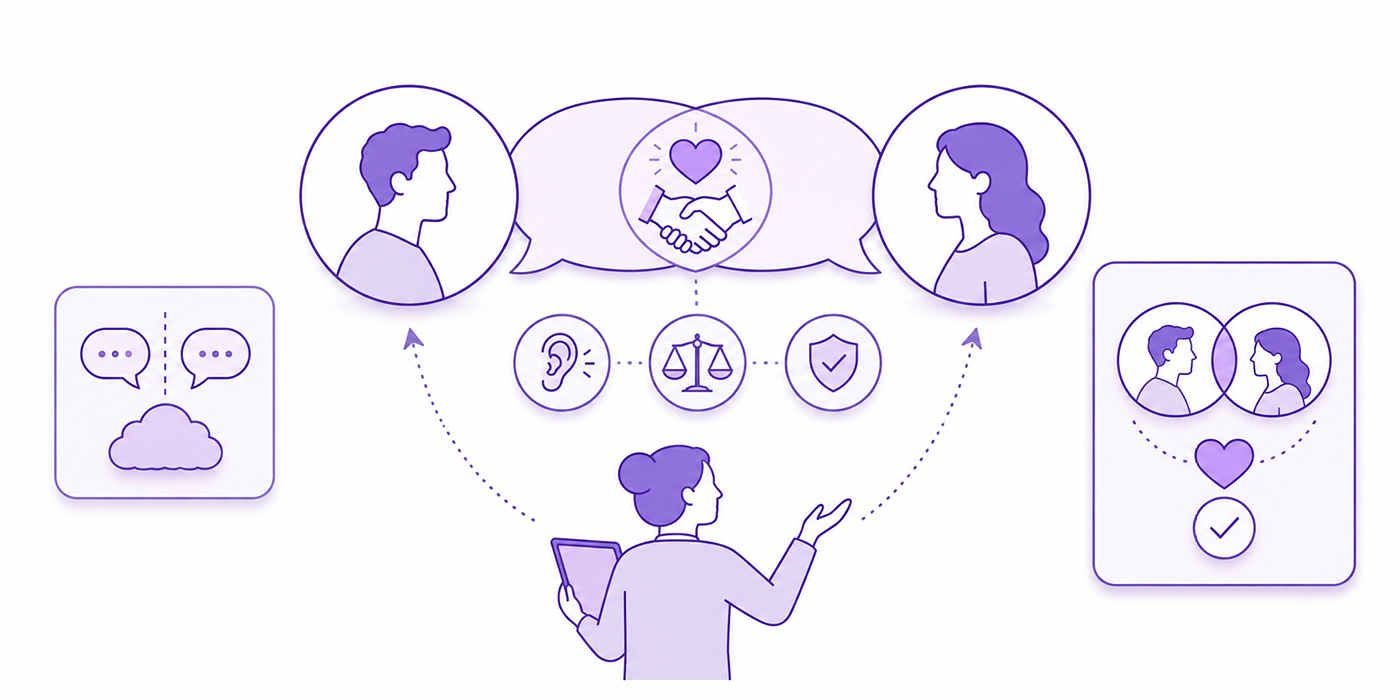
Couples are seeking structured support earlier, often before resentment, emotional distance, or recurring conflict becomes unmanageable. That shift creates a major opportunity for coaches skilled in emotional intelligence, behavior change, client anxiety, and constructive feedback. Effective couples coaching gives partners practical systems for communication, decision-making, accountability, and relationship maintenance while preserving clear ethical boundaries around therapy, diagnosis, trauma treatment, and crisis intervention.
1. Why Couples Coaching Is Becoming a High-Demand Niche
Couples coaching is expanding because modern relationships are carrying more operational pressure than many partners know how to manage. Two people may be negotiating careers, childcare, finances, household labor, aging parents, health goals, digital distractions, intimacy, and long-term planning simultaneously. Love can remain intact while the couple’s systems collapse. Partners then experience the same argument repeatedly because they lack an agreed process for discussing needs, repairing tension, and converting promises into observable action.
This is where coaches trained in managing client expectations, transformational coaching, emotional agility, strengths-based coaching, and accountability coaching can create immediate value. Many couples already understand their problem intellectually. They know communication has deteriorated or household responsibilities feel unfair. Their real difficulty is changing the behavior that keeps recreating the problem.
Demand signals are appearing across the broader relationship-support market. Thriveworks reported that interest in couples therapy grew year over year during both 2023 and 2024, with growth outpacing its general therapy services. That platform-specific data measures therapy inquiries rather than couples coaching purchases, yet it illustrates a larger consumer willingness to seek structured relationship support.
The broader coaching sector also gives specialists room to develop defined niches. The U.S. life-coaching market was estimated at $1.98 billion in 2024 and projected to grow through 2033. Relationship coaching can benefit from this expansion when practitioners offer a specific client, problem, and result rather than presenting themselves as generalists.
Several forces are accelerating the couples-coaching opportunity:
Couples are seeking preventive help. Partners increasingly want tools before reaching a separation decision. This resembles the shift toward preventive health coaching, where clients invest in reducing future risk instead of waiting for severe consequences.
Relationship problems are becoming operational. Couples frequently need support with calendars, boundaries, routines, role clarity, parenting coordination, money conversations, or shared goals. Coaches who understand habit formation, habit stacking, life visioning, and the life-balance wheel can turn vague relationship intentions into repeatable practices.
Remote delivery removes logistical barriers. Partners can attend sessions from home, avoid travel, and use shared digital worksheets between appointments. Coaches can integrate coaching automation, must-have coaching tools, technology-enabled coaching, and micro-coaching to maintain momentum without creating unhealthy client dependence.
People place enormous meaning on close relationships. The APA’s 2025 Stress in America research described a wider crisis of connection, while the U.S. Surgeon General’s advisory linked social disconnection with serious health and well-being consequences. These sources do not establish couples-coaching market size, though they show why relational health has become a high-priority concern.
Clients want specialized expertise. A coach who addresses “life improvement” may struggle to communicate a compelling reason to hire them. A specialist helping dual-career couples reduce recurring conflict, rebuild emotional teamwork, or prepare for marriage has a clearer value proposition. Specialization also strengthens coaching case studies, client experiences, referral generation, and the ability to develop high-ticket coaching offers.
2. Which Couples Are Most Likely to Pay for Coaching?
The strongest clients usually have a defined problem, enough stability to perform between-session work, and a shared willingness to participate. Marketing to “all couples who want better relationships” produces weak messaging because different couples buy for different reasons. A coach must identify the pressure point, the cost of leaving it unresolved, and the measurable improvement the program is designed to create.
Dual-career couples
These partners often struggle with scheduling, unequal mental load, travel, promotion decisions, and depleted attention. Their pain comes from operating two demanding careers without a relationship operating system. A specialized program can combine career-burnout coaching, life-balance tools, resilience coaching, and habit formation to help them protect time, divide responsibilities, and make high-stakes decisions together.
A compelling outcome would be: “Build a 90-day relationship operating system that reduces scheduling conflict, clarifies household ownership, and creates protected connection time.” This is more credible than promising permanent harmony.
Engaged and premarital couples
Premarital clients may have fewer entrenched conflicts and greater motivation to address differences before marriage. A program can cover money values, family boundaries, career expectations, children, faith, household roles, conflict recovery, and long-term priorities. Coaches can use life visioning, positive psychology, strengths-based coaching, and emotional intelligence to move conversations beyond wedding preparation and toward partnership preparation.
Couples navigating a major transition
Transitions expose weaknesses that routine once concealed. Relocation, parenthood, unemployment, retirement, caregiving, a new business, or a major health change can alter roles overnight. One partner may interpret the pressure as a practical problem while the other experiences it as emotional abandonment.
Transition programs should combine holistic coaching, self-care coaching, coaching through economic changes, and behavior-change planning. The coach helps the couple redesign expectations around current capacity instead of forcing an outdated arrangement to survive a changed reality.
Couples facing recurring low-to-moderate conflict
These clients can describe their cycle with painful accuracy: one criticizes, the other withdraws, frustration escalates, both make defensive statements, and the original issue remains unresolved. Awareness alone has failed them.
Coaching adds value through rehearsal, measurement, and accountability. Partners can practice constructive feedback, create a safe communication environment, develop emotional agility, and establish weekly accountability. The coach tracks whether clients used the protocol, how quickly they repaired tension, and which triggers still override the process.
Growth-oriented couples
Some partners are functioning well and want a stronger shared future. Their interests may include health, entrepreneurship, family culture, lifestyle design, retirement planning, contribution, or personal development. These clients respond well to self-actualization coaching, life-purpose coaching, preventive health coaching, and lifestyle medicine principles.
The marketing lesson is direct: sell a defined change to a defined couple during a defined moment. Specificity helps prospects recognize themselves and allows the coach to build repeatable assessments, exercises, milestones, and case studies.
3. The Scope, Ethics, and Safety Rules Couples Coaches Cannot Ignore
Couples coaching occupies a goal-focused, forward-looking space. It can support communication habits, shared decision-making, routines, accountability, values clarification, conflict procedures, and relationship goals. Licensed mental-health treatment covers diagnosis, clinical disorders, trauma treatment, suicidality, severe depression, addiction treatment, and other therapeutic needs.
The distinction must appear in the coach’s marketing, intake process, agreement, session language, recordkeeping, and referral procedures. Coaches can strengthen their judgment by studying the ICF Code of Ethics, legal requirements for coaches, credentialing mistakes, CPD accreditation, and certification portfolio development.
Screen both partners before coaching begins
A generic discovery call is insufficient. Couples work requires structured screening for:
Physical violence or credible threats
Coercive control, stalking, or intimidation
Fear of retaliation after speaking honestly
Active suicidal thoughts or self-harm risk
Untreated substance dependence
Severe psychiatric symptoms
Ongoing affairs when disclosure conditions are unresolved
Active legal disputes affecting confidentiality
A partner attending under pressure
Expectations that the coach will determine who is “right”
A coach who detects crisis indicators should activate an established referral or emergency protocol. The articles on supporting clients during emotional crises, understanding anxiety and stress, handling difficult client situations, and creating psychological safety can support policy development, though formal clinical and legal guidance remains essential.
Define who the client is
Couples coaching creates three interests: Partner A, Partner B, and the relationship system. Your agreement should state whether the coaching engagement serves the couple jointly, how individual disclosures are handled, and whether private sessions are permitted.
A dangerous ambiguity occurs when one partner privately shares information and expects the coach to conceal it indefinitely. The coach needs a written secrets policy before that situation arises. Possible policies include declining private disclosures relevant to joint work, pausing coaching until the client discloses important information, or referring the couple when continued coaching would compromise neutrality.
Protect balanced participation
A powerful speaker can dominate a session while a quieter partner agrees merely to end discomfort. Equal airtime, uninterrupted response rounds, written reflection, and private safety screening help the coach distinguish genuine agreement from compliance.
Balanced participation also requires skilled feedback delivery, expectation management, emotional-intelligence coaching, and transformational behavior strategies. The coach should interrupt contempt, labeling, threats, humiliation, or interrogation immediately and return the discussion to observable behavior, impact, needs, and requests.
Avoid outcome guarantees
Relationship outcomes depend on two autonomous people. Coaches should promise a structured process, professional support, useful tools, and measurable implementation. Claims that a program will “save any marriage,” “prevent divorce,” or “make your partner change” create ethical, legal, and reputational risk.
The U.S. recorded more than two million marriages and over 672,000 divorces in the CDC’s provisional 2023 reporting, though those population statistics cannot predict the outcome of an individual relationship.
Build a referral network before accepting clients
Responsible couples coaches need relationships with licensed couples therapists, domestic-violence resources, addiction specialists, financial planners, attorneys, physicians, and emergency services. Strong industry networking supports safer referrals, while appropriate joint ventures may expand education and visibility.
Referral readiness builds trust. A coach who recognizes the edge of their competence demonstrates professionalism rather than weakness.
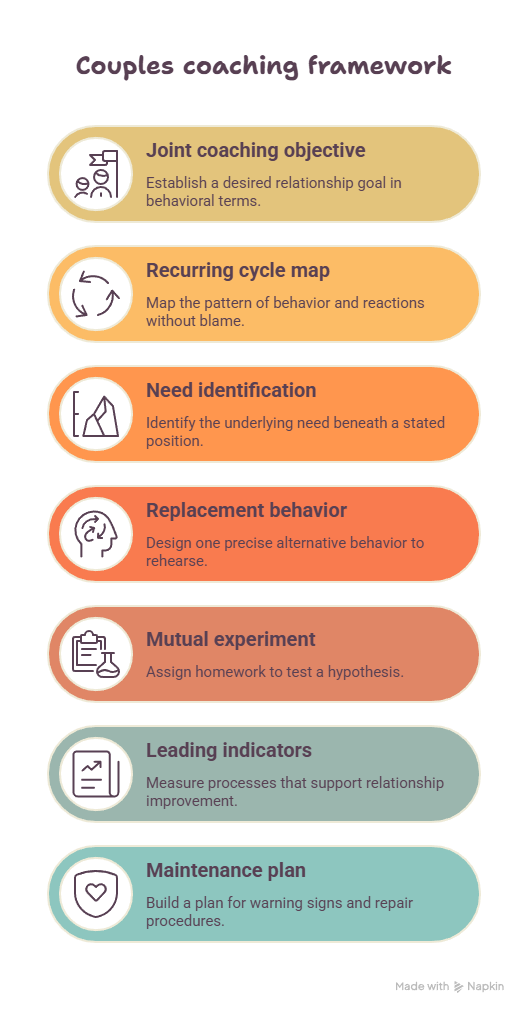
4. A Practical Couples-Coaching Framework That Produces Measurable Progress
Couples coaching becomes vague when sessions depend entirely on whichever disagreement occurred most recently. A structured framework keeps immediate concerns connected to long-term outcomes.
Step 1: Establish a joint coaching objective
Ask each partner to describe the desired relationship in behavioral terms. “We want better communication” offers little measurement value. A stronger objective might be:
Discuss money without insults, avoidance, or threats
Make weekly decisions within one scheduled meeting
Divide household ownership without repeated reminders
Repair minor conflict within 24 hours
Protect two hours of undistracted connection weekly
The coach can connect these objectives to behavior-change science, accountability coaching, habit formation, and life visioning.
Step 2: Map the recurring cycle
Each partner usually sees the other person’s behavior while underestimating their own contribution. Map the cycle without turning it into a blame chart:
What triggers the pattern?
What does Partner A do next?
How does Partner B interpret that action?
How does Partner B respond?
How does that response reinforce Partner A’s original fear?
What short-term reward keeps the cycle alive?
What long-term damage does it create?
This exercise draws on emotional intelligence, emotional agility, constructive feedback, and safe coaching practices.
Step 3: Identify the need beneath the position
A position sounds like “You need to spend less time at work.” The underlying needs may include reliability, companionship, shared parenting, recognition, rest, or influence over family decisions.
Coaches should help partners express:
The observable situation
The emotional impact
The value or need involved
The specific request
The behavior that would demonstrate progress
This prevents sessions from becoming debates over which interpretation is objectively correct.
Step 4: Design one replacement behavior
Broad resolutions collapse under stress. Each recurring pattern needs an alternative behavior precise enough to rehearse.
For example:
Criticism becomes a behavior-specific request.
Withdrawal becomes a stated pause with a return time.
Repeated reminders become assigned ownership.
Late-night conflict becomes a scheduled morning discussion.
Defensive explanations become a two-minute impact summary.
Assumptions become one clarifying question.
The replacement behavior can be reinforced through habit stacking, micro-coaching, transformational strategies, and weekly accountability.
Step 5: Assign a mutual experiment
Homework should test a hypothesis rather than punish the couple with additional work. A useful experiment includes:
One behavior per partner
A defined trigger
A frequency
A realistic duration
A simple tracking method
A review date
A plan for missed attempts
A couple could test a 12-minute evening check-in for seven days. Each partner answers: “How is your capacity?”, “What support would help tomorrow?”, and “What should we protect this week?” The coach then reviews adherence, emotional effect, and friction.
Step 6: Measure leading indicators
Relationship satisfaction can take time to improve. Leading indicators reveal whether the couple is building the processes that support improvement:
Number of agreed check-ins completed
Percentage of commitments fulfilled
Average repair time after conflict
Interruptions during structured conversations
Requests made without criticism
Decisions completed without reopening the argument
Protected connection time used
Weekly self-ratings for trust, teamwork, and clarity
This approach aligns with client accountability, client-feedback systems, habit tracking, and coaching automation.
Step 7: Build maintenance before graduation
A program should end with a relationship maintenance plan covering warning signs, repair procedures, recurring meetings, major-decision rules, support resources, and conditions for returning to coaching.
This strengthens client retention without manufacturing dependence. Graduated clients can return for quarterly planning, major transitions, or new shared goals.
5. How to Build and Market a Profitable Couples-Coaching Offer
A profitable couples-coaching practice needs specialization, boundaries, proof, delivery systems, and a credible acquisition strategy. Session skill alone rarely solves inconsistent sales.
Choose a commercially clear sub-niche
Strong positioning combines a client type with an urgent situation:
Dual-career couples rebuilding teamwork
Engaged couples preparing for marriage
Couples navigating new parenthood
Entrepreneur couples separating work from home
Couples managing relocation or career transitions
Blended-family couples clarifying roles
Empty-nest couples designing their next chapter
Health-focused couples building sustainable routines
A niche can remain broad enough for demand while specific enough for recognition. Use mindset coaching, life-purpose coaching, resilience coaching, and holistic coaching as supporting methods rather than competing labels.
Package a defined transformation
A six- or eight-session program is easier to understand than indefinite weekly coaching. A strong offer can include:
Individual pre-program questionnaires
One joint relationship assessment
Six structured coaching sessions
Weekly implementation exercises
Shared progress dashboard
Midweek accountability prompts
Conflict and repair templates
A final 90-day maintenance plan
Referral support when needs exceed scope
The program should explain its milestones without guaranteeing relationship survival. Coaches can refine their structure through high-ticket offer design, payment systems, financial forecasting, and profitable scaling.
Price the process rather than the hour
Hourly pricing encourages prospects to compare minutes instead of transformation. Package pricing can reflect assessment time, session delivery, between-session reviews, tools, administration, and professional expertise.
Before setting a price, calculate:
Delivery hours
Preparation and review time
Technology and payment fees
Client-acquisition cost
Supervision and continuing education
Taxes and insurance
Referral and partnership expenses
Refund and cancellation risk
Desired operating margin
Resources covering the coach’s tax obligations, coaching LLC setup, legal requirements, and income forecasting can help build a more sustainable business foundation.
Build proof around processes and outcomes
Ethical case studies can show the starting problem, coaching process, implementation challenge, and observable result. Useful evidence might include reduced conflict duration, improved follow-through, clearer role ownership, completed planning meetings, or higher self-rated teamwork.
Protect identities and obtain informed permission before publishing any client story. Study credible coaching case studies, successful coach-client transformations, client feedback, and exceptional client experiences to improve trust signals.
Create referral-led acquisition
Couples often prefer relationship professionals they encounter through trusted recommendations. Build educational relationships with therapists, physicians, wedding planners, financial professionals, parenting educators, faith-community leaders, HR professionals, and family-law professionals.
A therapist may refer stable, goal-oriented couples who need implementation support. A coach may refer clients requiring clinical treatment. This reciprocal clarity grows through professional networking, carefully designed joint ventures, strong client experiences, and reliable client-retention systems.
Use technology without weakening privacy
Digital intake forms, scheduling, progress dashboards, reminders, and secure client portals can reduce administrative friction. Every tool should be evaluated for access control, data storage, consent, confidentiality, and deletion procedures.
Useful systems may include coaching automation, business automation, coaching technology, and startup coaching tools. Sensitive relationship information should never be placed in an unapproved system merely because the software is convenient.
Credentialing also matters. ICF’s discussion of its 2025 Global Coaching Study reported that 73% of respondents said clients expect a coach to be credentialed or certified. This figure covers coaching broadly rather than couples coaching specifically, though it reinforces the commercial value of visible professional development.
6. Frequently Asked Questions About Couples Coaching
-
Couples coaching is a structured development process that helps partners improve shared goals, communication habits, decision-making, accountability, routines, and future planning. Sessions may use behavior-change principles, emotional-intelligence exercises, strengths-based methods, and habit-formation tools. The process should begin with written goals, scope boundaries, confidentiality terms, safety screening, and referral criteria.
-
Couples coaching generally focuses on present-to-future goals, skill development, behavioral implementation, and accountability. Couples therapy is delivered by appropriately licensed professionals and can assess or treat clinical symptoms, trauma, mental-health disorders, and complex relational distress.
Coaches should understand scope-of-practice boundaries, professional ethics, legal requirements, and crisis referral procedures. Some couples benefit from coaching and therapy at different stages or simultaneously when both professionals agree that the services are appropriate and clearly separated.
-
Certification requirements depend on jurisdiction, professional title, claims, services, and business structure. Formal training can strengthen coaching competence, ethics, contracting, assessment, and referral judgment. Prospective coaches should examine coaching accreditation comparisons, CPD certification maintenance, credentialing mistakes, and certification portfolio development. Local legal advice and appropriate insurance remain important even when coaching itself is unregulated.
-
Individual relationship coaching may help a person clarify boundaries, communication choices, values, and controllable behaviors. The service should be described accurately because one-person coaching cannot create a mutual agreement or assess the absent partner’s perspective.
Useful areas include emotional agility, self-care coaching, life-purpose coaching, and resilience coaching. Marketing should distinguish individual relationship coaching from joint couples coaching.
-
Many defined concerns can be addressed through six to twelve structured sessions, provided both partners are suitable for coaching and complete the implementation work. Program length should follow problem complexity, client capacity, session frequency, and agreed outcomes.
A strong program includes baseline measures, milestone reviews, weekly accountability, micro-coaching support, client-feedback checkpoints, and a retention or maintenance plan.
-
Referral becomes appropriate when the couple presents needs beyond the coach’s education, competence, legal authority, or safety capacity. Examples include violence, coercive control, active addiction, severe psychiatric symptoms, trauma treatment needs, suicidality, debilitating depression, or conflict that makes honest joint participation unsafe.
A written protocol should draw on emotional-crisis support principles, safe coaching environments, ethical coaching standards, and difficult-client management.
