
The Ultimate Guide to Getting Health & Life Coaching Certification in New Zealand: Everything You Need to Know in 2026-2027
Getting health and life coaching certification in New Zealand takes more than picking a course with a polished landing page. Aotearoa has a growing appetite for credible coaching, especially across wellbeing, workplace performance, lifestyle change, and whānau-centered support. The real decision is choosing a pathway that protects your credibility, strengthens your coaching skill, and gives clients a reason to trust you before the first session. This guide connects health coach certification options, ICF credentialing, ethical coaching standards, and coaching career growth into one practical New Zealand roadmap.

1. Understand the New Zealand Coaching Landscape Before Choosing a Certification
Health and life coaching in New Zealand sits in a credibility-driven market. Clients, employers, corporate wellbeing teams, and healthcare-adjacent partners increasingly want evidence that a coach understands boundaries, confidentiality, communication, behaviour change, and safe referral pathways. Healthify’s New Zealand health coaching overview says health coaches are currently outside health-practitioner registration, while pathways are being established through HCANZA membership routes. That makes your certification choice even more important because your training, ethics, and membership signals become your professional proof. Start by comparing which certification is right for you, health coach certification credentials, coaching integrity, and client trust-building.
New Zealand coaches usually move through one of three pathways. The first is a health and wellness coaching route, often chosen by people interested in lifestyle change, chronic-condition support, habit formation, workplace wellbeing, and primary-care-adjacent work. The second is an ICF-style life coaching route, useful for career, leadership, confidence, relationships, life transitions, and executive coaching. The third is a blended pathway for coaches who want strong coaching skill with a clear health or wellbeing niche. Health New Zealand describes GP-based wellbeing support as including health coaches who help people and whānau build knowledge, skills, and confidence to better manage health. That practical reality connects directly with behaviour change science, habit formation coaching, client anxiety support, and safe coaching environments.
The biggest danger is choosing a certification that gives you a certificate without giving you professional readiness. A course can teach scripts, motivation tools, or wellness concepts, yet leave you weak on scope, contracting, ethics, referral judgement, cultural humility, evidence-informed behaviour change, and client autonomy. That gap shows up fast when a client expects medical advice, emotional rescue, meal planning, diagnosis, therapy, or guaranteed outcomes. Build your foundation through non-negotiable coaching standards, emotional consent, coaching boundaries, and career-ending mistake prevention.
| # | Decision Point | What To Check | Pain Point It Prevents | Best ANHCO Resource |
|---|---|---|---|---|
| 1 | Choose your coaching lane | Health, life, workplace wellbeing, leadership, career, relationship, or blended practice. | Buying a course before knowing the market you want to serve. | Which Certification Is Right For You |
| 2 | Confirm professional credibility | Look for recognized training, clear standards, ethics, assessment, and supervision support. | Ending up with a certificate clients cannot evaluate. | How Certification Differentiates Your Business |
| 3 | Check health coaching scope | Confirm the course teaches coaching, referral boundaries, health behaviour change, and client autonomy. | Sliding into advice, diagnosis, therapy, or medical claims. | Coaching Standards |
| 4 | Check life coaching scope | Look for contracting, goal work, ethics, presence, listening, powerful questions, and accountability. | Sounding motivational while lacking coaching structure. | Essential Coaching Skills |
| 5 | Consider ICF pathway | Review ACC, PCC, or future MCC requirements before selecting training hours. | Choosing training that cannot support your credential goal. | ICF Application Process |
| 6 | Consider NBHWC pathway | Confirm whether the program is NBHWC-approved and supports board exam eligibility. | Completing health coach training that leaves you outside exam eligibility. | NBHWC Exam Pitfalls |
| 7 | Review HCANZA relevance | Check membership standards, scope expectations, code of conduct, and CPD commitments. | Missing the regional credibility signal for Australia and New Zealand. | Credentialing Resources |
| 8 | Audit ethical training | Look for confidentiality, consent, dual relationships, sponsor dynamics, and referral practice. | Being trusted with sensitive issues without ethical readiness. | Ethical Responsibilities |
| 9 | Check cultural responsiveness | Look for respect around whānau, community context, identity, language, and client-defined wellbeing. | Using generic coaching scripts in culturally complex conversations. | Safe Coaching Environment |
| 10 | Assess practice hours | Check whether the program includes real coaching practice, observation, and feedback. | Finishing training with theory confidence and session anxiety. | How Coaches Reach Mastery |
| 11 | Check assessment quality | Look for performance assessment, recorded sessions, mentor feedback, or live evaluation. | Passing a quiz without proving coaching competence. | Mastering Certification Interviews |
| 12 | Compare online flexibility | Review time zone fit, live attendance requirements, recordings, cohort access, and support. | Dropping out because the schedule ignores real life. | Online Certification Programs |
| 13 | Plan study timeline | Map coursework, coaching practice, assessment, application documents, and exam preparation. | Trying to organize everything after motivation fades. | Earn Certification Online |
| 14 | Prepare coaching log systems | Track sessions, dates, duration, client codes, topics, and consent procedures. | Losing professional proof because records are scattered. | Coaching Case Study Templates |
| 15 | Build referral awareness | Know when a client needs GP, therapist, dietitian, financial adviser, or crisis support. | Over-helping in situations that require another professional. | Support Clients During Crises |
| 16 | Strengthen communication | Practice listening, reflection, summaries, permission-based feedback, and clean questions. | Talking more than coaching. | Communication Secret |
| 17 | Study behaviour change | Learn motivation, readiness, habits, relapse, strengths, barriers, and sustainable action. | Giving clients plans they cannot maintain. | Behaviour Change Science |
| 18 | Build accountability skills | Create client-owned actions, check-ins, reflection loops, and progress reviews. | Turning accountability into pressure or guilt. | Accountability In Coaching |
| 19 | Prepare business basics | Set niche, pricing, website, onboarding, consent forms, terms, and client journey. | Getting certified and still having no client pathway. | Starting A Coaching Business |
| 20 | Check legal basics | Review business structure, contracts, privacy, advertising claims, and professional disclaimers. | Creating avoidable risk through sloppy client agreements. | Legal Requirements For Coaches |
| 21 | Create a credential bio | Use accurate language for training completed, certification earned, and credential in progress. | Overstating credentials before you earn them. | List Credentials On Resume |
| 22 | Capture testimonials ethically | Use consent-based testimonials without exposing private health or life details. | Building social proof at the cost of client trust. | Client Testimonials Capture |
| 23 | Choose tech tools carefully | Use scheduling, video, CRM, feedback, goal tracking, and secure documentation tools. | Letting admin chaos damage the client experience. | Coaching Business Tech Tools |
| 24 | Design first offer | Create a clear package with outcomes, boundaries, session rhythm, and client responsibilities. | Selling vague support that clients cannot understand. | High-Ticket Coaching Offers |
| 25 | Prepare CPD plan | Choose yearly learning around ethics, supervision, niche skill, business, and client outcomes. | Treating certification as the final step. | Continuous Coaching Education |
| 26 | Build local referral pathways | Connect with GPs, counsellors, dietitians, trainers, HR teams, and allied professionals. | Operating alone in a trust-based market. | Networking Secrets |
| 27 | Measure outcomes | Use feedback, goal tracking, session reviews, and client-defined success markers. | Claiming transformation without evidence. | Feedback Tools |
| 28 | Position for 2026-2027 growth | Align your niche with workplace wellbeing, preventative health, stress, habits, and digital coaching. | Launching with yesterday’s offer in tomorrow’s market. | Coaching Industry Trends |
2. Choose Between Health Coaching, Life Coaching, or a Blended Certification Path
A health coaching certification is the stronger choice when you want to support lifestyle change, stress management, sleep routines, movement habits, self-management, prevention, workplace wellbeing, and health-related confidence. In New Zealand, that lane works especially well when you understand whānau context, primary care realities, client readiness, and referral boundaries. HCANZA describes health and wellness coaching as a person-centred process that helps people develop and achieve self-determined health and wellness goals. That definition pairs naturally with health coach certification programs, NBHWC coaching competencies, effective NBHWC communication, and client diet-change coaching.
A life coaching certification is usually better when your work centers on identity, goals, career direction, confidence, relationships, leadership, purpose, habits, personal transitions, and decision-making. The best life coach training programs teach more than motivational language. They develop contracting, ethics, listening, presence, powerful questions, client autonomy, and session structure. ICF’s credential overview lists ACC as requiring 60+ hours of coaching education, 100+ hours of coaching experience, and 10 hours of mentor coaching, while PCC requires 125+ education hours, 500+ experience hours, and 10 mentor coaching hours. That makes ICF-aligned training useful for coaches who want internationally recognized credibility, especially when combined with ICF exam prep, ICF study scheduling, life coach certification programs, and CPD-accredited coaching guidance.
A blended pathway works when you want to serve the whole person while staying disciplined about scope. Many New Zealand clients bring linked issues: stress affects food choices, work pressure affects sleep, identity affects habits, and family responsibilities affect goal follow-through. A coach who understands both health behaviour change and life coaching frameworks can be valuable, provided their language stays careful and their referrals are responsible. Build that blended skill set through positive psychology coaching, solution-focused brief coaching, inner critic management, and transformational coaching strategies.
The wrong pathway creates expensive friction. Health-focused coaches who skip health behaviour change training may sound shallow when clients discuss lifestyle setbacks. Life coaches who skip ethics may overstep when clients reveal trauma, depression, addiction, or relationship danger. Business-minded coaches who skip practice hours may sell confidence before they can deliver a safe session. Compare every program against coaching integrity, client expectation management, emotional intelligence coaching, and handling difficult client situations.
3. Pick a Credible Certification Body and Verify the Training Before You Enrol
For health coaching, serious candidates should compare NBHWC-approved training, HCANZA-aligned standards, and regionally credible programs that reflect New Zealand’s healthcare and wellbeing context. NBHWC says candidates must complete an NBHWC Approved Training Program before applying for the board exam, and its approved-program directory lists programs that meet or exceed published training and education standards. HCANZA also presents membership as a credibility signal for trained professionals and states that members commit to its code, scope of practice, and continuing professional development expectations. Use those standards alongside NBHWC eligibility requirements, credentialing resources, health coach salary insight, and certification worth analysis.
For life coaching, ICF remains the most widely recognized global pathway. A New Zealand coach can pursue ICF-aligned training through local or online providers, then build toward ACC, PCC, or MCC depending on education hours, coaching experience, mentor coaching, performance evaluation, and exam requirements. ICF’s comparison page lists MCC as requiring 200+ hours of coaching education and 2,500+ hours of coaching experience. New Zealand also has ICF Australasia’s Aotearoa New Zealand branch, which supports ICF’s mission of advancing the coaching profession. Connect this pathway with ICF credentialing skills, ICF application strategy, certification study scheduling, and coaching mastery.
Before enrolling, ask hard questions. Does the program include live practice? Who gives feedback? Are trainers credentialed? Does the course include ethics, contracting, referral boundaries, and client safety? Does it prepare you for a recognized credential or only issue an internal certificate? What does the assessment involve? Can you speak to graduates? Does the program teach business setup, client onboarding, and professional documentation? These questions protect you from vague training promises. Strengthen your evaluation with common credentialing mistakes, certification portfolio building, coaching case study templates, and client experience strategy.
Be careful with “fast certification” language. Speed can be useful when a program is structured, assessed, and credible; speed becomes dangerous when it replaces practice. A strong program should leave you able to coach under pressure, document responsibly, refer appropriately, and explain your scope to clients. That kind of confidence takes practice, feedback, and reflection. Support your path with online certification planning, coaching toolkit design, client journaling tools, and goal tracking tools.
4. Build Your New Zealand Certification Timeline for 2026-2027
A practical certification timeline begins with the outcome you want. For a health coach aiming at NBHWC, the sequence usually involves approved training, practical assessment, coaching sessions, documentation, exam eligibility, and board exam preparation. For an ICF-focused life coach, the sequence usually includes coach-specific education, mentor coaching, logged coaching experience, performance evaluation, application, and credential exam. Each path has its own evidence trail. Build your calendar with NBHWC practice questions, ICF exam preparation, certification application planning, and credentialing mistake prevention.
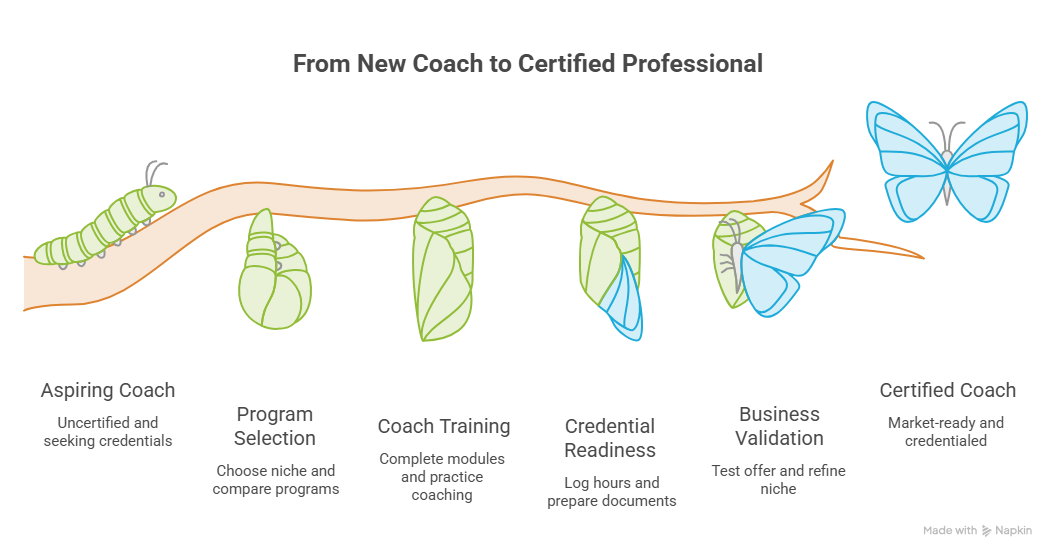
A 2026-2027 timeline should have four phases. Phase one is selection: choose your niche, compare programs, check recognition, and confirm whether the course helps with ICF, NBHWC, HCANZA, or another credible pathway. Phase two is training: complete modules, attend live sessions, practice coaching, collect feedback, and build your session structure. Phase three is credential readiness: log hours, prepare documents, complete mentor coaching or practical assessments, and review exam standards. Phase four is market launch: design your offer, create your website, collect testimonials ethically, and build referral routes. Support these phases with coaching business automation, CRM tools, payment systems, and financial forecasting.
Documentation deserves its own weekly slot. Many new coaches wait until the end of training to organize certificates, hours, feedback, supervision notes, client logs, testimonials, CPD records, and insurance or business files. That creates anxiety and avoidable errors. Create a certification folder from week one with subfolders for training proof, coaching hours, assessments, ethics documents, business setup, testimonials, and continuing education. Use certification portfolio guidance, case study templates, client feedback tools, and custom coaching dashboards.
Your timeline should also include business validation before graduation. Offer practice sessions, refine your niche, test your onboarding form, write your coaching agreement, identify referral partners, and clarify what clients receive after each session. Coaches who wait until certification day to think about business often discover that the market rewards clarity more than credentials alone. Develop that clarity through must-have coaching business tools, digital marketing for coaches, SEO tools for coaching websites, and client retention strategies.
5. Turn Certification Into a Trustworthy Coaching Practice in New Zealand
Certification gives you a professional starting point; your client experience turns that credential into trust. A New Zealand coaching practice should clearly explain who you help, what coaching can support, what coaching does not cover, how confidentiality works, when referral may be needed, how goals are reviewed, and how clients can give feedback. The Health Practitioners Competence Assurance Act exists to protect public safety for registered health practitioners, and coaches working around health topics should understand the broader safety logic even when operating outside that registration framework. Build your practice language with legal requirements for coaches, coaching LLC setup principles, professional boundaries, and trust-centered coaching.
Your first offer should solve a specific problem for a specific audience. Examples include stress reset coaching for busy professionals, lifestyle change coaching for people rebuilding routines, confidence coaching for career changers, wellbeing coaching for parents, leadership coaching for new managers, or habit coaching for clients who keep failing after intense starts. Vague promises make clients hesitate. Specific outcomes, safe boundaries, and structured support help clients understand the value. Shape your offer with high-ticket coaching offer strategy, client preference trends, micro-coaching opportunities, and preventative health coaching trends.
Referral relationships matter in New Zealand because trust travels through community, professional networks, workplaces, and health-adjacent spaces. You can build relationships with counsellors, GPs, physiotherapists, dietitians, personal trainers, HR leaders, community wellbeing organizations, and corporate wellness providers. The goal is clear positioning, mutual respect, and honest scope. A referral partner should immediately understand what you handle, what you avoid, and when you refer out. Strengthen that ecosystem with joint ventures for coaches, networking strategies, client testimonials capture, and case studies that build credibility.
Long-term growth comes from professional discipline. Keep supervision, CPD, ethics refreshers, feedback tools, outcome reviews, and business systems active after certification. The coaches who last in 2026-2027 will combine human presence with smart technology, clean boundaries, strong referral judgement, and measurable client experience. Build that future-facing practice through technology’s impact on coaching, AI in client interactions, coaching automation, and future-proof coaching practice trends.
6. FAQs About Health & Life Coaching Certification in New Zealand
-
Health coaching in New Zealand currently sits outside health-practitioner registration, and Healthify notes that anyone can train to work as a health coach while HCANZA membership pathways are being developed. Certification still matters because clients, employers, and referral partners need proof of training, scope, ethics, and professional seriousness. Compare health coach certification programs, life coach certification options, credential listing guidance, and coaching integrity standards.
-
The best option depends on your niche. ICF is strong for life, leadership, career, executive, and professional coaching credibility. NBHWC is strong for health and wellness coaching candidates who want board-certification eligibility. HCANZA is especially relevant for Australia-New Zealand health and wellness coaching recognition, while ANZCAL focuses on regional coaching accreditation for whole-person coaching. ANZCAL describes itself as a benchmark for credible coaching in Australia and New Zealand. Use which certification is right for you, ICF credentialing, NBHWC competencies, and credentialing resources to compare routes.
-
Yes, many health and life coaching programs offer online or hybrid learning, and New Zealand candidates can often train through international providers if the program fits their target credential pathway. Check time zones, live attendance rules, assessment format, recorded-session requirements, mentor coaching access, and whether the course supports ICF, NBHWC, HCANZA, or another credible route. Start with online health coach certification, fast online certification planning, online life coach programs, and continuous coaching education.
-
The timeline depends on the credential. A short certificate may take weeks or months, while ICF and NBHWC-oriented pathways can take longer because they involve training hours, practice, assessment, mentoring, coaching logs, and exam preparation. ICF’s public credential overview lists education and experience requirements by level, including ACC at 60+ education hours and 100+ experience hours, PCC at 125+ education hours and 500+ experience hours, and MCC at 200+ education hours and 2,500+ experience hours. Plan with ICF study scheduling, certification portfolio building, coaching case studies, and coaching mastery.
-
Avoid claims that sound like diagnosis, treatment, cure, guaranteed outcomes, medical advice, therapy, or disease management unless you hold the relevant regulated qualification and are practising within that scope. Safer marketing explains that coaching supports goal setting, self-management, habit change, accountability, motivation, confidence, and client-led action. Build clean language through legal requirements for coaches, ethical responsibilities, professional boundaries, and safe coaching environment guidance.
-
Yes, especially when coaches understand their scope and work alongside appropriate professionals. Health New Zealand’s GP wellbeing support page says health coaches can help people and whānau gain knowledge, skills, and confidence to better manage health. That makes health coaching valuable in prevention, lifestyle change, behaviour change, stress support, and self-management, provided coaches use responsible referral judgement. Strengthen that work with behaviour change science, habit formation tools, client anxiety coaching, and accountability coaching.
