
The Ultimate Guide to Getting Health & Life Coaching Certification in Ireland: Everything You Need to Know in 2026-2027
Health and life coaching in Ireland is becoming more serious, more evidence-aware, and more buyer-sensitive. Clients want support with stress, habits, wellbeing, confidence, work-life pressure, and lifestyle change, yet they also want proof that you are trained, ethical, and safe. That is where health coaching certification, life coach credentialing, coaching integrity, and a clear certification business advantage become your foundation.

1. Ireland’s Health & Life Coaching Certification Landscape in 2026-2027
Ireland is a strong coaching market for people who can combine credibility, empathy, boundaries, and practical client outcomes. A beginner who only buys a cheap certificate may struggle when a corporate buyer, wellness client, GP-adjacent referral partner, or stressed professional asks a simple question: “What are you actually qualified to do?” That question is exactly why credential clarity, ethical responsibility, trust-building, and client-safe coaching environments matter before you ever build a website.
The Irish coaching buyer is usually practical. They want help with weight management habits, sleep consistency, stress overload, confidence, relationships, career transitions, emotional resilience, family pressure, or executive performance. The coach who wins that trust usually has a clean pathway: suitable training, supervised practice, documented coaching hours, clear niche positioning, and a referral plan for issues outside coaching scope. That is where coaching boundaries, client expectation management, behaviour change science, and accountability systems create visible professionalism.
In 2026-2027, the strongest Ireland pathway is rarely “health coaching or life coaching?” The better question is: what client problem do you want to be trusted with? A health coach may focus on habits, prevention, lifestyle support, and wellness goals. A life coach may focus on confidence, transitions, relationships, purpose, productivity, or emotional growth. A blended health and life coaching practice can work beautifully when your promise is precise, your coaching toolkit is structured, your case studies prove progress, and your client feedback system captures outcomes without exaggeration.
2. Choose the Right Certification Path for Ireland
Start by deciding whether you want a health coaching practice, a life coaching practice, or a hybrid coaching practice. A health-led coach in Ireland may support behaviour change around sleep, stress, nutrition habits, activity routines, prevention mindset, or lifestyle consistency. That path needs strong habit formation tools, nutrition-change coaching skill, preventative health coaching awareness, and anxiety and stress coaching strategy because clients often arrive with frustration after repeated failed attempts.
A life-led coach may support confidence, identity shifts, relationships, career moves, self-leadership, emotional intelligence, or major personal transitions. That path needs deep competence in coaching communication, constructive feedback, emotional intelligence coaching, and handling difficult client situations. The danger is pretending broad inspiration equals coaching skill. Irish clients may be polite in the session, then quietly disappear when they feel the work lacks structure.
For internationally recognised coaching credentials, ICF remains a major route. ICF lists ACC as requiring 60+ hours of education and 100+ hours of coaching experience, while PCC requires 125+ education hours and 500+ coaching experience hours. That makes ICF especially useful for life coaching, executive coaching, leadership coaching, career coaching, and hybrid practices that need broad professional credibility. Pair that with ICF application guidance, ICF exam mistakes to avoid, ICF credentialing skills, and life coach exam preparation so your pathway is built around requirements rather than vibes.
For health and wellness coaching, NBHWC is one of the most recognised board-certification pathways internationally. NBHWC says approved training programmes meet its published standards, graduates of approved programmes can apply for the national board exam, and board eligibility includes 50 health and wellness coaching sessions plus an associate degree or 4,000 hours of work experience. That pathway suits coaches who want a more health-specific credibility signal alongside NBHWC exam preparation, NBHWC competency review, NBHWC communication skill, and NBHWC pitfalls.
EMCC is also relevant in Europe and Ireland. EMCC Ireland describes itself as a professional body for coaches, mentors, and supervisors in Ireland, while EMCC Global frames its accreditation around recognised professional standards for individuals, programmes, and organisations. For Ireland-based coaches who want a European professional identity, EMCC-style thinking pairs well with coaching supervision habits, professional standards, career-ending mistake prevention, and coaching integrity.
Some Irish learners may also explore university-backed health coaching study. RCSI’s online MSc in Positive Health Coaching, for example, lists eligibility around relevant-sector work, coaching experience, and degree or equivalent background in health-related areas. That kind of pathway suits people with healthcare, allied health, management, or advanced professional backgrounds. Beginners can still start wisely through online health coach certification options, quick health coach certification routes, CPD-accredited life coach certification, and continuous coaching education.
3. Build Eligibility Without Losing a Year to Avoidable Mistakes
Your certification plan should begin with a document, not a shopping cart. Write down your chosen credential, required education hours, practice-session rules, assessment format, mentor coaching expectations, exam window, fees, renewal duties, and evidence you must keep. This prevents the classic beginner mistake: finishing a course, then discovering the hours, supervision, assessment, or programme recognition do not match the credential you actually wanted. Use credentialing resources, common credentialing mistake guidance, portfolio-building strategy, and certification interview preparation before you pay.
Next, create a practice-hours system from week one. Every session should have a date, client type, duration, paid or unpaid status where relevant, coaching focus, consent confirmation, and a short reflection on your skill development. This gives you more than paperwork. It reveals patterns: where clients get stuck, where your questions become too leading, where accountability drops, and where your confidence still depends on scripts. A serious trainee uses session recording tools, surveys and feedback tools, client journaling tools, and custom coaching dashboards to turn practice into evidence.
Study should mirror the work you will do with real Irish clients. Learn coaching models, then test them against difficult realities: a client who wants fast weight loss before a wedding, a burned-out employee who cancels sessions, a parent who feels guilty about self-care, a manager who wants confidence but avoids conflict, or a client who expects you to fix motivation through advice. These situations require client anxiety and stress strategy, emotional-crisis support boundaries, safe coaching environment design, and expectation management.
A strong 2026-2027 timeline can be built in three layers. Month one is for credential selection, course enrolment, ethics, and basic coaching structure. Months two to five are for practice sessions, mentor feedback, client logs, case reflections, and exam study. Months six onward are for assessment, certification application, niche launch, website proof, testimonials, and referral-building. This keeps momentum high while protecting quality. Combine online course leverage, interactive goal tracking, accountability coaching, and business automation so certification progress does not collapse during busy work weeks.
4. Study Like a Coach, Not Like a Course Collector
The weakest certification students try to memorise models. The strongest ones use each model inside real client pressure. When you learn values work, apply it to a client who keeps choosing family approval over health goals. When you learn active listening, test it with a client who talks around the real issue for twenty minutes. When you learn accountability, use it with someone who agrees beautifully in session and does nothing afterward. This is where behaviour-change science, solution-focused brief coaching, appreciative inquiry, and inner critic management become practical.
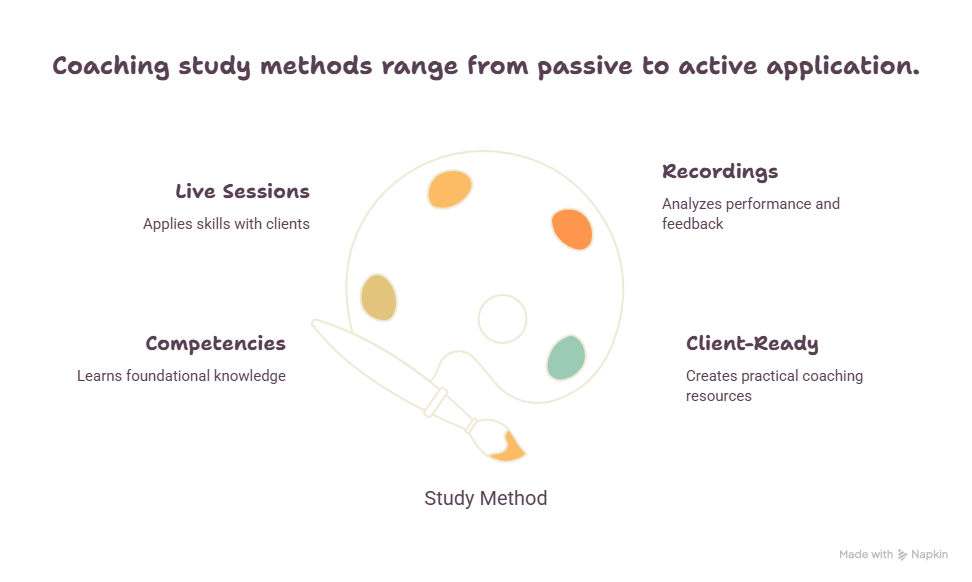
Build your study week around four blocks. First, spend one block on theory: competencies, ethics, session structure, habit psychology, goal design, and assessment expectations. Second, spend one block on live practice with peers or volunteer clients. Third, spend one block reviewing recordings, notes, and feedback. Fourth, spend one block creating client-ready tools: intake questions, values exercises, reflection prompts, progress dashboards, and check-in forms. This rhythm turns daily journaling prompts, life mapping, gratitude journal coaching, and visualisation methods into usable assets.
The biggest hidden pain point is confidence. Many new Ireland-based coaches delay selling because they fear being exposed: exposed by a complex client, exposed by a credentialing assessor, exposed by a corporate buyer, or exposed by a simple question about results. Confidence grows when you can explain exactly how your coaching process works. Use an intake map, session framework, client agreement, referral policy, progress tracker, and testimonial capture system. Then reinforce those assets with client testimonials capture, coaching case studies, exceptional client experience design, and client feedback growth strategy.
Exam preparation should be scenario-based. Ask yourself what you would do when a client asks for a meal plan, reveals severe anxiety symptoms, wants advice instead of reflection, asks you to guarantee weight loss, becomes dependent on sessions, or breaks confidentiality boundaries involving a partner or employer. Your answer should show ethics, scope, curiosity, referral awareness, and client autonomy. That is why health and life coaching ethics, emotional consent, coaches avoiding traps, and career-ending mistake prevention are exam preparation assets, not side reading.
5. Turn Certification Into a Paid Coaching Practice in Ireland
Certification gives you credibility, yet your offer turns that credibility into income. A strong Ireland coaching offer should name the client, the pain, the transformation, the process, and the proof. “I help busy professionals rebuild energy, reduce stress-driven habits, and create sustainable routines over 12 weeks” is easier to buy than “I offer health and life coaching.” Build your offer using high-ticket coaching principles, client retention strategy, payment systems, and financial forecasting so your business model stays healthy.
For Ireland, local trust signals matter. Mention your training route, credential status, supervision or CPD commitment, boundaries, confidentiality, and client process clearly. Use a website section that explains what coaching includes, what it excludes, who it suits, and how progress is measured. Add case-study stories that show starting point, obstacles, coaching approach, behaviour shifts, and client-owned results. This is where certification differentiation, resume credential listing, trust credibility, and case-study templates do real commercial work.
Your marketing should educate before it sells. Publish articles around problems your Irish audience already searches: stress habits after work, confidence after career breaks, health routines for busy parents, wellbeing coaching for professionals, life coaching after redundancy, burnout prevention, emotional eating triggers, and goal-setting that survives chaotic weeks. Support this with SEO tools for coaching websites, YouTube growth for coaches, automated email sequences, and digital marketing tools.
Your first clients should teach you how your market speaks. Listen for phrases such as “I know what to do, I just cannot stick to it,” “I am exhausted all the time,” “I keep putting myself last,” “I lose momentum after two weeks,” or “I need someone to keep me honest.” Those phrases should shape your sales page, discovery-call questions, programme modules, and follow-up emails. Build delivery around interactive goal tracking, gamification strategies, micro-coaching, and coaching automation so motivation does not depend on willpower alone.
The real career danger is becoming certified and still invisible. Many new coaches hide behind more courses because selling feels uncomfortable. Replace that spiral with a 90-day Ireland launch plan: define one offer, build one landing page, publish eight problem-led posts, run discovery calls, collect three testimonials, create one referral script, and improve your process after every client. Use must-have startup tools, coaching business automation, networking secrets, and profitable scaling as the business backbone.
6. FAQs About Health & Life Coaching Certification in Ireland
-
Choose based on the client problem you want to solve. For life coaching, leadership, career, confidence, and executive-style work, an ICF-aligned pathway can give broad professional recognition. For health and wellness coaching, an NBHWC-aligned education route can add stronger health-specific credibility. For Europe-facing professional coaching, EMCC can also make sense. Before choosing, compare your target client, required hours, assessment style, ethics training, practice requirements, and renewal rules. Use which certification is right for you, best online health coach certification programmes, online life coach certification, and credentialing resources before enrolling.
-
Yes, a blended practice can work when your scope is clear. You can support habits, stress, confidence, goal-setting, routines, resilience, and behaviour change while referring clients to qualified healthcare, mental health, dietetic, or legal professionals when their needs move beyond coaching. The smart move is to design your offer around one clear outcome, then use health and life coaching skills inside that outcome. A stress-and-lifestyle coach, confidence-and-wellbeing coach, or habit-change coach can feel far more credible than a vague generalist. Strengthen that with ethical responsibilities, coaching boundaries, habit formation, and behaviour change science.
-
A practical beginner timeline is usually several months, depending on the credential, training hours, practice-session requirements, assessment process, and your weekly availability. Someone studying part-time around work may need a longer runway than someone with protected study time and immediate practice clients. The biggest time-saver is organising evidence from day one: session logs, feedback, reflections, mentor notes, assessments, testimonials, and CPD records. Build your timeline with quick health coach certification guidance, life coach certification timing, certification portfolio planning, and common credentialing mistakes.
-
Start with low-risk, clearly framed practice sessions. Offer structured coaching to volunteers, peers, colleagues, wellness groups, or beta clients, and explain that the work is coaching practice with confidentiality, boundaries, and feedback built in. Avoid overpromising. Your goal is skill development, session confidence, and documented learning. Ask each client for specific feedback about clarity, trust, momentum, and action steps. Then turn patterns into stronger tools. Use surveys and feedback tools, client journaling tools, goal tracking tools, and client testimonials capture to build proof ethically.
-
The costly mistakes are choosing a programme because it is cheap, ignoring accreditation details, collecting poor practice-hour records, copying generic coaching packages, blurring scope, avoiding supervision, and launching with a weak message. Another common mistake is hiding behind education because paid client conversations feel uncomfortable. Certification should lead into a client-ready practice, not endless preparation. Protect yourself with career-ending mistake prevention, difficult client situation handling, legal requirements for coaches, and business setup guidance.
-
Create one focused offer, one clear audience, one repeatable process, and one proof system. For example, you could build a 12-week programme for stressed professionals, a habit reset for busy parents, a confidence coaching package for career changers, or a wellbeing accountability programme for remote workers. Price the structure, not the hour. Track baselines, behaviours, wins, barriers, and client confidence so your testimonials become specific. Then support growth through high-ticket coaching offers, client retention strategies, digital marketing tools, and scaling your coaching practice.
