
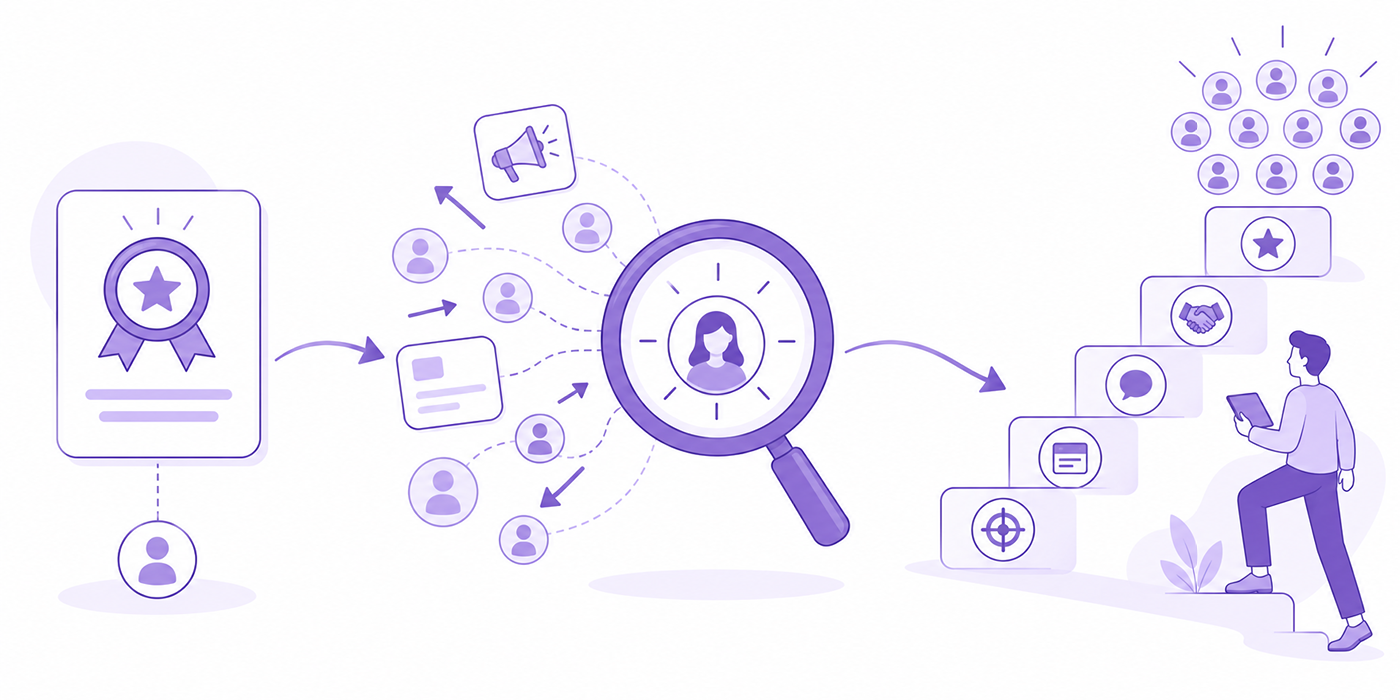
Finishing a coaching certification can create an uncomfortable surprise: you are more competent, more ethical, and more confident in sessions, yet your calendar remains empty. That gap is increasingly visible in coaching communities. Certification strengthens delivery; client acquisition depends on positioning, demand, trust, conversations, and an offer people can immediately understand. In 2026, coaches who solve only the credential problem can still struggle commercially. The practical goal is to turn professional competence into a market message, repeatable outreach system, and first ten clients without becoming a full-time content creator.
1. Why Certified Coaches Can Still Have an Empty Calendar
The coaching market has grown substantially. The International Coaching Federation's 2025 Global Coaching Study estimated 122,974 coach practitioners worldwide and $5.34 billion in annual coaching revenue, while 73% of coaches said clients and organizations increasingly expect certification or credentials. That creates an important commercial reality: professional credentials can strengthen credibility while competition for attention continues to rise.
Certification primarily answers a buyer's question about professional preparedness. Client acquisition begins with different questions:
Who exactly is this coach for? What painful situation do they understand? What changes after working together? Why should the prospect act now? Why should they choose this coach?
A practitioner may understand SMART goal setting, know the T-GROW coaching model, use the OSCAR framework, understand health behavior change, and follow a rigorous coaching code of conduct. Those competencies make the service stronger after somebody enters the coaching relationship. Marketing has to create enough relevance and trust for that relationship to begin.
This distinction explains why “life coach” often performs poorly as the entire positioning strategy.
Life coaching describes a professional category. Buyers usually think in problems: “I cannot make a career decision,” “I keep burning out,” “I have lost confidence after becoming a manager,” “my habits collapse after two weeks,” or “I know what I should change and cannot make myself do it.”
A broad coach competing for those buyers may be less compelling than someone clearly associated with career burnout coaching, self-confidence coaching, life purpose coaching, leadership coaching, or public speaking coaching.
The pain gets worse because new coaches frequently interpret low demand as a personal verdict.
They redesign the website. Buy another course. Change their logo. Post motivational graphics. Add another modality. Lower prices. Start a newsletter nobody asked for. Create a free ebook. Spend money on ads. After six months, the same underlying problem remains: the market still cannot quickly understand who should hire them and why.
A December 2025 Reddit thread captures this frustration. One coach reported beginning certifications and continuing education earlier that year, actively trying to acquire clients since June, using social media, flyers, workplace word-of-mouth, and still seeing very few leads. Responses focused heavily on broad positioning and unclear demand rather than the coach's willingness to work.
That is the diagnostic shift certified coaches need.
Your coaching contract, duty of care, cultural competence, familiarity with Immunity to Change, and use of positive intelligence can help make you a responsible practitioner. Your market still needs a reason to notice you.
2. Positioning Mistakes That Make Good Coaches Difficult to Buy
Strong positioning makes a prospect recognize themselves quickly.
Compare “I help people unlock their potential” with “I help newly promoted managers stop second-guessing difficult decisions and become confident team leaders.”
The first statement could apply to thousands of coaches. The second identifies a person, context, pain, and direction of change.
This is why effective positioning begins before content creation.
A practitioner working with leadership coaching could specialize around first-time executives, new managers, founders managing rapid growth, or senior professionals preparing for promotion. Someone interested in career burnout could focus on high-performing professionals returning after burnout, healthcare leaders with chronic overload, or managers considering career changes. Self-confidence coaching, life purpose coaching, and public speaking coaching become significantly more commercially useful when connected to a recognizable buying situation.
A helpful positioning formula is:
Specific buyer + expensive or emotionally important problem + context where it appears + credible direction of progress
“Expensive” includes more than money. A problem becomes commercially significant when it costs the client time, opportunity, relationships, confidence, healthful routines, performance, or peace of mind.
This is particularly important in niches such as couples coaching, money mindset coaching, self-care coaching, health behavior change, and conscious leadership. The service becomes easier to evaluate when prospects can connect coaching to a problem already consuming attention.
Another positioning mistake is leading with methodology.
Most prospects are not lying awake searching for the CLEAR coaching model, OSCAR coaching model, T-GROW framework, ADKAR model, or Immunity to Change. Those frameworks can strengthen the intervention. The buyer first needs to understand the problem you solve.
Your method becomes valuable evidence after relevance has been established.
The same principle applies to credentials. “Certified life coach with 120 training hours” communicates professional development. “I work with professionals who repeatedly reach burnout because achievement has become their only operating mode” communicates recognition.
Buyers need both at different stages.
The website homepage, social profile, referral introduction, workshop description, and first 30 seconds of a networking conversation should communicate the same core positioning. If each channel describes a different practice, the market never receives enough repetition to remember what you do.
A December 2025 Reddit discussion about attracting coaching clients emphasized this exact messaging problem: people typically hire around a problem they want solved, and clarity in how coaches describe their work can heavily influence whether prospective clients see the service as relevant.
Your first positioning draft should therefore answer five questions:
Who has this problem? What are they experiencing right now? What are they trying unsuccessfully? What outcome would matter enough to pay for? Why are you credible in this particular conversation?
Professional tools such as life visioning, the Wheel of Life, SMART Goals, positive intelligence, and transactional analysis can then support the work behind that promise.
3. What Reddit Stories Reveal About the Client-Acquisition Gap
Reddit provides useful qualitative evidence because struggling coaches often describe the unpolished middle of business building that polished success stories omit.
In March 2025, an aspiring ICF ACC coach described feeling confident in coaching capability while having almost no marketing background and uncertainty about attracting clients. Responses repeatedly emphasized specificity, direct conversations, targeted networking, workshops, reviews, and practical marketing rather than simply producing more generic content.
That is an important distinction for anyone who has invested heavily in professional coaching ethics, contracting in coaching, duty of care, cultural competence, and behavior-change methods. Professional competence and market competence require different practice.
A May 2026 Reddit discussion made the contrast even clearer. A therapist with ten years of experience described therapy client acquisition as relatively easy through an established directory while finding coaching clients substantially more difficult and wondering whether social media, referrals, networking, SEO, or another channel was the answer.
This illustrates a hidden issue: coaching often lacks the built-in demand pathways available to some established professional categories.
A person may already know where to search for a therapist, accountant, dentist, or estate attorney. A life-coaching prospect may first have to decide that coaching is the appropriate solution, determine what kind of coach is relevant, evaluate credibility, and overcome uncertainty about outcomes.
Your marketing therefore has more educational work to do.
That education should connect naturally to a concrete problem. Someone offering career burnout coaching can explain why high performers repeatedly rebuild the same workload. A self-confidence coach can unpack decision avoidance after promotion. A leadership coach can address the transition from individual contributor to manager. A coach specializing in money mindset can examine the behaviors surrounding pricing, negotiation, or financial avoidance while respecting appropriate professional boundaries. A public speaking coach can address the high-stakes moment before a promotion presentation or conference appearance.
An August 2026 Reddit post provides another useful warning. A coach with ACC credentials and several years in practice described repeatedly modifying a website and recently trying Google Ads while seeing little traction. Responses immediately returned to the identity of previous clients, message clarity, positioning, and potential distribution channels.
Paid traffic magnifies whatever message already exists.
When positioning is sharp, advertising can distribute a relevant offer faster. When positioning is vague, advertising buys larger quantities of indifference.
Older Reddit discussions show another recurring theme: first clients often emerge through trust-based proximity rather than algorithmic reach. Coaches describe networking, existing communities, in-person events, professional relationships, and referrals as early sources of paying clients. One coach reported that a first client arrived after more than a year through someone who already knew and trusted them.
This makes the first-ten-clients stage fundamentally different from scaling.
At client zero, you need market learning. At client three, you need proof. At client ten, you need to identify which acquisition mechanism is repeatable. The person attempting to build an automated funnel before understanding why a real human buys may automate the wrong message.
4. Build an Offer People Can Understand Before Chasing More Traffic
Before trying to acquire 10 clients, make the offer clear enough that one qualified prospect can evaluate it.
A strong early coaching offer needs five components:
A defined person. A recognizable problem. A structured engagement. A credible process. A clear next step.
Suppose you work in career burnout coaching. “Six life-coaching sessions” leaves the buyer to invent the value. A more useful offer could be a structured eight-week engagement for mid-career professionals who are functioning well externally while repeatedly reaching exhaustion, with sessions focused on workload patterns, boundaries, decision-making, values, behavior change, and a sustainable operating plan.
That description gives the prospect something to evaluate.
The internal methodology might combine Wheel of Life assessment, SMART goal design, Immunity to Change, ADKAR principles, and positive intelligence. Those methods now support a coherent client journey rather than appearing as a collection of credentials.
Avoid guarantees around outcomes you cannot control.
Ethical positioning should describe the problem, coaching process, intended progress, client responsibilities, and scope with precision. Strong coaching contracts, clear duty of care, a credible professional code, appropriate cultural competence, and disciplined behavior-change coaching strengthen trust without requiring exaggerated promises.
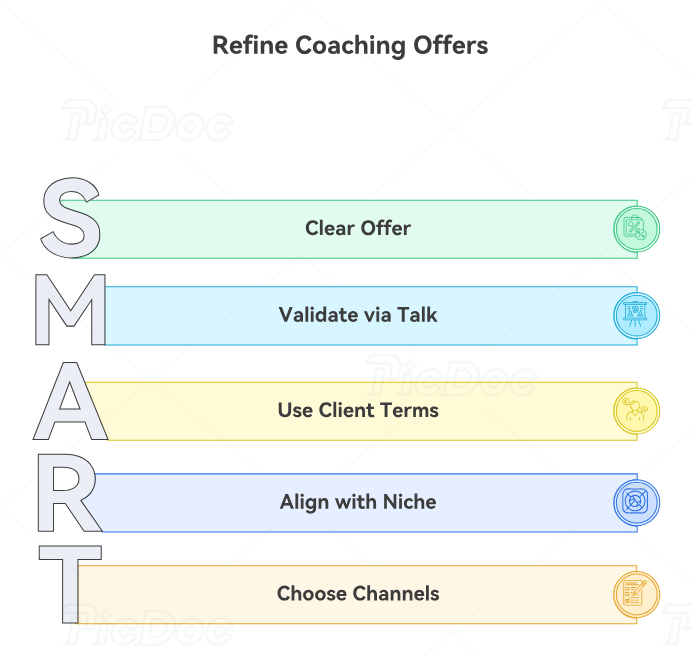
Next, validate the offer through conversations.
Speak with 15–20 people who resemble your intended buyer. Ask about the problem's language, consequences, failed attempts, triggers, existing alternatives, purchasing concerns, and what meaningful progress would look like.
Listen for repetition.
If eight managers independently describe dreading difficult feedback conversations, that language is more commercially valuable than a brainstormed slogan about “unlocking authentic leadership.”
Your offer then becomes anchored in the client's vocabulary.
This works across couples coaching, life purpose coaching, self-care coaching, conscious leadership, and self-confidence coaching. Different niches require different problem language, proof, boundaries, and acquisition channels.
Then choose one primary channel and one relationship channel.
The primary channel might be LinkedIn, workshops, local professional communities, SEO, targeted communities, speaking, or educational partnerships. The relationship channel might be direct introductions, referral partners, past colleagues, associations, or warm outreach.
This prevents a common beginner mistake: being inconsistently present everywhere.
Ten strong conversations with the correct people can generate more market intelligence than 30 generic posts viewed mainly by other coaches.
5. A Practical First-10-Clients Plan for Certified Coaches
The objective of your first ten clients is larger than revenue.
Those ten engagements should help you discover who converts, why they buy, which problems recur, which language resonates, what outcomes clients value, where referrals originate, and which parts of your coaching process create the greatest perceived value.
Clients 1–2: Prove the Problem
Choose one tightly defined buyer and conduct at least 15 discovery interviews before making major investments in branding or advertising.
Your interview should explore:
what happened that made the problem noticeable;
what it is costing the person;
what they have already tried;
why those attempts failed;
what they want instead;
how urgently they want change;
what would make outside support credible.
Then create one offer.
A coach focusing on leadership development might target managers during their first 12 months of leadership. Someone using public speaking coaching could focus on professionals facing high-stakes presentations. A practitioner in career burnout, money mindset, or self-confidence coaching should make the triggering situation equally concrete.
Aim to secure the first two suitable clients through existing trust: former colleagues, professional communities, introductions, workshops, alumni networks, relevant communities, or referral partners.
Use discounted founding-client pricing if strategically appropriate. Set a clear normal price and a clearly bounded reason for the introductory rate. Permanent discounting teaches neither you nor the market whether the full-value offer works.
Clients 3–4: Build Evidence
After each engagement, document what actually changed.
Do not settle for “Great coach, highly recommended.”
With permission, capture evidence around the client's initial situation, major obstacles, useful changes in thinking or behavior, measurable progress where appropriate, and what part of the process proved most valuable.
Strong coaching methodology helps here. SMART Goals can create measurable milestones, T-GROW can structure decisions, OSCAR can help clarify outcomes, life visioning can establish direction, and health behavior change principles can make follow-through more durable.
Clients three and four should leave you with evidence capable of answering a prospect's question: “What does working with you actually look like?”
Clients 5–6: Create a Referral Engine
Ask satisfied clients for introductions when the timing is appropriate.
Make the request specific enough to be actionable:
“Is there someone in your professional circle dealing with a similar transition who might benefit from a conversation like the one we began with?”
Also identify five to ten adjacent professionals serving the same population without directly competing.
For career burnout coaching, those relationships could include career consultants, HR professionals, leadership-development providers, or relevant wellbeing professionals. Couples coaching, life purpose coaching, leadership coaching, and self-care coaching each have their own logical referral ecosystems.
Referral relationships strengthen when scope is clear. Your coaching code of conduct and duty-of-care practices become commercial trust assets because adjacent professionals need confidence that referrals will be handled responsibly.
Clients 7–8: Identify Your Winning Channel
At this stage, stop saying “marketing isn't working.”
Break marketing into numbers.
Track:
Qualified conversations → discovery calls → proposals → paying clients → completed engagements → testimonials → referrals
Suppose 30 warm conversations produce 12 discovery calls, six proposals, and three clients. You now have a measurable acquisition path.
Suppose 40 social posts produce two inquiries and zero qualified calls. That channel may deserve less effort.
Suppose one workshop produces seven conversations and two clients. Run another workshop before creating a new funnel.
The point is to identify evidence.
A coach can be excellent at CLEAR coaching, transactional analysis, positive intelligence, ADKAR, and Immunity to Change while still needing disciplined measurement outside sessions.
Clients 9–10: Standardize What Works
By clients nine and ten, review every acquisition.
Where did they first encounter you? What language prompted interest? Which proof reduced uncertainty? What objections appeared? How long did conversion take? Why did they choose you? What part of the engagement created the strongest perceived value?
Then standardize.
Keep the niche that is producing clear demand. Strengthen the offer. Refine pricing. Improve the discovery process. Build a repeatable referral request. Produce content around real buyer questions. Continue the strongest acquisition channel.
Only then consider adding paid traffic, elaborate funnels, multiple products, or additional niches.
The ICF's current research suggests significant commercial opportunity remains in coaching: 59% of coaches surveyed expected their revenue to rise, generally through serving more clients and delivering more sessions rather than simply raising fees.
For a new independent coach, the immediate challenge is therefore practical: build a mechanism that repeatedly moves the correct person from awareness to trust to conversation to engagement.
6. FAQs About Finding Your First Coaching Clients
-
Certification develops professional capability and credibility. Client acquisition additionally requires a specific market, relevant positioning, an understandable offer, proof, visibility, conversations, and follow-up.
Start by examining whether your ideal client can recognize themselves in your message. “Helping people live their best lives” creates little buying clarity. Positioning around career burnout, leadership challenges, self-confidence, life purpose, or public speaking becomes more useful when attached to a precise person and triggering situation.
-
Choose a working niche early enough to generate meaningful market feedback. Treat it as a hypothesis you will test through conversations and client work.
A focused starting point allows you to learn which problems generate urgency, which language resonates, and which acquisition channels work. You can later expand from self-care coaching, money mindset coaching, couples coaching, conscious leadership, or behavior-change coaching once evidence shows where demand exists.
-
Social media is one distribution channel. Coaches also acquire clients through referrals, professional networks, speaking, workshops, communities, partnerships, search, coaching platforms, past professional relationships, and direct conversations.
Reddit discussions from both 2025 and 2026 show practitioners questioning heavy dependence on social media and describing networking, workshops, relationships, specific messaging, and referrals as important alternatives.
Use the channel where your intended buyer already pays attention. A leadership coach and a life purpose coach may require very different acquisition systems.
-
Limited free or reduced-price engagements can be useful for practice, market learning, testimonials, and proof when they have a defined purpose and endpoint.
Create professional boundaries from the beginning through proper coaching agreements, ethical standards, duty-of-care practices, cultural competence, and clear expectations around behavior change. Decide beforehand how many founding-client engagements you will offer and when standard pricing begins.
-
There is no universal conversion rate because niche, price, audience warmth, offer quality, credibility, lead source, and sales ability vary dramatically.
Build your own benchmark. Track qualified conversations, discovery calls, proposals, closes, completions, referrals, and repeat business. If 20 relevant conversations create six calls and two clients, you have useful data. If 1,000 social impressions create nothing, impressions are currently a weak business metric.
The discipline resembles good coaching itself: use SMART measurement, diagnose resistance through Immunity to Change, structure progress with OSCAR, manage change with ADKAR, and review actions through T-GROW.
-
Validate the offer first.
Paid advertising increases reach. It also increases the speed at which a weak proposition spends money. Before advertising, establish evidence that the correct prospect responds to your positioning, books conversations, understands the offer, and sometimes buys.
The August 2026 Reddit example of an ACC coach receiving little traction after website revisions and Google Ads is a useful reminder that acquisition problems can sit upstream in positioning and message-market fit.
