
Health coaching can support a full-time income, although the economics depend heavily on how you earn. An employed coach earning $25 an hour faces a different ceiling from a specialist private practitioner charging $125 per session, while someone combining preventive health coaching, habit formation, health behavior change, and corporate wellness may build several revenue streams. The useful question is whether your chosen business model can reliably produce enough clients, margin, and recurring revenue to support your life.
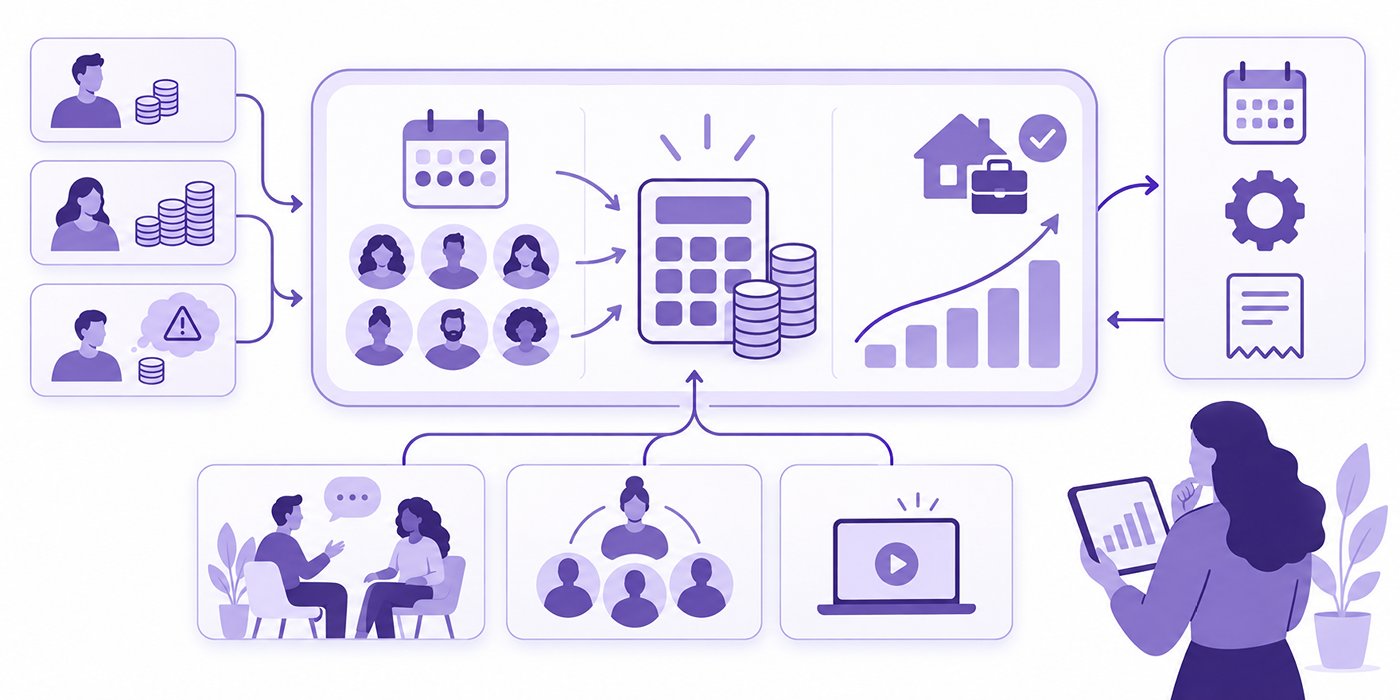
1. Can You Actually Make a Living as a Health Coach? Start With the Real Data
The most useful 2026 evidence comes from the National Board for Health & Wellness Coaching's 2025 workforce survey of 2,328 NBC-HWCs. The income distribution is wide. Thirty-six percent reported earning less than $10,000 annually from coaching, while 7% reported $100,000 or more. Among coaches working full-time, 67% reported annual earnings between $50,000 and $99,999, and 34% earned at least $75,000. Across all respondents, 34% earned $50,000 or more. Those figures immediately challenge both the “coaching is easy six-figure money” narrative and the idea that earning a living is unrealistic.
The employment structure explains much of that spread. Only 28% of survey respondents worked full-time, while 44% reported part-time work. Another major finding was that 58% described themselves as self-employed. Private practice was the largest primary setting at 41%, followed by healthcare at 22% and for-profit digital health at 10%. Coaches therefore operate across very different economics, from salaried healthcare roles to independent self-care coaching, virtual lifestyle medicine coaching, metabolic health coaching, and broader holistic coaching.
Hourly income creates another important distinction. The NBHWC survey reported an overall hourly-wage median of $40 and average of $54.42 among analyzed respondents. Full-time coaches had a median of $34 per hour and an average of $44.69, while part-time coaches reported a $50 median and $58.90 average. Those numbers describe reported wages rather than the economics of every private coaching session. A coach developing positive psychology coaching, emotional agility, resilience coaching, or accountability coaching should distinguish employee wages from client-facing private-practice rates.
Private-practice pricing is substantially higher. NBC-HWCs reported 2025 private-session prices ranging from $20 to $600 per hour, with most rates clustered between $75 and $150. The median was $100. After unusually high outliers were removed, the mean was $109.59. This makes a $100-to-$125 session rate commercially plausible for an established qualified practitioner, particularly when the coach combines a clear niche with exceptional client experiences, strong client retention, useful coaching case studies, and repeatable client accountability.
The trap is multiplying $100 by 40 hours and assuming a $208,000 business.
A private coach cannot usually sell 40 hours of coaching every week while simultaneously handling discovery calls, documentation, marketing, follow-up, cancellations, bookkeeping, referral relationships, program design, professional development, technology, and administration. Successful practices use coaching automation, streamlined payment systems, disciplined financial forecasting, and efficient business automation precisely because billable hours represent only part of the working week.
Consider a coach charging $100 per session and delivering 12 paid sessions weekly across 46 working weeks. Gross annual coaching revenue is $55,200. Raise the rate to $125 and the same caseload produces $69,000. Sixteen weekly sessions at $125 generate $92,000 gross. Those calculations expose a powerful commercial principle: increasing sustainable pricing and utilization has more leverage than filling every waking hour with sessions.
Expenses then reduce gross revenue. A private coach may pay for software, insurance, accounting, payment processing, continuing education, advertising, website hosting, contractors, office space, professional memberships, taxes, and legal business requirements. Someone establishing a formal entity may also incur LLC setup, ongoing tax-management costs, and investments in must-have coaching tools. Grossing $80,000 therefore does not mean having $80,000 available for personal spending.
The strongest evidence for financial viability is consequently revenue architecture, not the certificate itself.
| Business Model | Revenue Assumption | Approx. Annual Gross | What Must Go Right | Main Financial Risk |
|---|---|---|---|---|
| Hourly employment | $20/hr × 40 hrs × 52 weeks | $41,600 | Stable full-time hours | Low income ceiling |
| Hourly employment | $25/hr × 40 hrs × 52 weeks | $52,000 | Consistent schedule and paid hours | Limited upside without promotion |
| Hourly employment | $30/hr × 40 hrs × 52 weeks | $62,400 | Full workload throughout year | Credential competition |
| Hourly employment | $37/hr × 40 hrs × 52 weeks | $76,960 | Strong employer and experience profile | Roles at this rate may be competitive |
| Hourly employment | $40/hr × 40 hrs × 52 weeks | $83,200 | Higher-value role or specialist background | Fewer qualifying openings |
| Part-time employment | $25/hr × 30 hrs × 50 weeks | $37,500 | Reliable weekly hours | Benefits may be limited |
| Contract coaching | $30/hr × 30 billable hrs × 50 weeks | $45,000 | High utilization | No paid downtime and potentially no benefits |
| Private 1:1 | $75 × 8 sessions/week × 46 weeks | $27,600 | Eight consistently paying sessions | Too little volume for many full-time incomes |
| Private 1:1 | $75 × 12 sessions/week × 46 weeks | $41,400 | Stable caseload | Price constrains margin |
| Private 1:1 | $100 × 8 sessions/week × 46 weeks | $36,800 | Reliable acquisition and retention | Eight clients provide limited revenue capacity |
| Private 1:1 | $100 × 12 sessions/week × 46 weeks | $55,200 | 12 sessions filled most weeks | Cancellations and acquisition gaps |
| Private 1:1 | $100 × 16 sessions/week × 46 weeks | $73,600 | Strong lead flow plus retention | Administrative workload rises quickly |
| Private 1:1 | $125 × 12 sessions/week × 46 weeks | $69,000 | Credible niche and willingness to pay | Pricing requires stronger positioning |
| Private 1:1 | $125 × 16 sessions/week × 46 weeks | $92,000 | Consistent acquisition at a premium rate | Caseload stability |
| Private 1:1 | $150 × 12 sessions/week × 46 weeks | $82,800 | High perceived value and referral trust | Smaller qualified buyer pool |
| Private 1:1 | $150 × 16 sessions/week × 46 weeks | $110,400 | Premium positioning and strong retention | High acquisition expectations |
| Structured package | $600 × 4 new clients/month | $28,800 | Four conversions monthly | Low package value limits revenue |
| Structured package | $600 × 8 new clients/month | $57,600 | Eight reliable monthly sales | Acquisition volume becomes demanding |
| Structured package | $900 × 4 new clients/month | $43,200 | Four qualified clients each month | Revenue can fluctuate between launches |
| Structured package | $900 × 6 new clients/month | $64,800 | Strong conversion process | Lead-generation dependency |
| Premium package | $1,200 × 4 new clients/month | $57,600 | Clear transformation and credibility | Weak positioning destroys conversion |
| Premium package | $1,200 × 6 new clients/month | $86,400 | Six qualified buyers every month | Sales consistency |
| Group coaching | $300 × 8 seats × 4 cohorts | $9,600 | Four groups filled annually | Small cohorts contribute limited standalone income |
| Group coaching | $500 × 10 seats × 4 cohorts | $20,000 | 40 annual enrollments | Launch and enrollment risk |
| Group coaching | $750 × 10 seats × 4 cohorts | $30,000 | Strong niche-specific program | Group offer must justify price |
| Group coaching | $1,000 × 12 seats × 4 cohorts | $48,000 | 48 premium annual enrollments | Marketing and cohort-fill pressure |
| Corporate workshops | $750 × 2 engagements/month | $18,000 | Regular organizational buyers | Longer sales cycles |
| Corporate workshops | $1,500 × 2 engagements/month | $36,000 | Demonstrable organizational value | Inconsistent procurement cycles |
| Corporate workshops | $2,500 × 2 engagements/month | $60,000 | Premium B2B positioning | Requires stronger credibility and networking |
| Hybrid | $55,000 salary + 4 private sessions/week at $100 | $73,400 | Manageable side caseload | Time and energy capacity |
| Hybrid | $45,000 salary + 6 private sessions/week at $125 | $79,500 | Strong niche plus stable employment | Burnout from dual workload |
| Hybrid | $40,000 salary + monthly 8-person group at $300 | $68,800 | Consistent monthly group enrollment | Marketing workload alongside employment |
2. The Revenue Math Behind a $50K, $75K or $100K Health-Coaching Income
A health coach targeting $50,000 in personal income should begin with required business revenue rather than client count. If operating expenses consume 20% of revenue, producing $50,000 before personal income taxes requires roughly $62,500 in gross business revenue. At a 30% operating-cost ratio, the required gross rises to about $71,400. The exact percentage varies enormously, which is why financial forecasting, disciplined tax planning, efficient payment infrastructure, and appropriate business setup deserve attention before lifestyle decisions are based on gross sales.
Take a practitioner charging the 2025 NBHWC private-practice median of $100 per hour. Twelve paid sessions each week across 46 weeks produce $55,200. Fifteen sessions produce $69,000. Twenty sessions produce $92,000. Revenue therefore climbs meaningfully as utilization increases, although maintaining 20 recurring appointments requires excellent client retention, reliable client experiences, productive accountability systems, and enough lead flow to replace departing clients.
Now raise pricing to $125. Twelve weekly sessions produce $69,000; 16 produce $92,000. At $150, 12 weekly sessions generate $82,800. Private practice starts looking much more attractive when the coach can charge within the upper half of the observed $75-$150 range and maintain utilization. Achieving that usually requires expertise clients can understand, such as metabolic health coaching, career burnout coaching, preventative health coaching, or sophisticated habit-change coaching.
Package economics can improve predictability. Suppose a coach sells a 12-week program for $1,200. Four new clients each month produce $57,600 annual sales. Six clients produce $86,400. The coach must then design delivery carefully so every sale does not create unlimited labor. A sustainable high-ticket coaching offer may combine individual sessions, structured resources, limited between-session support, micro-coaching, and automated client accountability.
Group programs add leverage. Ten clients paying $750 for a cohort create $7,500. Running four successful cohorts produces $30,000 before expenses. Add eight weekly 1:1 sessions at $100 across 46 weeks and total gross becomes $66,800. This kind of blended model supports practice scaling, allows coaches to deliver transformational behavior change, incorporates habit formation, and reduces dependence on filling an entire calendar with private sessions.
Corporate work can create another layer. Two $1,500 wellness engagements each month equal $36,000 annually. Combined with ten weekly private sessions at $100 over 46 weeks, gross revenue reaches $82,000. B2B work requires different skills, including professional networking, strategic joint ventures, credible case studies, and highly professional client experiences.
The hybrid model is frequently the least financially fragile path. An employed coach earning $55,000 who maintains four $100 private sessions weekly for 46 weeks creates another $18,400 in gross side revenue, reaching $73,400 before side-business expenses. This gives the private practice time to develop referral relationships, improve marketing evidence, refine pricing, and establish retention systems without forcing every discovery call to pay next month's rent.
3. Reddit Income Reports Reveal Where Health Coaches Make Money—and Where They Get Stuck
Recent Reddit discussions line up surprisingly well with the NBHWC data: employment can provide stability, private practice creates greater upside, and neither route automatically produces high income.
In an April 2026 health-coaching discussion asking whether anyone was earning at least $80,000, one NBC-HWC described working as a chronic-condition health coach for $55,000 plus a performance bonus of roughly 12%, with health insurance, PTO, retirement matching, equipment reimbursement, and a weekday schedule. The same person said their manager, also NBC-HWC, earned above $80,000. Another experienced participant described many contract coaching jobs around $18-$25 an hour and characterized better-paying positions as highly competitive.
That comparison highlights why salary alone can mislead. A $55,000 employee receiving health insurance, paid time off, retirement contributions, equipment, internet reimbursement, and stable hours may have greater economic security than a contractor billing $65,000 who purchases every benefit independently. Coaches evaluating employment should therefore compare total compensation, especially when deciding whether another coaching certification, NBHWC eligibility pathway, CPD credential, or professional-development investment will improve access to stronger roles.
A 2025 Reddit thread included a coach who had moved into a full-time in-person health-coaching job earning $37 per hour. They said remote openings had been considerably more competitive and that finding the right opportunity took roughly one to two years. The experience offers a useful career lesson: geographic flexibility and willingness to accept in-person work can sometimes improve hiring odds when remote positions attract enormous applicant pools.
At the lower end, an August 2026 discussion criticized a bilingual role requiring NBHWC and offering approximately $20-$25 per hour without benefits. Another participant reported obtaining a $30-per-hour 1099 contractor role. The financial difference between those arrangements is smaller than the headline rates imply once unpaid leave, benefits, taxes, and downtime enter the picture.
NBHWC itself acknowledges the broader pressure. Its July 2026 midyear update says stakeholder feedback repeatedly emphasized the need to improve employment opportunities, increase awareness of health and wellness coaching, and strengthen business and practice-management skills. The organization's 2025 survey also found dissatisfaction highest around pay and job security, while client recruitment and adequate compensation emerged as leading professional challenges.
Private-practice Reddit stories reveal a different bottleneck: acquisition.
One coach discussing private practice said the major challenge was the amount of marketing and networking required to maintain a full caseload, with their Psychology Today listing producing only around one or two inquiries monthly and some failing to convert. They recommended building relationships with doctors' offices, counseling practices, hospitals, and wellness facilities. That approach fits particularly well for coaches specializing in preventive health, health behavior change, metabolic health, or lifestyle medicine.
A more optimistic 2026 Reddit contributor described running a local solo practice and pursuing a $200,000 annual target, although the post did not establish that $200,000 had already been earned. What made the account valuable was the acquisition strategy: local reputation, physician and wellness-professional referrals, community visibility, classes, and long-term recurring clients. The coach said social media played almost no role.
That experience undermines a common assumption among new coaches: building a practice does not require becoming a full-time influencer. Local referral ecosystems can support network-driven growth, stronger joint ventures, valuable case-study credibility, and durable client referrals without forcing the coach to post three reels every day.
The deeper Reddit pattern is consistent: coaching competence gets clients results; business competence gets enough clients through the door.
4. Which Health-Coaching Business Model Gives You the Best Chance of a Livable Income?
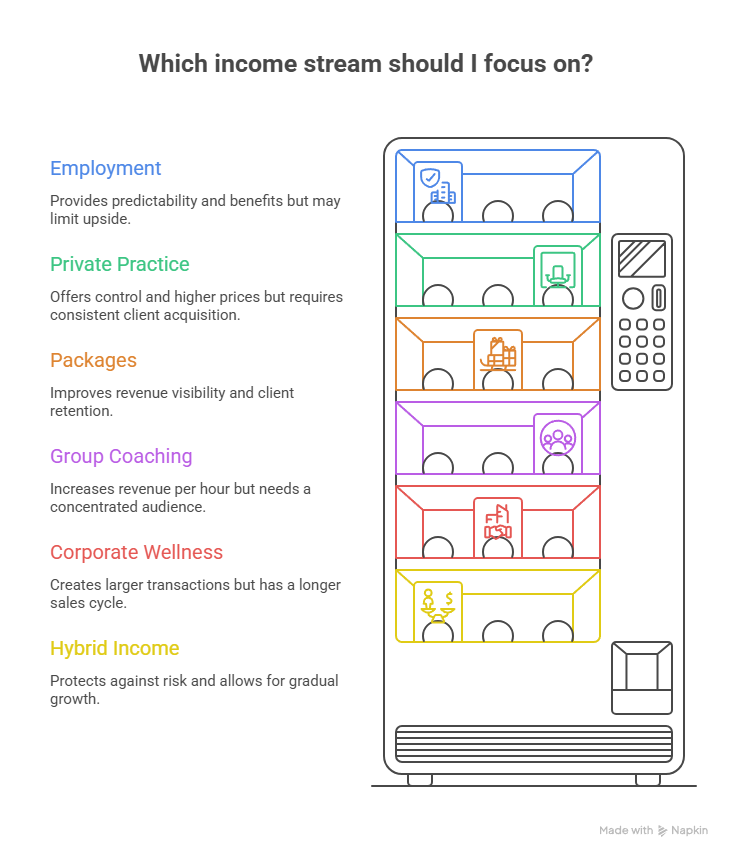
Employment provides the highest predictability. You trade much of the upside for scheduled hours, lower acquisition responsibility, and potentially benefits. Healthcare appears especially relevant: the NBHWC survey found that coaches employed in healthcare organizations were among those most likely to report annual salaries of at least $50,000. Full-time coaches working for employers that required NBC-HWC also had a higher likelihood of reaching that threshold.
For someone who wants reliable cash flow, employer-paid benefits, and less responsibility for business automation, financial forecasting, client acquisition, and payment management, employment can be economically superior even when the headline hourly rate looks lower.
Private 1:1 practice offers straightforward economics and higher price control. The problem appears when every dollar requires another appointment. Twelve clients at $125 across 46 weeks can generate $69,000 gross, while reaching $100,000 requires roughly 17 to 18 sessions per week at that rate before expenses. That caseload can work when sessions are structured, cancellations are controlled, and the coach uses coaching technology, efficient client management, automated follow-up systems, and strong retention practices.
Packages improve revenue visibility. A client purchasing a three-month program creates more predictable contracted revenue than someone booking isolated sessions whenever motivation returns. Packaging works particularly well when the program solves a clearly defined problem through health behavior change, habit stacking, accountability coaching, or targeted preventive health coaching.
Packages also make acquisition math clearer. If a $1,200 program converts 25% of qualified consultations, six monthly clients require approximately 24 qualified consultations. If only half of leads book a consultation, the practice needs about 48 qualified leads. Suddenly “I need more clients” becomes a measurable sales system. Coaches can then improve client feedback, case-study proof, premium offer design, and business scalability at the exact point where the funnel is leaking.
Group coaching increases revenue per delivery hour. Twelve participants paying $750 create $9,000 for one cohort. Even if the program includes eight 90-minute sessions, delivery revenue per live hour is dramatically higher than conventional 1:1 work. The difficult part moves upstream: filling twelve seats. Coaches therefore need a sufficiently concentrated audience, compelling positioning, effective professional networking, credible transformation evidence, and polished client experiences.
Corporate and organizational wellness can create larger transactions. One employer contract may replace dozens of individual client sales. Corporate buyers care about professional credibility, procurement requirements, appropriate coaching conduct, measurable outcomes, strong case studies, and reliable professional partnerships. The sales cycle is longer, yet the revenue concentration can make business development worthwhile.
Hybrid income has unusually attractive risk-adjusted economics. Keep employment or another stable profession while building private clients, groups, workshops, or employer contracts. A slower transition protects your ability to reject unsuitable clients, test pricing, develop client retention, strengthen business systems, collect credible feedback, and improve financial forecasts without making desperation part of the sales process.
5. A Realistic Roadmap From Certification to Sustainable Health-Coaching Income
Months 0-3: prove that strangers will pay. Your first target should be commercial evidence rather than a perfect brand. Choose a clear problem, define a narrowly understandable service, speak with prospective clients, and close the first three to five paid engagements. Use the sessions to improve constructive feedback, practice health behavior change, develop accountability systems, and create excellent client experiences.
Track five numbers from the beginning: leads, consultations, new paying clients, average revenue per client, and retention. A coach generating 20 monthly inquiries, eight consultations, two clients, and $500 average client value has $1,000 in new monthly sales. Improving consultation conversion from 25% to 50% doubles sales without creating another lead. Raising client value from $500 to $900 changes the economics again. Financial forecasting, client feedback, offer refinement, and retention strategy should therefore develop together.
Months 3-6: identify the acquisition channel that actually works. Test local practitioner referrals, professional partnerships, workshops, search-driven content, community events, employer contacts, social media, and existing networks. Record how many qualified inquiries each channel creates. Someone specializing in food-sensitivity coaching, metabolic health, career burnout, or self-care coaching needs referral partners and content tightly aligned with that specific demand.
Drop channels that consume dozens of hours without generating qualified conversations. Many coaches remain financially stuck because they confuse visibility with acquisition. Posting content, redesigning a website, and accumulating followers can feel productive while producing almost no revenue. A practice becomes stronger when networking, joint ventures, client referrals, and case-study credibility create measurable sales conversations.
Months 6-12: move toward recurring revenue. Replace isolated sessions with a coherent program whenever the client problem genuinely requires sustained work. Improve onboarding, progress reviews, reminders, renewal conversations, and offboarding. Use coaching automation, habit-building systems, stronger expectation management, and structured accountability to improve completion without creating unnecessary manual work.
A practical private-practice milestone is reaching 10-12 reliably paying sessions per week at a sustainable rate. At $100, that represents roughly $46,000-$55,000 gross across 46 weeks. At $125, the same range becomes approximately $57,500-$69,000. Once this baseline is stable, the coach can evaluate whether to increase prices, add groups, target employers, or scale the practice.
Year 2: reduce dependence on a single revenue mechanism. A coach might earn $45,000 from 1:1 coaching, $20,000 from groups, and $15,000 from workshops, producing an $80,000 business with three distinct sources. Another might maintain a $55,000 employer role and produce $25,000 through a private specialty practice. The ideal mix depends on risk tolerance, schedule, family obligations, location, credentials, and preferred style of coaching.
This is also where operational maturity becomes important. Review legal requirements, improve tax management, automate repetitive business administration, and create accurate income forecasts. Revenue becomes a livelihood when the business can survive vacations, client turnover, seasonal dips, sickness, and one marketing channel temporarily failing.
6. Frequently Asked Questions About Making a Living as a Health Coach
-
The 2025 NBHWC survey shows a broad distribution. Thirty-six percent of participating NBC-HWCs reported less than $10,000 in annual coaching income, while 7% reported $100,000 or more. Among full-time coaches, 67% reported $50,000-$99,999 annually, and 34% reported at least $75,000.
Individual earning power depends on employment status, experience, geographic market, additional professional credentials, utilization, and business model. Coaches with expertise in preventive health, lifestyle medicine, behavior change, and metabolic health still need a commercially workable method of turning expertise into paid work.
-
At $100 per session across 46 working weeks, generating $60,000 in gross session revenue requires roughly 13 paid sessions per week. At $125, the requirement falls to about 10.5 sessions weekly. At $150, roughly nine weekly sessions produce a similar gross result.
Private practice expenses must then be deducted. Coaches should use financial forecasts, understand tax obligations, streamline payment systems, and automate administrative work before interpreting gross coaching revenue as personal income.
-
The NBHWC data confirms that some do: 7% of 2025 survey respondents reported annual coaching earnings of $100,000 or more. Six-figure earnings were therefore present within the profession while remaining a minority outcome.
For a private practitioner, six-figure gross revenue becomes mathematically achievable through combinations such as 16 weekly sessions at $150 across 46 weeks, premium coaching packages, leveraged group delivery, or organizational joint ventures. Sustaining the number requires sufficient demand, retention, delivery capacity, and margins.
-
Employment provides predictable cash flow and may include insurance, retirement contributions, equipment, paid leave, and other benefits. Private practice gives the coach control over pricing, niche, workload, delivery method, and business growth. NBHWC's 2025 data found private practice was the largest employment setting, while healthcare employment had a particularly strong association with salaries of $50,000 or more.
The best financial route depends on the coach's risk tolerance and strengths. Someone skilled at professional networking, premium offers, client retention, and business scaling may benefit substantially from private practice. Someone who strongly values predictable income may prefer employment or a hybrid arrangement.
-
Employers apply different requirements. In NBHWC's 2025 survey, 24% of respondents said their employer required NBC-HWC and another 16% said it was encouraged or highly valued. Among full-time respondents, working for an organization requiring NBC-HWC was associated with a higher proportion earning at least $50,000.
Private clients may evaluate credentials differently. A coach building an independent self-care practice, habit-coaching business, or holistic coaching program should weigh certification against positioning, referrals, outcomes, and acquisition. Candidates targeting employers can review NBHWC eligibility requirements before committing to training.
-
Certification solves a competence and credibility problem. Low revenue may originate elsewhere: insufficient demand, weak positioning, low rates, poor consultation conversion, limited retention, inadequate referral networks, excessive discounts, or an offer people do not understand.
A coach can strengthen client acquisition through networking, improve client retention, use case studies, and build exceptional client experiences. Those capabilities directly affect whether excellent coaching skill becomes sustainable income.
