
Do Clients Care About Coaching Certification? Reddit Buyer and Coach Experiences + What Actually Builds Trust
A coaching certificate can strengthen credibility, but clients rarely make a buying decision from one acronym alone. They evaluate whether you understand their problem, whether your process feels credible, whether your boundaries are professional, and whether they can picture themselves succeeding with you. That distinction matters for anyone comparing health coach certification pathways, debating ICF versus NBHWC, worrying about health-coaching saturation, or struggling to turn certification into paying clients.
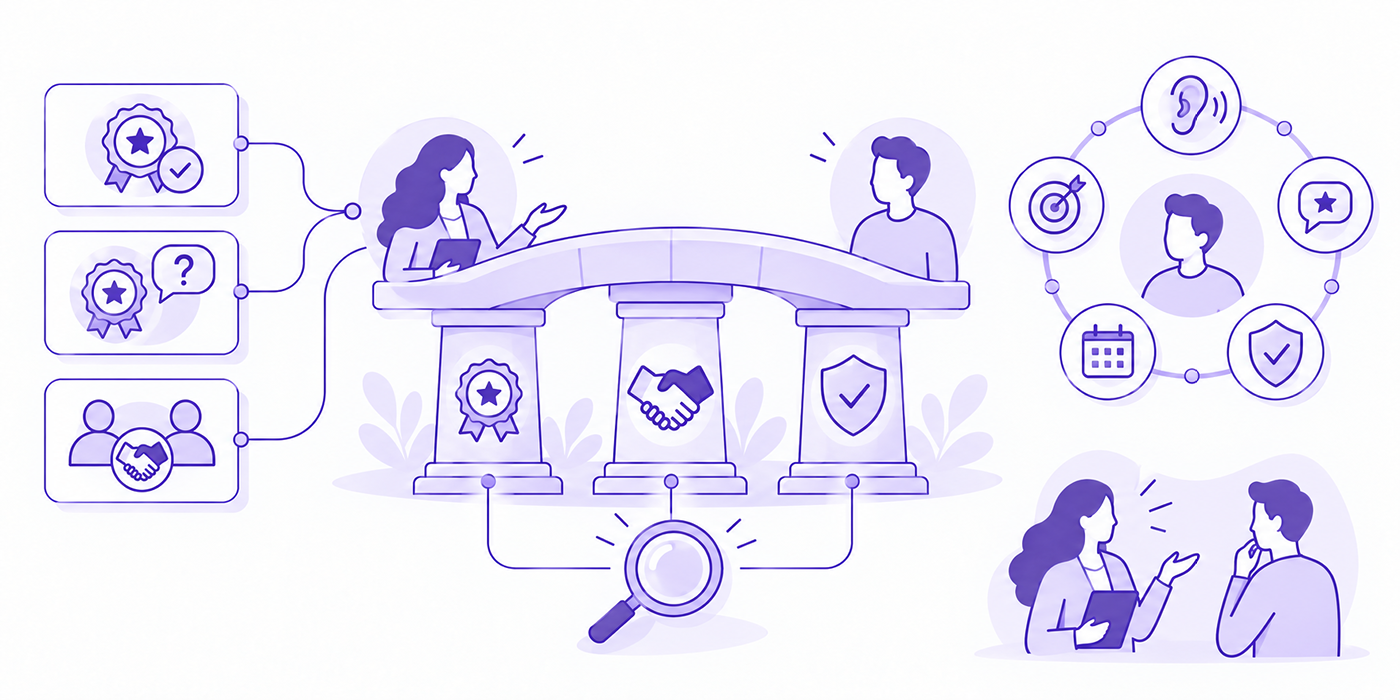
1. Do Clients Actually Care Whether a Coach Is Certified?
Consumer research suggests credentials matter to a meaningful share of coaching buyers. The latest ICF Global Consumer Awareness Study was commissioned by the International Coaching Federation and conducted by PwC across 30,727 respondents in 30 countries and territories. Among respondents who had previously participated in coaching, 65% said their coach held a certification or credential from a membership organization. Among people aware of coaching who would consider entering a coaching relationship, 78% said certification or credentialing was important or very important.
Those figures apply to professional coaching broadly rather than health coaching specifically, and ICF is itself a credentialing organization. They are still useful evidence that credentials can influence perceived legitimacy. Coaches deciding whether certification is worth the investment should therefore avoid assuming consumers completely ignore training, especially when a buyer has never met the coach before.
Reddit produces a more complicated picture.
In a March 2026 coaching discussion, a practitioner with 14 years of experience said almost nobody had asked about their certifications and argued that clients concentrated more heavily on whether the coach appeared capable of helping them achieve their desired outcome. Another commenter similarly questioned whether ordinary consumers recognize organizations such as ICF. These are individual experiences rather than representative consumer research, yet they reveal an important distinction between credential value and credential visibility.
A different Reddit discussion about finding a coach recommended professional credential directories while also emphasizing personal referrals and an introductory conversation as ways to judge fit. That reflects how buyers commonly reduce uncertainty through multiple signals rather than one qualification.
Think about the decision through four buyer types.
A cold consumer discovering you through Google, Instagram, LinkedIn, or an advertisement has little prior reason to trust you. A recognized credential can shorten the credibility gap. Your coaching code of conduct, duty-of-care practices, professional coaching contract, and clear behavior-change methodology then reinforce that first impression.
A referred consumer begins with borrowed trust. If a physician, colleague, therapist, trainer, friend, or former client recommends a coach, the referral itself becomes a powerful credibility signal. The credential can strengthen the decision, while client outcomes, specialization, communication, and fit often determine whether the referral converts.
An organizational buyer evaluates coaches differently. Employers, coaching platforms, health organizations, insurers, and corporate wellness teams may apply explicit qualification filters. Reddit discussions from 2024 through 2026 repeatedly mention applicants encountering roles asking for NBHWC or other recognized credentials, although individual job requirements vary. Anyone targeting health-coaching employment should examine actual job descriptions before selecting a credential.
A health-sensitive buyer may care strongly about professional boundaries because poor advice can have consequences. In this context, ethical health coaching, appropriate referrals, clear contracting, and evidence that you understand the difference between coaching and regulated clinical services all become trust assets.
Certification therefore works best as one part of a larger trust system.
| Trust Signal | What the Client May Infer | Where It Matters Most | What It Cannot Prove Alone | Best Way to Strengthen It |
|---|---|---|---|---|
| Recognized coaching credential | Formal training and external standards | Cold prospects and organizational buyers | Client acquisition or niche expertise | Pair it with evidence and specialization |
| NBHWC pathway | Health-coaching-specific competency standards | Health and wellness environments | Clinical licensure or medical authority | Explain scope clearly |
| ICF credential | Structured coaching education and experience | General, executive and organizational coaching | Subject-matter expertise | Show relevant domain knowledge |
| Relevant degree | Academic knowledge | Technical or health-adjacent niches | Actual coaching skill | Demonstrate coaching process |
| Professional license | Regulated expertise in another profession | Clinical-adjacent markets | That every service offered falls under that license | Separate professional roles clearly |
| Years of experience | Exposure to many client situations | High-consideration purchases | Quality of those years | Show relevant cases and lessons |
| Niche specialization | You understand a specific problem | Crowded markets | Competence by itself | Pair niche claims with training and proof |
| Client testimonials | Other people valued the service | Private practice | Causation or universal outcomes | Use specific, ethical testimonials |
| Case studies | You can explain your process | Complex coaching offers | Guaranteed repeatability | Describe context and limitations |
| Referral from a trusted person | Someone has already vetted you | Private practice | Fit for every referred client | Still conduct a discovery conversation |
| Physician or clinician referral | Professional confidence in your role | Health coaching | Authority to diagnose or treat | Maintain referral boundaries |
| Professional network | Other professionals recognize your work | Specialist niches | Coaching outcomes | Build reciprocal referral standards |
| Clear niche statement | You understand who you help | Discovery and comparison | Actual delivery quality | Show the method behind the niche |
| Specific problem language | You understand the client's situation | Landing pages and consultations | Credentials or competence | Connect pain points to process |
| Defined coaching process | The engagement has structure | Package sales | Guaranteed outcomes | Explain milestones and adaptation |
| Transparent pricing | You operate professionally | Consumer coaching | Value for that particular buyer | Explain deliverables clearly |
| Written coaching agreement | Boundaries and expectations are serious | Every paid engagement | Skill | Use precise terms and scope |
| Confidentiality explanation | Personal information will be handled carefully | Sensitive coaching topics | Legal compliance in every jurisdiction | Use appropriate professional policies |
| Clear scope of practice | You know your professional limits | Health coaching | Expertise outside that scope | Maintain a referral network |
| Evidence-based methods | Your process has intellectual grounding | Health and behavior coaching | Guaranteed individual results | Explain how methods are applied |
| Discovery call quality | You listen and understand | Before purchase | Long-term compatibility | Set realistic expectations |
| Workshop or webinar | The client can sample your thinking | Cold audiences | One-to-one coaching quality | Provide a clear next step |
| Educational content | You understand the topic | Organic marketing | Ability to coach | Show coaching-oriented applications |
| Consistent messaging | You have a coherent specialty | Longer buyer journeys | Results | Support messaging with proof |
| Professional website | Your business appears established | Cold discovery | Competence | Prioritize substance over aesthetics |
| Public professional profile | Your background can be checked | Higher-ticket services | Quality | Keep claims verifiable |
| Client outcome tracking | You pay attention to progress | Structured programs | Medical effectiveness | Track coaching-appropriate outcomes |
| Ethics framework | You operate under defined standards | Sensitive or organizational work | Perfect conduct | Maintain accountability procedures |
| Reliable communication | You will probably manage the relationship well | Every stage | Technical expertise | Combine reliability with competence |
| Client fit conversation | You care about appropriateness | Before enrollment | A guaranteed successful relationship | Refer unsuitable prospects elsewhere |
2. What Certification Proves — and Why It Cannot Carry Your Coaching Business by Itself
A credible credential can answer an important buyer question: Has somebody besides this coach evaluated their preparation?
For health and wellness coaching, NBHWC currently requires candidates for its board examination to complete an approved training program, complete 50 qualifying coaching sessions, and satisfy an education requirement through an associate degree or higher or 4,000 hours of work experience. NBHWC describes its approved training as covering coaching presence, coaching relationships and sessions, behavior-change theories, skills and strategies, ethics, and professional practice.
That structure can give prospective clients or employers a useful external reference point. Anyone considering this route should compare NBHWC eligibility, ICF versus NBHWC, health-coaching job requirements, and the likely career return on certification.
ICF credentials use a different structure. Its ACC pathway currently requires at least 60 hours of coach-specific education, 100 hours of coaching experience, including at least 75 paid hours, and 10 hours of mentor coaching, alongside the applicable assessment and examination requirements.
Credentials therefore provide evidence of preparation. They also give coaches access to frameworks surrounding professional conduct. ICF's current ethics framework addresses coaching agreements, confidentiality, professional conduct, conflicts of interest, value delivery, and accountability. Those themes overlap strongly with coaching contracting, professional duty of care, coaching ethics, and culturally competent coaching.
The commercial challenge begins after the certificate arrives.
A 2024 Reddit post from a certified health coach described completing a 12-week program and still struggling to attract paying clients after coaching several practice clients and one paying client. Another older health-coaching discussion described graduates who had certification but very few clients while working on their niches and marketing.
Those experiences align with the broader problem covered in why certified coaches still cannot find clients. Training develops capability. Demand generation requires separate competencies including choosing a viable niche, building distribution, developing referral relationships, communicating value, and understanding first-client acquisition timelines.
This distinction matters financially. A coach can hold an impressive credential and still possess weak positioning. They may describe themselves as “a certified holistic health coach passionate about helping you become your best self.” The prospect still has to figure out who the service is for, what problem it addresses, what happens during coaching, and why they should choose this person.
A sharper offer might focus on helping overloaded professionals rebuild sustainable routines after career burnout using behavior-change principles, SMART goal design, and structured accountability coaching.
Now the credential supports a proposition the client can actually understand.
3. What Builds Client Trust Beyond a Coaching Certificate
Trust becomes stronger when multiple independent signals point in the same direction.
The first signal is problem recognition. A prospect needs to feel that you understand the situation they are living through. Someone dealing with inconsistent routines after a promotion responds more strongly to specific language about workload, exhaustion, missed meals, disappearing exercise habits, and constant restarting than to generic wellness language. Coaches working around burnout, self-care, confidence, or behavior change gain credibility when their language reflects the client's actual friction.
The second signal is specificity of method. Explain what happens after enrollment. You might use T-GROW for structured conversations, OSCAR for outcome-oriented progression, CLEAR for contracting and reflection, or ADKAR when clients need structured support through change. The buyer does not need a lecture on frameworks. They need evidence that your service has intellectual architecture.
Third comes scope clarity. Health-related clients should quickly understand what coaching covers, which requests require another professional, and how referrals work. This turns duty of care, ethical coaching, client contracting, and cultural competence into visible buyer-facing credibility.
Fourth is proof. Useful testimonials show context and progress. “Amazing coach!” carries little decision-making information. A testimonial describing how a client moved from repeatedly abandoning a routine to consistently completing a realistic weekly plan for two months gives another prospect something concrete to evaluate. Keep proof aligned with coaching-appropriate outcomes and avoid implying medical treatment results.
Fifth is borrowed trust. Referrals can be especially powerful because a third party takes reputational risk by recommending you. This is why building relationships with relevant clinicians, trainers, wellness professionals, employers, alumni communities, professional associations, and complementary coaches can outperform endless posting. Reddit advice to newer health coaches has similarly highlighted workshops and webinars as useful because prospects can experience the coach's approach before committing.
Sixth is operational professionalism. Fast replies, clear pricing, organized onboarding, reliable scheduling, transparent cancellation rules, and a coherent coaching agreement communicate competence before the first full session occurs.
Seventh is fit. A trustworthy coach can identify clients they are well equipped to serve and situations requiring another professional. That selectivity can make professional ethics, inclusive coaching, and responsible health behavior coaching commercially valuable.
4. How Trust Changes at Each Stage of the Client-Buying Journey
Clients evaluate different evidence at different moments.
During discovery, the first question is relevance. Your prospect may spend only seconds deciding whether to continue reading. A clear niche, recognizable problem, useful content, and professional presentation matter heavily here. A coach specializing in self-care, career burnout, leadership, or life purpose should make that expertise visible immediately.
During evaluation, credentials become more useful. The prospect may check your background, testimonials, training, methodology, website, social profile, and professional affiliations. This is where health-coach certification, an ICF or NBHWC pathway, ethical standards, and a clear duty-of-care framework can reduce perceived risk.
During the consultation, your behavior becomes evidence. The client notices whether you ask intelligent questions, listen carefully, avoid overpromising, explain the engagement clearly, and distinguish their goals from assumptions you have made about them.
A coach who immediately pushes a package can damage trust.
A coach who can summarize the client's problem accurately, clarify the desired change, identify whether coaching is appropriate, and explain the next stage demonstrates the practical skills behind CLEAR coaching, OSCAR, T-GROW, and good coaching contracting.
During purchase, uncertainty shifts toward logistics. What exactly am I buying? How often do we meet? What happens between sessions? What are the payment terms? How does rescheduling work? What happens when this falls outside coaching scope?
This is where a carefully designed coaching contract, transparent pricing, a defined program structure, and clear professional boundaries carry enormous weight. Coaches who have worked through pricing mathematics can also communicate fees without sounding uncertain or defensive.
During delivery, trust becomes performance-based. Showing up prepared, remembering context, asking useful questions, holding accountability appropriately, and helping clients translate insight into action becomes more persuasive than any badge on a website.
This is where behavior change, SMART goals, Positive Intelligence, and Immunity to Change become practical skills rather than marketing language.
During retention and referral, trust becomes accumulated evidence. Clients have experienced your reliability, process, boundaries, and impact directly. They can now become the source of borrowed trust for the next prospect.
That is how a coaching practice becomes less dependent on constantly convincing strangers.

5. When Certification Is Worth Prioritizing — and Where Your Next Dollar May Create More Trust
The value of certification depends strongly on the market you want to enter.
For someone targeting health-coaching employment, credential requirements can materially affect eligibility. Reddit discussions include job seekers reporting listings that require or prefer NBHWC-related credentials, while others describe certification as helpful without guaranteeing a role. Study health-coach job requirements, compare NBHWC pathways, and evaluate credential ROI against specific target roles.
For someone building a private practice from zero, certification can strengthen trust while lead generation remains a separate problem. Allocate serious effort toward getting your first coaching clients, correcting positioning mistakes, finding a defensible health-coaching niche, and developing sustainable pricing.
For someone who already has a relevant professional background, the calculation changes. A nurse, registered dietitian, therapist, physiotherapist, experienced HR professional, or other specialist may already possess substantial domain credibility. Additional coaching education can strengthen conversation skills, behavior-change capabilities, professional boundaries, and access to certain roles. Reddit discussions include professionals weighing whether coaching certification adds enough incremental value to existing qualifications, which illustrates why career context matters.
For someone targeting corporate or organizational coaching, recognized standards can become especially useful because procurement and HR processes may require evidence that is easy to verify. An ICF-oriented pathway, leadership coaching capability, conscious leadership knowledge, and rigorous professional contracting can form a stronger package than credentials in isolation.
Before purchasing another training program, answer five questions:
Which exact opportunity will this credential unlock or strengthen?
Do employers, referral partners, or buyers in my target market recognize it?
Does the program improve actual coaching skill through practice and feedback?
Will I still need a separate strategy for positioning, marketing, referrals, and sales?
Would the same money produce more immediate trust if invested in supervised practice, specialist education, client research, workshops, or a better referral network?
That final question can prevent expensive credential collecting.
Training has value when it develops competence or opens a meaningful gate. Your broader trust infrastructure still needs ethical standards, behavior-change skill, clear agreements, evidence of client progress, and a practical client-acquisition system.
6. FAQs About Coaching Certification and Client Trust
-
Some do, especially during cold discovery or when comparing several unfamiliar coaches. Broader coaching research from the ICF-commissioned 2022 consumer study found substantial stated importance placed on certification, while Reddit coaches report that many private clients rarely ask directly about specific credentials. Your health-coaching certification, professional ethics, specialization, and client proof work together.
-
Trust usually develops from multiple signals. A recognizable qualification can reduce uncertainty, while clients also evaluate whether you understand their situation, communicate clearly, stay inside appropriate scope, provide a professional coaching contract, use credible behavior-change methods, and demonstrate duty of care.
-
It can strengthen conversion when lack of credibility is the obstacle. Lead generation still requires visibility and distribution. Reddit includes examples of certified health coaches struggling to attract paying clients after graduation, reinforcing the importance of first-client strategy, acquisition timelines, strong niche positioning, and sustainable coaching pricing.
-
They serve different professional contexts. NBHWC focuses specifically on health and wellness coaching, while ICF credentials span professional coaching more broadly. Compare your desired clients, employer requirements, geography, and long-term career model using ANHCO's breakdown of NBHWC certification pathways and ICF versus NBHWC. Current NBHWC and ICF requirements also involve different combinations of education, practical experience, mentoring, and assessment.
-
A strong referral, precise specialization, specific client proof, transparent scope, a credible coaching process, and excellent consultations can all materially influence trust. A coach who explains their CLEAR process, applies SMART goals, understands behavior change, and practices strong professional ethics gives the buyer several reasons to feel confident.
-
Private-practice requirements vary by jurisdiction and by the services being offered, so coaches should verify the rules applicable to their location and scope. Commercially, Reddit practitioners describe building client relationships where buyers focused more heavily on perceived ability, specialization, or referrals than a particular coaching credential. Anyone pursuing that route still needs appropriate duty of care, contracting, ethical boundaries, and a viable client-acquisition strategy.
