
How Much Should a New Life Coach Charge? Reddit Pricing Stories, Session Packages & When to Raise Rates
Pricing creates one of the earliest traps in a coaching business. Charge too little and a full calendar can still produce weak income. Charge too aggressively before building demand and prospects disappear. New coaches researching whether life coach certification pays off, full-time coaching income, private practice versus employment, and first-client timelines need a pricing system built around economics, positioning, buyer capacity, delivery load, and evidence from actual sales.

1. How Much Should a New Life Coach Charge in 2026?
For many new independent life coaches selling directly to consumers, $75–$150 for a 50–60 minute session is a practical testing range, with roughly $100–$125 per session serving as a useful starting calibration point for coaches who already have training, a defined audience, and a structured coaching process. That range should be treated as a starting hypothesis rather than an industry rule.
Recent Reddit discussions point in a similar direction. In a May 2026 r/lifecoaching discussion, one commenter described $100–$125 an hour as a range seen among newer independent coaches, with more experienced coaches moving beyond $150 and executive coaching reaching $250 or more. Another coach in the same thread reported charging roughly $115 per session through packages after building a referral-based practice. These are individual anecdotes rather than representative market statistics, but they provide useful clues about how working coaches are thinking about pricing.
That distinction matters. Someone exploring why certified coaches still struggle for clients, how long client acquisition takes, money mindset coaching, and self-confidence coaching needs to separate market price from your current ability to sell at that price.
The broader profession operates at considerably higher averages. The ICF's 2023 Global Coaching Study, based on 2022 activity, reported an average one-hour coaching fee of $244 globally, with substantial regional variation: $272 in North America, $277 in Western Europe, $226 in Asia, $165 in the Middle East and Africa, $138 in Eastern Europe, and $114 in Latin America and the Caribbean. Those figures cover active practitioners across experience levels and coaching categories, so a beginner should avoid treating $244 as an automatic starting quote.
The newer 2025 ICF study further shows how competitive the profession has become. It reports 122,974 coach practitioners globally and estimated annual industry revenue of $5.34 billion. Among surveyed coaches, 59% expected revenue growth, primarily through gaining more clients and delivering more sessions rather than through higher fees. The study gathered 10,035 responses across 127 countries.
That makes pricing inseparable from positioning. Coaches selling broad “clarity and accountability” face heavier substitution than specialists addressing career burnout, life purpose, leadership development, or public speaking. A buyer pays more easily when they understand the problem, the coaching process, the expected progress, and why your background fits their situation.
A new coach can therefore think in four broad pricing stages:
Practice stage: You are accumulating coached hours, testing methodology, and learning which clients you serve well. Limited founding-client pricing can make sense.
Validation stage: People outside your immediate network have paid you, completed the engagement, and produced useful feedback. Rates can begin moving toward sustainable economics.
Demand stage: Referrals, repeat inquiries, consistent conversion, and a recognizable niche demonstrate stronger market fit.
Specialist stage: Expertise, case evidence, reputation, organizational buyers, or commercially important problems increase pricing power.
The CLEAR coaching model, OSCAR coaching framework, T-GROW methodology, and SMART goals model can improve delivery, although clients ultimately buy progress rather than the number of frameworks a coach knows.
| # | Offer / Situation | Illustrative Starting Range | Best Pricing Structure | What Must Justify the Price |
|---|---|---|---|---|
| 1 | Founding-client pilot | $50–$90/session | 4-session pilot | Explicit testing phase, feedback and limited availability |
| 2 | General new life coach | $75–$125/session | Single session or 4-pack | Structured sessions and defined client profile |
| 3 | Certified new coach | $100–$150/session | 4–8 session package | Training, professional process and clear coaching standards |
| 4 | Career clarity coaching | $100–$175/session | 6–8 week package | Defined decision process and action plan |
| 5 | Career burnout coaching | $125–$200/session | 8–12 week package | Specific audience and a strong burnout coaching process |
| 6 | Life-purpose coaching | $100–$175/session | 6-session journey | Clear progression beyond open-ended conversation |
| 7 | Confidence coaching | $100–$175/session | 8-week package | Defined behavioral goals and measurable practice |
| 8 | Accountability coaching | $75–$125/session | Monthly retainer | Tracking, follow-up and useful between-session support |
| 9 | Habit-change coaching | $100–$150/session | 8–12 weeks | Strong behavior-change methodology |
| 10 | Relationship-goal coaching | $125–$200/session | Package | Clear scope and careful duty-of-care boundaries |
| 11 | Couples coaching | $150–$250/session | Multi-session package | Specialized competence and clear role definition |
| 12 | Money-mindset coaching | $100–$200/session | 8–12 week package | Clear distinction from regulated financial advice |
| 13 | Public-speaking coaching | $125–$250/session | Project package | Practice, feedback and performance-specific deliverables |
| 14 | New-manager coaching | $150–$250/session | 3-month package | Workplace expertise and practical leadership outcomes |
| 15 | Leadership coaching | $175–$300+/session | 3–6 month engagement | Commercially relevant leadership expertise |
| 16 | Executive coaching | $250+/session | Retainer or engagement | Experience, credibility, stakeholder complexity and organizational value |
| 17 | Monthly 2-session plan | $200–$300/month | Subscription | Continuity and defined communication boundaries |
| 18 | Monthly 4-session plan | $400–$600/month | Subscription | Weekly progression and structured accountability |
| 19 | Six-session package | $600–$900 | Upfront or installments | Clear objective and coherent session sequence |
| 20 | Eight-session package | $800–$1,200 | Upfront or 2 payments | Meaningful transformation window |
| 21 | 12-week 1:1 program | $900–$1,800 | Program fee | Defined outcome, accountability and support |
| 22 | Three-month specialist program | $1,500–$3,000+ | Program fee | High-value niche and established evidence |
| 23 | Six-month 1:1 engagement | $2,400–$6,000+ | Monthly payment plan | Complex goals requiring sustained implementation |
| 24 | Small-group coaching | $50–$150/person/session | Cohort | Peer value, facilitation and curriculum |
| 25 | Six-week group program | $300–$900/person | Cohort fee | Specific problem and structured progression |
| 26 | Workshop + coaching | $500–$2,000+ | Project fee | Useful teaching plus facilitated implementation |
| 27 | Async voice/text support add-on | $100–$400/month | Add-on | Response windows and communication limits |
| 28 | VIP intensive | $300–$1,000+ | One-off project | Preparation, extended session and concrete deliverables |
| 29 | Corporate coaching package | Custom | B2B contract | Procurement, reporting and organizational outcomes |
| 30 | Sliding-scale allocation | Coach-defined | Limited spaces | Sustainable access policy alongside full-fee work |
The ranges above are pricing-calibration examples rather than universal market rates. Geography, niche, credentials, delivery model, buyer type, experience and purchasing power can shift appropriate pricing substantially.
2. Calculate Your Minimum Sustainable Coaching Rate Before Copying Someone Else's Price
The most useful Reddit advice in a March 2026 pricing thread was economic rather than psychological: work backward from the revenue you need, account for expenses, determine how many sessions you can realistically deliver, and calculate the rate required to support that business.
This approach gives new coaches a stronger foundation than picking a number from Instagram. It also connects directly with the economics behind making a living as a life coach, choosing between employment and private practice, building a first-10-clients strategy, and understanding how quickly clients actually arrive.
Use this formula:
Monthly revenue requirement = owner pay + operating costs + tax reserve + reinvestment
Then:
Required effective session revenue = monthly revenue requirement ÷ realistic paid sessions per month
Imagine you want $4,000 for personal compensation. Your monthly business costs total $800. You reserve $1,000 for taxes and $500 for training, marketing, software and future growth.
Your business therefore needs roughly $6,300 in monthly revenue.
At 15 paid sessions per week, using 4.33 weeks per month, you have about 65 paid sessions available.
$6,300 ÷ 65 = $96.92 per paid session.
At only 10 paid sessions per week:
$6,300 ÷ 43.3 = $145.50 per paid session.
That calculation exposes why a $50 session can become dangerous. At $50, generating $6,300 requires 126 paid sessions every month, before allowing for discovery calls, marketing, session notes, cancellations, invoicing, content creation, professional development and administration.
A coach using SMART goals, CLEAR coaching, OSCAR coaching, and T-GROW may spend one paid hour with a client while another 20–40 minutes disappear into preparation, follow-up and administration. Your effective hourly revenue therefore matters more than the number printed beside “60-minute session.”
Calculate it this way:
Effective hourly revenue = total client revenue ÷ all time required to serve that client
Suppose an eight-session package costs $800. You deliver eight 60-minute sessions, spend 90 minutes total preparing, two hours on notes and follow-up, and another 90 minutes providing between-session support.
Total delivery time = 13 hours.
$800 ÷ 13 = $61.54 effective hourly revenue.
The headline price looked like $100 per hour. The business economics tell a different story.
That is why coaching contracts, professional coaching standards, duty of care, and cultural competence affect pricing. Unlimited messaging, unlimited rescheduling and undefined support can quietly destroy a package's economics.
3. What Reddit Pricing Stories Reveal About Buyers, Packages and Price Resistance
Reddit pricing discussions become useful when treated as qualitative market research rather than a universal rate card.
A December 2024 r/lifecoaching thread included advice for uncertain beginners to test around $100 per session, move toward packages, and increase pricing when repeated sales show that the market accepts the offer. The discussion also emphasized tying packages to outcomes rather than choosing arbitrary three- or six-month durations.
That supports an important principle for anyone reading about life coach certification ROI, life coaching income, client acquisition, and positioning mistakes: your first price is an experiment that produces information.
Another 2026 discussion offers a useful warning. A newly launched coach described struggling to book despite professional training and substantial related experience. The poster later reported that a modest rate reduction produced bookings immediately. That single story cannot establish a market-wide price threshold, but it shows how price can become the friction point after other parts of the offer are already working.
This is where coaches need diagnostic discipline.
If nobody visits your sales page, pricing data tells you very little.
If people visit and rarely book discovery calls, your audience, promise or positioning may need work.
If qualified prospects consistently attend calls and disappear when price is presented, affordability, value communication or pricing may be the friction.
If prospects routinely buy immediately and your calendar stays near capacity, you have evidence supporting a pricing test upward.
That diagnostic logic connects with self-confidence coaching, money mindset coaching, life visioning, and Immunity to Change. A coach's discomfort with charging money can influence pricing, yet sales evidence deserves more weight than internal confidence alone.
Price transparency also appears repeatedly in recent Reddit conversations. In late 2025, a prospective client asked whether requesting rates before a discovery call was acceptable after encountering coaches whose fees exceeded their budget. A March 2026 discussion generated similar support for making prices accessible, particularly when programs have relatively standardized deliverables.
For coaches selling couples coaching, career burnout coaching, life-purpose coaching, or leadership coaching, transparency can qualify buyers before a call. A “packages start at $900” line can preserve customization while preventing a prospect expecting $100 total from entering a 45-minute sales conversation.
4. Session Packages: How to Charge for Transformation Without Stuffing the Offer With Extras
Single sessions make sense for intensives, maintenance clients, introductory work, or clients with a highly specific decision to make. Packages become stronger when progress requires repeated implementation.
A client working through career burnout, life purpose, self-confidence, or money mindset generally needs time between sessions to act, observe what happens, identify resistance and refine the plan. Packaging creates that implementation runway.
A useful four-session package might include:
Four 50-minute coaching sessions over six weeks
A clear initial coaching objective
A simple action tracker
Brief post-session action summaries
One defined form of between-session accountability
At a $100 base session rate, a coach might price that around $400–$450, depending on support requirements.
An eight-session program could include:
Eight coaching sessions
Goal and baseline assessment
Personalized action milestones
Progress reviews after sessions four and eight
Limited between-session messaging
End-of-program continuation plan
At an effective base rate of $125, the coaching alone represents $1,000. Added support has its own delivery cost, so a price around $1,000–$1,300 may fit the economics better than discounting heavily.
This is where contracting in coaching, SMART goals, T-GROW, and OSCAR coaching become operational tools. Every component should move the client toward progress or reduce delivery friction.
Avoid turning packages into digital junk drawers. Twelve worksheets, unlimited WhatsApp access, a 70-page workbook, daily voice notes, a resource vault and three bonus calls can increase your workload while adding little perceived value.
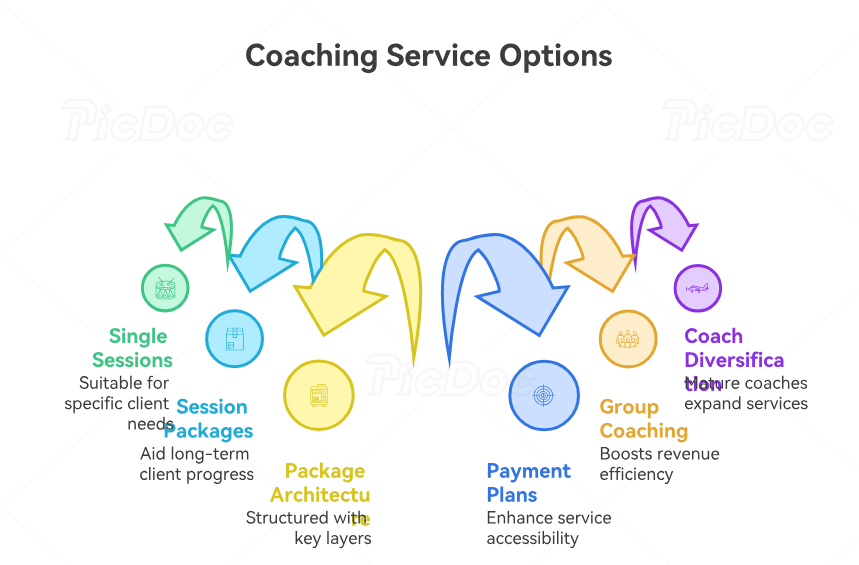
A stronger package architecture contains five layers:
Outcome: What change will the engagement work toward?
Cadence: How frequently should sessions occur for this problem?
Implementation: What happens between calls?
Support boundary: How and when can the client reach you?
Completion: What does the client leave able to do independently?
The CLEAR model, ADKAR model, Wheel of Life, and Positive Intelligence can help structure the journey according to the client's problem.
Payment design also affects accessibility. A $1,200 three-month program could offer:
$1,200 upfront
or
3 monthly payments of $425
The payment plan totals $1,275, accounting for additional collection risk and processing. The specific difference should reflect your payment system and business model rather than functioning as a punitive fee.
Group coaching creates another route. Ten clients paying $400 for a six-week cohort generate $4,000 in gross revenue. A one-to-one equivalent may require far more delivery hours. Coaches with facilitation skill can therefore use group delivery alongside public speaking expertise, leadership coaching, conscious leadership, and cultural competence.
The 2025 ICF study also shows that many coaches diversify beyond pure one-to-one sessions: 60% reported offering training, 57% consulting, 55% facilitation, and 49% mentoring. That does not mean a beginner needs five services immediately. It shows that mature coaching businesses frequently develop multiple revenue mechanisms.
5. When Should a Life Coach Raise Rates?
Raise rates when your own business generates evidence that the current price has become conservative relative to demand, expertise or delivery value.
The cleanest signals are measurable.
Your available capacity stays consistently full
If you have capacity for 12 ongoing clients and carry 10–12 for several months while new qualified inquiries keep arriving, price becomes a logical capacity-management lever. This is especially relevant for specialists offering leadership coaching, career burnout support, public speaking coaching, or couples coaching.
Qualified clients regularly accept without meaningful price friction
Track discovery calls for 60–90 days. Record how many qualified prospects attend, how many receive an offer, how many buy, and why others decline.
If eight qualified prospects hear the price and seven purchase quickly, you have useful information.
If twenty prospects love the concept until pricing appears and eighteen decline specifically because of cost, you have different information.
This is why first-client conversion, client positioning, life coaching economics, and certification ROI need to be evaluated together.
Your expertise has materially deepened
An additional certificate alone provides weak justification for a major increase. Pricing power becomes stronger when education changes the quality, specificity or credibility of what you deliver.
The 2025 ICF study found that 73% of surveyed coaches agreed clients and organizations expect coaches to have a certification or credential, showing that credentials can influence market expectations. Combine training with case experience, stronger coaching ethics, better contracting, clearer duty of care, and sharper cultural competence.
Your niche becomes more commercially valuable
Broad personal-development work competes with books, podcasts, courses, AI tools, communities and thousands of coaches.
Specialization can reduce direct substitution.
“Life coaching” may sell at $100.
“Leadership transition coaching for newly promoted directors managing teams for the first time” may support considerably stronger economics because the buyer, urgency and professional consequences differ.
A coach can sharpen specialization around leadership, career burnout, public speaking, or conscious leadership.
Raise rates in controlled experiments
A new coach charging $100 could quote the next five qualified prospects $120.
Track the result.
If demand remains healthy, keep the new price.
Later, test $140.
This creates a pricing ladder built from purchasing behavior rather than fear.
Existing clients can receive a separate transition. A coach might keep their current rate through the existing package and apply the new rate at renewal, or give 30–60 days' notice before a recurring rate changes. Clear coaching contracts, strong professional guidelines, thoughtful duty of care, and transparent expectations protect trust during that transition.
Rate increases also need restraint. Weak lead volume, unclear positioning, inconsistent coaching quality, poor client retention, or repeated price objections from well-qualified buyers are signals to diagnose the business first.
A pricing increase works best after the coach can say, with evidence: people want this offer, the clients fit, the delivery works, capacity is tightening, and the economics require the next level.
6. FAQs About Life Coach Pricing, Packages and Rate Increases
-
A practical testing range for many new consumer-facing coaches is around $75–$150 for a 50–60 minute session, depending on country, audience, niche, training and existing expertise. Reddit discussions from 2024–2026 repeatedly mention $100–$125 as a reasonable independent starting reference, although Reddit anecdotes cannot represent the entire profession.
Calculate your own sustainable floor using full-time coaching revenue math, client acquisition timelines, positioning fundamentals, and your desired certification ROI.
-
$50 can work strategically for a tightly limited founding-client pilot, supervised practice, a lower-cost community model, or a deliberate accessibility allocation. Building an entire one-to-one business at that rate creates difficult capacity mathematics in many markets.
At $50 per session, $5,000 in monthly gross revenue requires 100 paid sessions. Administrative and acquisition time comes on top of those sessions.
Coaches should understand life coaching income requirements, use clear contracts, build efficient SMART goal systems, and improve client acquisition before locking themselves into unsustainable volume.
-
Packages usually fit problems that require implementation across several weeks. Single sessions fit intensives, maintenance, troubleshooting and narrowly defined decisions.
A coach working on life purpose, career burnout, self-confidence, or leadership development can often create more continuity through six-, eight- or twelve-session engagements.
The package should correspond to the work required rather than functioning as prepaid calendar inventory.
-
Publishing full prices or at least a starting price can help prospects self-qualify. Recent Reddit discussions show prospective clients expressing frustration when pricing only appears after an introductory conversation, while several coaches reported preferring public pricing for the same reason.
Standardized offers lend themselves especially well to transparent pricing. Highly customized corporate engagements may use “starting from” pricing or require a proposal. Strong coaching contracts, clear professional conduct, solid positioning, and realistic income planning make either approach easier to manage.
-
A coach using a $100 baseline could price six sessions around $600, then account separately for assessments, asynchronous support, preparation or additional deliverables.
At $125 per session, the session component becomes $750.
At $150, it becomes $900.
The coach can then use CLEAR, OSCAR, T-GROW, or SMART goals to give the engagement a coherent progression rather than six disconnected calls.
-
A newer coach serving individual consumers might test approximately $900–$1,800 for a well-structured 12-week engagement, depending on session frequency, niche, market, support, experience and client purchasing power.
Specialist and executive programs can extend considerably above that range. Coaches should compare the package with their required annual income, first-client acquisition reality, private-practice economics, and credential investment.
