
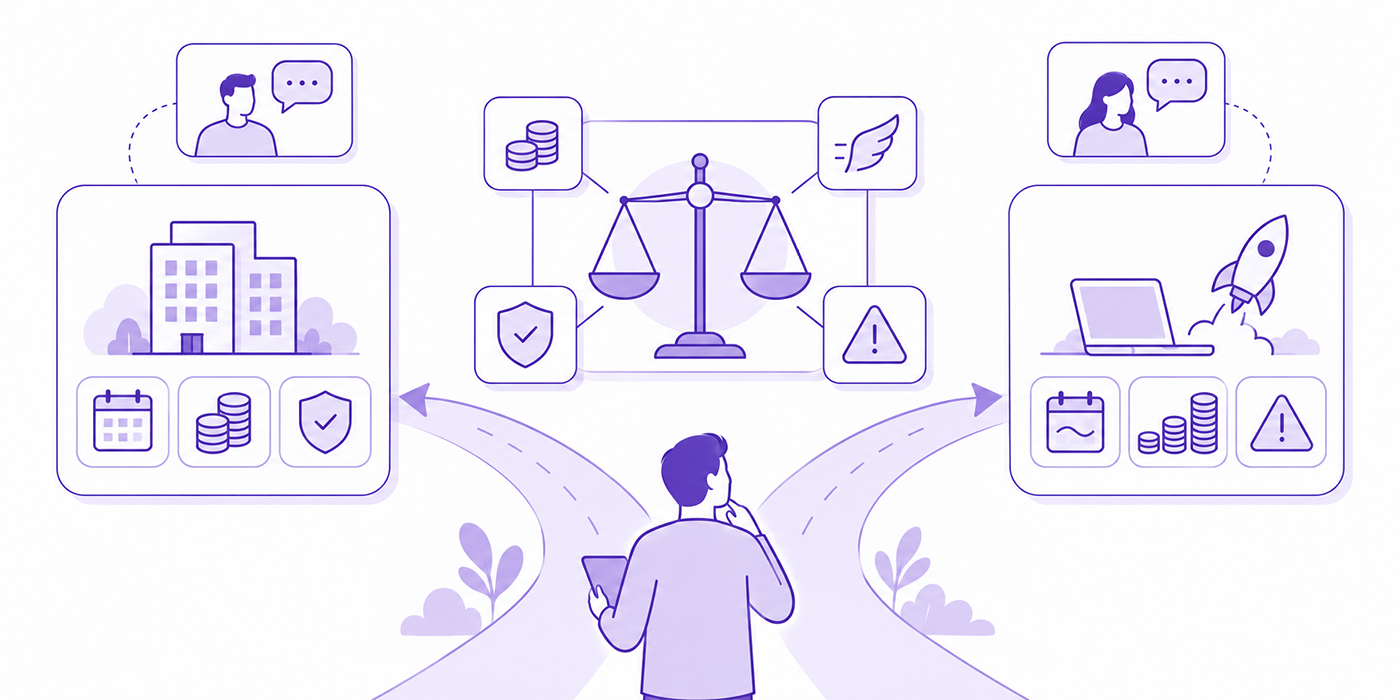
Life coaching can look like one career while hiding two radically different economic lives. An employed coach may sacrifice pricing control for predictable leads, infrastructure, and steadier income. An independent coach gains control over life-purpose coaching, pricing, schedule, and client selection while inheriting sales, retention, and cash-flow risk. Reddit's 2026 discussions expose this tradeoff repeatedly. Coaches trained in behavior change, professional contracting, and coaching ethics can thrive in either model, provided they choose the economics as carefully as the coaching work.
1. Life Coach Jobs vs Private Practice: You Are Choosing an Economic Model, Not Just a Workplace
The first decision is whether you want someone else to solve client acquisition for you.
In a conventional job, coaching sits inside an employer's business. The organization finds customers, establishes pricing, handles payment infrastructure, supplies policies, often provides technology, and decides which outcomes matter. Your responsibility centers more heavily on delivery, documentation, SMART goal setting, appropriate duty of care, measurable progress, and whatever performance standards the employer attaches to the role.
That structure removes a major pain point for coaches who love CLEAR coaching, T-GROW conversations, OSCAR coaching, and genuine client transformation but dislike selling themselves every morning.
Private practice reverses that arrangement. You decide whether to specialize in career burnout coaching, self-confidence coaching, money mindset coaching, leadership coaching, relationships, transition work, executive performance, or another defensible niche. You control your offer and price. You also become responsible for creating enough demand to keep the calendar occupied.
That second responsibility is where many career plans break.
A coach can become excellent at Positive Intelligence, understand Immunity to Change, master the Wheel of Life, and practice rigorous coaching contracting while producing very little income because nobody consistently enters the sales pipeline.
The wider industry is growing. ICF's 2025 Global Coaching Study estimated 122,974 coach practitioners worldwide and $5.34 billion in annual industry revenue. It also found that 59% expected revenue to rise during the following year, mainly through additional clients and sessions rather than higher fees.
Competition is growing alongside demand. That makes expertise in life visioning, transactional analysis, ADKAR, or conscious leadership commercially useful only when it connects to an identifiable buyer and problem.
The job-versus-practice decision should therefore begin with five questions: Who generates demand? Who absorbs an empty calendar? Who controls pricing? Who pays operating costs? Who owns the client relationship?
2. Reddit Career Stories Reveal the Part of Coaching Work Beginners Underestimate
A striking theme in 2026 Reddit discussions is that finding people to coach can be harder than coaching them.
One April discussion came from a coach who already had a well-paying full-time job, performed some coaching through a platform, and led a coaching group at work. The problem was volume: the paid work remained sporadic, and even attempts to recruit free practice clients through personal networks produced little traction.
That experience matters because gaining expertise in life-purpose coaching, using the Wheel of Life, applying life visioning, and learning SMART goal methodology does not guarantee a sufficient number of conversations in which to apply those skills.
Another July 2026 Reddit thread asked coaches what consumes their working day beyond sessions. Responses repeatedly identified marketing, sales, and lead generation, with several experienced commenters describing business-building as the majority of the workload during the early stage.
That changes the freedom calculation dramatically.
Someone attracted to private practice because they want to spend five hours a day doing self-confidence coaching, career burnout work, Positive Intelligence coaching, and CLEAR coaching may discover that Monday afternoon is spent following up with prospects, Tuesday morning on referral outreach, Wednesday on discovery calls, Thursday on invoicing, and Friday reviewing a pipeline that still contains too few qualified buyers.
A separate August 2026 Reddit discussion showed another version of this problem. A coach with four years in business, an ACC credential, a rebuilt website, and Google Ads still reported difficulty generating traction. Credentials can strengthen trust and professional discipline around coaching ethics, contracting, cultural competence, and duty of care. They cannot manufacture product-market fit.
Reddit also provides evidence for the upside.
A licensed therapist discussing a transition into coaching in July 2026 described moving from full-time mental-health employment into a coaching business because of greater schedule flexibility and more control over income. Coaching eventually became the person's primary income source. This illustrates where private practice can be especially powerful: the coach entered entrepreneurship carrying professional expertise, an existing identity, transferable skills, and likely a clearer market proposition than a brand-new generalist.
That same pattern applies to professionals moving from HR into leadership coaching, managers developing conscious leadership, communications professionals adding public-speaking coaching, or experienced practitioners turning career burnout expertise into a specialized service.
Private practice becomes easier when coaching is an extension of credibility rather than the only source of credibility.
3. Income Reality: Compare Paid Hours With Business Revenue, Not Hourly Rates With Session Prices
A salaried coaching role and a $150 private coaching session cannot be compared directly.
A job may pay for meetings, documentation, training, internal communication, cancellations, administrative time, and sometimes benefits. A private client paying $150 funds the entire business that made the session possible.
Current U.S. remote listings demonstrate how wide employed and contract compensation can be. In early September 2026, Indeed showed a Springboard remote career-coach contract role at $24 per hour, while another consulting career-coach listing advertised $50–$100 per hour. Pathstream separately advertised a remote professional coaching and education contract at $40–$50 per hour, requiring at least three years of relevant coaching experience and preferring a recognized coaching credential.
Those listings also reveal an important problem with researching “life coach salary.” The market uses titles such as professional coach, career coach, wellness coach, student-success coach, leadership coach, mindset coach, health coach, and business coach. Compensation reflects the buyer, specialization, underlying qualification, and responsibilities more than the words “life coach.”
That is why developing leadership coaching expertise, public-speaking capability, health behavior-change skills, or a strong career-burnout specialty can affect economic positioning more than simply using the title “certified life coach.”
For private practice, use net revenue per client hour.
Suppose you sell eight sessions for $1,200. The visible rate is $150 per session. Assume acquisition averages $180 per client, payment fees and software consume $60, you spend two unpaid hours on discovery and onboarding, two hours on follow-up and preparation, and one hour managing the account. Your eight client-facing hours actually required 13 working hours and produced $960 after those example direct costs.
That becomes roughly $73.85 per working hour before income tax, insurance, continuing education, general marketing costs, sick days, vacation, and empty calendar capacity.
The math changes again if two clients disappear and your next clients take six weeks to replace.
This is why money mindset coaching principles should never replace actual unit economics. Strong self-confidence helps a coach discuss fees. A structured coaching contract improves boundaries. A strong CLEAR framework improves delivery. Reliable profitability still depends on acquisition cost, conversion, retention, utilization, gross margin, and recurring demand.
Private coaching also has a potentially much higher ceiling because the coach can introduce groups, workshops, retainers, corporate contracts, training, consulting, and facilitation. ICF's 2025 research found that 60% of coaches also provide training, 57% consulting, 55% facilitation, and 49% mentoring.
That diversification can transform the economics of leadership coaching, conscious leadership programs, career burnout workshops, and self-care coaching. It also means that the financially successful “coach” you compare yourself against may receive a significant percentage of income from services outside one-to-one coaching.
4. Choose a Coaching Job When Stability Creates More Value Than Freedom
Employment is particularly valuable during the stage when you need repetition, feedback, and financial breathing room.
A coach developing proficiency with T-GROW, the OSCAR model, SMART goals, and Immunity to Change benefits enormously from consistent client exposure. Fifty real conversations generally teach more about resistance, accountability, trust, ambiguity, and behavior than another fifty hours redesigning a website.
Employer-funded client acquisition can therefore have hidden economic value even when the hourly rate looks disappointing.
The same applies to infrastructure. An employer may supply scheduling, client records, supervision, quality standards, professional development, escalation procedures, and standardized coaching contracts. Those systems help newer practitioners learn why duty of care, cultural competence, and a rigorous professional code affect actual client work.
Employment is also attractive when financial responsibilities make volatility expensive. Mortgage payments, dependents, debt, healthcare costs, and limited savings change the acceptable risk level. A $70,000 job and a hypothetical $120,000 business should be compared using probability-adjusted income, benefits, workload, and downside protection.
Organizational coaching demand itself remains meaningful. ICF's 2025 research says more than half of coaching clients are employer-sponsored, reinforcing the importance of organizations as purchasers of professional coaching. This supports opportunities around leadership coaching, career burnout, conscious leadership, and workplace behavior change.
The tradeoff is control.
Your employer may determine which clients you coach, how long sessions last, which goal-setting process you follow, how performance is measured, and how much documentation accompanies each interaction. A coach drawn to deep life visioning, exploratory life-purpose work, or individualized transactional analysis may eventually find a standardized delivery model restrictive.
A coaching job works best when what you need most is paid repetition and reduced business risk.
Private practice works best when what you already possess is marketable expertise plus a reliable way to reach buyers.

5. Build a Private Practice Through Proof, Pipeline and Runway Instead of a Leap of Faith
The strongest transition strategy is usually a controlled experiment.
Phase one is market validation. Before leaving employment, define one population and one costly problem. “I do self-confidence coaching” describes a method. “I help recently promoted technical managers stop avoiding difficult leadership conversations” identifies a buyer and business problem. You could then use leadership coaching, conscious leadership, CLEAR coaching, and SMART goals inside a commercially understandable offer.
Talk to at least 20 people matching the target profile before spending heavily on branding. Identify how they describe the problem, what they already tried, what delay costs them, who influences the purchase, and what outcome would justify paying.
Phase two is paid validation. Sell the smallest credible version of the service. Ten paying clients reveal more about willingness to pay than 10,000 social impressions. Track discovery-call conversion, average revenue per client, sessions delivered, acquisition source, retention, referrals, delivery hours, and unpaid support time.
Reddit's August 2026 discussion about inconsistent coaching businesses reflects this exact issue: coaches can publish repeatedly and still experience random client flow because attention and conversion are separate systems. Some contributors reported that direct relationships, invitations, referrals, and actually letting prospects experience the work produced stronger results than depending entirely on one-to-many content.
That logic works particularly well for relationship-driven services such as career burnout coaching, couples coaching, life-purpose coaching, and leadership coaching, where buyers often need considerable trust before purchasing.
Phase three is channel diversification. Aim for three acquisition engines rather than ten social platforms. One might be referrals. One could be direct professional networking. A third could be search, partnerships, workshops, employer contracts, speaking, newsletters, or highly focused content.
Someone specializing in public-speaking coaching might partner with professional associations. A career-burnout coach could build HR relationships. A self-care coach might develop wellness partnerships. A leadership coach can use former executive networks rather than trying to become a generic social-media influencer.
Phase four is financial runway. Calculate your minimum personal monthly requirement, business overhead, tax reserve, and insurance costs. Then determine how many months you can survive if revenue drops by 30–50%.
Set a transition trigger before emotion becomes involved. A cautious example could require the practice to generate 60–70% of required take-home income for six consecutive months, maintain at least six months of personal runway, produce clients from at least two independent channels, and demonstrate a repeatable offer.
The percentages are planning thresholds rather than universal rules. Someone with substantial savings can tolerate greater volatility. Someone supporting a family may require considerably stronger evidence.
Phase five is operational discipline. Establish professional contracting, a clear coaching code of conduct, appropriate duty-of-care procedures, and culturally competent practice before scaling. Separate coaching from therapy, medical treatment, legal advice, financial advice, or other regulated activities when the engagement could drift beyond your competence.
Then design capacity intentionally.
If 20 private clients generate enough income, building toward 45 may destroy the very freedom you wanted. Group programs, corporate retainers, workshops, facilitation, consulting, and training can increase revenue without multiplying one-to-one sessions indefinitely. Those extensions fit naturally beside Positive Intelligence, ADKAR change work, conscious leadership, and career burnout coaching.
Freedom becomes sustainable when it is supported by systems rather than dependent on constant hustle.
6. FAQs About Life Coach Jobs vs Starting Your Own Practice
-
Yes, although searching only “life coach” misses much of the market. Current roles appear under professional coach, career coach, success coach, wellness coach, mindset coach, health coach, employee coach, and related titles. September 2026 listings include both salaried and contract opportunities, with compensation varying substantially by specialty and required credentials. Experience in leadership coaching, career burnout, behavior change, and professional ethics can widen the roles you can credibly target.
-
Its ceiling can be substantially higher because you control pricing, packages, groups, workshops, and adjacent services. Income also carries greater variance. A coach charging premium rates for leadership coaching, self-confidence work, life-purpose coaching, or career burnout coaching still needs sufficient utilization after acquisition costs, cancellations, administration, and unpaid selling time.
-
Use revenue stability rather than a raw client number. Twelve $100 clients and twelve $1,000 clients create completely different businesses. Track recurring revenue, concentration risk, retention, acquisition source, and personal runway. Build clear coaching contracts, dependable goal-setting processes, strong duty-of-care boundaries, and a repeatable behavior-change process before making income entirely dependent on the practice.
-
Client acquisition. Recent Reddit conversations repeatedly describe coaches struggling more with marketing, sales, positioning, and lead generation than session delivery. Becoming highly competent in CLEAR coaching, T-GROW, Positive Intelligence, and life visioning develops the service. Building a pipeline develops the business.
-
Platforms can reduce acquisition friction while preserving remote flexibility, making them useful bridges between employment and entrepreneurship. Hours and demand may still fluctuate. One 2026 Reddit coach reported having platform access while receiving coaching work too sporadically to generate the desired practice volume. Examine guaranteed hours, cancellation compensation, client assignment, non-compete terms, contracting obligations, ethical requirements, and actual utilization before treating a platform acceptance as dependable income.
-
The strongest niches usually have a recognizable buyer, painful problem, credible coach, and measurable value. Leadership coaching, career burnout coaching, public-speaking coaching, self-confidence coaching, and health behavior-change coaching can all become commercially viable when positioned around a sufficiently specific population and outcome. A narrow title alone does not create demand.
