
Health coach certification can qualify you for far more than one-to-one private practice, but employers screen for a different package than most training programs teach. The strongest candidates pair credible training with board-certification awareness, demonstrable behavior-change skills, clear professional boundaries, population-specific experience, and evidence that they can work inside structured systems. Understanding where health-coaching demand actually exists and why qualified coaches still struggle to get hired can save months of applying to roles that were never a realistic fit.
1. What Health Coach Jobs Actually Look Like After Certification
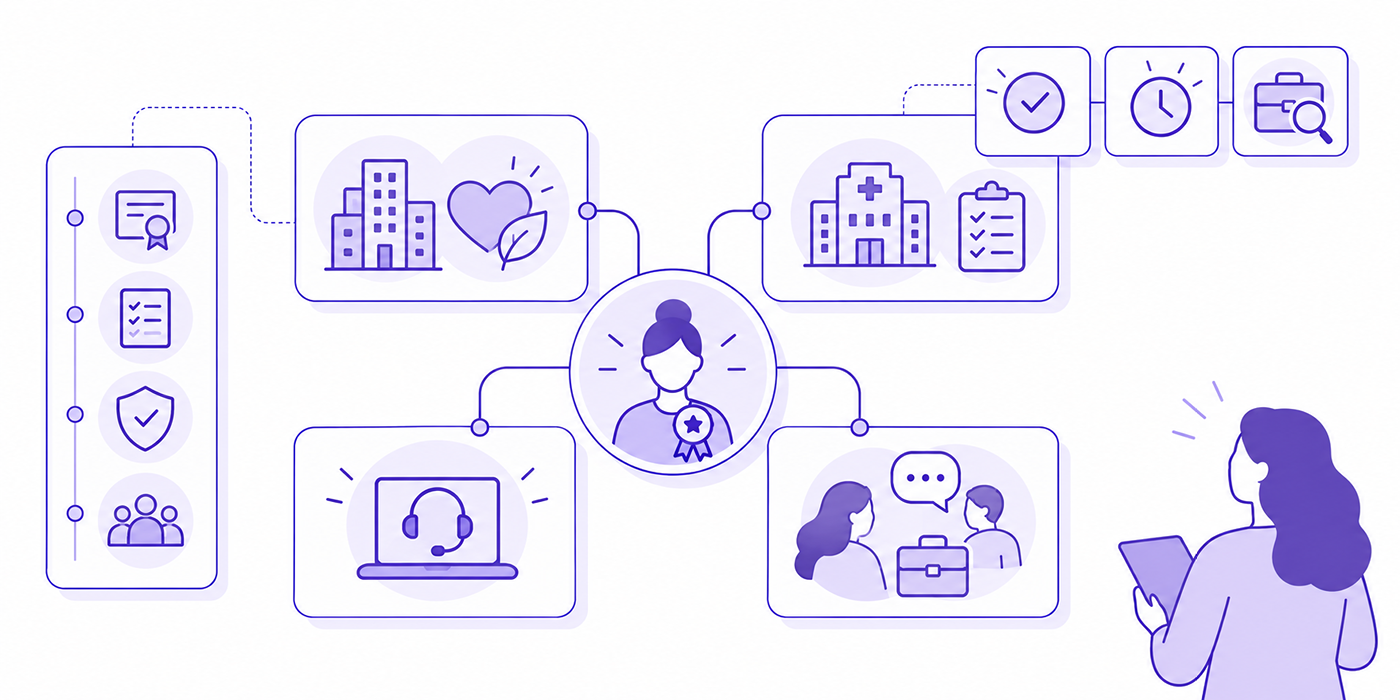
The first mistake after certification is searching only for the exact title “health coach.” Employers distribute coaching work across digital health companies, benefits vendors, hospitals, wellness programs, employee-assistance platforms, universities, population-health teams, insurance programs, fitness businesses and care-navigation services. Someone who understands health coaching career ROI, client behavior-change systems, structured goal tracking, and professional coaching agreements can therefore compete for a much wider employment pool than a certification title suggests.
Current U.S. postings illustrate how broad the work has become. A September 2026 Future posting described virtual coaching across movement, nutrition, sleep, stress, messaging and health-data interpretation, while requiring recognized coach training and at least two years of client-facing experience. A Vida listing required a health-related degree, NBHWC-approved training and three years of post-certification coaching experience. Sharecare advertised structured remote coaching involving motivational interviewing, documentation, software navigation and high-volume participant outreach.
That means your post-certification value comes from a skill stack, not the certificate alone. Employers can assess whether you understand SMART goal construction, can use feedback systems to measure outcomes, maintain appropriate duty of care, and communicate effectively with people whose health literacy, culture and readiness for change differ. Building cultural competence in coaching becomes particularly important when employers serve thousands of geographically and demographically diverse members.
The distinction between training certificate and board certification also matters in employer screening. NBHWC states that graduates of approved programs become eligible to pursue the national board pathway, while NBC-HWC certification additionally involves meeting eligibility requirements and passing the board examination. NBHWC tells employers that board certification provides a standardized signal around training, competency, ethics and scope. If organizational employment is your goal, understanding the health coach certification versus NBHWC pathway, the ICF versus NBHWC distinction, and the wider economics of a health-coaching career should happen before another expensive credential is purchased.
2. Corporate Wellness Requirements: What Employers Actually Screen For
Corporate wellness hiring becomes much easier to understand when you separate requirements into credential, evidence, operating skills and population fit. Certification can satisfy one screening field. Hiring managers still need evidence that you can coach effectively at volume, document correctly, communicate across channels and work inside the employer’s service model. That is why learning how to create useful coaching dashboards, how feedback improves coaching outcomes, how habit-formation tools support adherence, and how coaching automation affects workflows can make you substantially more employable.
Credential fit comes first. Some organizations accept a recognized health-coach certificate. Others specifically prefer or require training from an NBHWC-approved program, NBC-HWC board certification, ICF credentials, a health-related degree or some combination. A current Vida posting, for example, required a health-related degree and NBHWC-approved coaching training, while a Future posting accepted several recognized coaching qualifications and strongly preferred NBC-HWC status. This is why candidates should compare life-coach certification ROI, ICF and NBHWC career pathways, and board-eligibility requirements against actual target job descriptions before paying for another program.
Motivational interviewing and behavior change are practical hiring skills. Corporate roles often involve members who missed previous goals, stopped engaging, received alarming health information or enrolled because an employer benefit placed the program in front of them. Employers therefore need coaches capable of eliciting motivation rather than delivering lectures. Techniques connected to strength-based coaching, Immunity to Change, Positive Intelligence approaches, and structured CLEAR coaching conversations can broaden your toolkit, provided each method stays inside your professional scope.
Digital fluency now matters because coaching increasingly happens inside platforms. Sharecare’s 2026 posting described coaches moving between telephonic interactions, participant documentation, software and structured workflows. Future’s role combines video coaching, ongoing messaging and health-data interpretation. A candidate comfortable with coaching CRM systems, digital goal tracking, custom client dashboards, and coaching-business technology has a more credible answer when an interviewer asks how they manage dozens of active participants without losing follow-up tasks.
Documentation and boundaries can determine whether a skilled coach survives in healthcare-adjacent settings. NBHWC defines coaching around client-directed behavior change and makes clear that health coaches do not diagnose, prescribe or provide medical treatment through the coaching credential. Candidates should therefore understand professional duty of care, coaching codes of conduct, clear coaching contracts, and the distinctions involved in a mental-health coaching career.
A painful hiring trap appears when a newly certified applicant keeps targeting jobs requiring two or three years of post-certification coaching. The solution is to build verifiable experience before waiting for the perfect full-time opening. Run supervised practice sessions, facilitate small groups, deliver workplace workshops, support a nonprofit program, take an appropriate contract assignment or build a controlled pilot cohort. Combine that exposure with surveys that capture outcomes, structured client goal tracking, habit adherence systems, and clear professional contracting. Six months later, your résumé can contain evidence rather than course descriptions.
3. What Reddit Hiring Experiences Reveal About the Post-Certification Market
Reddit discussions from working and aspiring coaches repeatedly surface the same friction: certification improves eligibility while experience, networking and role fit often determine who gets the offer. One 2025 thread included a coach who had worked across corporate wellness and coaching companies for years and emphasized credentials, networking, delivery modality and experience with the employer’s target population. Another commenter described acquaintances working at organizations including Omada Health, Trustmark and Personify Health. These are individual experiences rather than labor-market statistics, but they expose useful hiring mechanics.
That pattern explains why someone can complete strong health-coach training, understand behavior-change tools, practice a proven T-GROW coaching framework, and still struggle for interviews. Their résumé may say “certified health coach” without demonstrating caseload size, coaching hours, engagement rate, group facilitation, virtual delivery, documentation, target-population experience or measurable outcomes. Employers cannot infer those capabilities from the certificate.
A second Reddit pattern concerns board certification as a door opener rather than an employment guarantee. Posters looking at corporate roles frequently report seeing NBC-HWC or another recognized credential requested or preferred. Other posters describe continuing difficulty even after obtaining advanced credentials. This is precisely why the decision should be based on your target employer list. Study 30 to 50 openings, compare the required credentials, then decide whether NBHWC board eligibility, ICF credentialing, stronger public-speaking capability, or better client-outcome tracking closes the largest recurring gap.
Compensation deserves equal scrutiny. Current postings show meaningful variation. Sharecare listed $21.50 per hour for one remote health-coach opening and $25 with specified certification, while Future advertised $30 to $40 per hour for a role demanding significant coaching experience. Reddit contributors have also warned about low-paid, high-volume “coaching mill” positions and described contract arrangements where compensation, cancellation policies and client volume materially changed the economics. These figures are examples rather than universal market rates. Anyone evaluating an offer should run the same realistic health-coach revenue math they would use for private practice.
For contract work, calculate effective hourly compensation, including charting, preparation, unpaid no-shows, required meetings, asynchronous messaging and administrative time. A nominal session rate can look attractive while business benchmarking, client-management systems, coaching automation, and simple revenue analysis reveal that unpaid work consumes the margin. This is one reason a first coaching job should be evaluated for experience quality, financial sustainability and résumé value simultaneously.
4. Roles Beyond Private Practice That Certified Health Coaches Should Target
A serious job search should use role families instead of one job title. Start with direct coaching titles such as health coach, wellness coach, lifestyle coach, behavior-change coach and wellbeing coach. Then expand toward engagement, navigation and program roles where coaching communication, goal-setting expertise, habit-change methodology, and strength-based techniques create direct value even when “coach” disappears from the title.
Corporate wellness can include employee coaching, wellbeing programming, workshops, challenges, benefits engagement and health education. Coaches who also understand leadership coaching, career burnout coaching, public-speaking coaching, and conscious leadership can become especially useful when wellness programming has to work across managers, teams and organizational cultures.
Digital health rewards another combination: excellent coaching plus operational discipline. A coach may conduct short video sessions, respond through secure messaging, document interactions, review participant data, follow escalation pathways and manage a high-volume caseload. Your familiarity with coaching dashboards, CRM systems, feedback tools, and automated coaching workflows therefore becomes part of your hiring story rather than merely a business-owner skill.
Care navigation and patient engagement can provide an important bridge for newly certified coaches who lack years of formal coaching employment. These roles can develop member communication, health-system navigation, follow-up, documentation and interdisciplinary collaboration. They also force you to practice duty-of-care judgment, ethical coaching conduct, culturally competent communication, and appropriate boundaries with issues that belong to mental-health professionals.
Group coaching and education offer another route. Employers need people who can turn wellness concepts into usable experiences rather than 60-minute information dumps. Build sessions around Wheel of Life assessments, SMART goal planning, ADKAR change principles, or strength-based coaching, then capture attendance, participant feedback and follow-through. That creates portfolio evidence an employer can evaluate.
Your previous career can also become a hiring advantage. A teacher may fit student-wellness programs. A nurse may offer healthcare fluency. A recruiter may understand employee populations. A fitness professional may fit activity-focused programs. A manager may transition toward leadership development. A financial-services professional may combine behavior change with financial coaching. Someone with relationship-work experience might eventually specialize through relationship coaching or couples coaching. Employers often hire the coach who understands their population, not simply the candidate with the longest credential list.

5. A 90-Day Plan to Turn Certification Into Employable Evidence
Days 1–15: reverse-engineer the market. Collect 30 to 50 realistic openings across health coaching, wellness, member engagement, lifestyle coaching, care navigation and digital health. Build a spreadsheet with columns for credential, degree, experience, population, delivery mode, technology, coaching methodology and schedule. Compare those patterns against your certification pathway, career-income expectations, business benchmarks, and existing coaching skill set. Your next investment should attack the most frequent hiring gap.
Days 16–30: create a proof portfolio. Include an anonymized coaching workflow, sample session structure, goal-tracking template, follow-up message, group-workshop outline, referral decision example and outcome dashboard. Show that you understand contracting, interactive goal tracking, client feedback, and ethical professional conduct. Remove identifying client information. The purpose is to make invisible coaching competence visible.
Days 31–45: accumulate targeted experience. Choose a population that appears repeatedly in your target jobs and coach within an appropriate supervised, volunteer, contract or pilot setting. Track sessions, delivery formats and outcomes. If adherence is the problem, use habit-formation tools. If resistance dominates, deepen your understanding of Immunity to Change. If clients struggle with confidence, examine self-confidence coaching. Purposeful experience beats collecting random hours that do not resemble your target role.
Days 46–60: rewrite the résumé around employer evidence. “Provided health coaching” says almost nothing. “Delivered 80 virtual coaching sessions across video and phone, documented goals and follow-ups, supported adults with sleep, activity and stress behavior-change goals, and maintained structured progress tracking” gives the recruiter something to evaluate. Use the same principle behind coaching-business benchmarking, client dashboards, CRM tracking, and survey-based outcome measurement: quantify what can be responsibly quantified.
Days 61–75: network around the hiring system. Connect with employed coaches, wellness-program managers, health-tech operations staff and coaching leaders. Ask what their company screens for, which populations are growing, what makes applicants fail interviews and which adjacent roles create viable entry points. Reddit experiences indicate networking has helped some coaches reach opportunities in a competitive field. Bring value into those conversations by knowing current coaching career realities, credential differences, corporate communication skills, and workplace burnout problems.
Days 76–90: apply in narrow batches and diagnose the result. Ten tailored applications to roles matching 70–90% of your profile can teach you more than 100 random applications. Zero recruiter screens usually points toward résumé positioning, credential mismatch or applicant competition. Screens without interviews suggest weak storytelling or role fit. Interviews without offers can expose coaching-demo, case-study, technology or communication gaps. Treat the job search like client goal tracking: collect evidence, identify the constraint and adjust one variable. Coaches who already understand feedback loops, SMART goals, and change-management principles should apply the same discipline to their own career transition.
6. FAQs About Getting a Health Coach Job After Certification
-
You can pursue entry-level coaching, contract, engagement, wellness-support and adjacent roles immediately, while individual employers may require prior coaching experience, a health-related degree or board certification. Current postings demonstrate substantial variation in requirements. Build experience quickly through appropriate supervised sessions, groups, workshops or contract assignments while strengthening goal-tracking capability, coaching ethics, behavior-change techniques, and client feedback systems.
-
Requirements vary by employer. NBHWC says many healthcare systems, wellness programs and digital-health organizations seek its board credential, while current openings show combinations ranging from recognized health-coach certification to NBHWC-approved training, preferred NBC-HWC status, specific degrees and experience thresholds. Compare NBC-HWC pathways, ICF versus NBHWC, certification ROI, and your target employers before investing further.
-
Search wellness coach, lifestyle coach, behavior-change coach, member engagement specialist, wellness program coordinator, care navigator, patient engagement specialist, wellbeing specialist, population-health coach, group coach, health educator and wellness operations roles. Then align your résumé with transferable capabilities such as leadership coaching, public speaking, CRM management, and digital coaching systems.
-
Create targeted experience that resembles the job. Facilitate groups, coach an appropriate pilot population, support a nonprofit wellness initiative, pursue viable contract work, conduct workshops or enter through care-navigation and member-engagement roles. Capture anonymized evidence using coaching dashboards, feedback surveys, habit tracking, and clear coaching agreements. Experience becomes valuable when a recruiter can see what you actually did.
-
The pressure changes. Organizational coaching can reduce the need to constantly market for individual clients, while some positions introduce caseload targets, documentation requirements, fixed schedules, outreach quotas, technology demands and back-to-back sessions. Reddit accounts describe both sustainable arrangements and frustrating high-volume environments. Evaluate workload alongside realistic income math, business benchmarks, burnout awareness, and contract terms.
-
A health coach can support client-directed behavior change and self-management while remaining within their training, credential and applicable legal scope. NBHWC describes coaches as partners who help clients pursue self-determined health goals and follow treatment plans created by appropriate healthcare professionals. Strong practitioners understand duty of care, ethical boundaries, appropriate contracting, and when issues require mental-health or clinical referral.
