
Getting a first paying coaching client can take weeks, months, or more than a year, and the difference usually comes from trust, positioning, prospect volume, and sales activity rather than coaching ability alone. Coaches who understand digital marketing, maintain a disciplined client CRM, track business benchmarks, and use thoughtful coaching automation can diagnose why clients are not appearing instead of waiting indefinitely for “visibility” to turn into revenue.
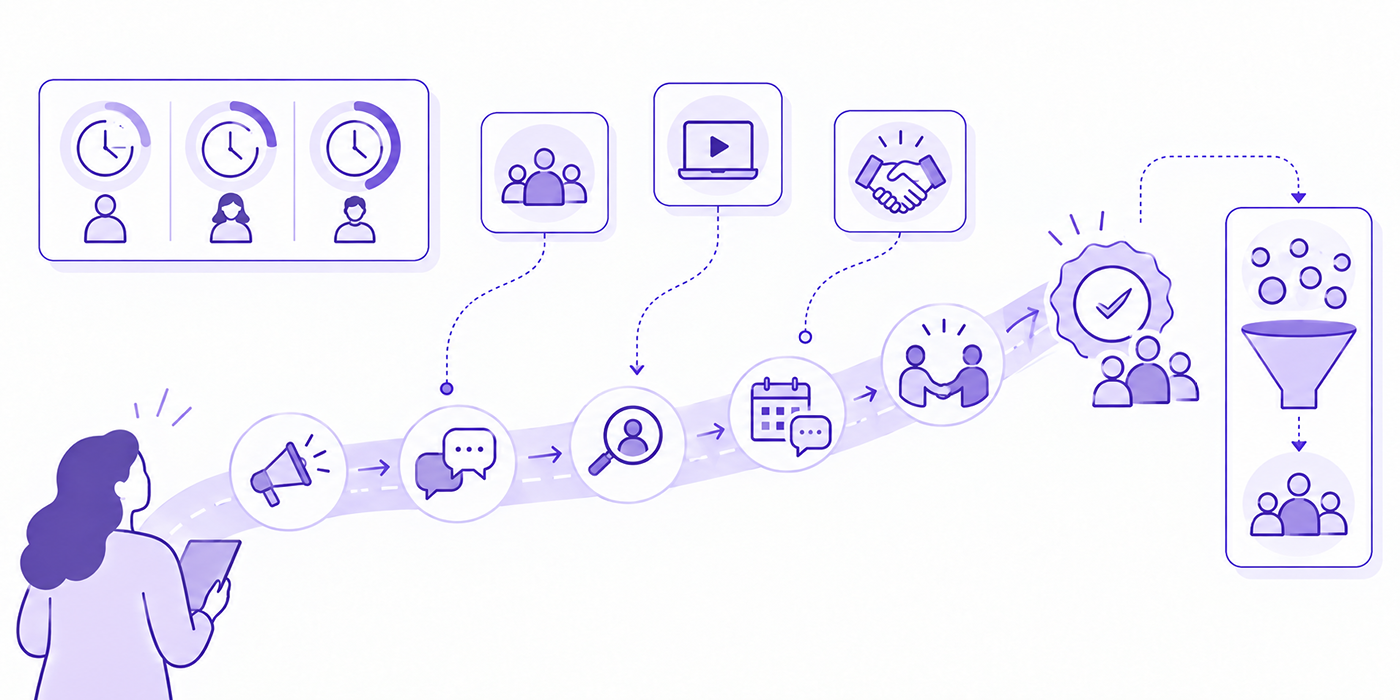
1. How Long Does It Actually Take to Get Your First Coaching Client?
Reddit provides a useful reality check because coaches describe dramatically different starting timelines. In one 2025 life-coaching discussion, self-reported answers included under 60 days, about two months, three months, and six months to a first paying or organic client. One contributor who reached a first organic client after three months said it took roughly another year to develop a steadier income stream. Another reported a first paying client after six months, followed by more business through referrals and word of mouth.
Another coach reported waiting more than a year while building the practice alongside full-time employment before an in-person relationship produced the first client. These anecdotes are useful precisely because they destroy the fantasy of a standard 30-, 60-, or 90-day timeline. They are personal experiences rather than a representative industry survey, so they should be used to understand possible trajectories rather than predict an individual's outcome.
The important variable is activity density.
Someone spending six months completing certifications, adjusting a logo, rewriting a website, and occasionally posting motivational content has experienced six calendar months but perhaps only two weeks of genuine client acquisition. Someone else may spend 30 days conducting 40 warm conversations, attending four professional events, requesting introductions, publishing niche-specific content, making partnership approaches, and conducting discovery calls. Their calendars say one month; their markets have received dramatically different exposure.
That distinction should shape how new coaches approach coaching business benchmarking, digital marketing systems, client relationship management, feedback collection, and business automation. Measure attempts and conversions before measuring months.
The market is also becoming more competitive. The 2025 ICF Global Coaching Study estimates 122,974 coach practitioners worldwide, up 15% since 2023. ICF reports that 59% of coaches expect increased revenue over the following year, primarily through more clients and more sessions rather than increased fees. A growing market can therefore create more opportunity and more competition simultaneously.
Credentials can help with trust—the same ICF research reports that 73% of coaches agree clients and organizations expect certification or credentials—yet qualifications still need to be paired with a clearly understood problem. Someone selling generic personal improvement faces a different acquisition challenge from a specialist in career burnout coaching, relationship coaching, leadership coaching, money mindset coaching, or self-confidence coaching.
A useful first-client timeline therefore looks like this:
Time to first client = relevant prospects reached × trust generated × offer relevance × conversion skill × follow-up consistency.
If one factor is close to zero, waiting another three months rarely fixes the equation.
The table below turns that principle into an acquisition map. The timing columns are planning ranges, rather than guaranteed industry averages. They are designed to help a new coach decide where immediate effort is most likely to create conversations.
2. Which Lead Sources Get New Coaches Their First Clients Fastest?
For a new coach, warm proximity usually beats raw reach.
Reddit discussions repeatedly mention networking, referrals, LinkedIn connections, local events, professional associations, community participation, talks, blogging, and existing relationships as first-client sources. A January 2026 discussion contained multiple recommendations around local events, associations, NGOs, networking, blogging, and referrals. A separate discussion from 2024 included coaches describing early clients coming through friends, LinkedIn contacts, referrals, social media, and speaking opportunities.
That pattern makes economic sense. A warm prospect already possesses something an Instagram stranger lacks: context.
They may know your professional history, competence, temperament, communication style, or reputation. That dramatically reduces the trust-building work required before someone pays you. New coaches should therefore inventory previous careers and networks before attempting sophisticated digital marketing campaigns, implementing elaborate coaching dashboards, building complex automation systems, or optimizing client feedback infrastructure.
Do not send everyone you know an awkward message asking whether they “need a life coach.” Describe the problem you solve.
A career burnout coach might ask former colleagues whether they know professionals struggling to recover from chronic overwork without damaging career momentum. A relationship coach could build relationships with professionals serving people through major relationship transitions. Someone specializing in public-speaking coaching can connect with founders, sales teams, professional organizations, and event communities. A leadership coach has a natural route into managers, HR professionals, and former workplace networks.
The second valuable source is adjacent trust.
Therapists, recruiters, HR professionals, fitness professionals, consultants, financial professionals, educators, community leaders, and business owners already interact with people who may encounter problems suitable for coaching. Partnership development works best when the boundary is clear. Strong coaching contracts, appropriate duty of care, a professional coaching code of conduct, and cultural competence make referral relationships easier to trust.
The third source is authority content tied to commercial intent.
Content should diagnose situations people already want to solve. Compare “Five Ways to Believe in Yourself” with “Why You Keep Freezing During Promotion Interviews Even Though You Know the Answers.” The second creates sharper problem recognition and fits naturally with self-confidence coaching, career coaching problems, structured visualization methods, and practical SMART goal interventions.
Content becomes commercially useful when every piece has a job: attract the correct person, sharpen awareness of the problem, establish competence, remove an objection, or create a next step. Posting daily without knowing which function a post performs is activity without strategy.
3. What Conversion Benchmarks Should a New Coach Track?
There is no credible universal benchmark saying that a life coach should convert exactly X% of Instagram followers, Y% of leads, or Z% of discovery calls. Audience temperature, price, niche, geography, reputation, qualification, and sales process vary too much.
There are useful external reference points. Unbounce's 2024 benchmark dataset covered more than 41,000 landing pages, 464 million visitors, and 57 million conversion actions. It found a 6.6% median landing-page conversion rate across industries and 6.1% for commercial and professional services. For professional-services landing pages, email traffic converted at a median 13.9% in its dataset. These figures describe landing-page actions, rather than coaching purchases, but they demonstrate why traffic quality and channel matter.
Historical ICF client research also found personal referrals and word of mouth highly influential in coach selection: 46% of surveyed clients consulted that source, and 38% called it the most influential source. The study is old enough that it should be treated as historical evidence rather than a 2026 acquisition benchmark, yet the trust mechanism remains relevant.
For operating the business, create your own funnel benchmark:
Relevant exposure → engaged prospect → qualified lead → booked consultation → attended consultation → paying client → retained client → referral.
Track each transition through a coaching CRM, compare monthly performance through business benchmarking, automate administrative follow-up with coaching technology, and capture post-sale insights using client feedback tools.
For an early practice, a 25% qualified-call-to-client close rate is a useful internal planning assumption—not a published coaching-industry average. At that planning rate, four genuinely qualified consultations produce one client.
Work backward:
Want 2 new clients per month? Plan for approximately 8 qualified consultations.
If 80% of booked qualified prospects attend, you need approximately 10 bookings.
If one in four qualified conversations produces a booking, you need roughly 40 appropriate conversations.
Over 20 working days, that means approximately two useful prospect conversations per day.
Now the vague anxiety of “nobody is booking me” becomes measurable.
If you conduct 40 relevant conversations and book zero discovery calls, investigate offer relevance, trust, positioning, or call-to-action clarity.
If you book ten calls and only five attend, investigate qualification, reminder systems, scheduling friction, and business automation.
If ten qualified prospects attend and none buys, investigate the offer, pricing logic, credibility, consultation process, and whether your coaching contract makes the engagement understandable.
If clients buy but leave quickly, the acquisition problem has become a delivery or fit problem. Strengthen goal tracking, habit formation support, strength-based coaching, client feedback, and outcome alignment through a suitable model such as T-GROW.
That diagnostic discipline prevents one of the costliest new-coach mistakes: changing everything at once.
4. What Should You Do in the First 30 Days to Get Coaching Clients?
Treat the first month as a market-learning sprint, rather than a content-production challenge.
During week one, define one buyer, one expensive problem, one outcome, and one primary offer. A coach cannot evaluate conversion when every prospect hears a different proposition. Use life purpose coaching, career burnout coaching, financial coaching, relationship coaching, and leadership coaching as examples of how a broad profession can be translated into recognizable client problems.
Then build a list of 100 people and organizations, divided into five categories:
People who could realistically become clients.
People who know suitable clients.
Professionals serving the same audience without competing directly.
Communities where the target audience already gathers.
Organizations that could purchase coaching for others.
Put those relationships into a CRM system, assign clear follow-up dates through automation, and measure conversations through business benchmarking. Memory becomes unreliable almost immediately once multiple conversations are active.
During week two, prioritize conversations over broadcasting. Ask target buyers how they describe the problem, what they have tried, what failure costs them, what would make them seek help, and what makes them distrust coaches. This is commercial research. The same discipline behind client surveys, interactive goal tracking, and custom coaching dashboards should be applied before the client relationship begins.
During week three, publish content based on language collected from real conversations. If professionals repeatedly say, “I know I should leave this job but I'm terrified I'll regret it,” that sentence contains more commercial intelligence than a generic post about courage. Connect such problems to concrete interventions such as SMART goals, Immunity to Change, Positive Intelligence, visualization techniques, or the CLEAR coaching model where professionally appropriate.
During week four, inspect conversion.
Which source generated conversations? Which conversations became consultations? Which objections repeated? Which prospects vanished after seeing the price? Which prospects wanted a different outcome? Which referral partners responded? Which content created actual inquiries?
That data becomes the second month's strategy.
The goal of a 30-day sprint is therefore larger than “get one client.” You are constructing a primitive client-acquisition engine that can later be improved through digital marketing, CRM discipline, coaching automation, business benchmarks, and feedback loops.

5. Why Do Some Coaches Stay Clientless for Months Despite Constant Marketing?
One common cause is visibility without buyer relevance.
A coach can receive thousands of views while communicating nothing that causes a suitable buyer to think, “This person understands my problem.” Generic motivation competes against millions of free posts, books, podcasts, videos, and AI-generated advice. Specific expertise creates a different comparison.
Consider the commercial difference between “I help people unlock their potential” and an offer built around career burnout, couples coaching, money mindset, public speaking, or leadership development. The latter group gives buyers a reason to self-identify.
Another cause is insufficient sales volume disguised as poor conversion.
Three discovery calls across four months provide too little data to conclude that pricing is wrong. Seven Instagram posts cannot prove Instagram “doesn't work.” One networking event cannot prove networking fails. A website that receives 40 visitors cannot meaningfully test an SEO strategy.
Set minimum evidence thresholds.
Before radically changing an offer, collect roughly 15–20 qualified sales conversations. Before declaring a message ineffective, test it across enough suitable prospects to observe a pattern. Before abandoning follow-up, measure how many prospects convert after the second, third, or later contact. Record all of this in a CRM, analyze it through business benchmarks, and remove administrative friction through coaching automation.
Another major leak is trust.
A buyer considering coaching may wonder whether you are qualified, whether the method is credible, whether you understand their situation, whether confidentiality will be respected, whether coaching is appropriate for their problem, and whether the engagement has boundaries. Trust is strengthened through professional contracting, clear duty of care, a defensible code of conduct, cultural competence, and evidence of structured delivery through approaches such as OSCAR.
One 2026 Reddit discussion from a long-term full-time coach reported that roughly 80% of that coach's business came through natural referrals, while other clients had come through webinars, trainings, and shared emails. That is a single practitioner's experience rather than an industry benchmark, but it illustrates what can happen once strong client outcomes begin feeding acquisition.
That creates the long-term flywheel:
Good targeting → suitable client → strong coaching fit → meaningful outcome → testimonial/referral → warmer next prospect → higher conversion efficiency.
Tools such as goal tracking, habit-formation support, strength-based coaching, client feedback, and coaching dashboards therefore contribute indirectly to future acquisition as well as current delivery.
Your first client is difficult because the flywheel has not started yet. Your job is to manufacture enough trustworthy contact with the right market to start it.
6. FAQs About Getting Your First Coaching Clients
-
Reddit experiences range from under two months to six months and beyond a year, demonstrating how misleading a universal timeline would be. Judge progress using qualified conversations, booked calls, close rate, and follow-up activity. A disciplined CRM, strong marketing system, measurable business benchmarks, and sensible automation provide far better evidence than calendar time alone.
-
Warm relationships, introductions, existing professional networks, local communities, and referrals generally have the greatest early advantage because trust already exists. Reddit discussions repeatedly mention referrals, networking, LinkedIn, events, associations, and existing relationships. Sharpening the offer around a recognizable field such as career burnout, relationship coaching, leadership coaching, or self-confidence coaching makes introductions substantially easier.
-
Avoid drawing conclusions from three or four conversations. A practical working threshold is 15–20 genuinely qualified sales conversations before making a major positioning decision, while documenting objections and patterns. Track the process using client relationship management, compare it against business benchmarks, and use feedback methods to understand rejection rather than guessing.
-
There is no authoritative universal life-coaching close-rate benchmark. For planning purposes, 25% of genuinely qualified discovery calls is a useful starting assumption: approximately four qualified calls for one client. Treat that as an internal management target. If your result is substantially lower after enough calls, inspect qualification, offer clarity, trust, pricing, and coaching contracts. Combine that analysis with CRM tracking, business benchmarking, and marketing analytics.
-
Selective free or reduced-fee work can generate practice, market feedback, and early proof when the arrangement has a defined purpose, duration, scope, and expectation. Endless free coaching can distort demand and attract people with little purchase intent. Protect the relationship through clear contracting, professional duty of care, structured goal tracking, and deliberate client feedback.
-
A large audience is unnecessary when a smaller group contains the correct buyers and sufficient trust. A coach with 500 highly relevant professional connections may have a stronger commercial asset than someone with 50,000 entertainment-driven followers. Build digital marketing around buyer problems, capture inquiries through a CRM, use automation for consistent follow-up, and measure commercial outcomes through business benchmarking.
