
How Much Should a New Health Coach Charge? Reddit Pricing Experiences, Package Math & Confidence Without Underpricing
Pricing creates a brutal early-career dilemma for health coaches. Charge too little and a full calendar can still produce weak income, unpaid admin, and eventual burnout. Charge aggressively before building proof and prospective clients may hesitate. Recent Reddit discussions show new coaches wrestling with exactly this tension, while working coaches report everything from modest per-session fees to four-figure specialist packages. The useful question is therefore economic: what rate supports your health-coaching career, client-acquisition costs, delivery workload, and credibility level?
1. What New Health Coaches Are Actually Charging in 2026
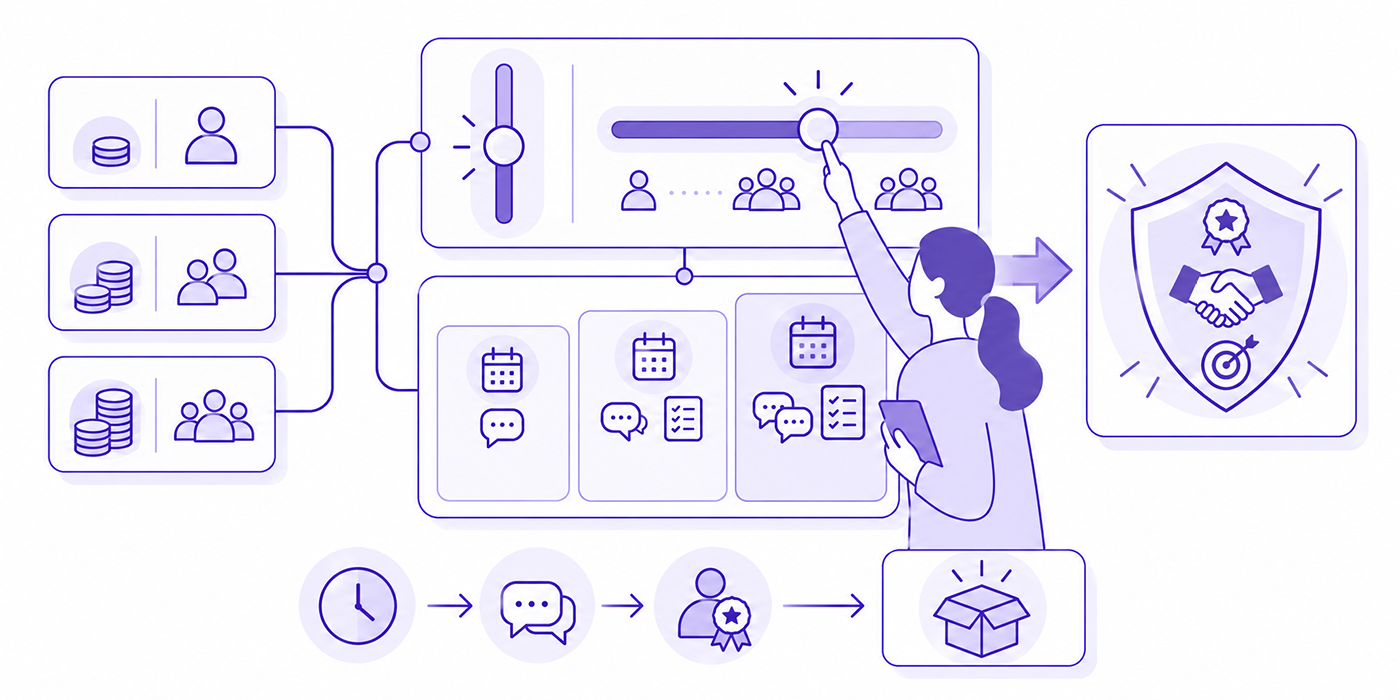
There is enormous variation in health-coaching pricing because the label covers very different services. A newly certified generalist selling 45-minute conversations competes in a different market from a specialist with a defined behavior-change process, professional referral relationships, measurable outcomes, and an eight- or twelve-week program.
Recent Reddit discussions illustrate that spread. In a November 2025 r/HealthCoaching pricing thread, individual commenters reported $40 for 30 minutes and $65 for 60 minutes. Another commenter described practitioners in a specialist network charging roughly $70–$100 per 50-minute session, with three-month programs around $1,500–$1,800. These are individual reports rather than market-wide benchmarks, but they demonstrate how strongly niche and delivery structure can change pricing.
A July 2026 Reddit discussion centered on an eight-week, $500 online health program. Several commenters considered that price inexpensive relative to more involved coaching services, while another correctly pointed out that there is no single normal price across the market. That matters for new coaches studying health-coaching income, first-client timelines, and post-certification careers.
A broader 2026 consumer pricing guide places many health-coaching sessions around $75–$150, with ongoing packages around $200–$600 per month. Another industry pricing guide places new coaches around $75–$150 per session. These commercial guides are useful reference points rather than authoritative fee schedules, because geography, credentials, niche, delivery intensity, and target market create substantial variation.
The practical mistake is copying the first number you find.
Your price needs to survive four tests:
Capacity. How many clients can you coach well without turning every working hour into delivery?
Economics. Does revenue cover client acquisition, software, payment processing, continuing education, taxes, cancellations, preparation, and administrative time?
Credibility. Does your experience, certification pathway, specialization, methodology, and proof support the offer?
Demand. Does your target client experience a sufficiently important problem to pay for structured support?
That final point is often missed. A coach who understands career burnout, self-care behavior, SMART goal implementation, and Immunity to Change may have a stronger economic proposition than someone selling generic weekly accountability.
A March 2026 Reddit pricing discussion captured a useful principle: calculate the income you need, the time available for coaching, your sustainable client load, session length, and remaining time required for marketing and operations. That turns pricing from a confidence exercise into business math.
The figures above are pricing scenarios for business-model calculations, rather than recommended market rates. The right figure depends on audience, geography, credentials, scope, demand, acquisition cost, and delivery intensity.
| Offer | Price | Delivery | Approx. Session Revenue | Revenue at 10 Clients | What to Check Before Using It |
|---|---|---|---|---|---|
| Starter session | $60 | 1 × 45 min | $60 | $600 | Prep and follow-up time |
| Starter session | $75 | 1 × 60 min | $75 | $750 | Local willingness to pay |
| Standard session | $90 | 1 × 60 min | $90 | $900 | Proof and specialization |
| Standard session | $100 | 1 × 60 min | $100 | $1,000 | Client acquisition cost |
| Specialist session | $125 | 1 × 60 min | $125 | $1,250 | Niche credibility |
| Specialist session | $150 | 1 × 60 min | $150 | $1,500 | Demand and proof |
| 4-week starter | $240 | 4 sessions | $60 | $2,400 | Admin may compress margin |
| 4-week starter | $300 | 4 sessions | $75 | $3,000 | Good for offer validation |
| 4-week coaching | $400 | 4 sessions | $100 | $4,000 | Define between-session access |
| 4-week coaching | $500 | 4 sessions | $125 | $5,000 | Requires stronger positioning |
| 6-week program | $450 | 6 sessions | $75 | $4,500 | Check total delivery hours |
| 6-week program | $600 | 6 sessions | $100 | $6,000 | Useful baseline model |
| 6-week program | $750 | 6 sessions | $125 | $7,500 | Need defined outcome pathway |
| 6-week specialist | $900 | 6 sessions | $150 | $9,000 | Strong niche proof helps |
| 8-week starter | $600 | 8 sessions | $75 | $6,000 | Watch support workload |
| 8-week coaching | $800 | 8 sessions | $100 | $8,000 | Simple package architecture |
| 8-week coaching | $1,000 | 8 sessions | $125 | $10,000 | Needs compelling positioning |
| 8-week specialist | $1,200 | 8 sessions | $150 | $12,000 | Measure client outcomes |
| 12-week starter | $900 | 12 sessions | $75 | $9,000 | Retention becomes important |
| 12-week coaching | $1,200 | 12 sessions | $100 | $12,000 | Add clear milestones |
| 12-week coaching | $1,500 | 12 sessions | $125 | $15,000 | Track completion rates |
| 12-week specialist | $1,800 | 12 sessions | $150 | $18,000 | Requires credible specialization |
| Biweekly 12-week | $600 | 6 sessions | $100 | $6,000 | Works for lower-touch clients |
| Biweekly 12-week | $750 | 6 sessions | $125 | $7,500 | Clarify support between calls |
| Monthly membership | $150/mo | 2 sessions | $75 | $1,500/mo | Retention controls economics |
| Monthly membership | $200/mo | 2 sessions | $100 | $2,000/mo | Keep support boundaries clear |
| Monthly membership | $250/mo | 2 sessions | $125 | $2,500/mo | Best with repeatable process |
| Small group | $300/person | 6 weeks | Varies | $3,000 | 10-person cohort assumed |
| Small group | $500/person | 8 weeks | Varies | $5,000 | Facilitation quality matters |
| Specialist group | $750/person | 12 weeks | Varies | $7,500 | Needs narrow problem and proof |
2. Calculate Your Minimum Sustainable Health-Coaching Price Before Looking at Competitors
Start with the amount the practice must generate.
Suppose you want $5,000 per month in business revenue. A calendar with 20 weekly clients sounds capable of producing it. Twenty sessions per week, however, means roughly 80 sessions per month before cancellations. At $75 each, gross session revenue reaches $6,000.
That initially looks comfortable.
Now add consultations, marketing, emails, documentation, payment administration, scheduling, follow-ups, continuing education, bookkeeping, cancellations, and preparation. A health-coaching business contains many hours that clients never see. This is why understanding realistic health-coaching revenue matters as much as studying coaching certification.
Use this formula:
Required monthly business revenue ÷ realistic number of paid client sessions = minimum average revenue needed per session.
If your required revenue is $6,000 and you can sustainably deliver 48 paid sessions monthly:
$6,000 ÷ 48 = $125 average revenue per delivered session.
A $65 session would require roughly 93 paid sessions per month to generate the same $6,000. A $100 session requires 60. A $150 session requires 40.
That comparison shows why underpricing creates a capacity problem before it creates a confidence problem.
The same principle applies to packages. An eight-week $800 program containing eight one-hour calls produces $100 of gross revenue per scheduled call before considering any messaging, worksheets, assessments, preparation, rescheduling, or acquisition cost.
Add two hours of onboarding and support across the engagement and you have roughly ten delivery hours:
$800 ÷ 10 = $80 gross revenue per actual delivery hour.
If the same offer costs $1,000:
$1,000 ÷ 10 = $100 per delivery hour.
This is why contracting in coaching affects profitability. Unlimited messaging, unrestricted rescheduling, long written follow-ups, and vague support promises silently expand delivery hours. Strong professional boundaries, a clear code of conduct, and defined program structure protect both client expectations and your economics.
Run the calculation with capacity rather than ambition.
If you can serve twelve ongoing clients exceptionally well, build the financial model around twelve. A business model that requires thirty clients when your coaching approach realistically supports twelve contains a structural pricing problem.
The same calculation helps when considering health-coach employment. Reddit discussions in 2026 included frustration over health-coaching roles advertised around $20–$25 per hour, while another commenter described a $30-per-hour contractor role. Those anecdotes illustrate the importance of comparing total compensation, contractor taxes and expenses, benefits, workload, and private-practice economics rather than comparing an hourly job rate directly with a client-facing coaching fee.
For private practice, build four numbers:
Floor rate: the minimum average revenue per client that makes the business sustainable.
Standard rate: the normal price offered to suitable clients.
Access allocation: the limited number of sliding-scale, scholarship, or pro-bono places you can sustainably support.
Future rate: the price you will test after gaining stronger proof, referrals, specialization, or demand.
This creates a more rational foundation than asking strangers what you are “worth.”
3. Session Pricing vs Packages: The Math New Coaches Usually Miss
Single sessions are easy to understand, but health behavior rarely changes neatly inside one isolated appointment. A defined coaching engagement can give the client enough time to apply behavior-change principles, test SMART goals, uncover resistance through Immunity to Change, and review progress using a structured coaching framework.
Packages also make revenue easier to forecast.
Consider two models.
Model A: $90 pay-as-you-go session
Ten clients attending three sessions in a month generate:
10 × 3 × $90 = $2,700 monthly revenue
A few missed bookings directly reduce revenue.
Model B: $360 monthly coaching package
Ten clients generate:
10 × $360 = $3,600 monthly revenue
The package might include three calls, a structured check-in, and defined between-session accountability. The client buys an engagement rather than repeatedly deciding whether to book another appointment.
The package still needs careful design. Throwing worksheets, messaging, trackers, and extra calls into an offer can make a $600 package less profitable than a $400 one.
Calculate effective delivery rate:
Package price ÷ total hours required to fulfill the package.
Imagine a 12-week program priced at $1,200 containing:
12 × 50-minute sessions = 10 hours
onboarding = 1 hour
progress review = 1 hour
weekly preparation = 2 hours total
client messaging = 3 hours total
Total delivery time = 17 hours
$1,200 ÷ 17 = $70.59 gross revenue per delivery hour.
At $1,500, the same program generates $88.24 per delivery hour.
At $1,800, it generates $105.88 per delivery hour.
This calculation matters when coaches compare their offer with the Reddit examples of specialist three-month programs around $1,500–$1,800. The visible package price gives only part of the story. Delivery burden, acquisition expense, refunds, payment fees, and time spent winning each client determine the underlying economics.
Program architecture can also make the offer easier to explain. A 12-week engagement might move through assessment, goal clarification, implementation, barrier analysis, adjustment, and maintenance. Coaches familiar with the CLEAR model, T-GROW, OSCAR, and ADKAR have multiple ways to create a coherent progression.
Your package therefore needs five explicit boundaries: duration, session frequency, session length, between-session support, and rescheduling policy. Those terms belong in coaching contracts alongside ethical scope and duty-of-care expectations.
4. How to Build Pricing Confidence Without Pretending You Have More Experience
New-coach confidence improves fastest when pricing rests on evidence.
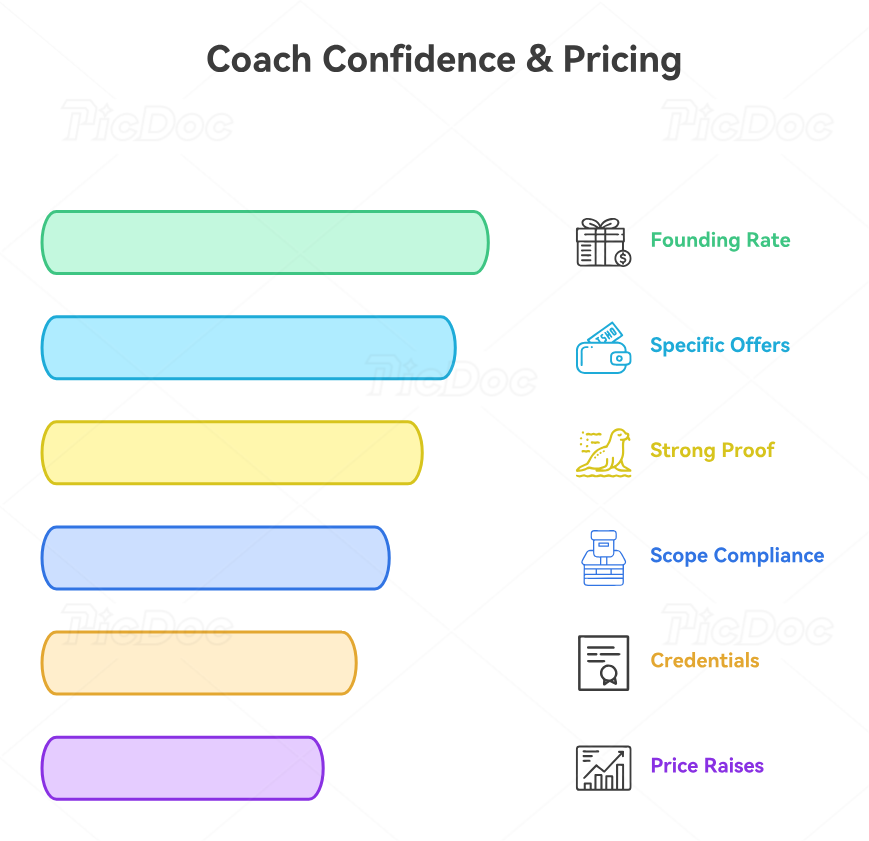
Start with a founding-client offer. A July 2026 Reddit post from a coach finishing certification described offering several initial free places and considering a founding price before raising rates after accumulating experience and testimonials. The useful part of this strategy is its explicit transition point.
For example:
Founding rate: $600 for eight weeks, limited to the first five paying clients.
Standard rate: $800 after those engagements are completed.
Review point: evaluate conversion, completion, workload, outcomes, referrals, and client feedback.
A founding rate prevents an introductory price from quietly becoming your permanent identity.
The next confidence source is specificity. Compare these two offers:
“Eight weeks of health coaching and accountability.”
“I help time-poor professionals build a weekly health routine they can maintain through unpredictable workloads, using structured planning, barrier analysis, and weekly accountability.”
The second offer connects naturally with career-burnout coaching, self-care coaching, behavior-change coaching, and practical goal-setting systems. A prospect can understand the problem, process, and relevance.
Then improve proof quality.
“Great coach, highly recommended” carries little information.
A stronger testimonial describes the starting problem, coaching process, behavioral change, and duration. Appropriate examples might include maintaining a planned routine for eight weeks, following through on weekly commitments more consistently, or creating a workable health structure around shift work.
Keep claims inside professional scope. Coaching ethics, duty of care, and clear agreements become particularly important when marketing health-related outcomes.
Credentials can also strengthen certain positioning. A coach pursuing employment or clinical-adjacent opportunities should understand NBHWC pathways and how they differ from ICF-oriented pathways. Private clients may evaluate credentials differently, so pair credentials with clear specialization and demonstrated process rather than relying on acronyms alone.
Finally, raise prices based on evidence such as:
repeated high conversion at the current rate
a waiting list or capacity constraint
improved outcomes and client completion
stronger specialization
additional credible training
higher-touch delivery
stronger referral demand
clear evidence that existing pricing makes the practice unsustainable
This connects pricing with the same business realities discussed in health-coaching income analysis, client-acquisition timelines, and first-client strategy.
5. How to Offer Affordable Coaching Without Destroying Your Margins
Accessibility works best when it is designed into the business model.
A March 2026 Reddit discussion about sliding-scale health coaching highlighted the tension clearly. Commenters discussed establishing a sustainable floor, limiting lower-cost access, and using group services or alternative revenue structures when the target population cannot support high one-to-one fees.
One practical approach is capacity-based sliding scale.
Suppose your standard 12-week package is $1,200 and you can serve twelve clients.
You might reserve:
8 places at $1,200
2 places at $900
1 place at $600
1 pro-bono place
Gross revenue across the twelve engagements would be $12,000, compared with $7,200 if every place were priced at $600.
The exact numbers can change. The principle is to decide how much subsidized capacity the practice can afford before emotional pressure enters the sales conversation.
A second option is group coaching.
Ten clients paying $300 for a six-week cohort create $3,000 in revenue. If the coach delivers six 90-minute group sessions plus three hours of preparation and administration, total delivery time is approximately 12 hours. That produces $250 gross revenue per delivery hour before expenses.
Compare that with ten people receiving six individual $50 sessions:
10 × 6 × $50 = $3,000
Those sixty individual sessions require 60 client-facing hours before preparation.
Group delivery therefore can improve accessibility while preserving economics, provided the topic is appropriate for group coaching and confidentiality, contracting, cultural competence, and professional ethics are handled properly.
A third route is a tiered offer ladder:
Free educational content → low-cost workshop → group program → standard coaching → higher-touch specialist coaching.
That allows a coach to serve people at multiple budget levels while protecting the viability of individual work. It also improves first-client acquisition because prospective clients can experience your thinking before making a larger commitment.
The strongest pricing system ultimately aligns five things:
who you serve, what problem you address, how intensively you deliver, what evidence you have, and what client volume your business requires.
A new coach working through health behavior change, self-confidence, burnout, or self-care can use exactly the same economics. The niche changes. The arithmetic remains unforgiving.
6. FAQs About Health-Coaching Pricing in 2026
-
Current commercial pricing guides place many health-coaching sessions around $75–$150, while Reddit reports include practitioners charging below and above that range. Treat those figures as reference points. Calculate your sustainable floor using delivery hours, overhead, capacity, target audience, and client-acquisition requirements. Your certification path, niche depth, geography, and health-coaching business model can materially change the viable number.
-
Packages often fit behavior-change work because clients have time to implement, review, and adjust their actions. A structured engagement can incorporate SMART goals, T-GROW, OSCAR, and other behavior-change methods. Calculate the total delivery hours before setting the package price.
-
Run the capacity math. At $50 per session, generating $5,000 requires 100 paid sessions per month before expenses. A coach with another income stream or a deliberately subsidized access program may choose that rate. Someone building a full-time practice should compare it with realistic income requirements, client volume, and the time required for marketing and acquisition.
-
Build the price from scope. Eight weekly sessions at a $100 base rate create $800 before between-session support. Add onboarding, assessments, messaging, personalized reviews, or extra calls and your effective delivery rate falls. Reddit users discussing an eight-week $500 health-oriented program in July 2026 generally considered the figure inexpensive, although commenters also emphasized the lack of one universal market price. Compare package economics with your coaching methodology, professional boundaries, and client agreement.
-
A defined founding rate can help you collect experience, learn where delivery breaks down, and gather appropriate testimonials. Set the client limit and future standard price in advance. This works particularly well while implementing a first-ten-clients plan, learning real acquisition timelines, and refining your behavior-change process.
-
Payment plans can make multi-month engagements easier to purchase. Price the plan with cash-flow timing, payment-processing costs, failed payments, refund policy, and contract terms in mind. A three-month $1,200 package could be paid as $400 monthly, while the coaching agreement specifies payment dates, missed payments, cancellations, and service access. Clear ethical standards prevent avoidable disputes.
