
Online Life Coaching Business From Zero: Reddit Lessons on Offers, Discovery Calls, Contracts & Client Retention
An online life coaching business becomes viable when four systems work together: a specific offer, a repeatable way to start conversations, a disciplined client experience, and enough retention or referrals to reduce constant prospecting. Coaches researching how long first clients actually take or whether full-time life coaching can pay often focus heavily on websites and posting. The harder work sits underneath: positioning, discovery calls, professional contracting, delivery, progress visibility, and a referral-worthy client experience.

1. Start With the Business Engine: Problem, Buyer, Offer and Revenue Math
The first version of an online coaching business can be remarkably small. You need a clearly defined buyer, an expensive or emotionally important problem, a coaching offer, a way to reach prospects, a discovery-call process, payment and scheduling systems, and a professional client agreement.
Everything else competes for attention.
A polished logo rarely fixes weak positioning. Twenty Instagram posts rarely repair an offer prospects cannot understand. Another certificate rarely solves a pipeline problem by itself. Reddit discussions from 2026 repeatedly surface this frustration: trained coaches can feel prepared for the session itself while remaining uncertain about where qualified prospects come from. In one May 2026 thread, coaches described referrals, professional networks, speaking, webinars, and direct relationships as meaningful acquisition channels, with several commenters saying social media played a smaller role in actual client generation. Those experiences are anecdotal, yet they reinforce the value of building multiple trust channels rather than measuring progress primarily through followers.
For a new coach, the first strategic question is which problem deserves an offer?
“Life coaching” is a professional category. Clients usually buy something more concrete: support through career burnout, stronger self-confidence, better leadership capability, improved public speaking, clarity around life purpose, healthier relationship patterns through couples coaching, or more effective behavior around money mindset.
A usable niche therefore answers four questions immediately:
Who is experiencing the problem?
“Newly promoted managers” gives you more information than “professionals.”
What keeps happening?
“They avoid difficult conversations and keep doing their team's work themselves.”
What consequence makes the problem costly?
Overwork, weak team performance, missed promotions, damaged relationships, lost confidence, or delayed decisions.
What does progress look like?
The manager delegates consistently, conducts difficult conversations, protects strategic work time, and builds a repeatable leadership rhythm.
This level of specificity improves your first-client acquisition strategy, makes coaching certification easier to translate into client value, and helps prevent the positioning failures described in why certified coaches still struggle to find clients.
Then build the smallest offer capable of producing meaningful movement.
A strong starter offer usually specifies:
one client type;
one central problem;
a defined duration;
session frequency;
the form of between-session support;
expected client responsibilities;
progress indicators;
boundaries and exclusions;
price and payment schedule;
what happens when the engagement finishes.
For example, “12 weeks of coaching for newly promoted managers who need to delegate, handle difficult conversations and stop taking unfinished team work home” provides substantially more buying information than “transformational one-to-one coaching.”
You could structure delivery with the CLEAR coaching model, use OSCAR for option-building, apply SMART goals to commitments, use T-GROW for structured progress, and introduce Immunity to Change when repeated resistance survives ordinary accountability.
Revenue math should follow immediately.
If your target is $6,000 per month and your average active client contributes $500 monthly, the model requires roughly 12 active-client equivalents before expenses, taxes, refunds, payment fees, software, and unpaid business time. If your delivery capacity comfortably supports eight clients, the offer economics need another solution: higher average client value, groups, corporate work, workshops, or a different income target.
This is why making a living as a life coach should be modeled from capacity backward rather than built around an aspirational monthly revenue screenshot. A July 2026 Reddit thread illustrates how differently coaches define capacity: one commenter preferred roughly 5–8 one-to-one clients, while another described eight rolling clients in three-month containers. Those figures reflect individual businesses rather than universal benchmarks, but they show why every coach needs a personal definition of a full roster.
| Stage | What to Build | Minimum Viable Standard | Failure Signal | Metric or Decision | ANHCO Resource |
|---|---|---|---|---|---|
| 1. Market | Choose one starting client group | You can describe them in one sentence | “Anyone who wants a better life” | Can you find 50 realistic prospects? | Client positioning |
| 2. Pain | Define one recurring problem | Prospects already complain about it | You have to teach them why they should care | 10+ real problem conversations | First-client benchmarks |
| 3. Outcome | Describe observable progress | Client can recognize improvement | Outcome is “transformation” or “empowerment” | 3–5 progress indicators | SMART goals |
| 4. Scope | Define what coaching covers | Role and exclusions are understandable | Client expects therapy, consulting or treatment | Written scope statement | Duty of care |
| 5. Offer | Create one primary package | Client, problem, process and duration are clear | Six confusing tiers | One flagship offer | CLEAR framework |
| 6. Duration | Set a coaching container | Enough time to create meaningful progress | Random session-by-session selling | 8–16 weeks or justified alternative | T-GROW model |
| 7. Delivery | Define session cadence | Weekly or biweekly rhythm is explicit | Clients repeatedly forget to book | Sessions booked ahead | Coaching contracting |
| 8. Support | Set between-session boundaries | Channel and response expectation are clear | Unlimited messaging becomes invisible labor | Defined support window | Code of conduct |
| 9. Pricing | Set package economics | Price supports delivery and business costs | Price was copied from another coach | Revenue per client | Revenue math |
| 10. Capacity | Define a full roster | You know the maximum active load | Every new client creates calendar anxiety | Maximum concurrent clients | Practice economics |
| 11. Messaging | Write a one-sentence value proposition | Prospect immediately understands relevance | You need five minutes to explain your work | Problem + audience + progress | Positioning mistakes |
| 12. Proof | Create ethical evidence | Specific experience, process and legitimate testimonials | Grand promises without substantiation | Proof assets collected responsibly | Professional conduct |
| 13. Network | Map warm relationships | 50–100 relevant people or connectors | Launching only to strangers | Weekly conversations started | Lead sources |
| 14. Partnerships | Find adjacent professionals | 5–10 genuine referral relationships | Generic “collaboration” DMs | Introductions per month | Cultural competence |
| 15. Content | Publish problem-led material | Each post addresses one buyer question | Inspirational quotes dominate the feed | Qualified conversations generated | Life-purpose coaching |
| 16. CTA | Ask prospects to take a next step | Clear invitation to reply or book | Audience consumes without engaging | Calls booked per 100 warm prospects | Conversion benchmarks |
| 17. Discovery | Create a fit-call structure | Problem, goal, urgency and fit are explored | Call becomes 45 minutes of free coaching | Qualified-call conversion rate | CLEAR model |
| 18. Qualification | Set acceptance criteria | Coach knows whom to decline or refer | Every willing payer becomes a client | Fit-based acceptance rate | Duty of care |
| 19. Follow-up | Create a post-call process | Decision deadline and next step are clear | Prospects disappear into endless follow-up | Follow-up completion rate | SMART structure |
| 20. Agreement | Use a written coaching contract | Scope, payment, scheduling and confidentiality addressed | Terms are discussed only after conflict | Signed before paid work begins | Contracting guide |
| 21. Payment | Automate invoices or checkout | Client knows due dates and payment terms | Coach repeatedly chases invoices | Payment collection rate | Income planning |
| 22. Intake | Collect useful baseline data | Goals, barriers, context and expectations captured | Session one starts from zero | Baseline completed | Wheel of Life |
| 23. Session System | Use a repeatable structure | Every session produces a clear next action | Conversation feels insightful but directionless | Action completion | OSCAR model |
| 24. Progress | Track meaningful change | Client can see movement over time | Month three feels identical to week one | Outcome indicators reviewed | SMART goals |
| 25. Resistance | Address recurring non-action | Patterns become coaching material | Coach simply adds more reminders | Barrier identified and tested | Immunity to Change |
| 26. Midpoint | Run a progress review | Goals and method are recalibrated | Problems surface only at the final session | Midpoint review completed | T-GROW |
| 27. Retention | Create continuation criteria | Renewal follows a legitimate next need | Client stays through vague dependency | Completion and renewal rates | Ethical coaching |
| 28. Referral | Build an introduction process | Satisfied clients know whom you help | Coach waits silently for word of mouth | Introductions per completed client | First 10 clients |
| 29. Review | Track funnel economics | You know conversation-to-client numbers | Marketing decisions rely on impressions | Leads, calls, sales, retention | Revenue metrics |
| 30. Scale | Add complexity only after proof | Core offer converts and delivers results | Ads, courses and funnels appear before product-market fit | Stable acquisition + delivery | Private-practice strategy |
2. Build an Offer People Can Understand Before You Build a Funnel
A coach starting from zero needs an offer that compresses the buying decision.
Prospects should understand who the coaching serves, what situation it addresses, what the engagement contains, how long it lasts, and what they should reasonably expect to work on. This is particularly important in coaching because the product is intangible. Clients cannot inspect a physical object before buying, so clarity, trust, process, professional ethics, and contracting carry more weight.
A December 2025 Reddit discussion on client acquisition argued that prospects respond to a coach's understanding of their problem and the clarity of the proposed route forward. That is one practitioner's perspective, but it matches a recurring theme in newer coaching discussions: marketing becomes difficult when the service is described mainly as “coaching.”
Build the offer around a situation, rather than a pile of sessions
Consider these two versions.
Version A:
Six Zoom sessions, WhatsApp support, worksheets, assessments and accountability.
Version B:
A 12-week coaching engagement for experienced professionals who are burning out and need to decide whether to redesign their current role, pursue promotion elsewhere or plan a deliberate career transition.
Version B gives the client a reason to care. Delivery details still matter, but the problem creates demand.
A career burnout coaching offer could use life visioning for direction, the Wheel of Life for baseline assessment, ADKAR for transition planning, and SMART goals for implementation.
A leadership offer might combine leadership coaching, conscious leadership, public speaking coaching, and Positive Intelligence around a buyer such as newly promoted directors.
Sell enough time for the problem you claim to address
Reddit coaches frequently discuss packages rather than isolated sessions. In one 2023 thread, several commenters preferred time-bound packages because they felt continuity increased commitment and reduced administrative friction. Treat those views as practitioner experiences rather than evidence that every client or niche requires the same structure.
Use the client's problem to determine duration.
A one-off decision session can make sense for a tightly bounded decision. Significant behavior change may justify eight to twelve weeks. Leadership development, career transitions, or complex identity changes can justify longer engagements when the scope is clear.
Your T-GROW process, CLEAR framework, OSCAR structure, and Immunity to Change work should support the outcome rather than exist as decorative methodology on a sales page.
Price from business economics and positioning
Calculate:
Desired monthly owner compensation + operating costs + tax reserve + business reinvestment = required gross revenue.
Then divide that by realistic client capacity.
If your service requires extensive preparation, personalized reviews and asynchronous support, twelve clients may represent a much heavier workload than twelve session-only clients. Full-time coaching income depends heavily on this delivery math.
Early pricing should also generate useful evidence. You need to learn whether qualified prospects understand the offer, perceive enough value, buy it, complete it, improve, and refer others. That learning is more useful than continuously comparing your rate with coaches serving different markets.
A coach deciding between employment and entrepreneurship should also compare life-coaching jobs with private practice, while anyone adding another qualification should evaluate life-coach certification ROI against the actual constraint in the business.
3. Get Discovery Calls: Reddit Lessons on Acquisition, Qualification and Closing
The beginning stage requires conversations more than reach.
A January 2026 Reddit thread asking coaches how they got their first clients included responses emphasizing referrals, communities, associations, local events, blogging and direct relationships. A May 2026 thread similarly featured experienced coaches reporting that referrals accounted for a large share of their own business, while another March thread discussed word of mouth, speaking opportunities and podcast appearances as trust-building channels. These are individual experiences rather than market-wide conversion statistics, but the pattern is valuable: high-trust services benefit from high-trust acquisition.
For a coach starting from zero, build four acquisition lanes.
Lane 1: Warm relationships
List former colleagues, classmates, professional contacts, community members, clients from adjacent work, trusted friends, and relevant acquaintances.
Your message can be simple:
“I've started coaching newly promoted managers who are struggling with delegation and difficult conversations. I'm speaking with people in that situation to understand what is hardest about the transition. Do you know anyone who would be open to a short conversation?”
This gives you research, language, referrals and potential clients simultaneously. It also accelerates the learning process behind getting your first coaching clients and solves the visibility problem described in why certified coaches struggle to find clients.
Lane 2: Adjacent referral partners
A career burnout coach might build relationships with recruiters, HR consultants, leadership trainers and career-service professionals. A couples coach may develop appropriate networks with relationship professionals while maintaining strict duty-of-care boundaries. A public-speaking coach might collaborate with leadership programs, professional associations and presentation trainers.
Referral relationships grow from specificity. “I help people with life” gives a connector very little to remember. “I work with technical experts during their first six months managing a team” gives them a trigger.
Lane 3: Authority content
Publish material that diagnoses real problems.
A money mindset coach could explain underpricing patterns. A self-confidence coach could break down why competent professionals stay quiet in meetings. A life-purpose coach could distinguish identity confusion from an actual decision problem.
The goal is qualified recognition: “This person understands the exact situation I am in.”
A February 2026 Reddit post from a career coach described warming engaged LinkedIn prospects through conversations and useful material before explicitly inviting them to consider coaching. It is one coach's method, yet it demonstrates a critical commercial lesson: content requires a bridge from attention to conversation.
Lane 4: Direct invitations
Create a weekly conversation target.
For example:
20 thoughtful outreach messages
10 existing-network follow-ups
5 referral-partner conversations
2 live conversations or events
3 discovery calls
The numbers should evolve from your own funnel.
Track:
prospects contacted → meaningful conversations → qualified leads → discovery calls → offers made → clients signed.
That pipeline makes first-client timelines measurable and helps you decide whether your problem sits in lead generation, qualification, sales, pricing or the offer.
Use the discovery call to diagnose fit
A discovery call should answer:
Why is the person looking for help now?
What is happening repeatedly?
What have they tried?
What does the unresolved problem cost them?
What result would make coaching worthwhile?
What kind of support are they looking for?
Does their need fit your competence and professional scope?
Can your offer realistically address the situation?
Are they ready to participate in the work?
What is the appropriate next step?
A 2024 Reddit thread from a new coach asking what to do after receiving a first serious inquiry generated advice to use a discovery conversation to understand what the prospect wants and what they are facing before presenting the coaching structure.
The call also protects the coach.
A 2025 Reddit contributor described learning from an early paid client that client fit matters alongside revenue. A clear qualification standard should therefore sit beside your coaching code of conduct, contracting process, and cultural competence.
4. Contracts, Payments and Onboarding: Build the Professional Infrastructure Early
A client saying “yes” creates a transition from marketing to professional service delivery.
Treat that transition seriously.
The International Coaching Federation's current Code of Ethics states that ICF professionals should establish the nature of coaching and co-create agreements covering roles, responsibilities, confidentiality, financial arrangements and other engagement terms before coaching begins. It also addresses termination rights, confidentiality, record security and obligations relating to technology used in coaching.
That provides a useful standard even for coaches still deciding whether ICF-style professional development fits their career.
Your coaching agreement needs operational clarity
A professionally reviewed agreement may address:
identities of the parties;
coaching service and package;
scope and limitations;
session length and cadence;
fees and payment schedule;
late-payment handling;
refunds where applicable;
cancellation and rescheduling;
no-shows;
package expiration;
between-session communication;
confidentiality and its limits;
record handling;
technology platforms;
client responsibilities;
coach responsibilities;
termination;
dispute procedures;
governing law where appropriate;
consent around testimonials or case studies;
intellectual-property terms for proprietary materials.
A 2025 Reddit discussion about coaching contracts produced a practitioner checklist covering scope, fees, cancellation, confidentiality, client responsibility, virtual-session safety and termination. Those examples can help coaches identify questions for legal review, while the final agreement should fit the laws and professional requirements relevant to the business.
A generic internet template deserves scrutiny. Your coaching contract should match your actual offer, professional duty of care, code-of-conduct obligations, data practices and jurisdiction.
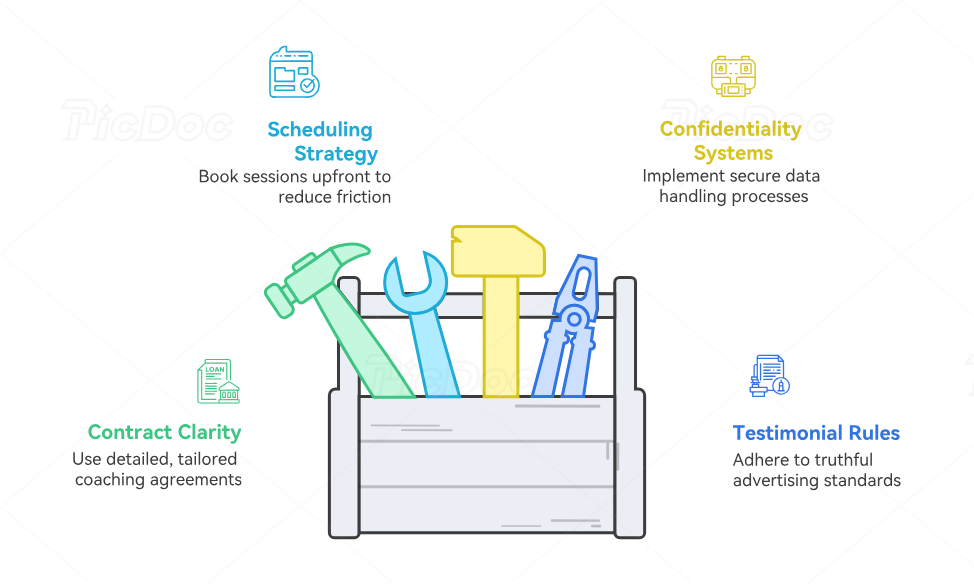
Schedule the engagement at the beginning
Scheduling friction quietly damages retention.
A 2025 Reddit discussion about three-month packages included several coaches who said they book all sessions at the start or maintain a recurring time, reducing the need to repeatedly chase clients for appointments.
For a 12-week program, onboarding can therefore include:
Day 0: agreement signed and payment completed.
Day 0: intake form sent.
Day 1: all sessions scheduled.
Before Session 1: baseline assessment completed.
Session 1: goals, responsibilities and success measures agreed.
Midpoint: formal progress review.
Final two sessions: maintenance, next-step and completion planning.
You could use the Wheel of Life for initial exploration, translate priorities through SMART goals, work through options using OSCAR, and review larger behavioral barriers through Immunity to Change.
Make confidentiality operational
Confidentiality involves your actual systems.
Think about:
where intake responses live;
where session notes live;
who can access them;
which video platform you use;
how client messages are stored;
whether AI tools process client information;
how long records are kept;
how files are deleted;
how testimonials are collected;
how employer-sponsored coaching information is separated.
ICF specifically addresses confidentiality, appropriate record storage and obligations when technology systems or AI are used.
This turns professional coaching ethics, duty of care, and clear contracting into operating procedures rather than website language.
Treat testimonials as advertising
Client results can become strong proof, especially after you move beyond the first few clients. Marketing still requires accuracy.
For U.S.-directed advertising, the FTC says advertising claims must be truthful and supported, while testimonials and endorsements must avoid deceptive representations. The agency also provides specific rules and guidance around consumer reviews and endorsements.
Use permission, preserve accuracy, identify material relationships where required, and avoid converting an exceptional result into a universal promise.
This matters for coaches promoting dramatic outcomes in career coaching, money mindset coaching, self-confidence coaching, couples coaching, or leadership coaching.
5. Client Retention: Keep Engagement High Without Creating Dependence
Retention starts during the sales process.
A poorly matched client can become disengaged even when the coaching itself is competent. A well-qualified client enters with a relevant problem, realistic expectations, willingness to work, clear goals and an understanding of what coaching requires.
Retention therefore begins with first-client positioning, continues through professional contracting, and is strengthened by a coaching process that makes progress visible.
Give every engagement a progress architecture
At onboarding, record:
current situation;
desired situation;
important behaviors;
relevant obstacles;
baseline confidence or readiness;
success indicators;
first commitments.
Every session can then answer three questions:
What changed?
What did we learn?
What happens next?
The OSCAR coaching model, CLEAR coaching, T-GROW, and SMART goals provide different structures for keeping that movement visible.
Keep between-session support lightweight enough to be used
More features can create more friction.
An April 2026 Reddit discussion asked coaches how they kept clients engaged between sessions. One experienced commenter described abandoning elaborate Notion and software systems after clients showed limited interest, eventually relying more heavily on the coaching session and a simple weekly review form.
That anecdote offers an important design rule:
Measure whether the client uses the system.
A beautifully designed portal has little value if clients ignore it.
Try a simple rhythm:
Monday: client executes agreed action.
Midweek: one short check-in if included in the package.
Before the next session: three-question reflection.
Session: review evidence, obstacles and next experiment.
A health behavior-change approach, Positive Intelligence, Immunity to Change, or Transactional Analysis can deepen the work when recurring patterns appear.
Run a midpoint review before dissatisfaction becomes silent
Halfway through the package, ask:
“What has improved?”
“What still feels stuck?”
“Which part of our process is most useful?”
“Which part produces little value?”
“Has the original goal changed?”
“What would make the remaining sessions meaningfully successful?”
This gives the client permission to surface friction while there is still time to respond.
Track retention correctly
Retention can mean several things:
Package completion rate — percentage finishing the original engagement.
Attendance rate — percentage of scheduled sessions attended.
Action-follow-through rate — percentage of agreed actions completed or meaningfully attempted.
Renewal rate — percentage entering a legitimate next engagement.
Referral rate — percentage generating an introduction.
Outcome attainment — percentage reaching agreed success indicators.
A July 2026 Reddit discussion asked coaches what percentage of clients remained beyond several months. Responses varied widely, and the thread itself raised an important question about whether keeping clients indefinitely should even be the objective.
That distinction matters.
Healthy retention means the client stays long enough to receive the value of the agreed process and continues when additional coaching serves a clear purpose. Ethical coaching conduct should favor client agency, while professional contracting should preserve clear termination rights and duty of care.
Turn completion into referrals
A strong final-session process can include:
compare baseline with current position;
document the most useful changes;
identify remaining risks;
create a 30- or 90-day maintenance plan;
determine whether further coaching has a defined purpose;
request feedback;
request a testimonial where appropriate;
explain exactly whom you can help next;
ask for introductions naturally.
This closes the loop.
Client acquisition becomes easier when good delivery creates referrals. That relationship is especially important for coaches building full-time coaching income, shortening first-client acquisition timelines, or trying to solve the client problem that often remains after certification.
6. FAQs About Starting an Online Life Coaching Business
-
At minimum, define a client, problem, offer, price, discovery-call process, payment method, scheduling process, professional agreement, intake workflow, delivery system and basic record-keeping process.
Your coaching methodology can then draw from frameworks such as CLEAR, OSCAR, SMART goals, and T-GROW.
A sophisticated funnel becomes useful after you understand who buys and why.
-
Start with direct conversations, warm contacts, professional communities, referral partners, small events and useful niche content.
Recent Reddit threads from coaches continue to emphasize referrals, professional relationships and direct conversations during early acquisition, though individual experiences vary substantially.
Track the process described in how long it takes to get first coaching clients, tighten the positioning problems covered in why certified coaches still cannot find clients, and make your niche easy to refer.
-
Choose the structure according to the problem and expected coaching process.
A discrete decision may justify a single session. Significant behavior change, career burnout work, leadership development, self-confidence coaching, or life-purpose work can require a longer container.
Packages can also simplify revenue forecasting, scheduling and continuity when the duration matches the intended outcome.
-
Explore the current problem, desired result, urgency, previous attempts, obstacles, expectations, scope fit, commitment and next step.
The discovery call should also identify situations requiring another professional through your duty-of-care process. Once fit is established, explain the offer, delivery, investment and coaching agreement clearly enough for the prospect to make an informed decision.
-
Common issues include scope, responsibilities, fees, payment, cancellation, rescheduling, confidentiality, package duration, communication, termination, records and applicable legal terms.
ICF's ethical framework specifically addresses agreements covering roles, responsibilities, confidentiality and financial arrangements before coaching begins.
Use contracting in coaching, professional duty of care, and the coaching code of conduct as operational starting points, then obtain jurisdiction-specific professional advice for legal drafting.
-
Keep the stack proportional to revenue and complexity.
Most solo online practices initially need scheduling, video calls, payment processing, document storage, an intake method and basic bookkeeping. Add CRM, automation, specialized coaching software or advanced email systems when a measurable bottleneck justifies them.
The April 2026 Reddit discussion about between-session engagement is useful here: elaborate systems can become wasted work when clients barely use them.
Spend first on systems that protect professional confidentiality, improve client contracting, simplify payment, or improve delivery.
