
Why Coaching Discovery Calls Don’t Convert: Reddit Experiences, Common Objections & a Better Sales Conversation Framework
A calendar full of discovery calls can create the illusion that client acquisition is working. Revenue exposes the truth. Coaches often reach the call after investing heavily in content, positioning and lead generation, then lose the prospect because qualification was weak, the conversation stayed superficial, or the offer arrived before enough trust existed. Stronger conversion starts by understanding why clients hire coaches, how behavior change actually works, and how professional coaching agreements should begin.
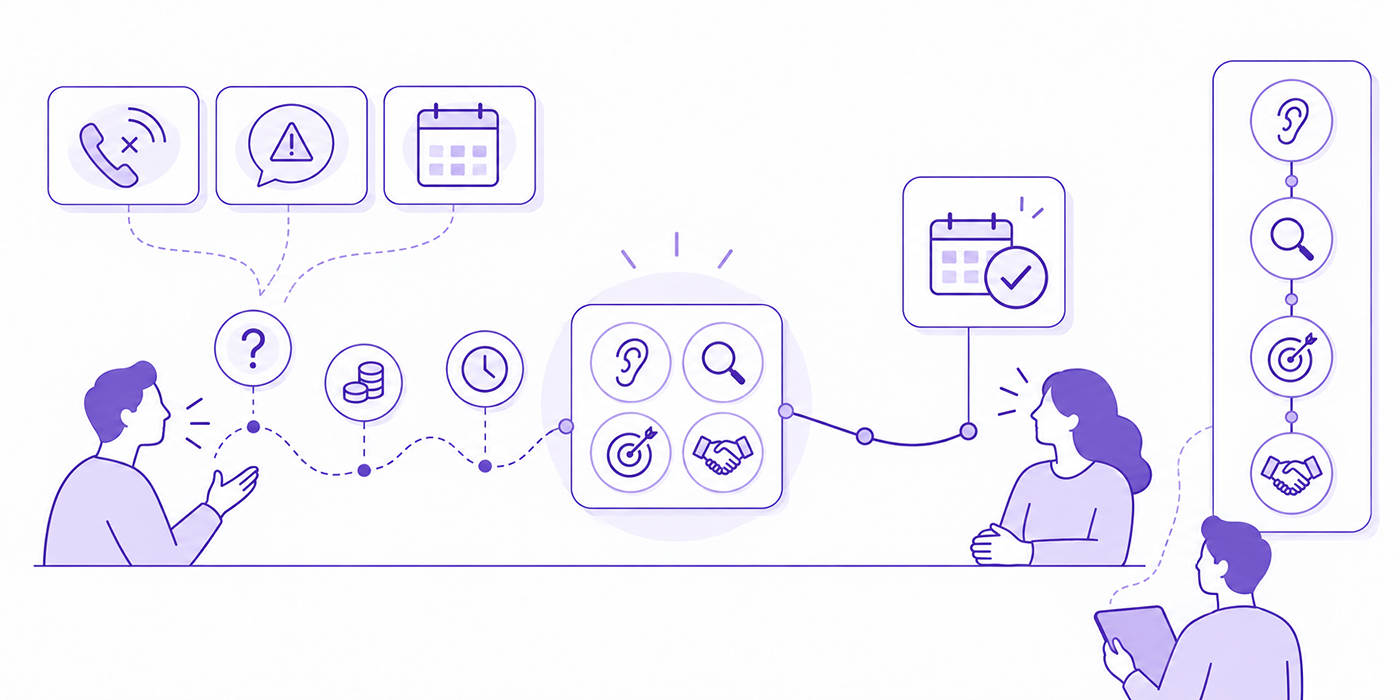
1. Why Coaching Discovery Calls Usually Fail Before the Price Is Mentioned
A prospect saying “that is too expensive” at minute 35 does not automatically mean price killed the sale. The call may have been losing momentum since minute five.
A September 2026 Reddit post illustrates the problem clearly. A dating coach said paid advertising was generating prospects who appeared to have both the problem and the financial means to buy, yet nobody converted. Prospects said the service was not enough of a priority, questioned whether it would work for them, or ended with variations of “I need to think about it.” The experience is particularly relevant to coaches who have already solved basic lead-generation problems but still struggle to turn conversations into sustainable coaching income.
The first failure point is poor qualification. A person can have a problem without being ready to solve it. They may lack urgency, control over the buying decision, available money, confidence in coaching, or willingness to implement change. A discovery call cannot manufacture all of those conditions. Coaches who understand health behavior change, Immunity to Change, SMART goal setting, and T-GROW coaching should recognize the distinction between wanting an outcome and being prepared to act toward it.
The second failure point is vague discovery. “Tell me about your goals” often generates polished answers rather than useful buying information. You need to understand what is happening, how long it has been happening, what they have tried, why those attempts failed, what the problem is costing them, what they want instead, and what makes solving it important now. Those questions resemble the diagnostic depth found in the CLEAR coaching model, OSCAR coaching framework, ADKAR change model, and Wheel of Life, but the purpose here is buyer clarity rather than free coaching.
The third failure point is premature teaching. New coaches often feel they must prove expertise by giving away ten solutions during the consultation. The prospect leaves with useful ideas while still lacking a compelling reason to purchase the structured engagement. A 2022 health-coach marketing discussion on Reddit described this exact tendency, arguing that coaches often know so much that they over-explain rather than discovering what prospective clients actually want and what has prevented them from getting it. Expertise should support the conversation through behavior-change insight, professional credibility, ethical practice, and clear scope boundaries.
The fourth failure point is an offer that feels disconnected from the diagnosis. The prospect spends 25 minutes describing burnout, inconsistent routines, anxiety around follow-through, and repeated failed attempts. The coach then switches into a memorized speech about “12 transformational sessions, Voxer support, worksheets, accountability and bonuses.” The connection disappears.
A stronger transition sounds conceptually like this: You told me X keeps happening, you have already tried Y, and what you want instead is Z. The part I believe coaching can help with is A. Here is how I would structure that work.
This style naturally connects the buyer's problem to career-burnout coaching, self-care behavior, self-confidence work, or another relevant coaching specialization.
The fifth failure is trying to close a trust gap with pressure. A June 2026 Reddit user described signing an $8,000 coaching agreement after being told the price would rise to $10,000 unless they committed immediately, then later seeking advice about getting out of the contract because the interaction felt highly pressurized. That buyer experience should concern coaches building around professional ethics, duty of care, clear coaching contracts, and long-term client trust.
NBHWC's current ethics standards explicitly require truthful representation of services and reasonable outcomes and specifically tell NBC-HWCs to avoid exaggerated claims and high-pressure sales tactics. Strong sales therefore begins with a better conversation rather than stronger pressure.
| What Happens | Likely Problem | What to Investigate | Better Move | Metric to Watch |
|---|---|---|---|---|
| Many bookings, few attendees | Weak commitment before booking | Lead source and booking friction | Require a short application and confirmation | Show rate |
| Prospects arrive unsure why they booked | Weak positioning | Message before the calendar | Clarify who the call is for | Qualified-call rate |
| Calls become free coaching sessions | Over-delivery | Coach discomfort with selling | Diagnose rather than solve everything | Offer-presented rate |
| Coach speaks most of the call | Poor discovery | Question quality | Ask, clarify, summarize | Talk/listen balance |
| Prospect describes vague goals | Shallow discovery | Desired outcome | Ask what would materially change | Outcome clarity |
| No discussion of previous attempts | Missing history | Why existing solutions failed | Explore prior efforts | Problem depth |
| No urgency surfaces | Timing unclear | Why now | Explore current trigger | Urgency-qualified calls |
| “I need to think” appears repeatedly | Unresolved uncertainty | Risk, price, fit or timing | Ask what remains unclear | Decision clarity |
| Price creates instant surprise | Poor expectation setting | Budget context | Set realistic investment expectations earlier | Price-shock rate |
| “I need to ask my partner” | Decision process unknown | Authority | Ask who participates in the decision before pitching | Decision-maker presence |
| “Send me some information” | Value still unclear | Unanswered buying question | Identify what information they need | Follow-up conversion |
| “Maybe later” | Low urgency | Trigger and consequences | Clarify what would need to change | Deferred-decision rate |
| “I can do this myself” | Role of coaching unclear | Implementation gap | Clarify what support changes | Value comprehension |
| “I have tried coaching before” | Prior disappointment | Previous experience | Ask what specifically failed | Past-solution recovery |
| “I am comparing coaches” | Differentiation unclear | Decision criteria | Ask how they will choose | Competitive close rate |
| Prospect loves call but never buys | Conversation felt useful, offer felt optional | Problem-to-offer bridge | Connect offer to diagnosed gap | Call-to-sale rate |
| Coach rushes through price | Pricing insecurity | Belief in offer economics | State terms clearly and stop talking | Price-stage drop |
| Immediate discount offered | Coach reacts to discomfort | Actual objection | Diagnose before changing price | Discount frequency |
| Everyone gets same pitch | Script overuse | Relevance | Customize explanation around discovery | Segment conversion |
| Wrong clients keep booking | Top-of-funnel problem | Content and CTA | Tighten qualification language | Qualified lead percentage |
| Cheap leads convert poorly | Lead quality issue | Traffic source | Compare channels separately | CAC by source |
| Referrals convert better | Trust gap in cold traffic | Pre-call nurture | Add proof and education before booking | Close rate by source |
| Prospects ask basic questions on call | Weak pre-call information | Website and booking page | Answer fundamentals before the call | Call time spent on FAQs |
| Prospect cannot explain offer back | Offer complexity | Language and packaging | Simplify mechanism and outcome | Offer comprehension |
| Long calls convert poorly | Conversation lacks decision structure | Call architecture | Use clear phases and time boundaries | Minutes per close |
| Short calls feel transactional | Insufficient discovery | Trust and depth | Protect enough time for diagnosis | Early-stage drop rate |
| Prospects ghost after verbal interest | No defined next step | Decision timeline | Agree on a specific follow-up action | Follow-up response rate |
| Clients join then disengage | Sales promised poor-fit engagement | Qualification quality | Screen willingness and expectations | Early churn |
| Refund pressure appears quickly | Expectation mismatch | Sales claims and onboarding | Set realistic outcomes before purchase | Refund rate |
| Coach changes script every week | No diagnostic data | Call tracking | Review patterns across 10–20 calls | Stage-specific conversion |
2. “I Need to Think About It,” “It’s Too Expensive” and Other Objections Are Diagnostic Data
An objection should tell you what remains unresolved.
“I need to think about it” could mean the prospect does not understand the offer, does not trust themselves to follow through, dislikes the price, needs another decision-maker, does not believe the problem is urgent, or simply wants a polite way to decline.
Treating every version with one clever rebuttal damages client trust, conflicts with responsible coaching ethics, weakens professional contracting, and can produce clients who were poorly qualified in the first place.
A better response is curiosity:
“Of course. What part would be most useful to think through?”
Then listen.
If they say price, clarify whether the problem is affordability, perceived value, cash flow, or uncertainty that the service will work for their particular situation. These require different responses. Someone who literally cannot afford the service has a financial constraint. Someone who could afford it but sees insufficient value has a positioning problem. Someone who wants the service but fears another failed attempt has a confidence and risk problem. Coaches who understand self-confidence coaching, behavior-change resistance, Positive Intelligence, and SMART goals should be particularly capable of hearing those differences.
If they say “I need to speak to my partner,” the important discovery happened too late. For a significant purchase, another household decision-maker may reasonably need involvement. Ask earlier about how the prospect makes investments like this. Ethical coaching agreements, professional duty of care, culturally competent communication, and clear professional conduct all favor informed decisions over engineered pressure.
If they say “this is not a priority right now,” revisit the problem rather than manufacturing urgency. Ask what is currently a priority and what would have to happen for this issue to move higher. Sometimes the correct commercial conclusion is that the prospect should wait. That protects your calendar from low-commitment clients and supports the kind of sustainable practice discussed in health-coaching income planning, first-client acquisition, health-coaching demand, and private-practice positioning.
If they say “I am worried this will not work for me,” resist launching into guarantees. Ask why. Perhaps they have bought coaching before, repeatedly abandoned plans, struggled with accountability, or experienced an offer that overpromised. That concern can lead naturally into an explanation of your behavior-change process, CLEAR framework, OSCAR approach, or ADKAR methodology without promising a predetermined outcome.
A current NBHWC ethical standard is especially relevant here. Coaches are expected to explain potential outcomes reasonably, represent services accurately and truthfully, and avoid high-pressure sales tactics. ICF's current ethics code similarly requires coaches to establish clear agreements around roles, responsibilities, confidentiality, financial arrangements, and other engagement terms before coaching begins. Those expectations align naturally with coaching contracts, ethical boundaries, professional coaching standards, and genuine client-centered behavior change.
The objective is decision clarity.
A clean yes, clean no, or defined next step is more commercially useful than an enthusiastic “maybe” that lives in your pipeline for six weeks.
3. A Better Coaching Sales Conversation Framework: Diagnose, Connect, Decide
A strong discovery call can follow eight phases without sounding scripted.
Phase 1: Set the frame. Explain what the call will accomplish. You are going to understand what the person wants, determine whether coaching is appropriate, explain how you work if there is a fit, and leave space for a decision or next step. That opening creates the same clarity valued in professional coaching contracts, CLEAR coaching, coaching ethics, and duty-of-care practice.
Phase 2: Identify the trigger. Ask why they booked now. Something usually happened: work became unbearable, another attempt failed, a promotion created pressure, confidence collapsed, health habits deteriorated, or an important deadline appeared. Understanding the trigger separates casual curiosity from real intent. It also connects naturally with career-burnout coaching, self-confidence coaching, self-care coaching, and life-purpose coaching.
Phase 3: Define the current problem precisely. Move beyond labels. “I lack confidence” needs unpacking. Where does that show up? What decisions change because of it? What behavior does it create? How frequently? For how long? Methods such as Transactional Analysis, Positive Intelligence, Immunity to Change, and the Wheel of Life can sharpen how a coach thinks about patterns without turning the consultation into a full intervention.
Phase 4: Explore previous attempts. Ask what the prospect has already tried and what happened. This prevents you from recommending another version of something they already know does not work. It also reveals whether their barrier is information, consistency, accountability, environment, confidence, competing commitments, or something outside coaching scope. This is where health behavior change, ADKAR, SMART goals, and T-GROW become commercially useful because they help you diagnose the implementation gap.
Phase 5: Define the desired outcome. Ask what would be different three or six months from now if the work succeeds. Push gently past abstractions. “Feel better” provides little direction. “Leave work by 6 p.m. four days a week, exercise three times weekly, stop checking email in bed, and have enough energy for my family” gives the coach and client something clearer. Life visioning, SMART goals, OSCAR, and CLEAR can all inform this part of the conversation.
Phase 6: Identify the decision conditions. Find out whether the person wants support now, who else is involved in the buying decision, whether the investment range is feasible, and what concerns they would need resolved. This can prevent the last ten minutes from becoming a surprise negotiation. Clear financial communication also supports professional contracting, ethical selling, responsible duty of care, and sustainable coaching economics.
Phase 7: Present only the relevant offer. Summarize what you heard. Explain the part you can help with. Describe the engagement in terms of process, frequency, support, boundaries and investment. Avoid dumping every feature you have ever created. Someone needing structured accountability may care far more about the behavior-change process, SMART goal system, T-GROW structure, and your coaching agreement than twelve downloadable worksheets.
Phase 8: Facilitate the decision. Ask how the offer feels against what they said they need. Let objections surface. Clarify rather than combat them. If the person needs information, provide it. If they need another decision-maker, establish the next step. If the offer is a poor fit, say so. If they are ready, explain onboarding. This preserves professional trust, ethical coaching practice, clear contracting, and long-term client retention through appropriate fit.
A recent Reddit discussion about building a consistent coaching business contained a useful pattern: several commenters distinguished content and visibility from actual sales conversations, with one emphasizing tangible outcome language and tracking where prospects sit in the buyer journey. Another commenter described one-to-one conversations as increasingly important for producing clients.
That reinforces the central idea: a discovery call should help a qualified prospect make an informed decision. It should also help the coach discover when the answer should be no.
4. Fix the Funnel Before Trying to Become Better at “Closing”
A poor sales call can lose an excellent prospect. Excellent sales technique cannot reliably rescue a calendar filled with the wrong people.
Qualification therefore starts before Zoom.
Your booking page should explain who the offer serves, what type of problem it addresses, how coaching works, what it does not provide, approximate commitment required, and what the discovery conversation is designed to determine. That preparation strengthens client trust, supports coaching ethics, reinforces scope boundaries, and makes eventual contracting cleaner.
Use a short application to collect information you genuinely need: desired outcome, current obstacle, what they have tried, why they are seeking support now, and whether they are prepared to commit time and resources to addressing it. The form should improve the conversation rather than interrogate the prospect.
Then examine lead source separately.
A referral from a previous client arrives with borrowed trust. Someone who has read ten useful articles about behavior change, burnout coaching, self-care, and confidence may arrive highly educated. A cold paid-ad lead may know you for three minutes.
Those calls should not be interpreted as equivalent opportunities.
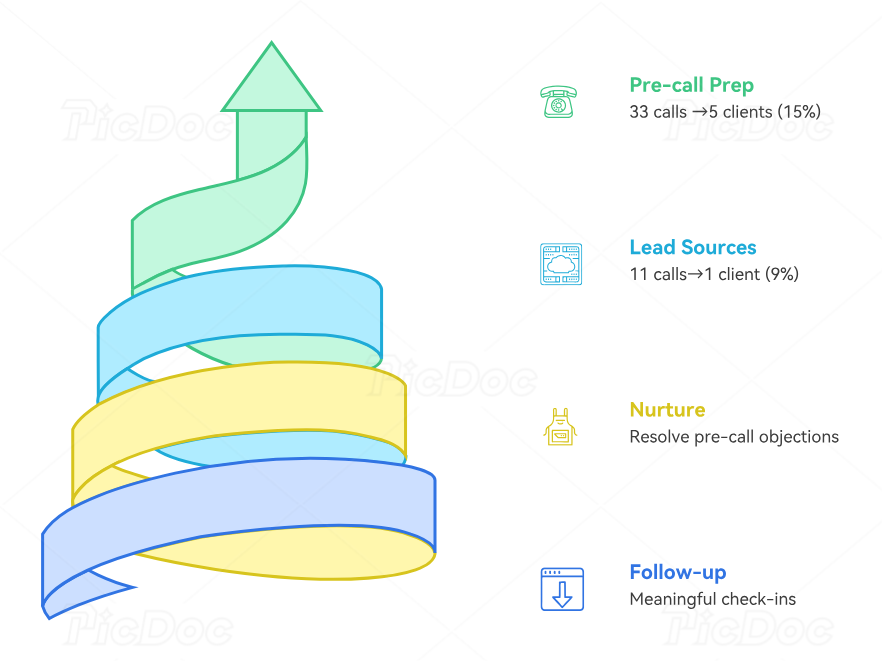
One self-reported April 2026 Reddit analysis of six coaching businesses showed how large the channel difference can become. The poster reported one paid-social campaign producing 33 booked calls and five new clients, while purchased appointments produced 11 qualified calls and one new client. The sample was small and independently unverified, so it should be treated as an illustration rather than a benchmark. Coaches evaluating client-acquisition timelines, private-practice economics, positioning problems, and market saturation should segment conversion data by source.
Pre-call nurture can also resolve objections before they become objections.
If prospects repeatedly ask whether coaching is credible, show your certification pathway, explain ICF versus NBHWC, publish your code-of-conduct standards, and describe your duty-of-care boundaries.
If prospects keep questioning what coaching actually changes, publish material demonstrating behavior-change mechanics, SMART goal implementation, Immunity to Change, and CLEAR coaching.
Then follow up with a reason.
“Just checking in” adds nothing. A useful follow-up might summarize the unresolved concern, answer the information request, restate the agreed next step, or close the loop if the prospect has decided against proceeding. Respecting the buyer's decision supports ethical practice, professional trust, good contracting, and stronger long-term referral relationships.
5. Measure Discovery Calls Like a Funnel, Then Fix the Exact Stage That Leaks
“People are not buying” is too vague to solve.
Track at least:
Leads → applications → calls booked → calls attended → qualified prospects → offers presented → clients enrolled → cash collected → clients who remain engaged.
Suppose 100 leads produce 20 booked calls, 15 attended calls, 10 qualified prospects and four clients.
Your booking rate is 20%.
Your attendance rate is 75%.
Your qualified-call rate is 67% of attended calls.
Your conversion from qualified prospect to client is 40%.
Your lead-to-client rate is 4%.
Each percentage diagnoses a different business problem. Coaches trying to build sustainable income, shorten first-client timelines, fix post-certification acquisition, and survive a crowded coaching market need stage-specific numbers.
If bookings are low, improve the offer, CTA or audience.
If bookings are high but attendance is weak, improve commitment and reminders.
If attendance is high but qualification is poor, tighten targeting and your application.
If qualified prospects consistently reach the price and retreat, examine value communication, market fit, affordability, and coaching economics.
If people buy and rapidly disengage, investigate qualification, expectation setting, professional contracting, behavior-change delivery, and SMART goal design.
Also tag every lost qualified opportunity with the primary reason: affordability, perceived value, timing, authority, trust, competing solution, scope mismatch, low urgency, uncertain outcome, or unknown.
After 20 calls, patterns appear.
Seven price objections suggest something different from seven “not now” objections. Six prospects who lack authority suggest something different from six who question your credibility. That data helps you decide whether to improve certification signals, client trust, offer positioning, or the underlying coaching methodology.
Review calls by stage, rather than asking whether the entire call was “good.”
Did you establish purpose? Did you understand the trigger? Did you identify the real problem? Did you uncover previous attempts? Did the client define a meaningful outcome? Did you understand the decision process? Did the offer address what they had actually said? Did objections become clear?
That process turns sales improvement into the same kind of reflective practice found in OSCAR coaching, T-GROW, ADKAR, and CLEAR.
The goal is a repeatable sales system in which the right prospects understand the value, unsuitable prospects are filtered respectfully, and every outcome teaches you something.
6. FAQs About Coaching Discovery Calls and Sales Objections
-
There is no universal rate that can be applied intelligently across every coaching business. Warm referrals, organic followers, webinar attendees, cold advertising leads and purchased appointments arrive with very different levels of trust and intent. Track conversion separately by source while monitoring client-acquisition timelines, coaching income economics, positioning quality, and market demand. A self-reported 2026 Reddit analysis also showed substantially different client-acquisition economics between channels, reinforcing why source-specific measurement matters.
-
Ask what specifically they would like to think through. Their answer may reveal price, timing, trust, another decision-maker, uncertainty about results, or a weak sense of urgency. Then address the actual issue using the same curiosity found in CLEAR coaching, OSCAR, T-GROW, and strong coaching agreements. Respect a genuine need for time rather than using artificial urgency. NBHWC's current ethics standards specifically caution against high-pressure sales tactics.
-
Transparency can improve qualification, particularly when pricing is fixed and prospects commonly reach the call with unrealistic expectations. Some coaches publish exact prices while others give a starting price or investment range. Whichever approach you choose, avoid allowing the first discussion of money to feel like a trap. Align pricing with coaching-income mathematics, professional contracting, client trust, and ethical standards.
-
Give enough insight for the prospect to experience how you think while keeping the call focused on fit, needs and decision clarity. Delivering an entire intervention can blur the purpose of the conversation and leave little distinction between the free consultation and paid engagement. Use your knowledge of behavior change, Immunity to Change, SMART goals, and Positive Intelligence to ask sharper questions rather than trying to solve months of work in 30 minutes.
-
Enthusiasm and purchase commitment are different signals. The prospect may have enjoyed the conversation while remaining uncertain about price, timing, fit, authority, or whether coaching is necessary. Establish the next step before ending, then follow up around the specific unresolved issue. Strong client acquisition, trust building, contracting, and ethical communication reduce ambiguity without creating pressure.
-
Use enough time to establish fit, understand the problem, clarify the desired outcome, explore relevant barriers, explain the offer and answer questions. Complexity matters more than an arbitrary duration. A tightly qualified prospect may need less time than someone exploring coaching for the first time. Structure the call using ideas from CLEAR, OSCAR, T-GROW, and professional coaching agreements so extra minutes add clarity rather than drift.
