
Health Coach vs Dietitian vs Nutritionist: Reddit Confusion, Scope Differences & Which Career Fits Which Goal
“Health coach,” “dietitian,” and “nutritionist” often appear beside each other online, yet they can lead to very different careers, legal scopes, education costs, and day-to-day work. The biggest mistake is choosing by subject interest alone. Loving nutrition does not automatically mean you need clinical dietetics, while loving behavior change does not automatically authorize individualized nutrition treatment. Anyone comparing health-coaching career potential, health-coach certification, coaching credibility, and behavior-change work needs to start with scope, setting, and career goal.

1. Health Coach vs Dietitian vs Nutritionist: The Difference That Actually Matters
The fastest way to understand these careers is to ask what problem you want to be professionally qualified to solve.
A health and wellness coach primarily works with behavior change. Under the National Board for Health & Wellness Coaching scope, coaches help clients clarify goals, identify strengths and barriers, create self-directed action steps, and build accountability. An NBC-HWC working solely within the coaching credential does not independently diagnose disease, interpret medical data, prescribe or deprescribe treatment, recommend supplements, provide individualized nutrition consultation, or create meal plans.
That makes coaching particularly relevant when the client's problem sounds like:
“I know what I should be doing, but I cannot make it stick.”
The work may involve health behavior change, SMART goal development, Immunity to Change, T-GROW coaching, or another structured method for converting intentions into repeatable action.
A Registered Dietitian or Registered Dietitian Nutritionist, RD/RDN, follows a substantially more standardized U.S. pathway. Since January 1, 2024, new candidates seeking eligibility for the registration examination need at least a graduate degree, qualifying accredited dietetics coursework, and accredited supervised practice before taking the examination.
The RDN scope can include individualized nutrition assessment, nutrition diagnosis, intervention, monitoring, medical nutrition therapy, specialty diets, meal planning, and other nutrition services within applicable competence and law. That distinction becomes critical when a prospective professional wants to work with disease states, hospitals, complex nutrition cases, or clinical treatment teams.
“Nutritionist” requires more care because its meaning varies dramatically by jurisdiction and credential. The Academy of Nutrition and Dietetics notes that the term lacks one standardized national meaning in the United States. Some jurisdictions regulate nutrition practice or particular titles, and advanced credentials such as the Certified Nutrition Specialist, CNS, have substantial education and supervised-practice requirements. The CNS pathway currently requires qualifying graduate-level education, an examination, and 1,000 hours of supervised practice.
This is why a person saying “I want to become a nutritionist” has not yet described a career path.
They could mean a university-trained nutrition professional working in public health. They could mean a CNS pursuing state licensure. They could mean a wellness educator. They could also mean someone who completed a short private certificate. Those backgrounds do not create equivalent competence or legal authority.
The distinction has direct implications for coaching ethics, professional duty of care, client contracting, and coaching credibility. A title tells only part of the story. The underlying training, credential, jurisdiction, and services offered determine much more.
| If Your Goal Is... | Health Coach | RDN | Nutrition Professional* | What You Need to Think About |
|---|---|---|---|---|
| Help clients build healthier habits | Strong fit | Strong fit | Possible | Coaching specializes in behavior implementation |
| Provide medical nutrition therapy | Outside standalone coaching scope | Core potential pathway | Credential and jurisdiction dependent | Check applicable licensing and practice law |
| Work in hospital clinical nutrition | Limited as standalone credential | Strong fit | Usually credential dependent | Hospitals often specify formal credentials |
| Create therapeutic meal plans | Outside standalone coaching scope | Potentially within scope | Depends heavily on credential and law | Individualized nutrition treatment can be regulated |
| Improve client follow-through | Core fit | Useful complementary skill | Useful with appropriate training | Behavior-change skill is central |
| Coach motivation and accountability | Core fit | Can incorporate | Can incorporate | Requires coaching competence rather than nutrition knowledge alone |
| Work with tube feeding | Outside standalone coaching scope | Relevant clinical pathway | Highly credential dependent | Requires advanced clinical competence |
| Work in outpatient clinical care | Possible as part of a team | Strong route | Depends on credential/state | Look at actual employer requirements |
| Become a wellness entrepreneur | Possible | Possible | Possible | Business skill matters in every route |
| Build a private practice | Possible within coaching scope | Possible | Possible depending on qualification | Scope determines what you may sell |
| Work in corporate wellness | Strong potential fit | Strong potential fit | Potential fit | Employer requirements vary widely |
| Help busy professionals change routines | Excellent fit | Possible | Possible | Behavior-change expertise is valuable |
| Treat nutrition problems associated with disease | Outside standalone coaching scope | Strong clinical fit | Depends on qualified credential/licensure | Clinical scope is the deciding issue |
| Teach general healthy-lifestyle principles | Possible | Possible | Possible | Stay within applicable scope |
| Work in community health | Possible | Possible | Possible | Job description may value different qualifications |
| Work in public-health nutrition | Possible in behavior-focused roles | Strong potential fit | Degree-dependent fit | Public-health education can follow several pathways |
| Work in foodservice management | Weak direct fit | Established pathway | Possible with relevant education | Operations knowledge becomes important |
| Work in nutrition research | Weak standalone pathway | Possible | Possible with academic training | Research usually requires deeper science preparation |
| Work in food product development | Weak direct fit | Possible | Potential fit | Food science or nutrition education may matter more |
| Help clients implement physician recommendations | Excellent fit within scope | Possible | Possible | Coaches can support adherence without changing treatment |
| Interpret lab results independently | Outside standalone coaching scope | Depends on scope and setting | Credential and law dependent | Requires appropriate professional authority |
| Recommend supplements therapeutically | Outside standalone coaching scope | Potentially within qualified practice | Depends on credential and law | Regulatory requirements vary |
| Focus mostly on motivational interviewing | Strong fit | Useful skill | Useful skill | Behavior-change training becomes central |
| Develop long-term habit systems | Core fit | Complementary fit | Complementary fit | Especially useful when information alone has failed |
| Get a standardized national nutrition credential | Different credential category | RDN is standardized | CNS is another advanced pathway | Compare credential requirements carefully |
| Enter healthcare quickly | Potentially shorter education path | Longer standardized pathway | Varies dramatically | Speed should be weighed against future scope |
| Keep clinical career options open | Limited alone | Broadest of these three for dietetic clinical roles | Depends on advanced credential | Future option value matters |
| Focus entirely on lifestyle change | Strong fit | Possible | Possible | You may not need a clinical role if clinical practice is not your goal |
| Combine nutrition expertise with coaching | Requires separate nutrition authority for individualized advice | RDN + coaching can combine both | Possible with appropriate credential + coaching skill | Dual-role boundaries should be explicit |
| Build the broadest nutrition-specific employment options | Limited nutrition authority alone | Usually strongest standardized route | Can be strong with advanced credential | Compare real job listings in your location |
*“Nutrition professional” can describe very different qualifications. Scope depends on the person's education, credential, license, jurisdiction, and employer requirements.
2. Scope of Practice: Where Health Coaching Ends and Nutrition Treatment Begins
The most important career decision may be the work you do not want to give up.
If you want to diagnose nutrition problems, deliver medical nutrition therapy, build individualized therapeutic diets, or manage complex clinical cases, a standalone health-coaching credential leaves those functions outside the NBHWC scope. NBHWC explicitly places coaching around self-directed goals, behavior change, accountability, and implementation while requiring referral or another professional credential when individualized nutrition treatment is needed.
That makes health behavior coaching, self-care coaching, career-burnout coaching, and structured goal-setting work natural applications. The client may already have appropriate professional guidance. The coach helps them build a life in which they can actually follow it.
Consider a client whose dietitian has recommended specific dietary changes after a medical assessment. The health coach can help the client explore grocery-shopping barriers, identify why preparation collapses on Wednesdays, design reminders, improve follow-through, examine competing priorities, and create realistic accountability. CLEAR coaching, OSCAR coaching, T-GROW, and ADKAR all provide useful ways to think about implementation.
The coach should not independently rewrite the therapeutic diet.
An RDN is trained for nutrition care at another level. The Academy's professional guidance describes RDN functions that can include nutrition assessment, nutrition diagnosis, medical nutrition therapy, individualized recommendations, meal plans, specialty diets, supplementation within scope, monitoring, and evaluation.
This is why professional duty of care, a coaching code of conduct, careful client contracting, and cultural competence become essential for coaches working near healthcare. Strong boundaries make interdisciplinary work easier because the dietitian, physician, therapist, or other professional knows what the coach will handle.
The nutritionist category demands additional research.
A June 2026 Reddit discussion captured the confusion unusually well. One career changer assumed “nutritionist” represented a straightforward lower-schooling alternative to dietetics. Commenters immediately disagreed about what the title meant, whether medical nutrition therapy was exclusive to RDNs, what different states permit, and what employers recognize. One commenter correctly highlighted that licensed nutritionists and CNS practitioners exist in some jurisdictions, while others emphasized how difficult it can be to market an undefined nutrition qualification to employers.
The key lesson is to investigate the credential behind the title.
A CNS, for example, currently requires qualifying graduate education, nutrition coursework, a certification examination, and 1,000 supervised-practice hours. That bears little resemblance to an unregulated weekend “nutritionist certification.”
Before enrolling anywhere, ask:
What credential will I be eligible for? What services does that credential allow where I will practice? What titles are protected there? What jobs explicitly hire people with it? Can I obtain any required license? Will insurers recognize it if reimbursement matters?
That exercise is more useful than comparing course websites.
3. What Reddit Career Experiences Reveal About the Trade-Offs
Reddit becomes valuable here because career brochures explain requirements while practitioners expose the hidden costs.
The first recurring concern is education return on investment.
In a June 2026 r/dietetics discussion, one working RD described enjoying both clinical and community work while also acknowledging that the full RDN path can be long and expensive compared with some other allied-health professions. Other commenters in the same thread reported choosing the RDN route because they believed a general nutrition degree would leave them with fewer job options.
That tension matters when comparing health-coaching career ROI, health-coaching employment, coaching income potential, and the challenge of finding initial coaching clients. A shorter qualification can lower upfront cost while transferring more risk onto entrepreneurship and client acquisition.
The second tension is employment flexibility versus scope flexibility.
Some Reddit commenters with nutrition degrees describe successful work in community education, foodservice, or related areas. Others report struggling to identify roles that specifically want nutrition education without also requesting an RD/RDN or another advanced credential. A 2025 thread included someone with a master's in dietetics who had not completed the internship and was seeking nutrition-related employment before becoming an RD. A commenter suggested WIC experience as one possible stepping stone.
That is the employment version of the same problem discussed in coaching saturation, health-coaching demand, certification strategy, and ICF versus NBHWC. A credential has greater career value when employers understand exactly what it represents.
The third tension is clinical authority versus preferred day-to-day work.
Many people assume becoming a dietitian means spending an entire career in a hospital. The Academy lists RDN opportunities across healthcare, community and public health, education, research, industry, government, corporate wellness, foodservice, communications, product development, and private practice.
A March 2025 Reddit thread similarly discussed food safety, nutrition labeling, community work, food science, product development, and foodservice leadership as possibilities around dietetics education.
So somebody interested in leadership coaching, corporate wellness, behavior change, or self-care interventions should compare actual daily work rather than assuming every RDN role is bedside clinical care.
The fourth tension is job satisfaction.
Reddit contains frustrated dietitians discussing workload, compensation, job availability, and burnout. It also contains dietitians describing satisfying work and warning readers that professional forums naturally overrepresent people seeking help or venting.
Career decisions should therefore combine anecdotes with labor-market evidence. In the United States, BLS reports a 2025 median annual wage of $76,400 for its combined dietitians-and-nutritionists occupation and projects 8% employment growth from 2025 to 2035, with roughly 5,700 openings per year on average.
Those statistics do not tell you whether your local market, preferred specialty, debt burden, or personality makes dietetics attractive. They do prevent a handful of unusually positive or negative Reddit posts from becoming the entire career forecast.
4. Which Career Fits Which Goal? Use the End Job to Choose the Education
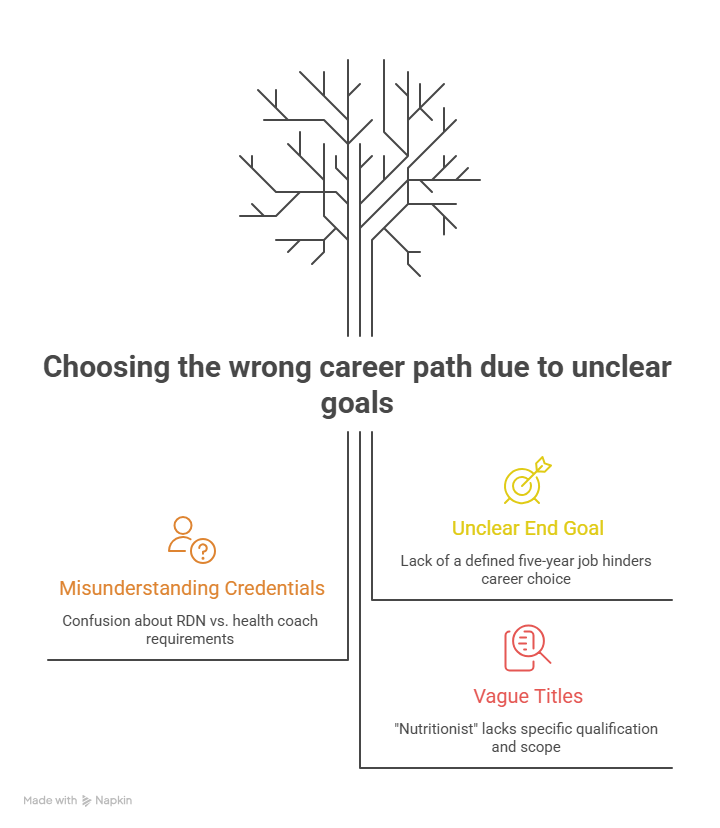
Start with the job you want five years from now and work backward.
If your dream is clinical nutrition, disease management, hospital care, outpatient medical nutrition therapy, renal nutrition, oncology nutrition, enteral feeding, or other advanced dietetic practice, the RDN pathway deserves serious consideration. The current U.S. pathway requires graduate-level education plus qualifying dietetics coursework and supervised practice before examination eligibility.
That pathway carries a higher education commitment, but it also provides a standardized professional credential recognized across many healthcare environments. Anyone evaluating the cost should compare the investment with health-coaching income realities, health-coaching job options, certification ROI, and the realities of independent coaching practice.
If your strongest interest is behavior change, health coaching may align more directly.
You might love asking powerful questions, helping people overcome inconsistency, designing accountability, exploring motivation, and making existing health recommendations workable in ordinary life. That sits close to health behavior change, Positive Intelligence, Immunity to Change, and SMART goal coaching.
Health coaching can also make sense for somebody who already possesses another professional credential. A dietitian, nurse, physician, physiotherapist, psychologist, or other qualified professional can develop coaching skills while maintaining the independent scope attached to their underlying credential. NBHWC specifically recognizes that coaches who hold additional professional credentials may operate within those additional scopes when roles and boundaries are appropriately disclosed.
That combination can be powerful. An RDN may use nutrition expertise while employing CLEAR coaching, OSCAR, T-GROW, and stronger client contracting to improve implementation.
If you want a nutrition-centered career without conventional dietetics, investigate the exact qualification rather than choosing the word “nutritionist.”
A university nutrition-science degree could support careers in research, public health, food industry, communications, education, product development, or other areas depending on the program and employer. An advanced CNS pathway may support personalized nutrition practice where the credential and applicable state laws permit it.
This is also where cultural competence, professional ethics, duty of care, and clear professional agreements matter. The broader the title, the more important it becomes to communicate exactly what qualification and scope sit behind it.
5. The Career Test to Run Before Spending Thousands on Training
Career confusion becomes expensive when education starts before job research.
Use a 20-job test.
Find 20 real positions that resemble the work you imagine doing. Record the required degree, preferred credential, license, experience, salary range, location, remote availability, clinical responsibilities, and daily duties.
If 17 of those 20 jobs require an RDN, you have learned something more useful than a certification sales page can tell you.
If most require health-promotion experience, coaching skill, or a broader wellness background, investigate health-coaching certification, health-coaching jobs, coaching career ROI, and ICF versus NBHWC.
Then run a 10-practitioner test.
Interview or shadow professionals working in the exact settings you are considering. Ask what percentage of their week is spent counseling, documenting, selling, managing, educating, performing clinical work, handling administration, and finding clients.
This is important because glamorous job titles can hide ordinary work.
A private-practice professional may spend substantial time marketing. A health coach may need to become good at client acquisition, pricing, positioning, and building credibility alongside coaching itself.
An RDN may spend significant time documenting, coordinating with healthcare teams, dealing with reimbursement systems, calculating nutrition requirements, or managing foodservice depending on the role. A nutrition scientist may spend far more time analyzing data and reading research than counseling clients.
Next run a scope test.
Write down ten activities you most want to perform professionally. Examples might include designing meal plans, treating disease through nutrition, coaching habits, teaching general nutrition, interpreting laboratory data, facilitating corporate wellness programs, creating food products, conducting research, supporting stress-management habits, or working inside hospitals.
Now map those tasks against actual scope rules.
Anyone drawn toward health behavior change, self-confidence coaching, self-care coaching, and burnout coaching may discover that coaching addresses most of the work they genuinely want to do. Someone who keeps writing “diagnose,” “treat,” “prescribe,” “clinical,” and “therapeutic nutrition” will probably need a different professional route.
Finally, calculate the opportunity cost.
Include tuition, prerequisite courses, unpaid or lower-paid training periods, lost salary, relocation, examination fees, licensing expenses, continuing education, and the number of years before earning full professional income.
Reddit career changers repeatedly mention these hidden costs. A 2026 UK thread included newly qualified dietitians discussing placement costs, relocation, and local job competition. A separate U.S. discussion asked whether dietitian compensation justified graduate education and supervised training. These experiences differ by country and individual, but they show why the education decision should be modeled financially rather than emotionally.
That same discipline belongs in coaching pricing, first-client planning, career positioning, and choosing professional credentials.
6. FAQs About Health Coach vs Dietitian vs Nutritionist Careers
-
A health coach working solely under the NBHWC coaching scope can discuss general evidence-based health information and help clients explore habits, goals, barriers, and implementation. NBHWC states that standalone coaches do not provide individualized nutrition consultation, create meal plans, diagnose, prescribe, or recommend supplements. Coaches can still provide enormous value through behavior-change coaching, SMART goals, accountability, and professional referrals.
-
The terms should not be treated as interchangeable. RDN is a standardized U.S. credential with defined education, supervised-practice, examination, and continuing professional requirements. “Nutritionist” can refer to practitioners with dramatically different training, though advanced credentials such as CNS have rigorous requirements of their own. Before choosing a pathway, compare professional ethics, duty of care, certification strategy, and actual employer requirements.
-
Your target job determines the answer. General wellness, self-care coaching, behavior change, burnout coaching, and corporate wellness can involve professionals from multiple backgrounds. The RDN pathway becomes especially relevant when you want dietetics-specific clinical authority or jobs that explicitly require the credential. The Academy also notes that RDNs themselves work in wellness, industry, education, research, public health, and private practice, so pursuing dietetics does not lock someone into hospital work.
-
Health-coaching training can generally be entered without completing the graduate-level dietetics pathway required of new U.S. RDN candidates, although specific health-coaching credentials have their own education and experience requirements. Someone comparing routes should examine NBHWC pathways, ICF versus NBHWC, health-coaching employment, and career ROI. Faster entry can come with a narrower standalone scope.
-
Yes. Dietitians can develop formal coaching skills and use them alongside their nutrition expertise. This combination can be especially useful when the client has enough information yet struggles to implement it. An RDN who understands T-GROW, OSCAR, Immunity to Change, and health behavior change can combine expert nutrition work with stronger behavior-change conversations while clearly identifying which professional role is being used.
-
Job security depends on geography, specialty, employer demand, qualification, and business model. U.S. BLS currently projects 8% growth for the combined dietitians-and-nutritionists occupation between 2025 and 2035 and reports about 5,700 openings annually on average. Health coaching has a less tidy standalone federal labor category, so career evaluation should include health-coaching demand, available coaching jobs, client acquisition, and private-practice economics.
