
Can You Coach Nutrition Without Being a Dietitian? Reddit Questions, Legal/Ethical Boundaries & Referral Rules
Nutrition sits in one of health coaching’s most confusing scope-of-practice zones. A coach may help clients improve routines, accountability, food awareness, and health behavior change, yet individualized nutrition treatment can trigger professional and legal restrictions. Reddit threads repeatedly show coaches struggling with meal plans, macros, supplements, labs, and chronic conditions. Understanding those boundaries matters for anyone evaluating health coaching as a career, health coaching jobs, or the NBHWC pathway.
1. Can You Legally Coach Nutrition Without Being a Dietitian?
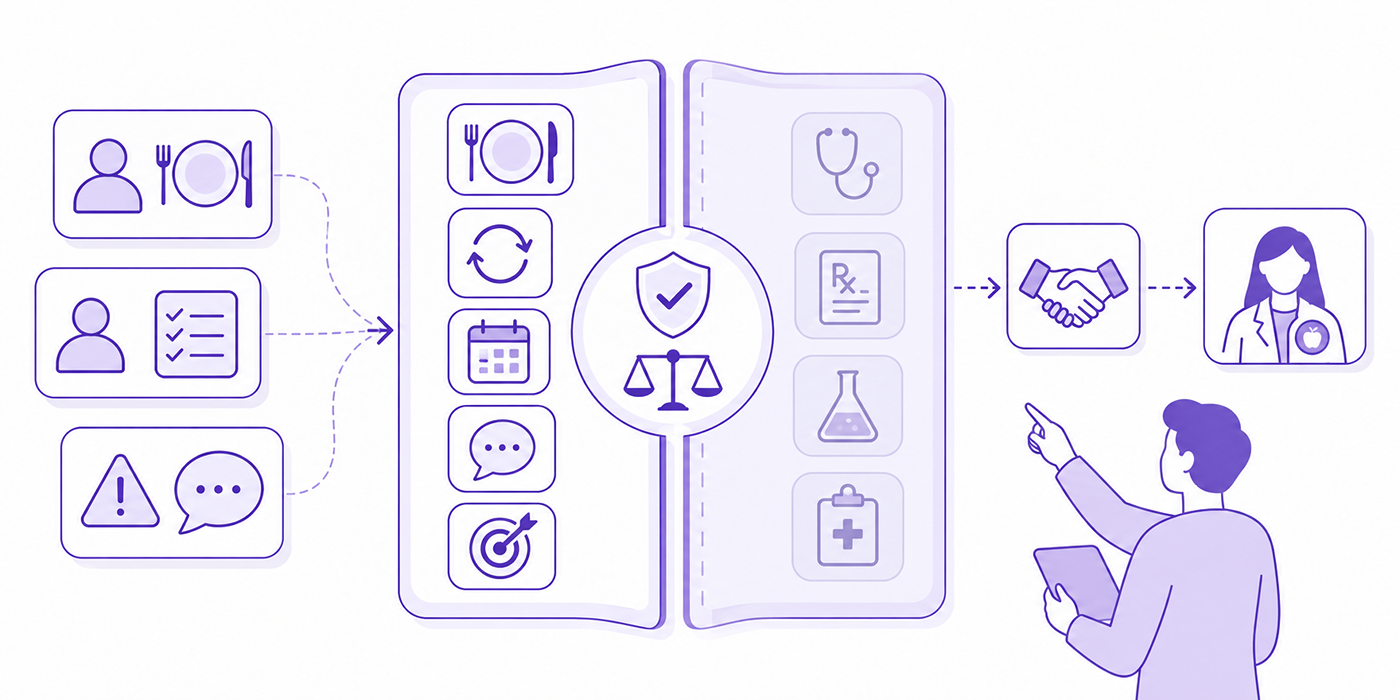
In many situations, a health or wellness coach can discuss food-related behavior, general nutrition education, goal setting, accountability, barriers, routines, and implementation without being a registered dietitian. The exact boundary depends on the law where the service is delivered, the coach's credentials, the service being advertised, and whether the client's situation has entered clinical nutrition territory.
That final distinction creates much of the confusion.
Helping a client identify why they skip breakfast, plan grocery-shopping routines, practice reading food labels, build consistency around meals, or follow general public-health guidance can fall within a coaching-oriented model. A coach trained in behavior change might use SMART goals, the CLEAR coaching model, or the T-GROW model to help the client convert intentions into repeatable habits.
The risk rises when the coach moves into individualized clinical recommendations. Examples include designing a diet to manage diabetes, adjusting intake because of kidney disease, interpreting bloodwork, prescribing a therapeutic eating protocol, recommending supplements for a diagnosed deficiency, or constructing a medical-condition-specific meal plan.
The National Board for Health & Wellness Coaching takes a particularly clear position. Its current scope states that coaches acting solely as health and wellness coaches do not diagnose, interpret medical data, prescribe or deprescribe, recommend supplements, provide nutrition consultation, or create meal plans. Coaches may provide evidence-based resources from nationally recognized authorities and can help implement another qualified professional's treatment plan when appropriately working under or alongside that professional.
That makes coaching scope and duty of care as important as knowledge of food.
A client might say:
“Just tell me exactly what to eat for the next eight weeks.”
The tempting response is to demonstrate expertise by producing a detailed prescription. A stronger coach first establishes what their credential, jurisdiction, and professional role permit. They can often continue helping with adherence, planning, environmental barriers, motivation, self-monitoring, and behavior-change implementation while referring individualized nutrition therapy to an appropriately qualified professional.
This distinction also matters when choosing between ICF and NBHWC pathways, evaluating health-coaching certification ROI, developing a professional coaching code of conduct, and setting expectations through clear coaching contracts.
The safest mental model is to separate four questions:
Legal scope: What does the client's jurisdiction allow?
Credential scope: What does your certification or professional body allow?
Competence: What have you actually been trained to do safely?
Clinical complexity: Does this client's situation require individualized medical or nutrition treatment?
A permission in one category does not automatically settle the other three.
| Client Request or Situation | Typical Coaching Approach | Risk Level | Safer Next Step | Useful ANHCO Resource |
|---|---|---|---|---|
| “Help me remember to eat regularly.” | Explore routines, barriers, cues and accountability. | Lower | Build a client-directed habit system. | Behavior change |
| “Help me plan grocery shopping each week.” | Coach planning, organization and follow-through. | Lower | Create a shopping routine based on the client's own choices. | SMART goals |
| “Teach me how to understand a food label.” | Use recognized educational resources where permitted. | Lower | Keep information general rather than disease-specific. | Code of conduct |
| “Help me stop ordering takeout every night.” | Explore triggers, environment and implementation barriers. | Lower | Develop client-chosen alternatives and accountability. | Behavior change |
| “Help me drink water consistently.” | Coach habit formation and self-monitoring. | Lower for healthy adults | Refer when fluid intake is medically restricted or clinically complicated. | T-GROW |
| “Tell me exactly how many calories I should eat.” | Potentially individualized nutrition prescription. | Higher | Check jurisdiction, credentials and clinical context before proceeding. | Duty of care |
| “Calculate my macros for weight loss.” | May move beyond general education into individualized advice. | Medium-high | Check applicable scope and consider RD referral. | Contracting |
| “Write me a seven-day meal plan.” | Common scope concern for standalone coaches. | High | Refer or collaborate with a qualified nutrition professional. | NBHWC pathway |
| “What should I eat for my diabetes?” | Disease-specific nutrition management. | High | Refer to an RD/RDN or appropriate licensed clinician. | Duty of care |
| “My glucose keeps dropping. What should I change?” | Potential clinical and medication-related issue. | Very high | Prompt medical referral; emergency escalation may be appropriate depending on symptoms. | Ethical practice |
| “Interpret these blood-test results.” | Medical-data interpretation. | Very high | Refer to the client's physician or qualified clinician. | Duty of care |
| “Which supplement fixes my deficiency?” | Supplement recommendation tied to a medical finding. | Very high | Refer to the appropriate qualified professional. | Professional boundaries |
| “Help me follow the plan my dietitian gave me.” | Excellent behavior-change coaching opportunity. | Lower with clear role boundaries | Support implementation without altering the clinical plan. | Behavior change |
| “I cannot stick to the dietary goals my doctor set.” | Coach barriers, motivation and adherence. | Lower with coordination | Keep clinical changes with the treating professional. | Immunity to Change |
| “I have kidney disease. How much protein should I eat?” | Disease-specific nutrient prescription. | Very high | Refer to an RD/RDN experienced in renal nutrition. | Duty of care |
| “I have celiac disease. Build my diet.” | Therapeutic dietary management. | High | Refer for individualized clinical nutrition care. | Scope contracting |
| “Help me organize meals around my work schedule.” | Routine and planning coaching. | Lower | Keep actual food choices client-directed or professionally prescribed. | CLEAR model |
| “Tell me which diet will cure my autoimmune condition.” | Disease-treatment claim. | Very high | Refer and avoid unsupported therapeutic claims. | Code of conduct |
| “Can we track how often I cook at home?” | Self-monitoring and accountability. | Lower | Use behavioral metrics chosen with the client. | SMART goals |
| “I binge and then heavily restrict food.” | Potential eating-disorder concern. | Very high | Refer to appropriately qualified eating-disorder professionals. | Duty of care |
| “My child refuses most foods. What diet should I use?” | Pediatric nutrition may involve growth and medical concerns. | High | Refer to pediatric healthcare and nutrition professionals. | Ethical boundaries |
| “I am pregnant. How much should I eat?” | Individual requirements can depend on medical and pregnancy factors. | High | Refer for individualized guidance while coaching habits within scope. | Coaching contracts |
| “Can you help me cook more vegetables?” | Behavioral implementation and practical education. | Lower | Use general evidence-based resources and client preferences. | Behavior change |
| “Should I stop taking my medication because my diet improved?” | Medication management. | Very high | Direct the client back to the prescribing clinician. | Duty of care |
| “Which foods are causing my unexplained stomach pain?” | May require diagnosis and clinical assessment. | High | Refer for medical evaluation rather than diagnosing a food intolerance. | Professional conduct |
| “Help me prepare questions for my dietitian.” | Client empowerment and communication coaching. | Lower | Help organize concerns without providing clinical answers yourself. | CLEAR coaching |
| “Help me stop emotional snacking when stressed.” | Explore triggers and behavior while screening for greater clinical complexity. | Variable | Coach within scope and refer when eating-disorder or mental-health concerns emerge. | Positive Intelligence |
| “Review my food diary and diagnose what is wrong.” | The diagnosis request creates a clinical boundary. | High | Use the diary for awareness or coaching questions rather than diagnosis. | OSCAR model |
| “My RD gave me targets. Help me stay consistent.” | Accountability and implementation support. | Lower | Coach execution while leaving target changes to the RD. | T-GROW model |
| “Guarantee that your program will reverse my condition.” | High-risk clinical and marketing claim. | Very high | Avoid guarantees and maintain evidence-based, lawful marketing. | Code of conduct |
2. The Legal Boundary: Why “Nutrition Coaching” Means Different Things in Different Places
The biggest mistake is searching for one universal answer to “Can a health coach give nutrition advice?”
In the United States, nutrition regulation varies by state. The Academy of Nutrition and Dietetics explains that states can use licensure, state certification, title protection, and practice-exclusivity rules. Practice-exclusivity provisions can restrict particular nutrition services to licensed professionals, while title-protection rules focus on who may use titles such as dietitian or nutritionist.
That means someone building a health coaching career needs more than a generic online article about scope. Your coaching contract, professional code of conduct, duty-of-care procedures, and service description should reflect the jurisdictions in which you actually practice.
The state differences can be substantial.
Illinois law currently includes an exemption allowing general nonmedical nutrition information, wellness-related nutrition recommendations, health coaching, behavior-change management, and certain other services provided they do not become medical nutrition therapy and the provider does not misrepresent themselves as licensed to deliver MNT.
Nebraska likewise has statutory language allowing individualized nutrition information, motivation, recommendations, behavior-change management, health coaching, and wellness education when the service does not constitute medical nutrition therapy and the person does not claim a protected license.
Other states can draw tighter lines. Alabama's statute, for example, restricts the practice of dietetics/nutrition and contains specific requirements around weight-control services and licensed professionals.
Those examples expose an important distinction for anyone considering health coach certification versus NBHWC: what local law permits can be broader than what your credential's professional scope permits.
NBHWC's published scope is conservative around nutrition. A coach practicing under that role should therefore follow the standards attached to that professional identity even where state law might allow an unlicensed person to perform broader nutrition activities.
This becomes particularly important for online coaches.
A practitioner can live in one state while serving a client in another. Before selling remote nutrition-oriented services nationally, review the current statute and licensing-board guidance relevant to the client's location and obtain professional legal advice where the boundary remains uncertain. The Academy itself cautions that its summaries are informational and that the relevant state board or agency ultimately interprets the state's requirements.
International practice adds another regulatory layer. Coaches serving clients across the Gulf, Europe, Africa, or Asia should evaluate local healthcare, dietetics, advertising, consumer-protection, and title-use requirements rather than assuming U.S. rules travel with the coach. Professionals researching geographically specific pathways can also explore ANHCO's guides for Saudi Arabia, Qatar, Kuwait, and Oman.
The practical rule is simple: check the law before building the offer.
A website promising “custom therapeutic diets for diabetes, PCOS and thyroid disease” creates a very different regulatory profile from an offer centered on sustainable routines, client-led goals, behavior-change coaching, self-care routines, accountability, and implementation of recommendations made by qualified healthcare professionals.
3. What Reddit Questions Reveal About the Real Scope-of-Practice Confusion
Reddit discussions expose how easily the boundary becomes blurred in real sessions.
A July 2026 discussion among personal trainers focused specifically on nutrition-coaching legality. Participants distinguished general healthy-eating support from meal plans, disease-specific advice, supplement recommendations, and working with clients who have significant health conditions. The thread also showed disagreement over exactly where each line sits, which is precisely why internet consensus cannot substitute for checking the applicable law and credential standards.
Another 2025 HealthCoaching thread centered on frustration from aspiring coaches who wondered how food could be discussed meaningfully when individualized recommendations and meal planning might exceed their professional scope.
A June 2026 dietetics discussion described an even more difficult scenario: a nutrition graduate found themselves giving plans to people with diabetes, thyroid issues and other medical concerns and began questioning whether the role had drifted beyond their preparation.
These conversations reveal five recurring problems.
Clients ask coaches to cross the boundary for them
The client rarely says, “Please violate your scope of practice.”
They say:
“Just tell me what you would eat.”
“Can you quickly check my bloodwork?”
“Which supplements would you take?”
“Can you adjust the diet my doctor gave me?”
“My glucose was low yesterday. Should I cut carbohydrates?”
“This meal plan is too complicated. Can you rewrite it?”
A coach needs a response system before those questions appear. Clear contracting, professional duty of care, and a defined coaching code of conduct make those conversations considerably easier.
Education can quietly become prescription
Discussing nationally recognized dietary guidance is one activity. Translating general guidance into a therapeutic diet for an individual with a diagnosed condition can create a completely different scope issue.
The current U.S. Dietary Guidelines for Americans 2025–2030 are population-level federal nutrition guidance. NBHWC specifically notes that population guidance should not be converted by a standalone coach into individualized prescriptive targets or specific dietary protocols.
A coach can instead use SMART goal setting, the OSCAR framework, T-GROW coaching, and health behavior-change strategies to help clients act on appropriate information.
A nutrition certificate does not automatically create a clinical license
Private certifications can improve knowledge, coaching technique, and professional development. Their legal effect depends on the jurisdiction.
This matters for anyone comparing health coaching certification and NBHWC eligibility, deciding whether health coaching remains worth pursuing, or examining health-coaching employment pathways.
Clinical information creates a new decision point
A client showing a coach laboratory results, glucose readings, medication concerns, unexplained symptoms, or a diagnosed condition should trigger a scope check.
One March 2026 Reddit thread from a dietitian working in telehealth described the difficulty of staying inside a coaching role when clients brought up glucose patterns, medications, laboratory data, and hypoglycemia. Even a licensed dietitian can face licensure questions when practicing across state lines, illustrating how quickly telehealth creates jurisdictional complexity.
Good referral behavior increases professional credibility
A referral does not signal that the coach failed.
It demonstrates that the coach understands where duty of care, professional conduct, coaching contracts, and the client's best interests meet.
A coach can often remain highly valuable after referral by helping the client execute the plan, overcome barriers, design routines, increase self-awareness, track behavior, and strengthen consistency through behavior-change coaching.
4. Nutrition Coaching Referral Rules: When the Coach Should Bring in an RD, Doctor or Other Professional
A strong referral system works better than relying on instinct during a difficult session.
Health coaches should establish referral criteria during service design and include those expectations in their coaching contract, ethical framework, and duty-of-care procedures.
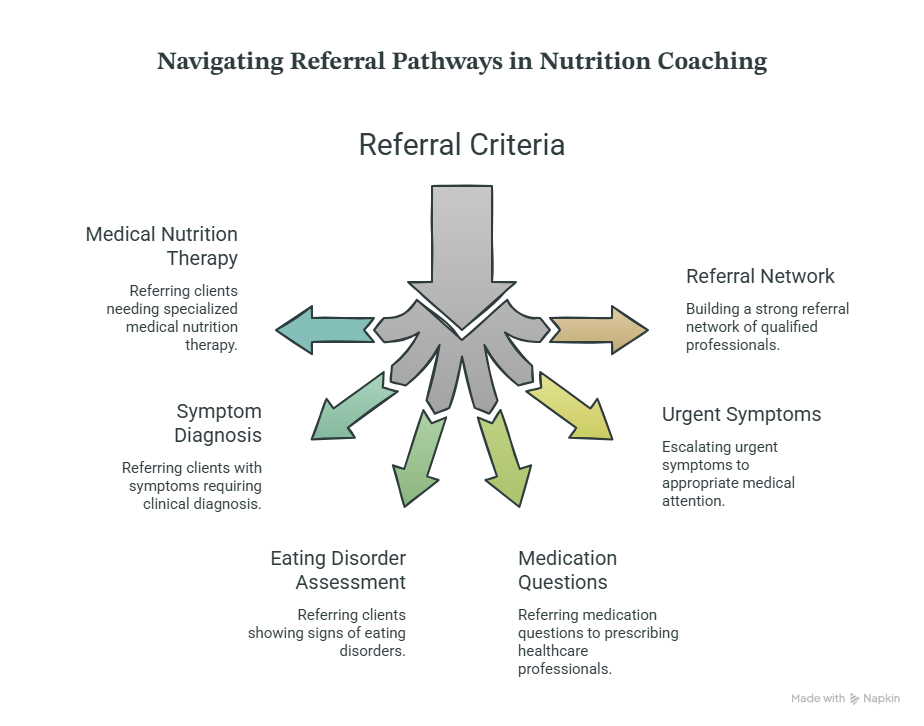
Refer when the client needs medical nutrition therapy
Medical nutrition therapy involves individualized nutritional assessment and intervention around disease or health conditions. The legal definition can vary by jurisdiction, so coaches should understand the applicable law.
Common situations that should trigger professional review include:
diabetes or significant glucose-management concerns;
chronic kidney disease;
diagnosed gastrointestinal disease;
cardiovascular disease requiring therapeutic dietary management;
food allergies with meaningful medical risk;
diagnosed nutrient deficiencies;
complex pregnancy-related nutrition needs;
pediatric growth or feeding concerns;
conditions requiring medically controlled nutrients;
tube feeding or other specialized nutrition support.
The coach's role can remain valuable. After the RD or clinician establishes the clinical plan, the coach can support behavior change, goal implementation, adherence, problem-solving through the OSCAR coaching model, and sustainable routines through T-GROW.
Refer when symptoms require diagnosis
A client may attribute fatigue, bloating, headaches, dizziness, weight change, abdominal pain, or skin symptoms to food. A coach should avoid deciding that gluten, dairy, insulin resistance, “toxins,” hormonal imbalance, or another cause explains the symptoms without appropriate clinical assessment.
Help the client document what they are experiencing, prepare questions, and seek appropriate evaluation.
That approach preserves the coaching relationship while respecting professional boundaries, duty of care, and clear contracting.
Refer when eating behavior suggests an eating disorder
Restriction, bingeing, purging, compulsive exercise, significant fear around food, rapid or unexplained weight change, or severe distress around eating can require specialized assessment and treatment.
A coach who sees these signs should have a referral pathway to appropriately trained medical, dietetic, and mental-health professionals. A general self-care coaching framework or Positive Intelligence approach should never substitute for clinically appropriate eating-disorder care.
Refer medication questions to the prescribing professional
Questions such as “Can I reduce my insulin?”, “Should I stop this medication?”, or “Can this supplement replace my prescription?” belong with qualified healthcare professionals.
NBHWC's scope specifically excludes prescribing and deprescribing medications.
The coaching opportunity lies in helping clients prepare for conversations with their clinician, track adherence, identify barriers, and create action plans using CLEAR coaching, SMART goals, or T-GROW.
Escalate urgent symptoms appropriately
Severe allergic reactions, loss of consciousness, severe hypoglycemia symptoms, chest pain, major dehydration, or other potentially urgent symptoms require medical attention rather than a scheduled coaching discussion.
Your duty-of-care process should tell you whom to contact, what to document, and how to respond without improvising during a crisis.
Build a referral network before you need one
At minimum, a nutrition-oriented coach benefits from relationships with:
registered dietitians;
primary-care clinicians;
eating-disorder specialists;
licensed mental-health professionals;
diabetes educators or relevant specialists;
other qualified professionals relevant to the population served.
This can make health coaching jobs and private-practice work more clinically integrated, while professional contracting clarifies how information and responsibilities move between professionals.
5. How to Build a Nutrition Coaching Offer That Stays Valuable Without Pretending to Be Dietetics
Coaches sometimes hear “stay within scope” and imagine their service becoming weak.
The commercial opportunity remains substantial because knowing what healthy behavior looks like and consistently doing it are separate problems.
A client can leave an appointment with an excellent nutrition plan and still struggle because work meetings disrupt meals, groceries never get purchased, family routines conflict with the plan, stress triggers old behavior, weekends destroy consistency, or perfectionism turns one difficult meal into a four-day collapse.
Those problems belong squarely in the territory of health behavior change, SMART goal design, Immunity to Change, and Positive Intelligence.
Build your service around implementation
A strong nutrition-adjacent coaching offer might help clients:
establish consistent meal routines;
identify practical barriers to planned behaviors;
improve grocery and meal-preparation systems;
make client-directed goals measurable;
develop environmental cues;
review adherence patterns;
plan for travel, work pressure or family disruption;
recover after lapses;
prepare questions for healthcare appointments;
follow through on clinician or dietitian recommendations;
strengthen self-monitoring;
reduce all-or-nothing behavior.
These services can create substantial value without requiring the coach to become the client's clinical dietitian.
Use OSCAR coaching to explore options, CLEAR coaching to structure the relationship, T-GROW to move toward action, and SMART goals to make the plan observable.
Put your scope in writing
Your client agreement should clearly explain what service you provide.
Useful language can cover:
Role: health and wellness coaching focused on behavior, goals, accountability and implementation.
Limits: diagnosis, medical treatment, medical-data interpretation, medication decisions and clinical nutrition services outside your professional authorization.
Referral: circumstances in which another qualified professional may need to become involved.
Collaboration: permission and process for coordinating with the client's RD, physician or other professional when appropriate.
Emergency policy: instructions for urgent medical or mental-health concerns.
These elements strengthen coaching contracts, support duty of care, and reinforce a professional coaching code of conduct.
Audit your marketing as carefully as your sessions
Scope problems often start on the sales page.
Statements such as “reverse diabetes naturally,” “balance your hormones,” “heal your gut,” “treat thyroid dysfunction,” or “fix insulin resistance through my protocol” can communicate health or treatment claims that create ethical, regulatory, and advertising issues.
In the United States, the FTC requires health-related advertising claims to be truthful, non-misleading, and supported by adequate evidence. Health claims generally require competent and reliable scientific evidence.
Testimonials do not automatically prove that a health claim is valid. The FTC specifically warns that individual experiences do not substitute for scientific substantiation.
That makes the marketing side of professional coaching conduct directly relevant to client safety.
Stronger positioning focuses on what the coaching process actually supports:
“Build food routines you can consistently follow.”
“Turn your clinician's recommendations into sustainable daily habits.”
“Develop planning and accountability around your health goals.”
“Understand the behavior patterns that keep disrupting your routine.”
These statements align far better with behavior-change coaching, self-care coaching, SMART goal setting, and professional coaching boundaries.
Separate education from individual treatment
Create a vetted resource library using recognized public-health authorities.
The current U.S. Dietary Guidelines for Americans 2025–2030 provide national nutrition guidance, for example.
Then use coaching questions:
“What part of these recommendations feels realistic this week?”
“What keeps getting in the way?”
“What would make grocery shopping easier?”
“What happened on the days the plan worked?”
“What is the smallest change you could repeat?”
“What support would help you carry out your dietitian's recommendation?”
This is where a coach's real skill becomes visible. Clients frequently have information already. They need help converting information into behavior.
That implementation expertise can also improve the economics discussed in whether health coaching is worth pursuing, health-coaching career options, health-coach certification versus NBHWC, and client-acquisition problems after certification.
6. FAQs About Coaching Nutrition Without Being a Dietitian
-
The answer depends on the type of advice, jurisdiction, credential and client.
General education, client-led goal setting, food-related habit coaching, accountability, and implementation support may be available within a coaching role. Individualized nutrition therapy, disease treatment, lab interpretation, meal-plan prescription, supplements, and similar services can trigger legal or credential restrictions.
NBHWC-certified coaches working solely within the NBHWC coaching role follow a scope that excludes nutrition consultation, meal plans, supplement recommendations, diagnosis and medical-data interpretation.
Anyone considering health coaching certification should therefore study professional contracting, duty of care, and coaching ethics alongside nutrition education.
-
Meal-plan rules depend on jurisdiction and professional credential.
NBHWC's current health-and-wellness coaching scope places meal-plan creation outside the standalone coach role. State laws may establish additional boundaries around dietetics, nutrition practice, medical nutrition therapy, and protected professional titles.
A coach can often provide substantial value through behavior-change coaching, SMART goals, and accountability-oriented coaching frameworks while an RD handles individualized nutrition planning.
-
General educational discussion can differ legally and professionally from prescribing individualized calorie or macronutrient targets.
The safest approach is to assess the purpose of the request, the client's health status, applicable law, and the coach's credential scope before providing individualized numbers. A healthy adult seeking general education creates a different risk profile from a client with diabetes, chronic kidney disease, pregnancy complications, disordered eating, or another clinical concern.
Use coaching contracts, professional conduct standards, and duty-of-care procedures to define the boundary before the question appears.
-
A coach can potentially support behavior change, accountability, routines, self-management goals, and implementation while qualified healthcare professionals handle diagnosis, medication and medical nutrition therapy.
Questions about glucose patterns, hypoglycemia treatment, medication changes, therapeutic carbohydrate targets, or individualized diabetes diets should move to appropriately qualified professionals.
A collaborative model allows the coach to use health behavior change, SMART goal setting, OSCAR coaching, and T-GROW around the clinical plan.
-
A private coaching certificate and professional dietetics licensure operate through different credentialing and legal systems.
State laws can regulate titles and practice, while professional certifications define their own competence and scope standards. The Academy of Nutrition and Dietetics emphasizes that state licensure is distinct from private certification.
Coaches comparing credentials should examine health coaching certification versus NBHWC, ICF versus NBHWC, health-coaching job requirements, and career ROI after certification.
-
NBHWC's standalone coaching scope specifically excludes supplement recommendations. Other professionals may have different legal scopes depending on their credentials and jurisdiction.
Supplement questions tied to deficiencies, medications, pregnancy, disease, adverse symptoms, or treatment goals particularly warrant qualified clinical review.
Coaches can still help clients organize questions, follow professional recommendations, and work through adherence using CLEAR coaching, SMART goals, behavior-change strategies, and strong duty-of-care boundaries.
