
Therapist vs Life Coach Boundaries: Reddit Real-World Questions, Red Flags & When a Coach Must Refer Out
The therapist-versus-life-coach boundary becomes difficult when a client arrives with goals and emotional pain at the same time. Career decisions, confidence, relationships, burnout, grief, trauma histories, anxiety, and identity changes rarely fit into neat boxes. Coaches therefore need more than a disclaimer. They need a repeatable decision system grounded in coaching duty of care, a clear coaching code of conduct, strong client contracting, and the judgment to recognize when another professional should enter the picture.

1. Therapist vs Life Coach: Where the Professional Boundary Actually Sits
Psychotherapy is a professional treatment designed to assess and treat psychological, emotional, and behavioral difficulties. The American Psychological Association describes psychotherapy as a psychological service delivered by a trained professional that can involve assessment, diagnosis, and treatment of dysfunctional emotional reactions, thinking patterns, and behaviors. In the United States, psychotherapists practicing through regulated professions are licensed according to the requirements governing their profession and jurisdiction.
Life coaching has a different professional center of gravity. A coach commonly works with goals, decisions, behavior, accountability, performance, values, transitions, leadership, relationships, habits, and forward movement. That makes frameworks such as the CLEAR coaching model, OSCAR coaching model, T-GROW coaching model, and SMART goals useful because they organize client-led action rather than clinical treatment.
The boundary therefore depends heavily on what the professional is attempting to do.
A client can cry during coaching.
A client can talk about childhood.
A client can describe fear, disappointment, grief, anger, embarrassment, or insecurity.
A difficult emotion appearing in a session does not automatically transform the engagement into psychotherapy. Coaches frequently encounter emotions while helping clients work through career burnout, self-confidence, life purpose, or major life change.
The critical question is whether the coach is facilitating a client-led goal within their competence or attempting to assess, diagnose, treat, resolve, process, or clinically manage a mental-health condition.
For example, a client saying, “I become anxious before presentations and want to build a preparation routine,” can create legitimate work around public speaking coaching, self-confidence coaching, SMART goals, and behavior change.
A coach who starts diagnosing that anxiety, determining its clinical cause, delivering psychotherapy for an anxiety disorder, or attempting trauma processing has changed the nature of the service.
The International Coaching Federation's current Code of Ethics took effect on April 1, 2025. It requires coaches to maintain appropriate professional boundaries and specifically addresses professionals who hold multiple roles. Standard 3.7 says that when an ICF professional also has another professional role, such as therapist, mentor, HR specialist, or assessor, they are responsible for disclosing when they are acting outside the coaching role.
That makes contracting in coaching, professional ethics, duty of care, and cultural competence operational safeguards rather than paperwork.
A therapist who also coaches needs role clarity.
A coach with psychology education needs role clarity.
A former clinician who no longer practices clinically needs role clarity.
A coach who has personally recovered from trauma needs role clarity.
Expertise, personal experience, and adjacent education can improve understanding while the professional service being offered still needs clearly defined boundaries.
| # | Client Situation | Likely Coaching Decision | Appropriate Coaching Focus | Escalation Trigger |
|---|---|---|---|---|
| 1 | “I hate my job and cannot decide whether to leave.” | Coaching can fit | Values, options, priorities, decision criteria | Severe psychological impairment emerges |
| 2 | “I get nervous before presentations.” | Often coachable | Preparation, confidence, exposure to normal professional challenges | Symptoms suggest significant anxiety requiring clinical assessment |
| 3 | “I have panic attacks several times a week.” | Mental-health referral indicated | Coaching may later complement treatment if appropriate | Recurrent panic or major functional impairment |
| 4 | “My childhood affects every relationship I have. Help me process it.” | Refer for therapy | Keep coaching away from trauma processing | Past trauma becomes treatment target |
| 5 | “My confidence drops during job interviews.” | Coaching can fit | Preparation, beliefs, practice, action planning | Broader psychiatric symptoms emerge |
| 6 | “I have been diagnosed with depression and stopped functioning.” | Clinical care should be prioritized | Possible adjunct coaching only with appropriate stability and boundaries | Significant impairment or safety concerns |
| 7 | “I procrastinate on my business goals.” | Coaching can fit | Habits, accountability, barriers, priorities | Symptoms point toward an untreated clinical issue |
| 8 | “Tell me whether my partner is a narcissist.” | Do not diagnose | Explore observable behavior, boundaries and client choices | Diagnosis or abuse-related safety concerns |
| 9 | “I am grieving and need help rebuilding my routine.” | May be coachable depending on presentation | Routine, values, support, realistic goals | Persistent severe impairment, suicidality or need for grief treatment |
| 10 | “I cannot stop thinking about killing myself.” | Urgent safety response | Follow crisis protocol and connect to appropriate emergency/crisis support | Suicidal thoughts, plan, intent or immediate danger |
| 11 | “I want better boundaries with my manager.” | Coaching can fit | Communication, values, assertiveness, rehearsal | Workplace abuse or severe psychological impact may require additional support |
| 12 | “I binge and purge after stressful days.” | Specialist referral | Do not attempt eating-disorder treatment through coaching | Disordered eating behavior |
| 13 | “I want accountability for my morning routine.” | Core coaching territory | Environment, cues, consistency, tracking | Clinical concerns emerge later |
| 14 | “I drink heavily every night and cannot stop.” | Professional assessment needed | Support connection to appropriate treatment resources | Possible substance-use disorder or withdrawal risk |
| 15 | “My divorce destroyed my confidence.” | Potentially coachable | Identity, goals, future direction, confidence | Clinical depression, trauma or safety problems dominate |
| 16 | “Help me recover suppressed childhood memories.” | Outside coaching role | Avoid memory-recovery techniques | Trauma/memory treatment request |
| 17 | “I am burned out and need a sustainable workweek.” | Often coachable | Workload, boundaries, recovery, priorities | Severe depression, anxiety or functional deterioration |
| 18 | “I hear voices telling me people are watching me.” | Prompt clinical assessment | Facilitate connection to appropriate care | Possible psychosis or thought disorder |
| 19 | “I have ADHD and want help organizing my week.” | Can be coachable within competence | Structure, planning, accountability, implementation | Diagnostic or treatment questions belong with clinicians |
| 20 | “Do you think I have ADHD?” | Do not diagnose | Discuss observed difficulties and referral options | Diagnostic assessment requested |
| 21 | “My therapist and I are treating anxiety. I also want career accountability.” | Concurrent care can fit | Career goals with explicit boundaries | Coaching begins duplicating treatment |
| 22 | “I am afraid to leave an abusive partner.” | Safety-sensitive referral | Support access to specialized domestic-abuse resources | Threats, coercion, violence or immediate safety risk |
| 23 | “I want to become more assertive in meetings.” | Coaching can fit | Communication practice and behavioral goals | Underlying clinical problem becomes primary |
| 24 | “I cannot get out of bed and have stopped going to work.” | Clinical assessment warranted | Help client connect to appropriate care | Major decline in everyday functioning |
| 25 | “I keep choosing partners with the same unhealthy pattern.” | Depends on goal and depth | Present choices, values, boundaries and patterns | Trauma treatment or psychopathology becomes the focus |
| 26 | “Use CBT to treat my anxiety.” | Therapeutic treatment request | Clarify role and provide referral | Psychological treatment explicitly requested |
| 27 | “My father died and I need help deciding what comes next professionally.” | May be coachable | Values, capacity, decisions, pacing | Grief symptoms require clinical treatment |
| 28 | “I cut myself when overwhelmed.” | Safety response and referral | Follow appropriate crisis/safety procedures | Self-harm behavior |
| 29 | “I want to rebuild my social life after finishing therapy.” | Strong coaching possibility | Goals, social actions, accountability and confidence | Clinical symptoms return or destabilize |
| 30 | “I need someone to keep me moving toward my goals.” | Core coaching territory | Goal clarity, action, accountability, reflection | Needs exceed coaching competence |
The table is a decision aid rather than a diagnostic instrument. A coach should consider the person's presentation, professional competence, local law, contractual scope, and immediate safety rather than making a referral decision from one sentence alone. ICF's referral guidance likewise emphasizes individualized judgment and collaboration with appropriate helping professionals.
2. Reddit's Real-World Questions Show Why the Boundary Gets Confusing
One of the most persistent oversimplifications says therapy deals with the past while coaching deals with the future.
Real clients rarely divide themselves that cleanly.
A May 2026 Reddit user explicitly asked whether they needed a therapist or life coach because they wanted somewhere to discuss troubling thoughts. Responses leaned toward therapy first when an unresolved mental-health issue might be involved, while emphasizing that an ethical coach should refer when the client's needs exceed the coach's training.
That example matters for coaches building services around life visioning, life-purpose coaching, self-confidence coaching, or career burnout. Forward-looking language alone does not establish that coaching is appropriate.
Someone can say, “I want to move forward,” while experiencing severe depression.
Someone can say, “I need accountability,” while struggling with an eating disorder.
Someone can say, “I want relationship coaching,” while living under coercive control.
Someone can say, “I need confidence,” while actually requesting treatment for debilitating social anxiety.
The underlying need determines the professional boundary.
A 2025 Reddit discussion offered an even clearer example. The poster had a diagnosis of borderline personality disorder, wanted to consider DBT, was already in therapy, and wondered whether life coaching might be a better fit. A highly supported response distinguished treatment from goal-focused coaching and suggested that coaching can sometimes coexist with therapy when a condition is sufficiently managed and the coaching goal is clearly separate.
That is an important model.
Therapy and coaching do not always have to compete for the same client.
A person might work with a therapist on anxiety while using career coaching principles to prepare for a promotion.
A therapist might treat trauma while a coach works on public speaking, leadership skills, or a structured SMART goal.
A client finishing psychotherapy might use coaching to translate improved psychological stability into career changes, routines, relationships, or life visioning.
This complementary model appeared in another Reddit discussion about placing coaches inside therapy practices as a form of continuity after clients complete treatment or when clients have appropriate non-clinical goals. Commenters described coaching as potentially useful alongside broader medical and mental-health services.
Childhood and trauma create one of the hardest gray areas
A client may discover during Immunity to Change work, Transactional Analysis, Positive Intelligence, or self-confidence coaching that a present pattern has roots in earlier experiences.
Recognizing that history exists differs from turning the coaching engagement into trauma treatment.
A Reddit thread asking where coaching ends and therapy begins focused specifically on a client whose “blocks” appeared rooted in childhood trauma. Responses emphasized referral when the presenting need exceeds a coach's training.
A separate 2024 discussion went further. A coach-in-training described concern about coaching practitioners using “inner child” work and trauma-oriented methods in ways that appeared to cross into psychotherapy. The concern was not that coaches had heard of therapeutic concepts. It centered on professionals attempting therapeutic work without the clinical preparation and safeguards associated with that work.
ICF's own 2025 coaching-versus-therapy ethics case study addresses this directly. Its example involves a coaching client beginning to unpack painful past experiences. The resource identifies anxiety, depression, eating disorders, PTSD, substance misuse or addiction, suicidal ideation, and thought disorders among mental-health issues that may signal a need for therapy.
A coach using CLEAR, OSCAR, ADKAR, or T-GROW therefore needs one more skill beyond methodology: recognizing when the methodology should stop.
Diagnosis creates another clean boundary
A 2025 Reddit discussion raised concerns about a life coach repeatedly labeling people described online as narcissists. The concern centered on diagnosing individuals from secondhand social-media descriptions without clinical qualification.
A coach can help a client describe what another person's behavior does to them.
A coach can ask what boundary the client needs.
A coach can explore what the client controls.
A coach can support communication and decision-making.
Assigning a psychiatric diagnosis to the client's spouse, boss, parent, colleague, former partner, or the client themselves requires a different level of professional authority and assessment.
That distinction strengthens couples coaching, cultural competence, professional duty of care, and coaching ethics because the conversation stays anchored to observable behavior rather than amateur diagnosis.
3. Red Flags That Should Trigger a Referral, Pause or Safety Response
The most useful way to handle red flags is to divide them into three levels.
Level 1: Coaching can continue while the coach monitors scope
Normal emotional intensity belongs here.
The client cries after a breakup.
They feel nervous about a promotion.
They describe imposter feelings before public speaking.
They are disappointed in themselves after abandoning a goal.
They feel uncertain during a major transition.
Those experiences can coexist with appropriate self-confidence coaching, leadership coaching, life-purpose coaching, or career burnout coaching.
The coach should still watch functioning, severity, persistence, safety, and whether the coaching goal is changing.
Level 2: Referral or concurrent professional support becomes appropriate
The client begins showing persistent psychological distress that interferes substantially with daily functioning.
They repeatedly return to unresolved trauma and want to process it.
Anxiety or depression dominates the engagement.
Eating-disorder behavior appears.
Substance dependence becomes evident.
They request treatment of a diagnosed mental-health disorder.
They appear unable to participate meaningfully in the coaching process because the underlying clinical need is too significant.
ICF maintains a dedicated referral guide designed to help coaches recognize needs outside their competencies, discuss referral with clients, identify appropriate professional help, and follow up after a referral. The resource was revised in August 2026, making it particularly relevant for current coaching practice.
That responsibility aligns directly with duty of care, clear contracting, the coaching code of conduct, and culturally competent coaching.
Referral also does not automatically mean terminating coaching forever.
Three models are possible:
Pause coaching. The client addresses the mental-health need first and may return later.
Continue concurrently. Therapy handles clinical treatment while coaching maintains a distinct non-clinical goal.
End the engagement. Coaching is no longer appropriate, useful, or safe.
ICF's 2025 boundary case study explicitly identifies possibilities including discussing the issue, obtaining appropriate outside support, pausing coaching, or ending the relationship when the client's needs exceed the coaching role.
Level 3: Immediate safety concerns require crisis procedures
Suicidal intent, active self-harm danger, threats of serious violence, severe intoxication or overdose risk, or another acute emergency cannot be handled as an ordinary referral conversation.
A coach needs a crisis protocol established before encountering that situation.
In the United States, SAMHSA directs people experiencing suicidal crisis or mental-health-related distress to the 988 Suicide & Crisis Lifeline. It identifies situations such as a suicide attempt in progress, an immediate self-harm plan with access to means, suspected overdose, or certain acute medical symptoms as examples where emergency services may be needed.
Outside the United States, coaches need to know the relevant emergency and crisis resources for the client's location rather than assuming one country's system applies globally.
A coach cannot build a credible professional coaching practice, maintain proper duty of care, create effective coaching contracts, or serve clients with appropriate cultural competence while improvising safety procedures after a crisis has already started.
4. How to Refer a Coaching Client to Therapy Without Damaging Trust
A referral conversation works best when the coach focuses on the client's needs and the limits of the coaching engagement.
The coach does not need to diagnose the client in order to refer them.
They do not need to say, “I think you have PTSD.”
They can say that the issues arising deserve expertise beyond the coaching service they provide.
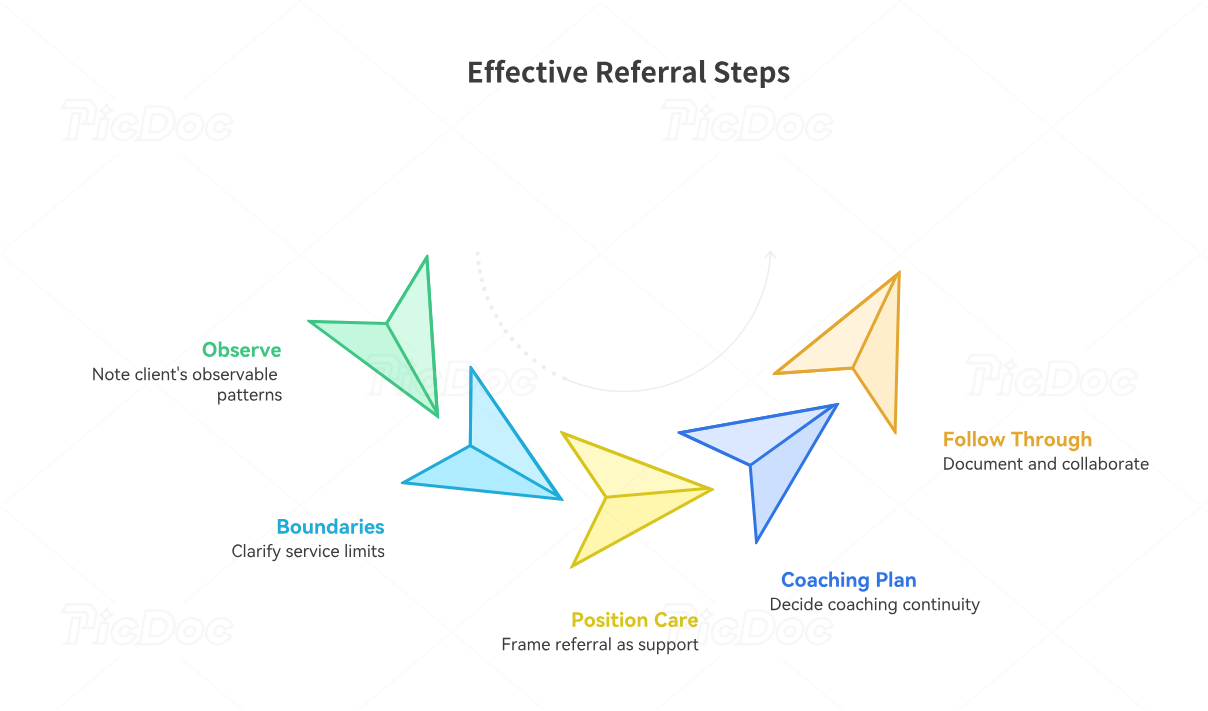
A useful referral conversation has five parts.
Name what you are observing
Stay with specific, observable patterns.
The client has repeatedly reported being unable to sleep, work, eat, or manage daily responsibilities.
The sessions repeatedly return to traumatic experiences the client wants to process.
The client's distress has become more intense over several sessions.
The client is asking for treatment-oriented help outside the coaching agreement.
This approach fits the discipline behind CLEAR coaching, OSCAR coaching, professional contracting, and duty of care.
Explain the boundary
The coach should explain which part of the client's need falls outside the service.
For example:
“Our work has focused on your career goals and accountability. Over the past few sessions, the distress connected to these earlier experiences has become a major part of what you need support with. That deserves care from a qualified mental-health professional with the training to work with it safely.”
The wording avoids amateur diagnosis while giving the referral a clear rationale.
Position referral as appropriate professional care
Poorly handled referrals can make clients feel discarded.
A better process communicates that professional coaching ethics, duty of care, client contracting, and culturally competent practice sometimes require bringing another professional into the client's support system.
A 2024 Reddit discussion involved a coach who believed a client would benefit from therapy but worried that raising the subject might be inappropriate. The most supported response pointed directly toward the coach's responsibility to recognize when coaching has stopped delivering what the client needs and discuss that change openly.
ICF's referral resources make the same point: recognizing needs outside coaching competence and facilitating access to appropriate professional help forms part of responsible coaching practice.
Decide what happens to coaching
Ask whether coaching should:
pause while the client seeks therapy
continue around a separate, clearly bounded goal
resume after treatment reaches sufficient stability
end because the current engagement no longer fits
Concurrent care can work when roles are distinct. A therapist might address panic disorder while the coach helps the client implement a career-development goal. Therapy might address trauma while coaching supports leadership development. Clinical treatment might stabilize symptoms while later coaching focuses on life visioning or SMART goals.
Follow through professionally
With appropriate client permission and within applicable confidentiality rules, collaboration may sometimes help maintain role clarity. The coach should continue documenting what service they provide, what falls outside it, what referrals were discussed, and any changes to the coaching agreement.
For a coach working toward long-term credibility, this matters as much as learning Transactional Analysis, Positive Intelligence, ADKAR, or the Wheel of Life.
Technical coaching knowledge is useful. Professional judgment determines when that knowledge should be used.
5. Build a Boundary System Before Your First Difficult Client Arrives
Ethical boundaries become easier when the business is designed around them.
Put scope into the coaching agreement
A strong agreement should explain what coaching covers, what it excludes, what confidentiality means, when referrals may occur, how emergencies are handled, and what happens when the engagement ceases to be appropriate.
This is where contracting in coaching, coaching duty of care, the professional code of conduct, and cultural competence should directly affect the documents clients sign.
A generic disclaimer buried in a website footer provides very little operational help when the client suddenly discloses self-harm during a session.
Screen for fit before beginning
An intake form can ask what the client wants from coaching, whether they are currently receiving mental-health treatment relevant to the coaching goal, whether there are current safety concerns, what support professionals are already involved, and whether they understand the distinction between coaching and therapy.
The purpose is fit assessment, rather than amateur psychological screening.
A client seeking leadership coaching, public-speaking coaching, self-confidence coaching, or life-purpose coaching should understand what type of support the coach actually provides before payment begins.
Create a referral directory
A coach should know where they can appropriately direct clients.
Useful categories include:
licensed therapists or counselors
trauma specialists
eating-disorder professionals
substance-use treatment services
domestic-abuse services
psychiatrists or other appropriate medical professionals
crisis resources
community mental-health services
region-specific emergency services
The directory should reflect the populations and jurisdictions the coach actually serves.
This becomes especially important for coaches building international practices or exploring coaching certification in Saudi Arabia, coaching in Qatar, coaching in Germany, or coaching in South Africa. Local law, professional titles, emergency systems, and referral pathways differ.
Write the crisis protocol
The protocol should answer practical questions before a crisis happens:
What information about client location is available during remote sessions?
Which emergency resources apply to the client's jurisdiction?
What will the coach do after a disclosure of immediate danger?
Who can be contacted when local law and the agreement permit it?
How will the interaction be documented?
What happens to future coaching?
Those questions belong beside duty-of-care planning, professional conduct, contracting, and inclusive coaching practice.
Be extremely careful with therapy-derived language in marketing
Phrases such as “heal trauma,” “treat anxiety,” “resolve PTSD,” “recover suppressed memories,” or “cure depression” position the coach as providing something substantially different from ordinary goal-oriented coaching.
Even popular therapeutic concepts require judgment.
A coach can learn communication principles.
A coach can understand behavior patterns.
A coach can learn about nervous-system regulation.
A coach can study Transactional Analysis, Immunity to Change, Positive Intelligence, or ADKAR.
The marketing promise should still accurately reflect the service and the coach's qualifications.
A 2025 Reddit discussion asked whether coaching might be presented as an alternative when therapy was financially inaccessible. Responses strongly cautioned against treating coaching as a substitute for mental-health treatment simply because therapy cannot be obtained.
That is commercially important too.
Trustworthy positioning helps explain why certified coaches still need strong positioning, why coaching certification ROI depends partly on credibility, why first-client acquisition depends on clear expectations, and why building a sustainable life coaching income requires protecting reputation as carefully as improving sales.
6. FAQs About Therapist vs Life Coach Boundaries
-
A diagnosis alone does not determine whether every coaching goal is inappropriate. The more useful questions concern stability, functioning, the nature of the coaching goal, the coach's competence, existing treatment, and whether coaching can remain clearly separate from clinical care.
Someone receiving therapy for anxiety might also work on leadership development, public speaking, SMART goals, or life visioning. ICF's referral guidance emphasizes recognizing when the client's needs exceed coaching competence rather than treating every mental-health history identically.
-
A client's history can arise naturally when understanding present goals and patterns. The professional boundary becomes important when the work turns toward processing trauma, treating psychological injury, recovering memories, treating attachment disorders, or resolving clinical symptoms.
A coach can redirect toward the present coaching objective, use appropriate CLEAR questions, work with SMART goals, maintain clear contracting, and refer when duty of care requires expertise beyond coaching.
-
Coaches operating solely in the coaching role should not present themselves as diagnosing mental-health disorders. APA's definition of psychotherapy explicitly includes assessment, diagnosis, and treatment within trained professional psychological services.
A coach can discuss observable experiences and goals, use behavior-change methods, build self-confidence, establish professional boundaries, and recommend an appropriate assessment when diagnostic questions arise.
-
The significance depends on what the client needs from the conversation. A historical reference can arise during ordinary coaching. A request to process trauma, treat PTSD symptoms, recover memories, or resolve substantial trauma-related impairment points toward qualified mental-health care.
ICF's ethics resources specifically discuss recognizing anxiety, depression, PTSD, eating disorders, substance problems, suicidal ideation, and thought disorders as issues that may warrant referral. Coaches should combine that awareness with duty of care, coaching ethics, contracting, and cultural competence.
-
Yes, when the roles remain clearly differentiated and the client's needs make concurrent support appropriate. Therapy could focus on treatment while coaching focuses on defined goals, implementation, career development, habits, or performance.
That arrangement works best with clear coaching contracts, well-defined professional conduct, appropriate duty of care, and coaching methods such as T-GROW.
-
The coach should assess the situation from the standpoint of coaching fit and safety rather than attempting to diagnose severity independently. A substantial decline in functioning, persistent symptoms, treatment needs, or safety concerns should prompt referral to an appropriate mental-health professional.
ICF's current referral resources explicitly exist to help coaches recognize when needs exceed coaching competencies and manage the referral process. The coach can then decide whether SMART goal coaching, career coaching, life visioning, or another coaching goal can appropriately continue alongside treatment.
