
How to Actually Empower Clients (Real Results)
Most clients do not fail because they lack ambition. They fail because they feel powerless inside the exact moments that matter. A stressful email hits, a family conflict pops up, a deadline tightens, and their nervous system chooses protection over progress. Real empowerment is not hype. It is the skill of staying steady under pressure, choosing the next right action, and repeating it long enough to change identity. When you coach empowerment correctly, you stop chasing motivation and start building capacity, ownership, and follow through that lasts, like the methods inside how to inspire clients to take immediate action and effective strategies for reinforcing positive client behaviors.

1) What empowerment actually means in coaching (and why most coaches miss it)
Empowerment is not “believe in yourself.” Empowerment is a client having access to choice when they are triggered, tired, or unsure. If they only feel confident when life is calm, they are not empowered. They are conditionally stable. This is why empowerment connects so tightly with emotional regulation skills taught through stress management techniques every coach should know and state control practices inside mindfulness and meditation techniques for emotional coaching.
Most coaching fails because it over focuses on insight and under builds capacity. Insight can be true and still useless if the client panics during execution. A client can understand boundaries and still people please in the moment. A client can understand priorities and still freeze when they need to act. If you want real results, you coach the moment where behavior breaks, which is why empowerment overlaps with managing difficult client conversations with ease and the relational safety skills inside building deep trust: how to strengthen your client relationships.
Empowerment has three visible signs:
The client can name what is happening without collapsing into shame. This improves honesty and creates momentum, similar to the trust building approach in effective listening techniques that transform client conversations.
The client can choose a next step that matches their capacity. This prevents boom and bust cycles and supports sustainable progress like effective strategies for coaching clients through burnout.
The client can repair after setbacks without disappearing. This is the difference between a client who grows and a client who restarts the same week forever, which is why reinforcement matters so much in effective strategies for reinforcing positive client behaviors.
The biggest empowerment killer is hidden fear. Fear of judgment. Fear of conflict. Fear of being seen. Fear of messing up. Fear shows up as procrastination, perfectionism, excuses, and overthinking. Empowerment means you help clients face fear without turning coaching into therapy. You create safety and structure, like the professional boundaries taught in techniques for maintaining professional boundaries with clients, and you guide action using frameworks like the art of powerful questioning in coaching.
Empowerment is also relational. Many clients are not unmotivated. They are dysregulated from conflict, grief, or trauma load. When they carry that weight, their brain prioritizes survival. This is why empowerment coaching often intersects with compassion based support strategies from coaching clients through grief and loss: compassionate strategies and scope awareness inside how coaches can support clients with PTSD and trauma.
A high level coach does not just ask what the client wants. They help the client become the kind of person who can handle what they want. That is empowerment. It is built through communication, boundaries, and consistent action, which connects directly to communication techniques every coach should master and conflict skills from conflict resolution strategies every coach needs.
2) The empowerment framework that actually produces results: Safety, Clarity, Capability, Ownership, Reinforcement
If you want predictable results, you need a system that turns insight into action. Empowerment is built in layers. If you skip a layer, clients leak momentum.
Step 1: Safety (state first, strategy second)
A client cannot act when their body is in threat mode. Start by teaching regulation habits that reduce panic and overthinking. This overlaps with the emotional stability tools in stress management techniques every coach should know and grounded practices from mindfulness and meditation techniques for emotional coaching. Safety here means the client can pause, breathe, and return to choice.
Your empowerment signal is not calm. It is recovery speed. When a client can recover in minutes instead of hours, they can choose better actions and communicate better, which supports communication techniques every coach should master and reduces breakdowns that require managing difficult client conversations with ease.
Step 2: Clarity (one outcome, one next step)
Disempowered clients live in mental fog. They do not need more options. They need a smaller target. Use concise questions from the art of powerful questioning in coaching and clean reflection skills from effective listening techniques that transform client conversations. Your job is to reduce noise until the next step is obvious.
A ruthless clarity rule is this: if the client cannot complete the next action in one sentence, they are not clear. Make the action measurable, time bound, and small enough to start today. That supports fast execution like how to inspire clients to take immediate action.
Step 3: Capability (skills, not pep talks)
Clients fail when they do not have the skills required for the situation. If they struggle with boundaries, teach boundary skills, not “confidence.” If they struggle with conflict, teach conflict skills, not “positivity.” This is why empowerment naturally builds on conflict resolution strategies every coach needs and clear lines from techniques for maintaining professional boundaries with clients.
Capability also includes language. Language changes behavior. Use reframing tools and pattern interruption from neuro-linguistic programming NLP techniques every coach should master when clients are locked in a limiting story.
Step 4: Ownership (agency language and controllables)
Empowerment is agency. Agency is a client saying “Here is what I can do today” even when life is hard. Build ownership by shifting from blame to controllables. This creates movement and reduces helplessness, which increases retention and trust like building deep trust: how to strengthen your client relationships.
Ownership does not mean harsh accountability. It means honest responsibility with compassion. That tone is essential when clients are dealing with grief or trauma load, where you may need the pacing guidance from coaching clients through grief and loss: compassionate strategies and scope clarity from how coaches can support clients with PTSD and trauma.
Step 5: Reinforcement (make progress feel real)
Clients repeat what gets rewarded. If progress feels invisible, they quit. Reinforcement is not compliments. It is evidence. Build a proof log, track one weekly metric, and celebrate recovery speed after setbacks. This is the engine behind effective strategies for reinforcing positive client behaviors and sustainable capacity building like effective strategies for coaching clients through burnout.
3) Empowerment in the moments that matter: tough conversations, boundaries, burnout, and emotional load
If you only empower clients on good days, you are training fragility. Empowerment shows up under stress.
Empowerment in communication
Most clients do not need more “communication tips.” They need a regulated body before they speak. Teach them to pause, ground, then communicate with one clear request. This ties directly into communication techniques every coach should master and improves outcomes from managing difficult client conversations with ease.
A practical coaching move is the three line script:
Here is what I notice.
Here is what I need.
Here is what I propose next.
This reduces emotional chaos, and it also strengthens conflict handling frameworks taught in conflict resolution strategies every coach needs.
Empowerment through boundaries
Clients who cannot set boundaries feel trapped, then resentful, then reactive. Empowerment is teaching boundaries as a skill, not a personality trait. Use the structure inside techniques for maintaining professional boundaries with clients as a model. Boundaries must be specific, time bound, and tied to values.
A boundary is stronger when it is paired with a replacement. Instead of “stop messaging me,” teach “message me during these hours, and here is the process.” That type of structure builds safety and trust like building deep trust: how to strengthen your client relationships.
Empowerment during burnout
Burnout clients do not need bigger goals. They need recovery systems that protect capacity. Empowerment here is teaching minimum habits, reducing inputs, and building predictable routines. Use the recovery first principles inside effective strategies for coaching clients through burnout and daily balance practices inside helping clients manage work-life balance successfully.
A brutal truth you can tell clients is this: you cannot empower your future if you keep abandoning your body today. That message lands best when paired with self care frameworks from the importance of self-care coaching for client mental health.
Empowerment with emotional load and grief
Some clients are carrying loss, and empowerment looks different. It is not hustle. It is gentle stability. In these cases, focus on grounding, simple routines, and meaning making. Use the compassionate pacing strategies inside coaching clients through grief and loss: compassionate strategies and keep your scope aligned with techniques for maintaining professional boundaries with clients.
If a client is experiencing trauma symptoms, empowerment starts with safety and referral awareness. You coach stabilization, not trauma processing, using the ethical guidance inside how coaches can support clients with PTSD and trauma.
4) How to coach empowerment step by step in a session (without fluff, without therapy)
If you want empowerment to be your signature, your sessions need a repeatable flow that works even when clients arrive stressed.
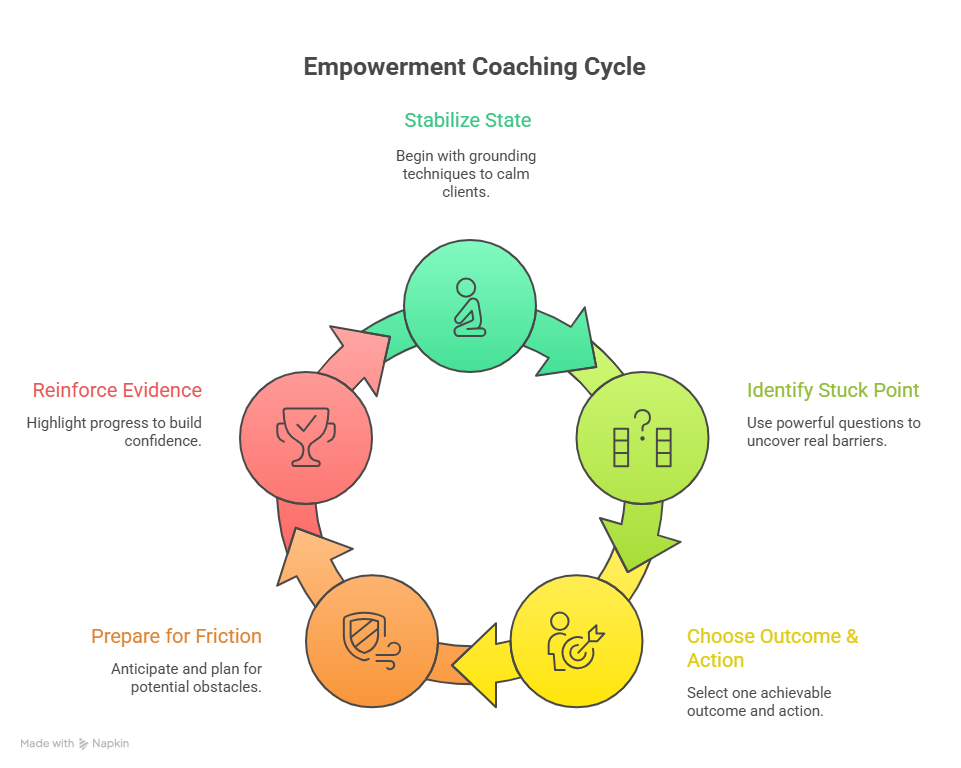
Step 1: Stabilize the state
Start with a fast capacity check and one regulation cue. This is the same practical foundation used in stress management techniques every coach should know and the emotional grounding approach inside mindfulness and meditation techniques for emotional coaching. A client who can breathe and slow down can hear you.
Step 2: Identify the real stuck point
Ask questions that expose the real barrier. Avoid surface talk. Use the precision of the art of powerful questioning in coaching. Then reflect back what you hear using methods from effective listening techniques that transform client conversations. Clients feel empowered when they feel understood.
Step 3: Choose one outcome and one action
Empowerment collapses when you assign too much. Choose one outcome and one action that fits capacity. This helps clients build momentum fast, aligning with how to inspire clients to take immediate action.
Step 4: Prepare for friction
Ask, “What will try to stop you?” Then build a “hard moment” plan. If the client tends to avoid conflict, rehearse a script using principles from communication techniques every coach should master. If they tend to shut down, teach a grounding reset.
Step 5: Reinforce evidence
End with a proof statement: “What is the evidence you are becoming the person who follows through?” This locks in agency and supports the reinforcement mechanisms from effective strategies for reinforcing positive client behaviors.
Throughout the process, maintain clean scope boundaries. If a client’s situation is trauma heavy, keep the session stabilization focused and referral aware, using guidance from how coaches can support clients with PTSD and trauma and boundaries from techniques for maintaining professional boundaries with clients.
5) How to scale empowerment in groups and programs so clients stay engaged and get results
Empowerment scales when you build rituals, not lectures. Group clients disengage when content becomes passive. If you want real results, make empowerment active.
Start every session with a regulation ritual
A 2 minute grounding practice creates immediate safety and makes coaching land better. This aligns with mindfulness and meditation techniques for emotional coaching and supports participants who are already stressed from life pressure, similar to topics inside stress management techniques every coach should know.
Create one weekly empowerment challenge
One weekly action creates identity change. Rotate the challenge around boundaries, communication, and self care. Use boundary themes from techniques for maintaining professional boundaries with clients, communication themes from communication techniques every coach should master, and recovery themes from effective strategies for coaching clients through burnout.
Build community trust, not just content
Clients act more when they feel safe and seen. Use listening and reflection frameworks from effective listening techniques that transform client conversations, and reinforce relational safety using building deep trust: how to strengthen your client relationships.
Make empowerment measurable and simple
Use one metric per week. Completion rate, boundary conversations attempted, number of reset rituals done, or one self care block completed. This supports the reinforcement mechanics in effective strategies for reinforcing positive client behaviors without overwhelming clients with tracking.
Elevate your authority with education and certification alignment
Clients pay more when they trust your method. Clear education content plus professional development helps your positioning, similar to the credibility angle in how certification differentiates your health coaching business. If you want to speak to cost objections, reference pricing education content like life coach certification costs full breakdown amp hidden expenses and decision making support like health coaching certification how to choose the right program.
When you coach empowerment well, you become the coach clients stay with. Not because you motivate them, but because you help them become stable enough to create results in real life.
6) FAQs: How to empower clients for real results
-
Motivation is a feeling. Empowerment is a capability. Motivation rises and falls. Empowerment improves with practice. Empowerment means the client can choose action even when they are stressed, tired, or triggered. That is why empowerment pairs well with stress management techniques every coach should know and action building strategies like how to inspire clients to take immediate action. If a client acts only when they feel good, they are motivated. If they can act when they feel uncomfortable, they are empowered.
-
Start by stabilizing state. A brief grounding cue and slower breathing can shift a client from threat mode to choice. Then reduce the problem to one next step that can be done today. Finally, create a simple friction plan that prepares them for the moment they usually quit. This mirrors the structure behind effective listening techniques that transform client conversations and the decision clarity approach inside the art of powerful questioning in coaching.
-
Empowerment requires a pause, a script, and a practice plan. Teach clients to pause before agreeing, then use a single boundary sentence that is respectful and clear. Roleplay the hardest moment in session and assign a small weekly boundary action. This aligns with techniques for maintaining professional boundaries with clients and strengthens communication skills from communication techniques every coach should master. The goal is not conflict. The goal is self respect.
-
Burnout clients need recovery systems and minimum habits. Empowerment here is building capacity before intensity. Reduce tasks, protect sleep, and define minimum standards that keep identity intact. This is exactly why burnout coaching must follow the principles inside effective strategies for coaching clients through burnout and balance frameworks from helping clients manage work-life balance successfully. When clients stop collapsing, they regain agency.
-
Measure one signal. Recovery speed after stress, number of actions completed, number of difficult conversations attempted, or number of times they used a reset ritual instead of spiraling. Keep it simple so clients do not quit tracking. Then reinforce evidence weekly using the approach from effective strategies for reinforcing positive client behaviors. Empowerment becomes real when clients can point to proof, not just feelings.
-
Your role is stabilization and support within scope, not trauma processing. Use grounding and pacing, then encourage appropriate professional help when needed. Maintain ethical boundaries using techniques for maintaining professional boundaries with clients and follow guidance like how coaches can support clients with PTSD and trauma. You can still coach empowerment by helping the client build safe routines, small actions, and a consistent support plan.
