
Health coaches increasingly encounter a frustrating contradiction: insurers recognize certain coaching services, yet independent practitioners often struggle to receive payment. Reddit discussions reveal confusion surrounding NBC-HWC certification, CPT codes, National Provider Identifiers, and Medicare eligibility. The financial consequences can be substantial for coaches considering health coaching as a career, researching certification requirements, or calculating realistic coaching income. Understanding who can submit claims, which services qualify, and how employers receive reimbursement provides a clearer route toward sustainable practice.
1. Can Health Coaches Bill Insurance in 2026? What Reddit Gets Right and Wrong
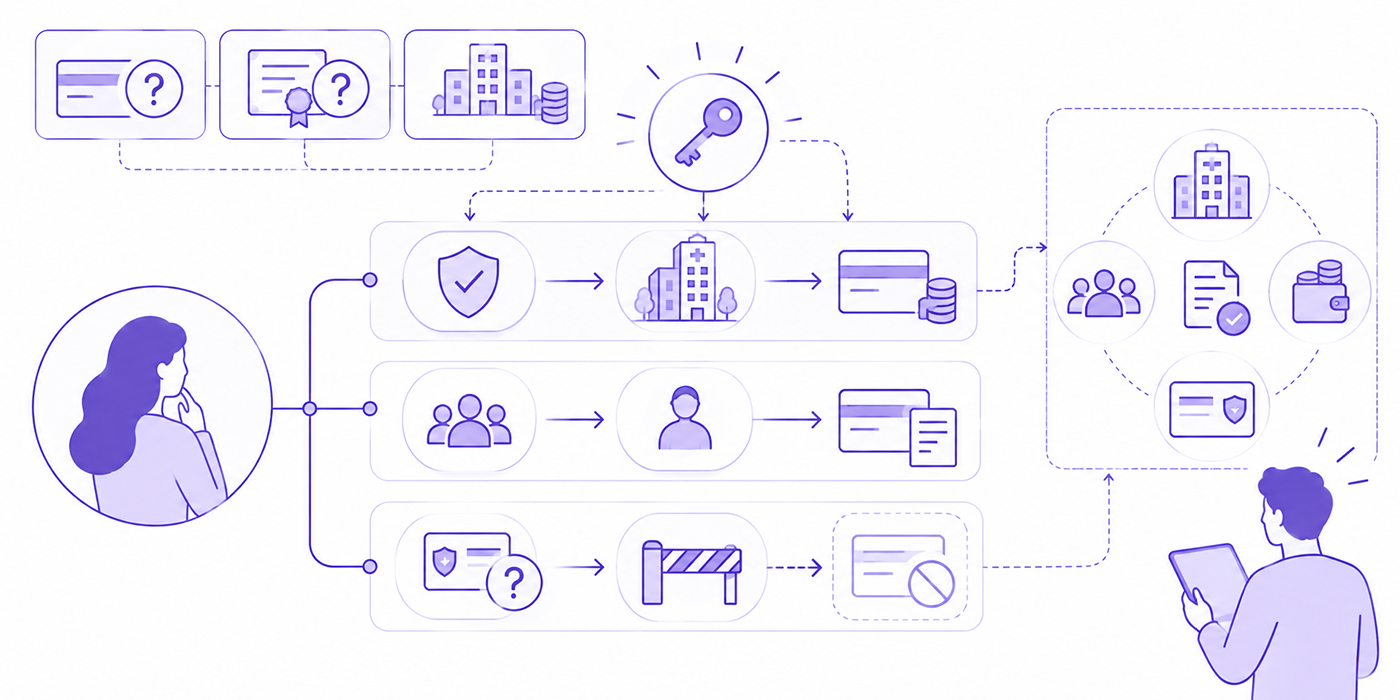
Health coaches can participate in insurance-funded services through specific approved arrangements. Independent reimbursement depends on the payer, the service, the billing entity, provider eligibility, and applicable regulations.
The central question is who holds the authority to bill.
A health coach working in a physician-led clinic may perform qualifying services under an authorized billing arrangement. A coach delivering a Medicare Diabetes Prevention Program (MDPP) service may work for an enrolled supplier. Someone offering general wellness sessions independently faces a different set of coverage and contracting requirements.
These distinctions shape the practical value of NBC-HWC certification, the availability of health coaching jobs, and the prospects for private-practice income.
The Reddit NPI misconception
In a May 2023 discussion on r/HealthCoaching, a prospective practitioner asked whether obtaining a National Provider Identifier (NPI) would allow them to bill insurance using health-coaching CPT codes.
Other participants expressed uncertainty about Category III codes, insurer acceptance, and certification requirements.
The underlying confusion involves three separate processes:
Identification: An NPI identifies a healthcare provider in standardized transactions.
Professional qualification: Training, certification, licensing, and relevant competency determine whether someone can perform particular services.
Payment authorization: Payer contracts, coverage policies, enrollment requirements, and billing rules establish whether a particular claim qualifies for reimbursement.
Obtaining an NPI does not automatically establish provider-network participation or payment eligibility.
This matters for coaches considering professional credential investments or exploring health coaching without a nutrition degree.
The Reddit board-certification misconception
A November 2024 r/HealthCoaching discussion questioned whether NBHWC certification was necessary for insurance billing.
Participants distinguished independent coaching from work delivered through a healthcare organization, although some comments assumed that certification itself could eventually unlock reimbursement.
An April 2025 discussion raised the financial stakes. A coach serving a low-income community considered pursuing NBC-HWC certification because clients could barely afford the existing service prices. The hoped-for benefit was access to insurer reimbursement and reduced patient costs.
That illustrates the difference between professional advancement and financial feasibility.
A credential may strengthen applications for hospital-based coaching positions, improve credibility in corporate wellness settings, or support participation in a qualified clinical program. Its return on investment still depends on the opportunities actually available.
The major Medicare development in 2026
On July 14, 2026, the Centers for Medicare & Medicaid Services (CMS) released its proposed 2027 Medicare Physician Fee Schedule.
The proposal includes national payment and conditions for three existing health and well-being coaching codes: 0591T, 0592T, and 0593T. It also addresses coach qualifications, supervision, and arrangements involving community-based organizations.
As of October 28, 2026, these proposed national payment provisions remain pending finalization. The proposal is therefore an important development to monitor when evaluating future health coaching demand and professional credential pathways.
The existing Medicare Diabetes Prevention Program already provides a separate, established organizational reimbursement pathway.
For coaches deciding between employment and private practice, this distinction changes which opportunities deserve immediate attention.
2. Credentials, CPT Codes and NPIs: What Actually Determines Reimbursement?
Health coaches frequently invest in education before identifying the payment pathways available to their intended clients.
That sequencing can create an expensive mismatch between qualifications and commercial opportunities.
A practitioner exploring NBHWC certification requirements should evaluate the credential against actual employer expectations, clinical roles, and payer policies. Someone choosing between ICF and NBHWC pathways should also understand that the credentials serve different professional contexts.
The three health-coaching CPT codes
The American Medical Association established three Category III codes for health and well-being coaching, effective January 1, 2020.
CPT 0591T — Initial individual assessment. This describes an initial face-to-face health and well-being coaching assessment, with a 60–90-minute duration under the relevant coding description.
CPT 0592T — Individual follow-up. This describes follow-up health and well-being coaching sessions lasting at least 30 minutes.
CPT 0593T — Group coaching. This describes health and well-being coaching for groups of two or more individuals, lasting at least 30 minutes.
The codes permit standardized reporting of specific services. Payment depends on coverage rules and qualified billing arrangements.
The Veterans Health Administration contributed to the development of these codes as part of its Whole Health initiatives. Their creation helped healthcare organizations track utilization and support evidence development.
For independent practitioners developing preventive health coaching services, lifestyle medicine programs, or metabolic health coaching offers, code availability alone provides insufficient evidence that clients' insurers will pay.
What the proposed 2027 Medicare rule changes
CMS has proposed national payment for 0591T–0593T, alongside requirements governing qualifying coaches and supervision.
The proposed framework identifies relevant national credentialing standards, including those associated with the National Board for Health & Wellness Coaching, the National Commission for Health Education Credentialing, and certified nurse coaches.
It also discusses appropriately trained personnel from certain evidence-based community programs.
Under the proposed framework, a qualified billing practitioner would have a central role, with specified supervision requirements for auxiliary personnel. Community-based organizations may participate through suitable relationships with billing practitioners.
These are provisions from the proposed 2027 rule, so implementation depends on the final rule and subsequent guidance.
Before planning an insurance-based health coaching business, review the CMS proposed-rule information and relevant credentialing requirements.
Does NBC-HWC certification guarantee insurance payment?
NBC-HWC certification demonstrates completion of a defined professional credentialing pathway. Employers may value it when hiring for corporate coaching positions or healthcare coaching jobs.
Insurance payment still requires the remaining conditions to be satisfied.
For example, a coach could hold NBC-HWC certification and an NPI while operating outside any qualifying payer arrangement. Their qualifications may support professional credibility, but a payer can still deny a claim when the provider type or service falls outside coverage.
Similarly, a clinician who holds both an eligible healthcare license and coaching qualifications must submit claims reflecting services actually delivered within the applicable scope.
The distinction between health coaches, dietitians, and nutritionists matters particularly when a practitioner considers nutrition-specific billing.
Private insurance offers narrower exceptions
Cigna's Administrative Policy A015, effective November 24, 2025, identifies certain behavioral health coaching services as covered when defined conditions are met.
The policy includes CPT 0591T and 0592T and addresses qualified coaching services associated with mental health or substance use disorders.
Coverage remains subject to the member's plan terms, applicable state requirements, and the coach's qualifications.
This example demonstrates why insurer-specific verification matters when considering behavioral coaching boundaries and professional duty of care.
A policy covering defined behavioral health services should never be interpreted as universal reimbursement for general wellness coaching. Coaches must also avoid providing mental health treatment beyond their authorized scope.
The role of an NPI
The National Provider Identifier is a standardized identification number used in healthcare administration and billing transactions.
An NPI may be necessary for certain arrangements, including coaches appearing on a Medicare Diabetes Prevention Program supplier's roster.
Yet additional processes establish payment eligibility. These may involve enrollment, contracting, provider credentialing, tax information, payer identification, and claims-system registration.
The CMS NPI guidance provides the official identification framework.
Coaches researching legitimate remote health coaching work should ask employers whether the NPI supports internal documentation, rendering-provider identification, or actual billing arrangements.
3. Five Reimbursement and Employment Pathways Health Coaches Can Pursue
Insurance-funded coaching opportunities usually depend on a healthcare organization, recognized program, payer contract, or employment relationship.
The best pathway depends on whether the coach prioritizes independent practice, predictable earnings, clinical integration, or access for clients with limited budgets.
Pathway 1: Work through a healthcare practice
Physician practices and health systems may incorporate health coaches into structured care teams.
A coach might support patient-defined goals, self-monitoring, practical behavior change, and follow-through under a qualified clinical arrangement.
Before accepting such a role, ask whether the organization has a recognized billing method for the actual services being provided. Determine who submits claims, what supervision applies, and whether the position is supported by clinical revenue, operational budgets, or a separate program contract.
This distinction is valuable for professionals considering hospital health coaching jobs, preventive health services, and clinical lifestyle medicine.
A coach may also find opportunities supporting functions associated with community health integration or principal illness navigation, provided the duties meet those services' specific requirements.
Those codes have their own billing conditions. General habit-change coaching cannot automatically be reported as a navigation service.
Pathway 2: Deliver an approved Diabetes Prevention Program
The Medicare Diabetes Prevention Program provides one of the clearest established payment routes involving lifestyle coaches.
Medicare pays enrolled organizational suppliers that deliver qualifying services to eligible beneficiaries. Individual lifestyle coaches working within those programs do not bill Medicare independently.
The organization must meet CDC recognition and Medicare enrollment requirements. The coach must satisfy applicable training and supplier roster requirements.
CMS states that eligible beneficiaries receive qualifying MDPP services without out-of-pocket charges.
In 2026, MDPP suppliers can bill through applicable session codes for in-person, distance-learning, and newly recognized online program delivery, subject to program requirements.
Coaches interested in health behavior change, diabetes prevention, or metabolic health support should examine this pathway.
Review the official CMS MDPP guidance before approaching suppliers.
Pathway 3: Find employer-funded coaching contracts
Many coaching opportunities are funded through employer wellness budgets or vendor contracts rather than individual medical claims.
An employer may purchase coaching sessions directly, contract with a wellness platform, or provide access through its employee benefits arrangements.
This model can offer greater payment predictability because the purchaser is identified in advance.
For someone considering corporate health coaching, remote coaching employment, or a specialized career-burnout program, employer funding may be commercially attractive.
An independently contracted coach should confirm employee access, session limits, data privacy, cancellation terms, and whether the employer expects aggregate reporting.
Individual confidential coaching details should remain protected under applicable laws and contractual obligations.
Pathway 4: Participate in a health plan or digital-health program
Health insurers, chronic-care vendors, and digital-health companies may employ coaches or contract with organizations providing behavior-change services.
The funding may come from health-plan administration, employer contracts, care-management budgets, or qualifying reimbursed services.
These arrangements produce different roles. Some coaches receive salaries, while others work under hourly or program contracts.
Before applying, examine the responsibilities, required credentials, caseload, supervision, compensation, and clinical escalation procedures.
Research on remote health coach salaries, coaching employer requirements, and NBHWC career eligibility can help identify suitable opportunities.
Pathway 5: Maintain self-pay services while exploring reimbursable programs
Independent practice remains a viable alternative when insurance eligibility is limited.
Coaches can sell clearly defined services through transparent agreements, appropriate pricing, and realistic client expectations.
For example, habit-stacking programs, self-care coaching, and general accountability coaching can operate through self-pay arrangements when provided within professional boundaries.
Clients may ask about HSA or FSA payments. Eligibility depends on whether the expense qualifies as medical care under IRS rules and the relevant plan's requirements.
General wellness expenses often fail to qualify. A medically directed service addressing a specific eligible condition may require supporting documentation, and acceptance remains dependent on the applicable rules.
Coaches should direct clients to their plan administrator and the IRS medical-expense guidance rather than promising reimbursement.
The distinction matters when calculating health coaching package prices and developing sustainable client-acquisition strategies.
4. How Health Coaches Can Verify Reimbursement Eligibility Before Submitting Claims
The most expensive billing mistakes often begin before the first claim is submitted.
A coach pays for certification, purchases practice-management software, begins advertising insurance acceptance, and only then discovers that the intended payer does not recognize the billing arrangement.
A disciplined verification process protects both the practice and its prospective clients.
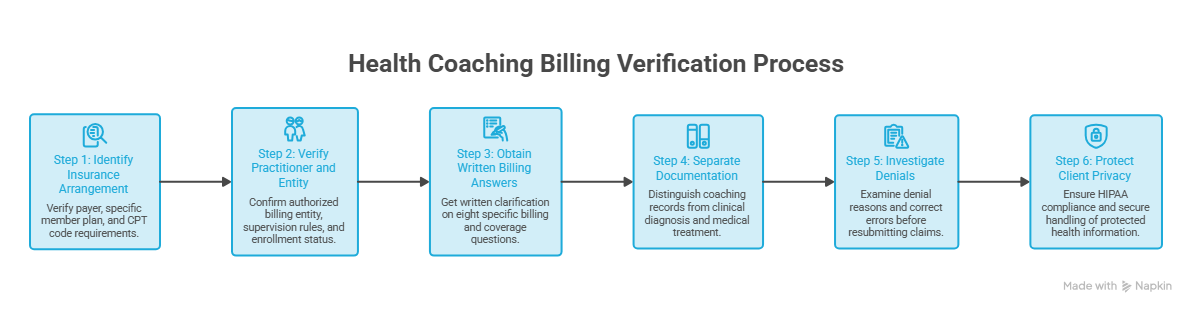
Step 1: Identify the exact insurance arrangement
Start with the payer and the specific member plan.
Commercial coverage can differ between employer plans, individual policies, managed-care products, and state-specific arrangements.
A broad statement that an insurer recognizes health coaching provides limited practical guidance.
Request confirmation of the relevant CPT code, provider eligibility, permitted billing entity, and network requirements.
When researching corporate coaching opportunities, establish whether the employer purchases coaching directly or offers access through a covered health benefit.
Step 2: Verify the practitioner and billing entity separately
Ask who is legally and contractually authorized to submit the claim.
If services are furnished through a clinical practice, determine whether the organization bills under its own credentials and how the health coach is identified.
Confirm applicable supervision rules, the role of auxiliary personnel, enrollment status, and any payer-specific documentation conditions.
These requirements are particularly important when choosing health coaching employment instead of independent practice.
Step 3: Get written answers to eight billing questions
Ask the payer or billing administrator to clarify the following:
Are CPT 0591T, 0592T, or 0593T covered under the specific plan?
Which professional credentials and provider types qualify?
Can the service be billed by the health coach directly or only through another eligible practitioner?
What enrollment, network, contracting, and NPI requirements apply?
Are referrals, medical necessity, diagnoses, or prior authorizations required?
What supervision and documentation rules apply?
Are telehealth, group sessions, and out-of-network services eligible?
What payment rates, patient cost-sharing rules, and claim-submission deadlines apply?
Keep a record of the representative, date, reference number, and written policy.
These checks can be incorporated into professional coaching contracts, client onboarding, and the broader coaching code of conduct.
A verbal assurance from a customer-service representative should be supplemented by the applicable written policy or provider agreement.
Step 4: Separate legitimate coaching documentation from clinical diagnosis
Health coaching records should accurately describe the services performed.
Useful elements can include client goals, coaching activities, session duration, progress, follow-up plans, and consent where appropriate.
Clinical programs may impose additional medical-record requirements, including documentation supporting the billed service and supervision.
Coaches who lack diagnostic authority should avoid assigning unsupported diagnoses or describing general wellness sessions as medical treatment.
The boundaries discussed in nutrition coaching without dietitian credentials, health coach scope of practice, and therapist-versus-coach responsibilities become especially significant in reimbursed care.
Step 5: Investigate denials before resubmitting
A denied claim should be examined using the actual payer explanation.
Common underlying categories include ineligible provider status, uncovered services, missing authorization, coding errors, incomplete documentation, and incorrect enrollment information.
The appropriate correction depends on the denial reason.
For example, CMS identifies MDPP claim problems when the coach's NPI is missing or the coach is not correctly associated with the enrolled supplier for the date of service.
A coding change cannot resolve a fundamentally ineligible service.
Coaches working with healthcare employers should clarify who manages appeals, overpayments, compliance reviews, and documentation corrections.
Step 6: Protect client privacy throughout the billing process
Clinical billing arrangements can involve protected health information, payer submissions, and sensitive coaching records.
Organizations subject to HIPAA must follow applicable privacy and security requirements. Other coaches may face different professional, state, and contractual confidentiality obligations.
Avoid using unapproved consumer tools for clinical records or transferring information beyond what is authorized.
Relevant safeguards should be reflected in coaching agreements, professional duty-of-care procedures, and client communication policies.
5. Insurance Billing Versus Employer Contracts Versus Private Pay: Which Earns More?
Health coaches often focus on reimbursement as a way to make services affordable for clients.
That is a legitimate commercial objective, but insurance-based revenue introduces administrative demands and payment uncertainty.
Evaluating alternative business models requires more than comparing nominal session rates.
Scenario A: Insurance-linked clinical coaching
Imagine a qualified practice receives an illustrative $85 per reimbursed coaching session.
If 60 sessions qualify for payment during a month, gross receipts would total $5,100.
Now suppose the billing arrangement incurs $700 in direct administrative and claims-related expenses. The remaining $4,400 precedes compensation for the coach, other direct delivery expenses, fixed overhead, and taxes.
This scenario assumes all 60 services meet payer requirements and are paid. It makes no claim about actual insurer fee schedules.
A coach working as an employee may receive an agreed salary rather than the claim amounts collected by the practice.
Understanding this difference helps when comparing hospital-based coaching jobs, remote health coach salaries, and independent health coaching earnings.
Scenario B: Employer-sponsored coaching
Suppose an employer pays a coach $3,000 monthly to provide a defined wellness program.
The agreement includes 30 coaching sessions, periodic group education, and aggregate participation reporting.
The coach's income is contract-based and may be more predictable than collecting individual claims. However, preparation, reporting, scheduling, and the possibility of contract termination affect profitability.
For professionals entering corporate health coaching, value can come from program consistency, employee engagement, and clearly defined deliverables.
The employer may prioritize retention, accessibility, and preventive wellness participation alongside other organizational objectives.
Scenario C: Independent private-pay practice
Imagine eight clients purchase four-session coaching packages at $480 each.
Gross booked package revenue equals $3,840, assuming all eight purchases occur in the month.
The coach controls package structure, scheduling, and client acquisition but must manage marketing, service delivery, and customer support.
An appropriate program might support health behavior change, habit stacking, or personal accountability.
The profitability question becomes whether client acquisition and delivery expenses leave enough contribution to justify the required working hours.
For guidance on defining packages, review new health coach pricing and the financial realities of earning a living through coaching.
Four financial risks worth calculating
Delayed payments: Insurance claims may require processing, correction, or appeal. Businesses need adequate cash reserves to manage timing differences.
Unreimbursed services: Sessions that fail coverage requirements may generate no payment. Client financial responsibility should be communicated lawfully and transparently in advance.
Administrative expense: Billing software, claim submission, documentation, credentialing, and compliance support can reduce contribution margins.
Customer concentration: A single hospital, employer, or health plan can account for a large share of income. Losing that relationship may disrupt the practice.
These variables deserve attention when deciding between health coach employment and private practice or selecting coaching niches with sustainable demand.
The ANHCO reimbursement-readiness strategy
For coaches with limited experience and no established clinical relationships, a practical first step is to identify qualified employers, healthcare teams, and recognized prevention programs.
For independent practitioners with existing clients, maintain financially sustainable services while researching specific payer contracts.
For credentialed coaches already working inside healthcare, focus on documenting program value, understanding employer billing arrangements, and monitoring the final 2027 Medicare policy.
Relevant professional development may include lifestyle medicine, motivational behavior-change methods, and accountability coaching.
The business objective is to combine clear professional competence with a verified source of payment.
6. FAQs: Health Coach Insurance Billing, Certification and Reimbursement
-
An independent health coach generally lacks a separate Medicare provider benefit category allowing direct reimbursement simply for holding a coaching certificate.
Certain approved programs, particularly the Medicare Diabetes Prevention Program, involve reimbursed services delivered by coaches through enrolled organizational suppliers.
The proposed 2027 Physician Fee Schedule would create additional payment conditions for qualifying health and well-being coaching services if finalized.
Coaches comparing NBC-HWC certification, healthcare employment, and preventive coaching opportunities should evaluate these pathways separately.
-
NBC-HWC certification can support professional credibility and eligibility for roles requiring nationally recognized health-coaching qualifications.
Reimbursement also depends on the payer's conditions, the billing provider, covered services, and applicable regulations.
A coach should confirm those arrangements before investing in certification primarily for insurance revenue.
Compare NBHWC board eligibility, ICF versus NBHWC career goals, and actual health coach hiring requirements.
-
These codes describe specific individual and group health and well-being coaching services.
Their appropriate use requires alignment with the code descriptions, qualified personnel, documentation, and billing arrangements.
A coach should verify whether the intended payer accepts the relevant code and recognizes the billing entity.
Professional boundaries remain essential when services involve nutrition coaching, metabolic health, or lifestyle medicine.
-
An NPI may be available to eligible healthcare providers who meet the applicable enumeration criteria. Professional designation and taxonomy should accurately reflect the applicant's qualifications.
CMS allows lifestyle coaches participating in MDPP supplier arrangements to use an appropriate taxonomy, including Health Educator where relevant.
The NPI supports identification within healthcare transactions. Payer participation and reimbursement require separate authorization.
This distinction is important for people exploring health coaching without clinical degrees and clinical coaching career paths.
-
Eligibility depends on the medical purpose of the expense, applicable IRS requirements, and the client's account or plan rules.
General wellness coaching frequently falls outside eligible medical expenses. Certain medically related services may qualify under specific circumstances and documentation requirements.
Clients should seek confirmation from their account administrator and qualified tax professionals when appropriate.
Coaches offering preventive health services, habit-change programs, or holistic coaching should avoid blanket eligibility promises.
-
Coverage depends on the actual service, professional qualifications, and payer rules.
Medical Nutrition Therapy has distinct Medicare eligibility requirements involving qualified registered dietitians or nutrition professionals. Ordinary health-coaching credentials do not automatically satisfy those standards.
Coaches should distinguish behavior-change support from clinical nutrition treatment.
Review the differences between health coaches and dietitians, nutrition coaching scope, and metabolic health coaching.
