
Preparing for the National Board for Health & Wellness Coaching (NBHWC) certification exam requires a strategic balance of theoretical knowledge, practical coaching judgment, ethical reasoning, and health literacy. Candidates frequently struggle with distinguishing appropriate coaching responses, applying health behavior change theories, and remembering professional scope of practice boundaries. A winning NBHWC certification study plan combines structured revision, scenario-based exercises, SMART goal setting, and deliberate professional skills development. With the updated examination content outline introducing five weighted competency areas, candidates need a targeted preparation strategy that addresses knowledge gaps and develops consistent decision-making under examination conditions.

1. Understanding the NBHWC Certification Exam and Its Updated Content Outline
Successful exam preparation begins with understanding exactly what the examination assesses. Candidates studying from outdated textbooks, recycled flashcards, and older examination preparation materials risk allocating valuable study time to the wrong competencies.
The 2026–2030 NBHWC Content Outline organizes examination content into five weighted domains. Understanding these domains also helps candidates distinguish the NBHWC board certification pathway from other professional credentials and evaluate the differences between ICF and NBHWC certification.
Domain 1: Coaching Presence, Relationships, and Sessions — 25%
This domain examines the coach's ability to establish productive relationships, demonstrate professional presence, facilitate client-led conversations, and structure coaching engagements.
Candidates should develop a working understanding of emotional intelligence, cultural competence, coaching agreements, and techniques for creating a safe coaching environment.
Practice distinguishing empathetic responses from reassurance, reflective listening from interpretation, and collaborative agenda setting from coach-directed problem-solving.
Domain 2: Theories, Models, and Approaches to Behavior Change — 15%
This domain covers the theoretical foundations of motivation, learning, behavioral development, and sustainable lifestyle change.
Prioritize the following subjects:
Motivational Interviewing 4.0.
Transtheoretical Model and stages of change.
Self-Determination Theory.
Self-Efficacy Theory.
Neuroplasticity and healthy habit development.
Growth and fixed mindsets.
Goal-setting theories.
Positive psychology and Appreciative Inquiry.
Studying positive psychology coaching, habit formation, self-confidence coaching, and transformational coaching can help translate abstract concepts into recognizable coaching situations.
Domain 3: Skills, Tools, and Strategies — 25%
This domain evaluates the application of coaching techniques, communication skills, motivational strategies, and behavioral support tools.
Candidates should practice selecting appropriate interventions according to client readiness and circumstances. Tools such as the Wheel of Life, SMART goals, constructive feedback, and accountability coaching provide useful opportunities for application-based learning.
Together, Domains 1 and 3 account for 50% of the published examination content weighting. Communication and practical coaching judgment should therefore receive substantial preparation time.
Domain 4: Ethics and Professional Practice — 15%
Ethical questions frequently involve situations where several responses appear supportive, but only one appropriately respects professional responsibilities.
Develop familiarity with the current NBHWC Code of Ethics and Professional Conduct, confidentiality obligations, professional boundaries, data security, conflicts of interest, and referral responsibilities.
Supplement your official materials with practical exploration of informed consent, duty of care, coaching power dynamics, and professional misrepresentation.
Domain 5: Health and Wellness — 20%
This domain assesses foundational health literacy, whole-person wellness, health promotion, chronic disease awareness, and factors influencing health outcomes.
Candidates should understand general evidence-based recommendations concerning nutrition, movement, sleep, stress management, and preventive health while maintaining appropriate coaching boundaries.
Knowledge from lifestyle medicine coaching, metabolic health coaching, preventive health coaching, and holistic coaching can complement official examination preparation materials.
NBHWC Exam Format and Timing
The published examination format includes:
150 multiple-choice questions.
Two examination sections containing 75 questions each.
One hour and 52 minutes for each question section.
A 15-minute tutorial.
Up to 15 minutes of break time between sections.
A 15-minute post-examination survey.
Approximately four and a half hours of total examination time.
Once candidates close an examination section, they cannot return to it. Practice completing each section independently under timed conditions.
The following study matrix provides a practical framework for covering essential concepts, testing knowledge, and identifying areas requiring additional preparation.
2. Building a Personalized Eight-Week NBHWC Certification Study Schedule
An effective study schedule should reflect examination weighting, individual weaknesses, available preparation time, and the candidate's existing professional experience.
Use the principles of SMART goal planning, habit stacking, accountability, and self-care coaching to develop a preparation routine that remains manageable alongside work and personal responsibilities.
Establish a Diagnostic Baseline Before Studying
Begin with 50 unfamiliar, appropriately sourced practice questions covering all five examination domains. Complete them without consulting textbooks or notes.
Record three results for each domain:
Percentage of questions answered correctly.
Percentage answered correctly with low confidence.
Frequency of errors involving professional judgment or ethical reasoning.
Low-confidence correct answers deserve additional attention because successful guessing can conceal significant knowledge gaps.
Use constructive feedback techniques and principles from positive intelligence coaching to evaluate weaknesses objectively.
Allocate Your Study Hours According to Examination Weighting
For an illustrative eight-week schedule containing 80 preparation hours, the initial allocation would be:
Coaching Presence, Relationships, and Sessions: 20 hours.
Theories, Models, and Approaches to Behavior Change: 12 hours.
Skills, Tools, and Strategies: 20 hours.
Ethics and Professional Practice: 12 hours.
Health and Wellness: 16 hours.
Adjust these allocations after reviewing diagnostic results. A candidate with extensive clinical experience may require additional practice with coaching communication and professional scope boundaries, while an experienced life coach may need more foundational health science revision.
Week 1: Establish Coaching Presence and Relationship Foundations
Begin with Domain 1 and explore professional presence, empathy, client autonomy, cultural humility, trust, and coaching relationships.
Practice introducing coaching agreements, clarifying expectations, and responding to emotionally challenging client statements.
Use resources concerning inclusive coaching, coaching contracts, and psychological safety in coaching.
Weekly deliverable: Complete 40 original practice questions and conduct two mock coaching conversations emphasizing relationship-building skills.
Week 2: Master Behavior Change Theories
Create a comparison sheet covering the major theories and approaches identified in the examination outline.
For each theory, document its central concept, recognizable client behaviors, appropriate coaching responses, and common misunderstandings.
Integrate positive psychology, health behavior change, habit formation, and self-confidence coaching into application exercises.
Weekly deliverable: Complete 40 theory-based questions and explain at least eight hypothetical client situations using relevant theoretical concepts.
Week 3: Develop Motivational Interviewing and Communication Skills
Dedicate this week to recognizing change talk, sustain talk, discord, reflective listening, affirmations, summaries, and permission-based information sharing.
Study Motivational Interviewing 4.0 using materials aligned with the updated outline.
Practice conversations involving clients who express ambivalence, frustration, or uncertainty. Techniques from emotional agility coaching, emotional intelligence development, and constructive feedback can supplement practical exercises.
Weekly deliverable: Complete 50 communication-focused questions and write three alternative reflections for ten hypothetical client statements.
Week 4: Strengthen Goal Setting and Behavioral Coaching Strategies
Focus on values exploration, wellness visioning, confidence scaling, barrier identification, environmental influences, and sustainable accountability.
Practice using the Wheel of Life, life visioning, habit stacking, and SMART goals.
Weekly deliverable: Develop five hypothetical coaching plans containing client-defined goals, anticipated barriers, self-monitoring preferences, and review strategies.
Week 5: Master Ethics and Professional Responsibilities
Read the current NBHWC Scope of Practice and Code of Ethics and Professional Conduct directly.
Create scenario cards addressing confidentiality, clinical referrals, financial conflicts, consent, professional dual roles, record storage, and responsible technology use.
Study professional indemnity considerations, informed consent, misrepresentation, and duty of care.
Weekly deliverable: Complete 50 ethical decision-making questions and explain the rationale behind every incorrect or uncertain answer.
Week 6: Review Health and Wellness Foundations
Organize health science revision around whole-person wellness, nutrition, hydration, physical activity, sleep, stress, chronic disease awareness, and health equity.
Candidates should understand general health recommendations and their relationship to everyday behaviors. Clinical diagnosis, treatment selection, medical interpretation, and individualized therapeutic prescriptions require separate professional qualifications.
Explore lifestyle medicine, metabolic health, preventive wellness, and the differences between health coaches and dietitians.
Weekly deliverable: Complete 60 health-related questions and create a concise review sheet containing important public health recommendations, disease risk factors, and referral triggers.
Week 7: Conduct Integrated Examination Practice
Complete mixed-domain question sets that require shifting between communication, theoretical knowledge, health literacy, and ethical judgment.
Identify whether mistakes arise from incomplete knowledge, misreading questions, premature problem-solving, or overstepping professional boundaries.
Use accountability coaching principles, emotional agility techniques, and structured professional development to guide targeted revision.
Weekly deliverable: Complete two timed 75-question practice sections and document your ten most frequent error patterns.
Week 8: Final Examination Simulation and Targeted Revision
Complete a full 150-question simulation using unfamiliar, appropriately aligned questions. Replicate the published section timing and break restrictions.
Spend the remaining preparation time reviewing recurring weaknesses rather than consuming entirely new study resources.
Apply principles of stress management, self-care, and managing expectations to protect sleep quality, concentration, and examination readiness.
Weekly deliverable: Complete the simulation, finalize your error review, and confirm examination logistics.
3. Evidence-Informed Study Techniques That Improve NBHWC Examination Preparation
Repeatedly reading familiar notes can create a misleading sense of mastery. Effective preparation requires retrieving information independently, applying concepts across unfamiliar scenarios, and examining the reasoning behind incorrect responses.
The same principles underlying behavioral transformation, habit development, positive psychology, and continuing professional development can strengthen the preparation process itself.
Use Active Recall Instead of Passive Reading
After studying a concept, close your materials and reconstruct the explanation independently.
For Self-Determination Theory, for example, explain autonomy, competence, and relatedness, then describe how each could influence a client's wellness journey.
Apply the same technique to SMART goals, professional coaching boundaries, and client accountability.
Every flashcard should ideally test one concept and include a practical application.
Create a Spaced Repetition Schedule
Revisit difficult concepts at increasing intervals. An illustrative revision sequence includes:
First review: one day after initial study.
Second review: three days later.
Third review: seven days later.
Fourth review: fourteen days later.
Final review: approximately one month later.
Shorten these intervals whenever retrieval becomes difficult.
Use micro-coaching principles and habit stacking to integrate brief revision periods into existing routines.
A ten-minute review of challenging flashcards during a lunch break can complement longer evening study sessions.
Build an Examination Error Log
An error log helps distinguish recurring weaknesses from isolated mistakes. For every incorrect or uncertain answer, record:
The examination domain.
The concept being assessed.
Your selected response.
The reasoning behind the preferred response.
Why the other choices were less appropriate.
The type of error.
The scheduled reassessment date.
Common error categories include knowledge gaps, misinterpreted client readiness, inappropriate clinical advice, leading questions, and overlooking confidentiality obligations.
This process applies principles from constructive feedback, coach supervision, emotional agility, and professional self-awareness.
An error becomes genuinely useful when the candidate can answer a different question testing the same concept correctly.
Use Interleaved Learning Across Examination Domains
Interleaving involves mixing related subjects during practice sessions.
For example, instead of completing 30 consecutive questions on nutrition, combine nutrition questions with motivational interviewing, ethical boundaries, and coaching relationship scenarios.
This method helps candidates distinguish situations requiring health literacy, behavioral exploration, professional referral, and client-centered communication.
Practice the Coach's Perspective When You Have Clinical Experience
Healthcare professionals sometimes approach examination questions through their existing clinical training. A nurse, dietitian, or physician may instinctively select an intervention that would be appropriate within their licensed profession.
For the NBHWC examination, evaluate scenarios from the health and wellness coaching role unless the question explicitly establishes another professional capacity.
Understanding nutrition coaching boundaries, therapy versus coaching distinctions, and professional power dynamics can help candidates adjust their reasoning.
Build a Small, Reliable Study Resource Library
Organize your resources around five priorities:
The current official NBHWC Content Outline.
Current NBHWC ethical and professional scope documents.
Materials from your approved coach training program.
Evidence-based health information from established public health organizations.
Official and reputable outline-aligned practice examinations.
Candidates trained before 2026 should review the official content outline crosswalk to identify competencies introduced, reorganized, or revised.
Before purchasing additional preparation products, evaluate their alignment with the current outline. The same scrutiny used to identify health coach training program red flags and credentialing overpromises can protect your preparation budget.
4. Mastering NBHWC Scenario-Based Questions and Coaching Decision-Making
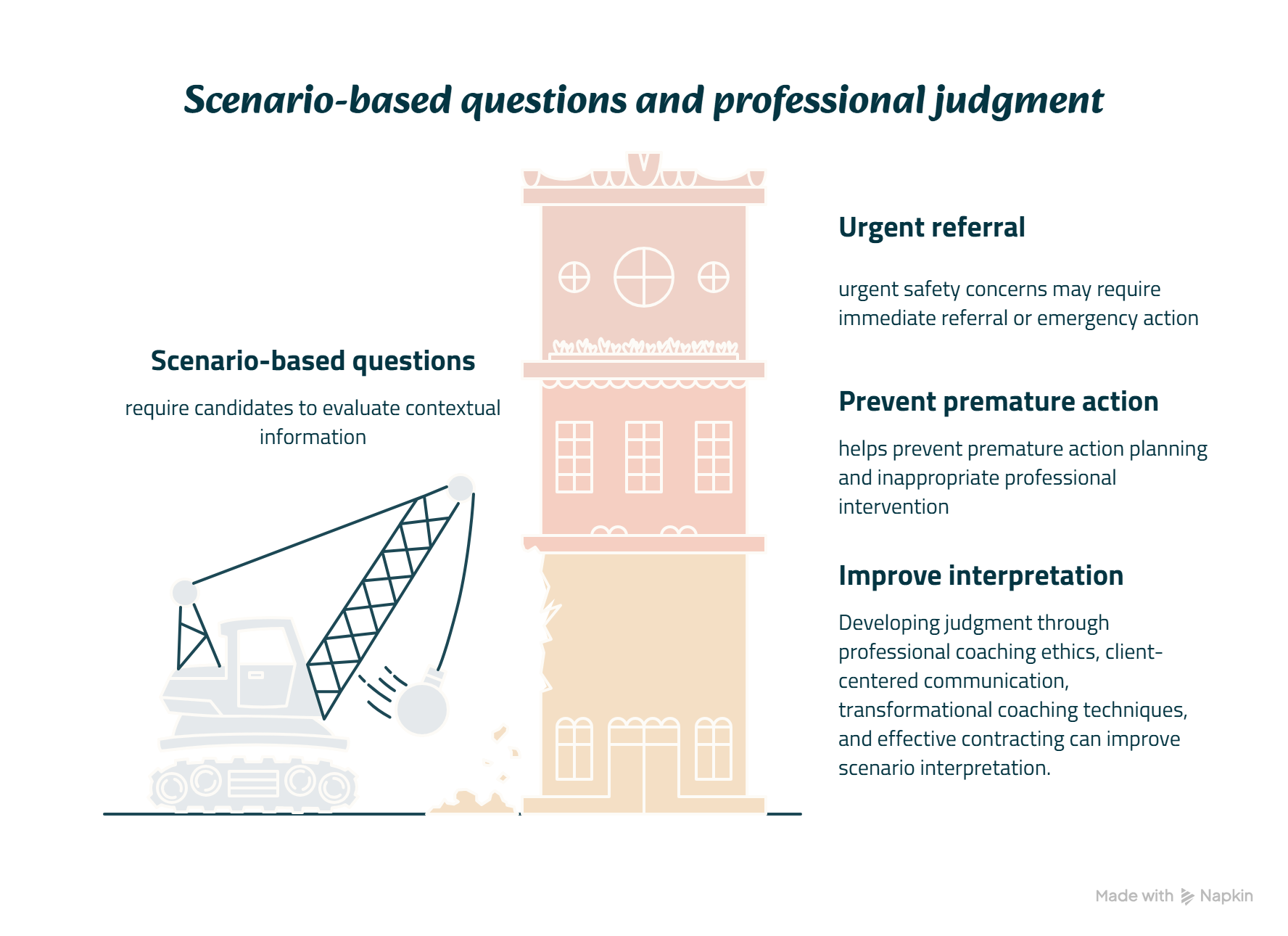
Scenario-based questions require candidates to evaluate contextual information and identify the most professionally appropriate response. Several answer choices may appear helpful while differing substantially in timing, ethical suitability, and respect for client autonomy.
Developing judgment through professional coaching ethics, client-centered communication, transformational coaching techniques, and effective contracting can improve scenario interpretation.
The following original practice scenarios illustrate common reasoning challenges.
Practice Scenario 1: Recognizing Client Readiness
A client explains:
"I know becoming more active would probably help me, but I have too much happening at work to start exercising regularly."
What should the coach do next?
A. Develop a weekly exercise schedule.
B. Explain the health consequences of physical inactivity.
C. Explore the client's feelings about becoming more active and the demands affecting their readiness.
D. Establish a daily activity target.
Best response: C.
The client expresses awareness of potential benefits alongside concerns about implementation. Exploring ambivalence helps clarify readiness and motivation before action planning.
This reasoning draws on health behavior change principles, career burnout coaching, and emotional agility.
Practice Scenario 2: Responding to Requests for Medical Advice
A client with hypertension asks their coach whether they should stop taking prescribed medication because their recent readings have improved.
A. Recommend gradually reducing the medication.
B. Explain that medication decisions require the prescribing healthcare professional and support the client in preparing questions for that consultation.
C. Recommend natural supplements as an alternative.
D. Interpret the client's recent readings and suggest an appropriate dosage.
Best response: B.
Medication decisions belong to the appropriately qualified healthcare professional. The coach can facilitate communication, explore concerns, and support adherence to clinician-directed recommendations.
Review scope of practice, duty of care, and the professional responsibilities associated with lifestyle medicine coaching.
Practice Scenario 3: Selecting an Effective Reflection
A client states:
"I keep trying to improve my eating habits, but whenever my family gets busy, everything falls apart."
A. You should prepare your meals every Sunday.
B. Why haven't you found a better routine?
C. You want to develop healthier habits, and unpredictable family responsibilities make consistency difficult.
D. Meal preparation is the most important skill you need.
Best response: C.
The response acknowledges the client's desired change and contextual barriers while preserving opportunities for further exploration.
Developing emotional intelligence, holistic coaching awareness, and constructive communication helps candidates recognize effective reflective responses.
Practice Scenario 4: Handling Confidentiality in Corporate Wellness
An employer sponsoring a coaching program requests detailed information about an employee's personal disclosures during sessions. The existing coaching agreement permits attendance reporting only.
A. Provide the requested information because the employer funds the service.
B. Share selected personal details without identifying the employee's name.
C. Clarify the agreed confidentiality boundaries and limit reporting to authorized information, subject to applicable legal and ethical obligations.
D. Ask the employee to disclose their personal concerns directly to the employer.
Best response: C.
The agreed information-sharing boundaries remain central to the coaching relationship.
Candidates should understand corporate health coaching, informed consent, and professional power dynamics when evaluating organizational scenarios.
Practice Scenario 5: Addressing Low Confidence
A client rates their confidence in completing a self-selected wellness goal as three out of ten.
A. Encourage the client to commit to the original goal.
B. Tell the client they are more capable than they realize.
C. Explore what contributes to their current confidence and what might increase it by one point.
D. Select an easier goal for the client.
Best response: C.
The response explores existing resources, perceived barriers, and opportunities to strengthen self-efficacy while maintaining client ownership.
This approach complements self-confidence coaching, positive psychology, and client accountability.
Practice Scenario 6: Recognizing Social Determinants of Health
A client reports difficulty purchasing fresh food because their neighborhood has limited grocery stores and their household budget is restricted.
A. Encourage the client to prioritize spending more money on nutritious food.
B. Explain that healthier eating requires greater discipline.
C. Explore the client's available resources, food preferences, access barriers, and interest in identifying affordable alternatives.
D. Provide a predetermined weekly meal plan.
Best response: C.
Environmental and financial circumstances can substantially influence health behaviors. Appropriate coaching explores feasible solutions collaboratively and respects the client's lived experience.
Study cultural competence, holistic wellness, and health behavior change to develop greater sensitivity to structural barriers.
Apply a Five-Step Reasoning Framework to Difficult Questions
When evaluating unfamiliar scenarios, ask yourself:
What is the client communicating or requesting?
Which examination competency is being assessed?
Are there immediate safety, ethical, or scope concerns?
What response appropriately supports the client's current needs and autonomy?
Which answer best fits the timing and circumstances of the conversation?
This approach helps prevent premature action planning and inappropriate professional intervention. However, scenarios involving urgent safety concerns may require immediate referral or emergency action before ordinary coaching exploration.
5. Measuring Examination Readiness and Avoiding Last-Minute Preparation Mistakes
An effective readiness assessment considers accuracy, confidence, timing, retention, and consistency across all examination domains.
Candidates who rely exclusively on familiar question banks may achieve impressive practice scores while remaining vulnerable to unfamiliar wording and integrated competency questions.
Applying SMART performance objectives, accountability systems, constructive feedback, and professional reflection creates a more reliable assessment process.
Track Four Independent Readiness Indicators
1. Unfamiliar question accuracy
Measure performance using questions you have never encountered before. An illustrative personal target could be 80–85% accuracy across multiple mixed-domain practice sets.
2. Domain consistency
Examine individual domain performance. A strong overall score can conceal considerable weakness in ethics, health science, or behavior change theory.
3. Reasoning accuracy
Explain why the preferred response is appropriate and why competing responses are less suitable.
4. Timed performance
Complete each 75-question section within the published 112-minute limit while preserving time to review uncertain answers.
These benchmarks are preparation targets rather than official passing scores or guarantees of examination success.
Create a Weighted Study Priority Formula
Calculate a preparation priority score by multiplying the published domain weight by your current proportion of incorrect answers.
For example:
Domain 1 weight: 25%.
Current practice accuracy: 60%.
Current error rate: 40%.
Study priority score: 0.25 × 0.40 = 0.10.
Compare this result with the corresponding scores for your other domains. Higher values indicate areas deserving greater revision attention.
This approach applies structured goal-setting methods and principles of client progress monitoring.
Use the formula as a scheduling aid while independently prioritizing repeated safety and ethical errors.
Develop a Practical Examination Pacing Strategy
With 112 minutes available for 75 questions, candidates have an average of approximately 90 seconds per question.
A useful practice strategy is to reserve approximately 12 minutes for reviewing flagged questions.
This leaves 100 minutes for completing the initial question pass. Monitor progress around the following checkpoints:
Question 25: approximately 33 minutes elapsed.
Question 50: approximately 67 minutes elapsed.
Question 75: approximately 100 minutes elapsed.
During review, reconsider questions involving overlooked details, incorrect assumptions, or misunderstood professional responsibilities.
Verify Certification Eligibility Before Your Application Deadline
Examination preparation should occur alongside the administrative requirements for board certification.
Candidates must generally complete an NBHWC-approved training program, document 50 qualifying health and wellness coaching sessions, and satisfy the education or work experience requirement through an associate degree or higher, or 4,000 hours of work experience.
Understanding board eligibility requirements, health coaching career pathways, and professional credential distinctions helps prevent confusion between completing training and becoming eligible for board certification.
Confirm that your documentation meets current requirements before the applicable application deadline. Application fees are generally non-refundable.
Prepare for Examination Anxiety and Cognitive Fatigue
Candidates often maintain intensive study schedules until the evening before their examination. Excessive preparation can interfere with sleep, concentration, and emotional regulation.
Use techniques from stress management coaching, self-care coaching, positive intelligence, and managing expectations to develop sustainable preparation routines.
During the final 48 hours, prioritize familiar concepts, examination logistics, regular meals, sufficient sleep, and brief retrieval exercises.
Avoid These Costly NBHWC Preparation Mistakes
Using outdated examination outlines: Study materials developed for the earlier four-domain examination structure require comparison with the updated five-domain framework.
Memorizing responses without understanding context: Practice recognizing why a response suits a particular client and situation.
Overemphasizing health science: Maintain balanced preparation across all domains, particularly communication and practical coaching skills.
Neglecting professional ethics: Review confidentiality, referral obligations, consent, technology safeguards, and role boundaries regularly.
Repeating identical practice questions: Introduce unfamiliar scenarios to distinguish genuine understanding from memorized answers.
Purchasing too many study resources: Prioritize materials aligned with the current official outline and your documented weaknesses.
Using recalled examination questions: Protect examination integrity by using authorized preparation resources and original practice scenarios.
The most valuable preparation habits mirror the professional qualities emphasized through ethical coaching practice, professional development, and sustainable behavior change.
6. Frequently Asked Questions About Creating an NBHWC Certification Study Plan
-
An eight-to-twelve-week preparation period can provide a manageable structure for candidates studying alongside employment and personal responsibilities.
Candidates with substantial knowledge gaps may benefit from a longer schedule. Use diagnostic results, SMART goal setting, and accountability strategies to determine your preparation timeline.
-
A practical starting target is eight to twelve hours weekly over eight weeks, producing approximately 64–96 total preparation hours.
This is an illustrative recommendation rather than an official NBHWC requirement. Candidates should adjust their schedules using habit formation techniques and realistic evaluations of their existing knowledge.
-
The five domains are:
Coaching Presence, Relationships, and Sessions: 25%.
Theories, Models, and Approaches to Behavior Change: 15%.
Skills, Tools, and Strategies: 25%.
Ethics and Professional Practice: 15%.
Health and Wellness: 20%.
The updated framework supports a balanced assessment of coaching relationships, behavior change, professional ethics, and health literacy.
-
Difficulty varies according to professional background. Clinically trained candidates may struggle with coaching boundaries, while candidates from non-healthcare backgrounds may require additional health science preparation.
Scenario-based questions involving emotional intelligence and ethical scope decisions can require particularly careful reasoning.
-
Eligible candidates can independently prepare for the board examination using appropriate study resources and practice exercises. Eligibility still requires completion of the applicable NBHWC-approved training and other requirements.
Review the distinction between health coaching certification and NBHWC board eligibility before relying on independent preparation.
-
An illustrative personal target of 80–85% on several unfamiliar practice examinations can encourage consistent preparation.
NBHWC practice examination results are intended for learning purposes and do not predict actual board examination performance. Evaluate accuracy alongside reasoning, timing, and domain-specific weaknesses through structured constructive feedback.
