
Preparing for the National Board for Health & Wellness Coaching (NBHWC) examination requires candidates to translate theoretical knowledge into sound professional judgment. Case-based questions can become particularly challenging when several responses appear empathetic, scientifically accurate, or professionally appropriate.
Successful preparation requires understanding when to apply health behavior change strategies, recognize professional scope-of-practice boundaries, demonstrate emotional intelligence, and facilitate meaningful client accountability. By developing a structured approach to interpreting scenarios, eliminating misleading answer choices, and practicing competency-based decision-making, candidates can strengthen their examination readiness while developing the practical judgment required of board-certified health and wellness coaches.

1. Understanding NBHWC Case Study Questions and What the Exam Actually Tests
The NBHWC Board Exam assesses the foundational knowledge, professional judgment, coaching skills, and ethical understanding required to become a National Board Certified Health & Wellness Coach (NBC-HWC).
Candidates frequently struggle when their previous experience in healthcare, nutrition, fitness, or counseling influences their interpretation of coaching scenarios.
Understanding the differences between health coaches, dietitians, and nutritionists, recognizing nutrition coaching boundaries, and maintaining appropriate coaching power dynamics can prevent candidates from selecting technically knowledgeable responses that exceed professional coaching responsibilities.
Understanding the Updated NBHWC Examination Structure
The updated 2026–2030 NBHWC Content Outline organizes examination material into five weighted areas:
Coaching Presence, Relationships, and Sessions: 25%.
Theories, Models, and Approaches to Behavior Change: 15%.
Skills, Tools, and Strategies: 25%.
Ethics and Professional Practice: 15%.
Health and Wellness: 20%.
The examination contains 150 multiple-choice questions divided into two sections of 75 questions. Candidates receive 112 minutes for each section within an approximately four-and-a-half-hour examination appointment.
The two areas covering coaching relationships and practical skills collectively account for half of the examination's content weighting.
Preparation should therefore emphasize transformational coaching, constructive feedback, professional ethics, and the practical application of coaching knowledge.
Why Case Study Questions Can Be Difficult
Consider a client who repeatedly misses their weekly movement commitments because of unpredictable working hours.
Potential responses might include explaining physical activity recommendations, encouraging greater discipline, reducing the client's target, or exploring how their schedule influences their choices.
Several responses may appear reasonable. The most appropriate choice depends on the client's circumstances, readiness, established goals, and the specific question being asked.
Understanding habit formation, SMART goal setting, holistic coaching, and client expectation management helps candidates distinguish appropriate interventions from premature solutions.
Recognizing the Difference Between Health Knowledge and Coaching Judgment
Candidates need foundational knowledge of physical activity, nutrition, sleep, stress, chronic conditions, health promotion, and other wellness topics.
They must also recognize when applying this knowledge becomes individualized clinical advice.
For example, understanding general principles of metabolic health, preventive health, and lifestyle medicine supports informed coaching conversations.
Interpreting laboratory results, recommending medication changes, prescribing exercise, or developing therapeutic meal plans requires separate professional authority.
Use the following 30 original practice scenarios to develop competency recognition and identify common answer-choice traps.
2. Mastering the Five NBHWC Examination Domains Through Case-Based Learning
Studying each examination domain through applied scenarios helps candidates understand how professional knowledge influences actual coaching decisions. Memorizing definitions provides a foundation; applying those definitions under changing circumstances develops examination-level judgment.
Domain 1: Coaching Presence, Relationships and Sessions
This domain examines the professional relationship, collaborative session structure, trust, empathy, and responsiveness to client needs.
Imagine a client arrives at a session visibly distressed about a family disagreement. The previous session ended with an agreement to discuss physical activity.
An appropriate response would acknowledge the client's current experience and collaboratively establish whether the original agenda remains suitable.
Candidates should review creating safe coaching environments, coaching contracts, emotional agility, and cultural competence.
Pay particular attention to scenarios involving silence, changes in session priorities, personal disclosure, and disagreement between coach and client.
Domain 2: Theories, Models and Approaches to Behavior Change
The updated examination outline includes Motivational Interviewing 4.0, the Transtheoretical Model, self-efficacy, self-determination theory, neuroplasticity, goal-setting approaches, growth mindset, positive psychology, and appreciative inquiry.
Candidates should understand which theoretical mechanism explains the client's situation.
For example:
A client questioning whether change is worthwhile may be experiencing ambivalence.
A client doubting their ability to succeed may require self-efficacy support.
A client consistently performing a new behavior for several months may be progressing through action or maintenance, depending on the timeframe.
A client motivated by personal values demonstrates a potentially important source of autonomous motivation.
Studying positive psychology coaching, self-confidence development, self-actualization, and habit stacking helps connect theoretical principles with practical coaching applications.
Domain 3: Skills, Tools and Strategies
This domain examines how coaches select and apply communication techniques, facilitation tools, reflective practices, action planning, and accountability strategies.
Candidates should distinguish between the four core OARS communication skills:
Open-ended questions: Encourage exploration and elaboration.
Affirmations: Recognize strengths, efforts, and capabilities.
Reflective listening: Communicate understanding and deepen awareness.
Summaries: Integrate important information and consolidate learning.
A question asking which response demonstrates reflective listening requires recognition of a reflection rather than selection of a generally helpful open-ended question.
Practice integrating wellness exploration tools, life visioning, constructive feedback, and accountability coaching.
Build practice questions that isolate individual techniques before attempting scenarios involving multiple competencies.
Domain 4: Ethics and Professional Practice
Ethical questions may involve confidentiality, informed consent, conflicts of interest, technology use, dual professional roles, professional competence, and appropriate referrals.
A candidate with additional healthcare qualifications should answer according to the professional role established in the scenario.
For example, a registered dietitian working explicitly in a health coaching capacity should maintain the boundaries of that role unless an appropriately disclosed and documented professional arrangement establishes otherwise.
Review informed consent, professional misrepresentation, duty of care, and professional indemnity considerations.
Pay attention to the distinction between confidentiality obligations and circumstances where disclosure or emergency intervention may become legally or ethically necessary.
Domain 5: Health and Wellness
Health and wellness represents one-fifth of the updated examination content weighting. Candidates should develop foundational knowledge across health promotion, chronic conditions, preventive care, sleep, movement, nutrition, wellbeing, and factors influencing access to health resources.
Understanding lifestyle medicine, metabolic health, preventive health coaching, and self-care practices helps candidates recognize the health-related context of a scenario.
Study general recommendations from nationally recognized health authorities while practicing the distinction between population-level information and individualized treatment.
Candidates should also understand social determinants of health, health literacy, numeracy, and how structural barriers influence a client's opportunities to pursue wellness goals.
3. A Six-Step Strategy for Answering NBHWC Case Study Questions
Candidates who consistently narrow questions down to two plausible answers often need a stronger decision-making framework. The following six-step method provides a practical way to evaluate scenarios under examination conditions.
This is an independent study framework designed for preparation purposes.
Step 1: Identify What the Question Is Actually Asking
Read the final question carefully before analyzing the response options.
Common instructions may require identifying:
The most appropriate next coaching response.
The communication technique being demonstrated.
The client's current readiness for change.
An ethical concern requiring action.
The most suitable intervention within coaching scope.
A relevant health or wellness concept.
A scenario involving emotional distress could assess coaching presence, emotional intelligence, or professional referral boundaries.
The final instruction determines which competency deserves priority.
Step 2: Screen for Safety and Scope-of-Practice Concerns
Identify whether the scenario includes a medical emergency, significant psychological distress, inappropriate professional advice, confidentiality concerns, or another ethical issue.
Safety-sensitive circumstances may require immediate referral or escalation before routine exploratory coaching.
Review professional scope of practice, mental health coaching boundaries, responding to emotional crises, and professional duty of care.
Eliminate options involving unauthorized diagnosis, treatment, medication management, or individualized clinical recommendations.
Step 3: Identify the Client's Readiness for Change
The Transtheoretical Model provides a useful framework for recognizing behavioral readiness.
Precontemplation: Little or no intention to change within the next six months.
Contemplation: Considering change within the next six months.
Preparation: Intending to act soon, commonly within 30 days.
Action: Recently implementing the target behavior.
Maintenance: Sustaining the changed behavior, typically for six months or longer.
A client can occupy different stages for different behaviors.
Connecting readiness assessment with behavior change coaching, habit formation, and client motivation management helps candidates recognize when planning, reflection, or maintenance support is appropriate.
Step 4: Determine the Appropriate Motivational Interviewing Task
Motivational Interviewing 4.0 organizes the conversation around four tasks:
Engaging: Developing the working relationship.
Focusing: Establishing a shared direction.
Evoking: Drawing out the client's motivations and perspectives.
Planning: Supporting commitment and action when appropriate.
These tasks can overlap and recur throughout a conversation.
Candidates should recognize that a client expressing unresolved ambivalence may benefit from further exploration before developing a detailed action plan.
Principles of holistic coaching, emotional agility, and transformational coaching reinforce responsiveness to the client's needs throughout this process.
Step 5: Evaluate Whether the Response Preserves Client Autonomy
Review whether an answer encourages clients to identify their priorities, generate solutions, evaluate alternatives, and establish meaningful commitments.
Coaches can provide appropriate general educational information using collaborative techniques such as ask-offer-ask.
A response involving unnecessary persuasion, rigid instructions, judgment, or premature problem-solving may undermine autonomy.
Study coaching power dynamics, self-actualization, and life purpose exploration to strengthen your understanding of client ownership.
Step 6: Eliminate Answers That Are Appropriate at the Wrong Time
Several interventions may be useful during different stages of the same coaching conversation.
If a client is expressing emotional uncertainty, empathic reflection may be the appropriate immediate response. Later, the coach and client might explore barriers, establish a goal, or develop an accountability arrangement.
Use SMART goals, client accountability, self-confidence coaching, and constructive feedback strategies to understand how interventions fit within different conversation stages.
The strongest response addresses the immediate competency being assessed while respecting professional boundaries and the information provided in the scenario.
4. Ten NBHWC Practice Case Studies With Answers and Detailed Explanations
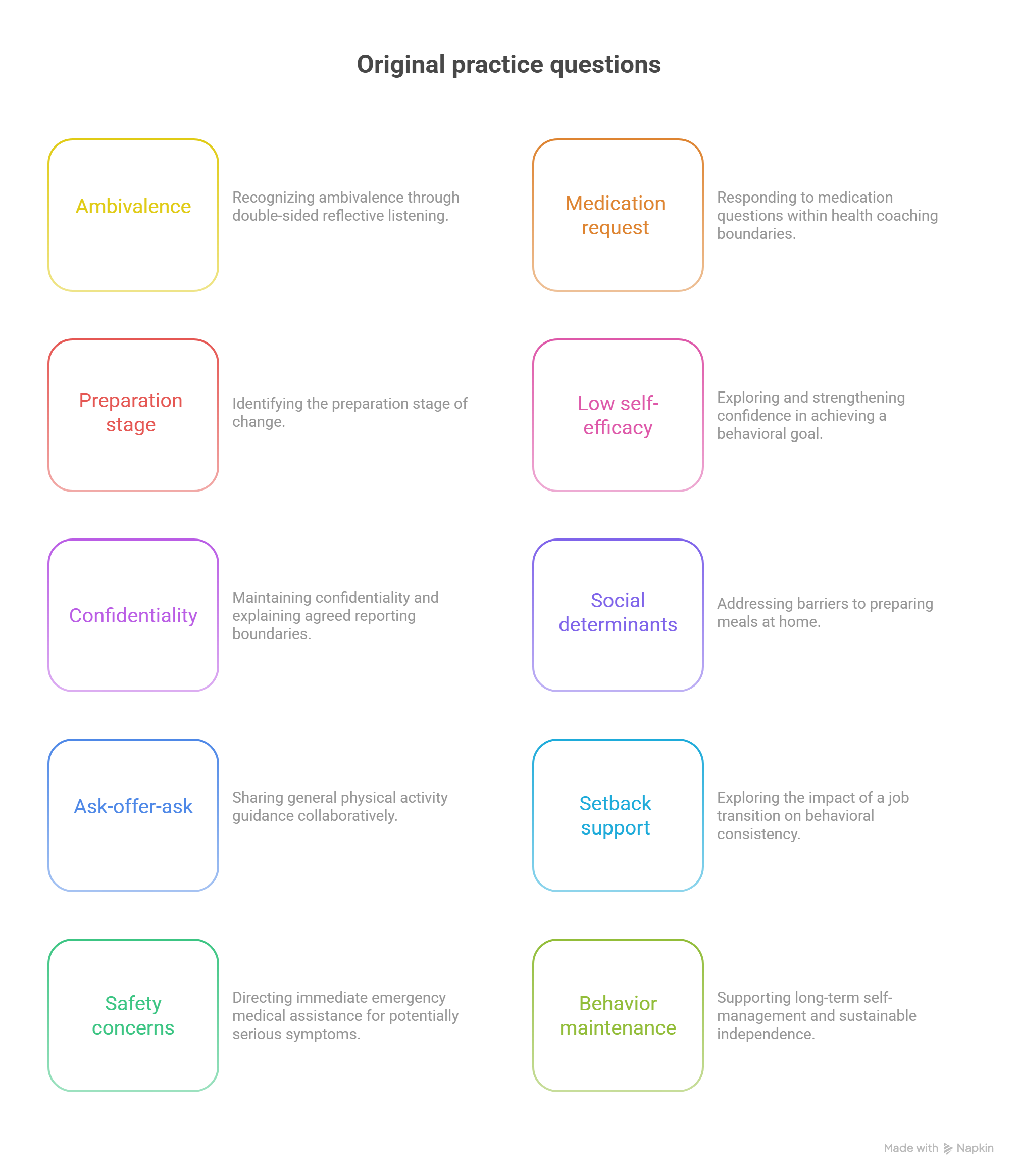
The following original practice questions develop scenario interpretation, ethical judgment, theoretical understanding, and answer elimination. They are independently developed learning exercises rather than official or recalled NBHWC examination questions.
Attempt each question before reviewing its explanation.
Case Study 1: Recognizing Ambivalence
A client says, "I know walking regularly could help my health, but after working all day, I just want to relax."
Which response best demonstrates double-sided reflective listening?
A. You should try walking immediately after work.
B. Why do you keep prioritizing relaxation?
C. You value the potential health benefits of walking, and relaxing after work feels important to you.
D. Would you commit to walking for 30 minutes tomorrow?
Correct answer: C.
The response acknowledges both sides of the client's ambivalence. Option D introduces planning before the client's competing priorities have been sufficiently explored. Options A and B introduce direction and potential judgment.
This scenario draws upon health behavior change and emotional agility.
Case Study 2: Responding to a Medication Request
A client with hypertension tells their health coach that their blood pressure readings have improved and asks whether they should stop taking prescribed medication.
What is the most appropriate response?
A. Recommend reducing the medication gradually.
B. Encourage the client to discuss medication decisions with their prescribing healthcare professional.
C. Suggest replacing medication with dietary changes.
D. Interpret the readings and determine whether medication remains necessary.
Correct answer: B.
Medication management falls outside the independent health coaching role. The coach can help the client prepare questions for their healthcare professional and support behavioral goals consistent with the resulting treatment plan.
Review scope-of-practice boundaries, lifestyle medicine, and professional duty of care.
Case Study 3: Identifying the Preparation Stage
A client has decided to begin regular physical activity within the next two weeks and has started exploring nearby recreational facilities.
Which stage of change best describes the client?
A. Precontemplation.
B. Contemplation.
C. Preparation.
D. Maintenance.
Correct answer: C.
The client intends to act soon and has started making preliminary arrangements. Preparation involves near-term intention and practical steps preceding implementation of the target behavior.
Strategies involving habit formation and realistic goal setting may support the client's transition into action.
Case Study 4: Addressing Low Self-Efficacy
A client rates their confidence in achieving a weekly behavioral goal at four out of ten.
Which response most appropriately explores and strengthens confidence?
A. Four is too low; you need to believe in yourself.
B. What makes it a four rather than a one, and what might help you move toward a five?
C. I will reduce your goal to something easier.
D. Let us increase your accountability requirements.
Correct answer: B.
This response explores existing sources of confidence while inviting the client to identify achievable improvements. It also provides information that can guide subsequent collaborative planning.
Option C introduces a potentially useful adjustment but transfers the decision to the coach.
Review self-confidence coaching, positive psychology, and client motivation strategies.
Case Study 5: Managing Confidentiality in Corporate Coaching
An employer funding an employee wellness program requests detailed personal coaching notes from an individual participant's sessions. The existing agreement permits aggregate participation reporting only.
What should the coach do?
A. Share the notes because the employer pays for the program.
B. Share the notes after removing the employee's name.
C. Provide verbal summaries instead of written documentation.
D. Maintain confidentiality and explain the agreed reporting boundaries.
Correct answer: D.
The employer's financial involvement does not automatically authorize access to confidential coaching information. The coach should follow established agreements and applicable legal and ethical obligations.
This scenario illustrates the importance of corporate health coaching boundaries, informed consent, and professional contracting.
Case Study 6: Addressing Social Determinants of Health
A client wants to prepare more meals at home but lives in an area with limited access to affordable groceries and reliable transportation.
Which response is most appropriate?
A. Explore accessible food resources and alternatives that align with the client's circumstances.
B. Explain that meal preparation is a matter of discipline.
C. Recommend purchasing more expensive organic foods online.
D. Require the client to follow a standardized grocery list.
Correct answer: A.
The scenario involves economic and environmental barriers. Collaborative resource exploration acknowledges structural constraints and preserves the client's ability to select realistic options.
Study cultural competence, holistic coaching, and nutrition coaching boundaries.
Case Study 7: Applying Ask-Offer-Ask
A client asks their health coach about general physical activity recommendations for adults.
Which response best demonstrates ask-offer-ask?
A. Provide a detailed exercise prescription.
B. Explain all physical activity recommendations without interruption.
C. Explore what the client already knows, obtain permission to share general guidance, and ask what they think about the information.
D. Refuse to discuss physical activity under any circumstances.
Correct answer: C.
Health coaches may share appropriate evidence-based general information from recognized authorities. Ask-offer-ask creates a collaborative process that respects existing knowledge and encourages the client to interpret information in their own context.
Review preventive health coaching, health education boundaries, and health behavior change.
Case Study 8: Supporting a Client After a Setback
A client who had maintained a consistent wellness routine for several months reports missing commitments for two consecutive weeks after starting a new job.
What should the coach do first?
A. Increase the difficulty of the client's weekly commitments.
B. Explore the impact of the job transition and acknowledge the client's experience.
C. End the previous coaching plan and introduce an entirely new program.
D. Require daily progress reports.
Correct answer: B.
The client's environmental circumstances have changed. Understanding how the transition influences behavioral consistency establishes a foundation for adjusting goals and identifying suitable support.
Resources involving career burnout coaching, coaching through major change, and self-care coaching provide useful contexts for similar questions.
Case Study 9: Recognizing Immediate Safety Concerns
During a virtual coaching session, a client reports sudden chest pressure, sweating, and shortness of breath.
What is the most appropriate response?
A. Guide the client through a relaxation exercise.
B. Ask whether workplace stress contributed to the symptoms.
C. Recommend discussing the symptoms at their next routine medical appointment.
D. Stop routine coaching and direct immediate emergency medical assistance.
Correct answer: D.
Potentially serious medical symptoms require urgent professional medical attention. Routine coaching, motivational interviewing, and behavioral exploration should be suspended while immediate safety is addressed.
Understanding professional duty of care and scope-of-practice boundaries is essential for recognizing these circumstances.
Case Study 10: Facilitating Independent Behavior Maintenance
A client nearing the end of a coaching program says they are worried about maintaining their progress without weekly sessions.
Which response best supports long-term self-management?
A. Explore strategies, strengths, support systems, and accountability arrangements the client can maintain independently.
B. Recommend purchasing another year of coaching immediately.
C. Require the client to continue sending daily reports indefinitely.
D. Reassure the client that setbacks will never occur.
Correct answer: A.
Effective coaching supports sustainable independence. The coach can help the client recognize existing capabilities, anticipate barriers, identify external resources, and establish personally meaningful maintenance strategies.
This approach integrates habit stacking, accountability coaching, and lasting behavioral transformation.
5. Building a Six-Week NBHWC Case Study Preparation Plan
An effective study schedule should combine foundational content review, scenario-based retrieval practice, error analysis, and timed examination simulations.
Candidates who repeatedly reread training materials may develop familiarity with concepts while remaining unable to distinguish between competing answer choices.
Use a structured preparation plan that measures practical competency recognition alongside factual knowledge.
Week 1: Establish Your Baseline and Update Your Study Materials
Complete a diagnostic practice assessment covering all five examination domains.
Candidates trained under an earlier content outline should compare their education against the 2026–2030 outline and official crosswalk. Identify newly introduced or expanded topics and obtain appropriate learning materials.
Review professional development strategies, health coaching certification pathways, and certification training quality considerations.
Create a prioritized study list based on weaknesses rather than personal preferences.
Week 2: Master Coaching Relationships and Communication
Complete daily exercises involving active listening, affirmations, open-ended questions, reflections, summaries, and collaborative agenda setting.
For every practice scenario, generate at least two potentially helpful responses and explain why one is more suitable at that moment.
Use emotional intelligence, safe coaching environments, constructive feedback, and professional coaching agreements as supplementary conceptual resources.
Week 3: Practice Behavioral Science Applications
Concentrate on motivational interviewing, readiness for change, self-efficacy, self-determination, growth mindset, habit formation, and strengths-based development.
Create contrasting scenarios that differ in one important variable, such as confidence, willingness, behavioral consistency, or environmental support.
For instance, compare a client who wants to change but doubts their ability with a client who feels capable but sees little personal value in changing.
The first scenario may require confidence exploration, while the second may require exploration of personal meaning and motivation.
Study positive psychology, habit formation, self-confidence, and life purpose exploration.
Week 4: Strengthen Ethics and Scope-of-Practice Judgment
Practice scenarios involving confidentiality, professional competence, dual roles, conflicts of interest, informed consent, inappropriate advice, and referrals.
Create flashcards that identify the specific professional boundary illustrated in each scenario.
Prioritize coaching ethics, informed consent, ethical misrepresentation, and therapy versus coaching distinctions.
For each question, explain whether an option exceeds coaching scope, violates an ethical principle, requires further clarification, or is appropriate within an established professional arrangement.
Week 5: Consolidate Health and Wellness Knowledge
Review foundational health topics using current resources from recognized health authorities.
Focus on general physical activity guidance, nutrition, sleep, stress, tobacco use, chronic disease prevention, wellbeing, health equity, and health literacy.
Connect these areas with metabolic health coaching, preventive health, lifestyle medicine, and self-care coaching.
Create two question types for every topic: one testing factual health knowledge and another testing how that knowledge can be used appropriately within coaching.
Week 6: Complete Timed Examination Simulations
Practice answering 75 questions within 112 minutes to reproduce the official section timing.
A suggested pacing strategy allocates approximately:
30 minutes for the first 25 questions.
30 minutes for the next 25 questions.
30 minutes for the final 25 questions.
22 minutes for flagged questions and review.
This schedule is an independent preparation recommendation. Candidates can adjust it according to their reading speed and question complexity.
Once an examination section has been closed, candidates cannot return to it. Complete all intended reviews before submitting each section.
Manage preparation pressure through appropriate stress management strategies, self-care routines, and manageable SMART study goals.
Create an Examination Error Journal
An error journal reveals patterns that overall practice scores can conceal.
For every incorrect or uncertain answer, record:
The examination domain.
The competency being assessed.
The selected answer.
The correct answer and its rationale.
Why the incorrect option appeared attractive.
Whether the error involved factual knowledge, ethical judgment, timing, or interpretation.
A new scenario testing the same competency.
A scheduled date for reassessment.
Pay particular attention to correctly answered questions that involved guessing. These may conceal unresolved knowledge gaps.
Combining error analysis with constructive feedback, accountability strategies, and reflective professional development can make study sessions increasingly targeted.
Allocate Study Hours According to Examination Weight and Personal Weaknesses
For an illustrative 60-hour preparation schedule, an initial allocation reflecting the official domain weightings would include:
Coaching relationships and sessions: 15 hours.
Behavior change theories and approaches: 9 hours.
Coaching skills, tools, and strategies: 15 hours.
Ethics and professional practice: 9 hours.
Health and wellness: 12 hours.
Adjust these allocations following diagnostic assessments. A candidate with strong clinical knowledge but limited motivational interviewing experience may need substantially more applied communication practice.
Candidates can also use micro-coaching principles, habit stacking, and self-directed learning strategies to establish sustainable study routines.
Avoid Memorizing Unofficial Answer-Selection Rules
Statements such as "always select the open-ended question" or "always choose the most empathetic response" can produce avoidable errors.
A question testing reflective listening may require a reflective statement. A safety scenario may require urgent escalation. A health knowledge question may require identifying an accurate factual statement.
Developing flexible judgment through professional supervision, coaching ethics, and professional accountability prepares candidates for the variety of decisions represented across examination domains.
6. Frequently Asked Questions About NBHWC Case Study Preparation
-
The NBHWC Board Exam uses multiple-choice questions that can assess professional knowledge through realistic coaching scenarios. Candidates should prepare for both applied judgment and factual knowledge questions.
Studying health behavior change through practical examples helps connect theoretical knowledge with coaching decisions.
-
The published 2026 examination format contains 150 multiple-choice questions divided into two sections of 75 questions. Each section has a time allowance of one hour and 52 minutes.
The overall examination appointment lasts approximately four and a half hours, including the tutorial, available break time, and post-examination survey.
Candidates should check the examination information packet applicable to their scheduled testing window.
-
Many candidates find distinguishing between several plausible coaching responses particularly challenging.
Common difficulties include selecting an intervention at the appropriate time, interpreting readiness for change, recognizing communication techniques, and maintaining professional scope-of-practice boundaries.
Detailed answer-rationale practice helps address these weaknesses.
-
The updated outline organizes competencies across five weighted examination domains and incorporates updated or expanded content, including Motivational Interviewing 4.0, health equity, health literacy, and additional professional knowledge and skills.
Candidates trained under earlier standards should use the official content crosswalk and pursue appropriate continuing professional development to address gaps.
-
Motivational interviewing is particularly important because it connects communication skills, autonomy, readiness for change, intrinsic motivation, and behavioral planning.
Candidates should practice the four motivational interviewing tasks, OARS, change talk, sustain talk, discord, and ask-offer-ask.
Studying emotional agility and client motivation management can complement this preparation.
-
Identify the precise competency being tested, assess the client's circumstances, and determine which response addresses the immediate coaching need.
Consider whether an answer is premature, overly directive, outside professional scope, or inconsistent with the client's readiness.
Principles of coaching power dynamics and client-centered transformation are especially useful when comparing competing options.
