
Maintaining your National Board Certified Health and Wellness Coach (NBC-HWC) credential requires completing 36 continuing education credits every three years, paying annual recertification fees, and maintaining accurate documentation. With updated continuing education opportunities and digital tracking changes, coaches need a proactive approach to continuing professional development. Strategic recertification planning strengthens professional credibility, reinforces ethical coaching standards, and creates opportunities to pursue specialized health coaching career pathways. This guide explains renewal requirements, eligible educational activities, cost-saving strategies, documentation procedures, and practical methods for protecting your board certification while developing commercially valuable professional expertise.

1. Understanding NBHWC Recertification Requirements, Fees and Deadlines
The National Board for Health and Wellness Coaching maintains professional certification through two separate obligations: annual fee payments and a three-year continuing education cycle. Coaches must manage both requirements to protect their credential and maintain eligibility for positions where board certification is expected.
Understanding these responsibilities is particularly important for professionals pursuing corporate health coaching, competing for remote health coaching positions, evaluating NBHWC credentialing pathways, or establishing an independent practice based on professional coaching credibility.
The Core NBHWC Recertification Requirements
NBC-HWCs must fulfill the following obligations:
Complete 36 eligible continuing education credits during each three-year certification cycle.
Pay a nonrefundable annual recertification fee of $75.
Record and submit continuing education information through the applicable NBHWC recertification process.
Retain evidence of course completion for possible audits.
Maintain compliance with NBHWC professional standards.
NBHWC strongly recommends allocating at least 18 credits to coaching competencies within content areas 1–4 of its competency outline. This recommendation helps practitioners balance specialized health knowledge with core coaching capabilities.
Relevant development areas include health behavior change, emotional intelligence coaching, client accountability, and professional scope of practice.
How Much Does NBHWC Recertification Cost?
At the published annual fee of $75, maintaining certification across three years costs $225 in base recertification fees. Continuing education expenses, petition charges, and potential late fees can increase the overall cost.
A financially responsible coach should establish a separate professional development budget covering mandatory payments, educational activities, and administrative expenses. This becomes particularly valuable when evaluating health coaching income potential, coaching package pricing, and the broader financial value of a health coaching career.
Understanding the Updated Sponsored CE Allowance
NBHWC's fourth-quarter 2026 guidance establishes a maximum of 18 credits from its sponsored continuing education events per three-year cycle. Older recertification handbooks describe a 12-credit allowance, creating potential confusion for coaches relying on previously downloaded documents.
The updated allowance creates an opportunity to fulfill half of the required continuing education credits through complimentary sponsored activities. Coaches should consult their current NBHWC account and the latest official guidance when calculating remaining requirements.
Select educational activities that directly improve capabilities such as habit formation, motivational support, culturally competent coaching, and constructive client feedback.
Understanding Individual Recertification Deadlines
Annual payment deadlines and continuing education submission deadlines should be recorded separately. Your NBHWC account identifies the dates applicable to your certification status.
Set personal reminders 90, 60, and 30 days before important deadlines. An expired payment card, outdated email address, or unsubmitted CE record can create credentialing problems despite successful completion of educational requirements.
2. What Counts as NBHWC-Approved Continuing Education?
Continuing education eligibility depends on the educational activity's approval status, learning format, relevance to professional coaching, and alignment with NBHWC scope requirements.
Purchasing a course marketed toward wellness professionals provides insufficient assurance that its credits will qualify. Coaches should evaluate educational investments with the same scrutiny applied when investigating health coaching certification red flags, assessing nutrition coaching boundaries, and comparing health coach and dietitian responsibilities.
Using the Official NBHWC Continuing Education Directory
The official NBHWC directory allows coaches to identify approved educational opportunities by topic, delivery format, and cost. Individual listings provide course approval information and available credit values.
Before enrolling, establish five details:
The exact course appears in the applicable approved directory.
Its approval covers the intended participation dates.
The advertised NBHWC credit value matches the official listing.
The provider issues appropriate evidence of completion.
The curriculum advances a skill relevant to your coaching practice.
For example, a coach specializing in metabolic health may benefit from education addressing behavioral barriers to sustainable lifestyle changes. A practitioner working in preventive health coaching might prioritize motivational interviewing, while a coach providing holistic wellness services could develop stronger assessment and goal-setting capabilities.
How NBHWC Calculates Continuing Education Credits
For standard instructor-led educational activities, 60 minutes of qualifying instructional content generally equals one CE.
Course duration and approved educational value can differ. Conferences may include networking sessions, meals, breaks, promotional presentations, and other activities excluded from instructional credit calculations.
Qualifying academic coursework follows separate conversion rules:
One academic semester credit equals 15 CEs.
One academic quarter credit equals 12.5 CEs.
Academic education must still satisfy NBHWC eligibility criteria and applicable review requirements. Coaches considering university education should investigate its relevance to lifestyle medicine coaching, behavioral transformation, professional development, and their long-term specialization.
How to Petition for Non-Approved Continuing Education
NBHWC permits individual applications for certain completed educational activities outside its approved directory. A CE petition costs $35 under the published handbook rules, and the fee remains nonrefundable regardless of the outcome.
Coaches should submit petitions within six months of completing the coursework. Published review dates are the first and fifteenth of each month.
Prepare a strong application by gathering:
Course learning objectives and curriculum.
Instructor qualifications.
Evidence of structured instruction.
Information about the learning assessment.
Completion certificate.
Requested credit value and supporting instructional hours.
Explanation of relevance to NBHWC coaching competencies.
Explain how the education strengthens your professional coaching capabilities. A course examining food sensitivity coaching, for instance, should support client awareness, communication, and appropriate referrals within the health coach's professional scope.
Education involving clinical interpretation, dietary prescriptions, or therapeutic treatment may create eligibility problems. Understanding professional nutrition coaching restrictions and ethical misrepresentation helps coaches identify unsuitable coursework before committing money.
Continuing Education Through Teaching, Mentoring and Publishing
Experienced coaches may pursue alternative credit opportunities through qualifying instructional, mentoring, and publication activities.
Teaching and mentoring each have separate published limits of 18 credits per recertification cycle, subject to specific faculty, institutional, and professional requirements. Qualifying publications may receive up to 36 credits following review, with eligible publication content generally requiring at least 2,500 words.
These pathways can support coaches progressing toward educational leadership, coach supervision, advanced coaching competency development, and broader contributions to the health coaching profession.
Maintain independent evidence of each activity and secure the necessary approvals before including its credits in your completed total.
3. How to Earn NBHWC Continuing Education Credits Affordably
Continuing education expenses can accumulate rapidly when coaches purchase specialized certifications, conferences, and premium training packages without a structured development plan. A cost-efficient strategy prioritizes complimentary education, employer benefits, and targeted courses with measurable professional relevance.
Maximize Complimentary NBHWC-Sponsored Education
Under updated sponsored-event guidance, NBC-HWCs can apply up to 18 sponsored credits toward their 36-credit requirement.
Sponsored educational activities are available through live participation and on-demand learning. Coaches must complete applicable course assessments to receive credit, including the required quiz following live participation where specified.
A practical schedule involves completing six sponsored credits annually. Choose topics based on recurring professional challenges, such as client resistance, emotional agility, accountability coaching, and client motivation management.
This schedule distributes learning throughout the certification cycle and reduces financial pressure near the submission deadline.
Investigate Employer-Funded Continuing Education
Health systems, digital health companies, wellness organizations, and corporate employers may provide professional development allowances or internal training programs.
Before purchasing courses independently, investigate whether your employer offers reimbursement, approved internal education, conference funding, or access to professional learning platforms.
Practitioners exploring corporate wellness careers, remote coaching employment, and health coaching jobs beyond private practice should include educational benefits when comparing compensation packages.
Request written confirmation of reimbursement conditions, eligible providers, and any repayment obligations associated with leaving employment.
Calculate the Cost Per Continuing Education Credit
Comparing educational programs by total price alone can obscure substantial differences in value.
Consider three hypothetical courses:
Course A costs $150 and provides three CEs, equivalent to $50 per credit.
Course B costs $240 and provides 12 CEs, equivalent to $20 per credit.
Course C costs $450 and provides 18 CEs, equivalent to $25 per credit.
Course B offers the lowest cost per credit. However, Course C could justify its higher expense if it develops specialized expertise directly relevant to your practice.
Evaluate these opportunities against health coaching niche demand, competitive coaching positioning, client acquisition challenges, and existing professional weaknesses.
Build a Low-Cost Three-Year Recertification Budget
A hypothetical cost-conscious recertification strategy could include:
18 complimentary NBHWC-sponsored CEs.
12 approved CEs costing an average of $15 each.
Six qualifying employer-funded CEs.
Three annual recertification payments of $75.
The resulting estimated three-year expenditure would be $405, equivalent to $135 annually before any applicable taxes, travel expenses, or additional fees.
Actual educational expenditure depends on course availability, employer policies, and individual learning preferences. Coaches should incorporate these expenses into their health coaching business model and maintain realistic professional service pricing.
Avoid Expensive CE Purchasing Mistakes
A premium course deserves careful evaluation when its marketing emphasizes guaranteed income, accelerated expertise, or unsupported clinical capabilities.
Common purchasing mistakes include enrolling before verifying approval, assuming another credential's credits automatically qualify, overlooking course completion deadlines, and choosing education unrelated to current professional objectives.
Review certification scam warning signs, training program credibility indicators, and professional scope requirements before investing in advanced training.
4. A Three-Year NBHWC Continuing Education and Recertification Roadmap
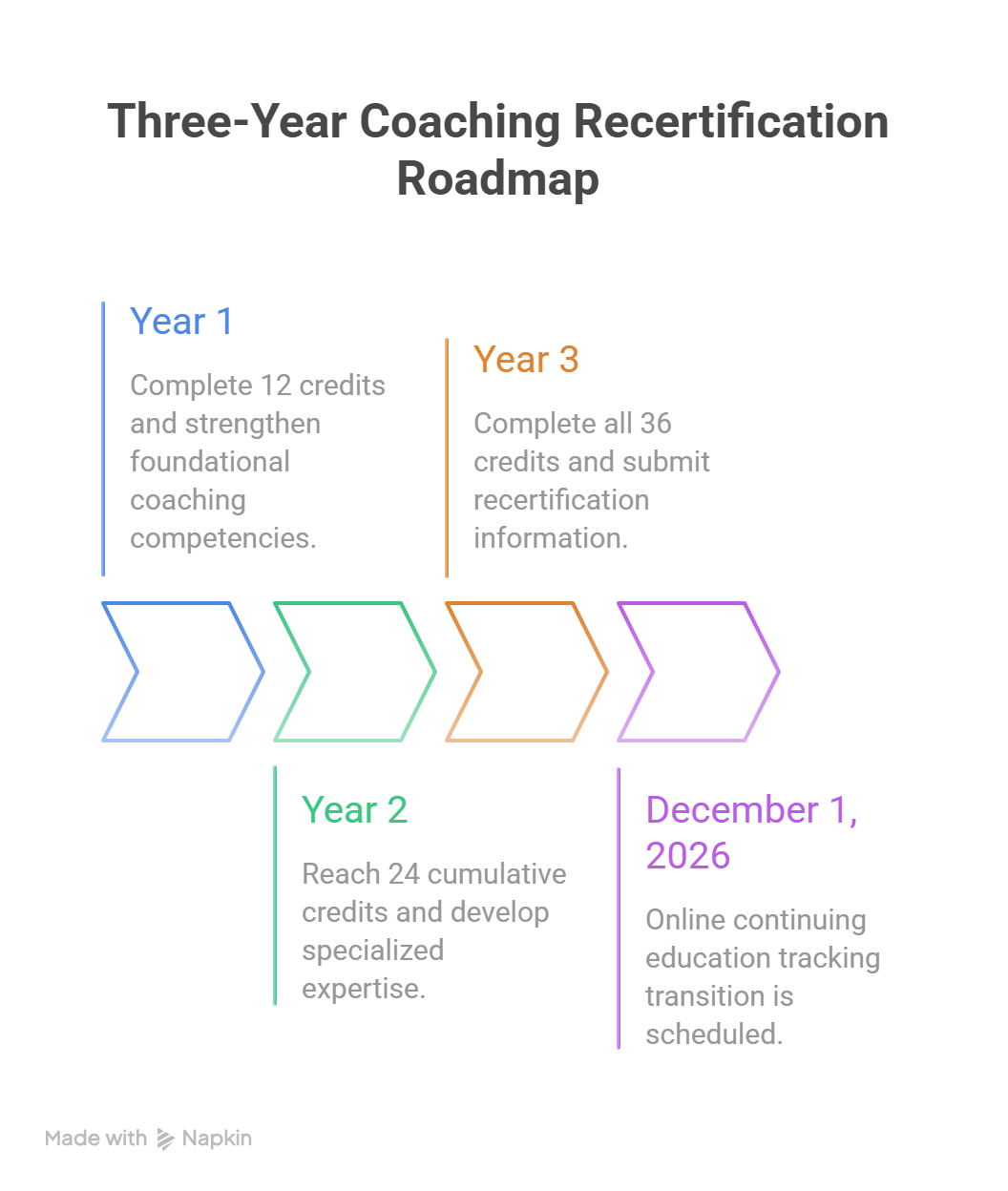
Dividing 36 credits across three years creates an average target of 12 credits annually. Coaches can adjust this distribution according to course availability, professional responsibilities, and upcoming certification deadlines.
A structured roadmap should incorporate educational progress, documentation reviews, practical application, and financial planning.
Year 1: Strengthen Foundational Coaching Competencies
Use the first year to identify recurring difficulties within your coaching sessions. Review consented session feedback, client adherence patterns, communication challenges, and circumstances requiring referral.
Potential development priorities include active behavioral support, emotional intelligence, professional coaching agreements, and psychologically safe coaching environments.
An illustrative allocation includes six sponsored credits, three approved motivational interviewing credits, two approved ethics credits, and one approved cultural competence credit.
End-of-year objective: Complete 12 credits, document each educational activity, and identify at least three practical improvements introduced into your coaching process.
Year 2: Develop Specialized Health Coaching Expertise
The second year provides opportunities to strengthen expertise relevant to your preferred client population or employment sector.
A practitioner supporting lifestyle-related goals could pursue education in metabolic health, preventive wellness, lifestyle medicine, and evidence-informed self-care coaching.
An illustrative allocation includes six sponsored credits, four approved specialization credits, and two approved credits addressing interdisciplinary communication or professional referrals.
Before purchasing specialist education, examine whether the curriculum supports your actual coaching responsibilities and fits your professional scope.
End-of-year objective: Reach 24 cumulative credits and introduce a specialized coaching resource or intervention grounded in approved training.
Year 3: Consolidate Skills and Complete Recertification
During the third year, prioritize remaining credit requirements, unresolved documentation issues, and emerging professional responsibilities.
Potential learning areas include AI-assisted coaching, digital coaching technology, coaching power dynamics, and professional duty of care.
Complete the remaining 12 credits well before your submission deadline. Reconcile your records, verify sponsored-event limits, resolve outstanding petitions, and confirm annual fee payment status.
End-of-year objective: Complete all 36 credits, submit the required recertification information, and verify successful processing through your NBHWC account.
Build an Audit-Ready Continuing Education Portfolio
A comprehensive CE portfolio protects coaches when course providers close, learning platforms change, certificates become inaccessible, or NBHWC requests verification.
For every completed activity, retain the course title, provider, completion date, approval number where applicable, credit value, certificate, and any petition decision.
Use consistent file names such as:
2027-03-15_Motivational-Interviewing_3CE_Certificate.pdf
Maintain secure backups and reconcile your personal records with your official tracker quarterly.
This documentation discipline complements responsible informed consent practices, professional accountability, and ethical practice management.
Understand the December 2026 CE Tracking Changes
NBHWC announced a transition to online continuing education tracking scheduled for December 1, 2026. Under the announced system, successfully completed sponsored activities will automatically appear in the online CE tracker.
The updated sponsored education platform describes automatic credit posting following successful completion of applicable course requirements.
Coaches should download historical certificates, review migrated records, reconcile automatically recorded activities, and follow the current portal instructions for externally completed courses.
Automated tracking can simplify credential maintenance, while independent documentation provides protection against missing records and administrative discrepancies.
5. Protecting Your NBHWC Credential From Audits, Expiration and Professional Risks
Failure to maintain certification can affect employer verification, professional marketing, client confidence, and eligibility for roles requiring active board certification. Coaches should treat recertification as an ongoing business responsibility.
What Happens During an NBHWC Continuing Education Audit?
NBHWC selects a proportion of recertification records for verification. Coaches selected for an audit must provide acceptable completion evidence covering all 36 required credits, generally within 30 days of notification under the published handbook.
Prepare for an audit by ensuring each claimed credit has supporting documentation, each course falls within the correct certification period, and all applicable petitions have received approval.
Professional recordkeeping strengthens the same transparency expected when maintaining coaching agreements, documenting ethical responsibilities, managing professional indemnity considerations, and demonstrating client trustworthiness.
What Happens if You Miss Your Recertification Deadline?
Published NBHWC policies establish a $25 late charge for missed applicable recertification deadlines and provide a six-month reactivation period for addressing outstanding obligations.
During delinquency or deactivation, coaches should verify their credential status before representing themselves as actively board-certified.
Failure to resolve outstanding requirements within the applicable six-month period can result in credential removal. Regaining certification then requires satisfying current examination eligibility requirements and retaking the NBHWC Board Exam.
This creates significant professional consequences for coaches relying on board certification to pursue health coaching employment, demonstrate professional credibility, or investigate health coaching reimbursement opportunities.
Protect Your Professional Identity During Certification Changes
Review credential status before updating professional directories, résumés, websites, employer profiles, or digital badges. NBHWC restricts badge usage when certification requirements remain unfulfilled.
Coaches experiencing credential expiration should remove or appropriately update affected certification claims and determine whether contractual or employer notification obligations apply.
Understanding professional misrepresentation, client-centered ethical boundaries, and the potential implications for independent coaching businesses supports responsible professional communication.
Turn Continuing Education Into Measurable Career Development
Every substantial educational investment should address an identifiable professional development need.
A coach struggling with inconsistent client follow-through might study advanced habit stacking and develop improved behavioral prompts. A practitioner experiencing challenging conversations could strengthen constructive feedback, while a coach pursuing employer-funded wellness programs might develop stronger group facilitation and leadership coaching skills.
Use a five-step learning-to-practice process:
Identify a recurring professional performance gap.
Select an eligible course addressing that gap.
Define an observable improvement before enrollment.
Apply the acquired technique within your professional competence.
Evaluate its usefulness through feedback and outcome measurement.
For example, completing motivational interviewing training could lead to a structured review of how frequently clients identify their own reasons for change, resolve ambivalence, and develop independently selected behavioral commitments.
This approach helps coaches obtain both regulatory value and practical performance improvements from their professional development budget.
Maintain Certification Across Multiple Professional Credentials
Coaches holding both ICF and NBHWC credentials may identify educational activities that satisfy requirements across both organizations. Eligibility must be confirmed independently for each credential.
Maintain separate trackers showing the activity's applicable approval numbers, accepted credit values, renewal cycles, and submission status.
Practitioners evaluating ICF versus NBHWC certification should consider long-term maintenance costs alongside initial training expenses. Strategic course selection can support dual-credential development while reducing duplicated educational expenditure.
6. Frequently Asked Questions About NBHWC Recertification and Continuing Education
-
NBC-HWCs must complete 36 eligible continuing education credits during each three-year certification cycle. Standard qualifying instructional activities generally provide one CE per instructional hour. NBHWC also strongly recommends allocating 18 credits to designated core coaching competency areas.
-
The published annual recertification fee is $75, resulting in $225 across three years at the current rate. Course expenses, petition fees, and potential late charges are additional. Coaches can reduce total expenditure through complimentary sponsored courses and employer-supported professional development.
-
Yes. Eligible online instruction, approved on-demand courses, and qualifying virtual workshops can satisfy the continuing education requirement. Verify each course's approval status and completion requirements. The separate sponsored-event credit cap remains applicable even when completing education online.
-
NBHWC's updated fourth-quarter 2026 guidance permits up to 18 sponsored-event credits per three-year cycle. Older handbooks reference a 12-credit maximum. Consult the latest sponsored education guidance and your online certification records to confirm the applicable allowance.
-
Surplus credits cannot be transferred into the following certification cycle under published NBHWC requirements. Complete and record educational activities within the applicable period. Additional education may still provide professional benefits, particularly when strengthening specialized coaching expertise.
-
The published general recertification requirements establish 36 total credits and strongly recommend 18 credits associated with designated coaching competency areas. Coaches should review current guidance for any additional or cohort-specific requirements. Regular study of coaching ethics, confidentiality and informed consent, and professional scope remains valuable regardless of mandatory allocations.
