
Effective documentation for Continuing Professional Development (CPD) certification protects coaching professionals from rejected renewal applications, missing education credits, unnecessary training expenses, and preventable audit complications. A well-organized CPD portfolio demonstrates continuous learning, competency development, ethical responsibility, and practical improvements in coaching delivery. Whether maintaining an ICF credential, pursuing NBHWC recertification, or documenting independent professional development, coaches need reliable systems for recording educational activities, preserving supporting evidence, and demonstrating learning outcomes. Integrating continuing professional development, professional ethics, reflective supervision, and structured accountability practices creates a stronger foundation for sustainable professional growth.

1. Understanding CPD Documentation Requirements for Professional Coaching Certification
Completing professional development activities without maintaining appropriate evidence can leave coaches facing unexpected credit shortages shortly before their certification expires. A certificate without instructional hours, a webinar without attendance verification, or a training course without recognized approval may create problems during renewal.
Effective documentation begins with understanding the requirements of the organization maintaining your professional credential. Coaches comparing ICF and NBHWC certification pathways should establish separate documentation standards for each credential.
Understand the differences between CPD, CCE and CE credits
Continuing Professional Development describes the broader process of maintaining and expanding professional competence. Credentialing organizations establish their own systems for recognizing these activities.
The International Coaching Federation uses Continuing Coach Education (CCE) credits, while the National Board for Health & Wellness Coaching uses Continuing Education (CE) credits.
Independent CPD certification providers may use different accreditation arrangements, learning-hour calculations, assessment requirements, and recognition standards.
Before purchasing training, evaluate coaching certification program red flags, potential qualification misrepresentation, and the relationship between certification and professional credibility.
A course advertised as CPD-certified may require additional approval or supporting documentation before its hours qualify toward a particular professional credential.
ICF continuing education documentation requirements
As of November 2026, ICF requires ACC, PCC, and MCC credential holders to complete 40 CCE credits during their three-year renewal cycle.
The general distribution includes:
At least 24 credits in Core Competencies.
At least three of those Core Competency credits in Coaching Ethics.
The remaining 16 credits in Core Competencies or Resource Development.
For ACC renewal, 10 qualifying mentor coaching hours within the required Core Competency allocation.
ACC credential holders must also satisfy the applicable mentor coaching duration, individual-session, and mentor eligibility requirements.
Training in coaching agreements, ethical duty of care, coaching power dynamics, and constructive feedback may support competency development when the educational activities meet ICF's recognition requirements.
ICF's simplified renewal process generally removes the requirement to upload every education certificate during the initial renewal submission. Coaches must retain supporting evidence for potential audits and verification requests.
NBHWC continuing education documentation requirements
National Board Certified Health & Wellness Coaches must document 36 qualifying continuing education credits during each three-year recertification cycle.
Coaches should maintain their official CE tracker and preserve course completion certificates, approval information, educational hours, and any relevant authorization for alternative learning activities.
Training related to health behavior change, lifestyle medicine, preventive health coaching, and metabolic health coaching can strengthen professional knowledge when pursued through appropriately recognized educational activities.
Verify recognition before investing in professional development
Before enrolling in any CPD course, establish whether the provider, activity, credit category, completion date, and assessment method satisfy your credentialing organization's requirements.
Request written confirmation when recognition remains uncertain. This prevents coaches from discovering that substantial educational investments contribute little toward their actual renewal obligations.
The following documentation framework identifies 30 common professional development activities and the evidence coaches should maintain.
| CPD Activity | Primary Evidence | Supporting Documentation | Learning Outcome to Record | Common Documentation Mistake |
|---|---|---|---|---|
| ICF-accredited CCE course | Course completion certificate | CCE category breakdown and provider information | Specific coaching competencies developed | Recording all credits under Core Competencies |
| NBHWC-approved CE course | Completion certificate | Course approval number and awarded credits | Health coaching knowledge or skills gained | Failing to verify course approval |
| Professional ethics training | Ethics course certificate | Ethics credit classification and curriculum | Improved ethical decision-making | Assuming any ethics course meets credential requirements |
| Individual mentor coaching | Mentor coaching confirmation | Mentor credentials, contact details and session dates | Observable improvements in coaching behaviors | Failing to verify mentor eligibility |
| Group mentor coaching | Attendance and completion confirmation | Group format, duration and mentor details | Competency feedback and peer learning | Exceeding permitted group mentoring allocations |
| Individual coaching supervision | Supervisor confirmation | Supervisor qualifications and session log | Improved reflective and ethical practice | Including identifiable client details unnecessarily |
| Group coaching supervision | Verified participation record | Session dates and supervision format | Professional awareness and case reflection | Counting unsupported attendance estimates |
| Live professional webinar | Attendance or completion certificate | Event agenda and instructional hours | New knowledge applicable to coaching practice | Using registration confirmation as completion evidence |
| Recorded webinar | Provider-issued completion record | Viewing verification or assessment results | Understanding of the educational topic | Assuming video access establishes course completion |
| Self-paced online course | Completion certificate or transcript | Module durations, syllabus and assessment evidence | Competency or knowledge improvements | Counting advertised study hours without verification |
| Professional coaching conference | Conference education transcript | Session attendance and approved credit allocation | Relevant industry knowledge and skills | Including meals, networking and exhibition time automatically |
| Coaching skills workshop | Workshop certificate | Learning objectives and agenda | New practical coaching techniques | Missing evidence of instructional duration |
| Motivational interviewing training | Training completion certificate | Curriculum and skills assessment | Improved elicitation of client motivation | Failing to document recognized credit status |
| Cultural competence training | Provider completion record | Course objectives and reflective exercises | Greater awareness of assumptions and accessibility barriers | Claiming competency without evidence of learning |
| Confidentiality and privacy training | Training certificate | Assessment results and course syllabus | Improved client information management | Assuming workplace compliance training automatically qualifies |
| Independent professional reading | Dated reading log | Publication details and reflective summary | Application of new professional insights | Claiming unrecognized reading activities as formal credits |
| Professional journal review | Article review record | Bibliographic details and critical appraisal | Improved evaluation of research evidence | Recording article titles without meaningful reflection |
| Peer learning group | Participation log | Discussion agenda and facilitator confirmation | Alternative approaches to coaching challenges | Automatically classifying informal discussions as approved credits |
| Teaching coach education | Provider or employer confirmation | Curriculum, delivery dates and eligible teaching hours | Development of professional educational competence | Claiming repeated delivery beyond permitted limits |
| Developing coaching curriculum | Completed educational materials | Development log and relevant approval documentation | Improved educational design and competency integration | Counting all development time without checking eligibility |
| Professional research project | Research output or project summary | Methodology and documented contribution | Evidence-based professional understanding | Assuming all research hours qualify automatically |
| Coaching article publication | Published article | Publication date and authorship evidence | Professional knowledge synthesis | Counting marketing content as recognized education |
| Digital coaching technology training | Course completion record | Technology curriculum and approval status | Improved digital service delivery and security | Misclassifying software instruction as coaching competency training |
| Business development course | Completion certificate | Course objectives and credit classification | Stronger professional practice management | Assigning business education to the wrong credit category |
| Health education seminar | Attendance certificate | Provider details and recognized educational credits | Improved general health literacy | Confusing health knowledge with clinical practice authority |
| Leadership development program | Program completion record | Competency mapping and instructional hours | Improved leadership coaching capabilities | Assuming generic management education qualifies as coach education |
| University continuing education module | Academic transcript or certificate | Module descriptions and instructional duration | Relevant academic knowledge development | Confusing academic credit units with CPD clock hours |
| Professional case-study training | Training completion certificate | Case exercises and assessment results | Improved contextual coaching judgment | Exposing confidential client information in learning records |
| Non-accredited coach education | Provider-issued completion evidence | Detailed syllabus and competency alignment | Documented skills or professional knowledge | Assuming automatic recognition by every credentialing body |
| Formal professional assessment | Assessment result or completion confirmation | Evaluation criteria and associated course details | Demonstrated competence or knowledge improvement | Counting assessment time separately when already included in awarded credits |
2. How to Create a Comprehensive CPD Log and Evidence Portfolio
A collection of certificates scattered across email inboxes, learning platforms, and personal devices creates unnecessary administrative risk. A comprehensive CPD portfolio should connect each educational activity with its supporting evidence, credit classification, completion status, and professional learning outcome.
Effective use of coaching technology, consistent habit formation, structured SMART goals, and professional accountability systems makes this process considerably easier to maintain.
Establish a master CPD activity register
Assign every educational activity a unique identification number. This creates a direct connection between your learning register and supporting documents.
Each entry should include:
CPD activity identification number.
Course or activity title.
Education provider.
Start and completion dates.
Learning delivery format.
Verified instructional hours.
Awarded credits.
Applicable credentialing organization.
Credit category.
Accreditation or approval reference.
Completion or assessment status.
Professional learning objective.
Reflective learning summary.
Supporting evidence location.
Renewal cycle.
Verification status.
For coaches maintaining multiple qualifications, include separate eligibility fields for ICF, NBHWC, and other professional organizations. Recognition under one system should be assessed independently from recognition under another.
This distinction is particularly valuable for professionals combining health coaching, leadership coaching, and specialized holistic coaching services.
Create an evidence hierarchy
Different documents establish different aspects of professional learning. Organize your evidence according to what each item verifies.
Primary evidence: Official certificates, transcripts, provider-issued completion letters, and recognized education records establish participation, completion, and awarded credits.
Supplementary evidence: Course syllabi, assessment results, instructional schedules, and accreditation details help demonstrate eligibility and educational content.
Reflective evidence: Learning summaries, professional development plans, and anonymized practice evaluations demonstrate how educational activities influence coaching competence.
Administrative evidence: Registration confirmations, payment receipts, and correspondence support the chronology of an activity but may require additional completion evidence.
An invoice establishes that training was purchased. A completed assessment, attendance verification, or provider confirmation establishes a different and more relevant aspect of the learning activity.
Maintaining this hierarchy supports ethical professional conduct and accurate representation of coaching qualifications.
Adopt a consistent file-naming convention
A structured naming convention makes retrieving documents significantly faster during renewal preparation.
Use a format such as:
2026-11-18_CPD-027_Ethics-Training_3CCE_Certificate.pdf
Supporting documentation can use the same activity identifier:
2026-11-18_CPD-027_Ethics-Training_Syllabus.pdf
2026-11-18_CPD-027_Ethics-Training_Reflection.pdf
2026-11-18_CPD-027_Ethics-Training_Assessment.pdf
This system connects related documents even when they are stored across different directories.
Coaches operating a growing online coaching business or delivering corporate coaching services can apply similar conventions across employee development records.
Establish a four-stage document verification process
Assign every CPD activity one of four statuses:
Planned: Activity selected but learning remains incomplete.
Completed: Learning finished, with evidence verification pending.
Verified: Supporting evidence and credit eligibility confirmed.
Submitted: Activity reported through the applicable renewal process.
Include a separate exception flag for disputed, rejected, or partially recognized credits.
Only verified eligible credits should contribute toward your conservative renewal-readiness calculation. This prevents unfinished courses and unsupported claims from creating misleading progress indicators.
3. Writing Reflective CPD Records That Demonstrate Professional Competence
A meaningful CPD reflection explains how learning has influenced professional judgment, practical skills, or client support. It provides a developmental record that can help coaches identify recurring weaknesses and demonstrate the relationship between education and professional practice.
Reflective documentation is particularly valuable when developing emotional intelligence, cultural competence, professional self-awareness, and effective constructive feedback techniques.
Use the LEARN reflective documentation framework
The following independent framework provides a repeatable structure for documenting professional development.
L — Learning objective
Identify the professional weakness, knowledge gap, or competency you intended to develop.
For example, a coach may pursue training after recognizing difficulties maintaining appropriate boundaries when clients request direct advice.
E — Educational insight
Summarize the specific concept, technique, or ethical principle acquired through the activity.
Identify how the learning relates to professional scope of practice, client autonomy, or another relevant area.
A — Application
Explain how the learning will influence your coaching approach. Describe a practical change rather than relying on broad statements about improved understanding.
R — Results
Document observable changes following implementation. Evidence may include professional feedback, improved session contracting, self-assessment results, or anonymized behavioral observations.
N — Next development need
Identify the remaining weakness and establish your subsequent learning objective.
This framework complements the developmental principles underlying the OSCAR coaching model, T-GROW framework, and ADKAR change management model.
Example of a completed reflective CPD entry
Activity: Advanced coaching communication workshop.
Duration: Four verified instructional hours.
Learning objective: Improve responses to clients who demonstrate hesitation or conflicting motivations during goal-setting conversations.
Learning acquired: The workshop demonstrated how reflective listening and open questions can explore ambivalence while preserving client autonomy.
Application: Introduce a clarification question before discussing potential actions whenever clients express uncertainty about their commitments.
Evidence of improvement: During five subsequent practice reviews, the coach identified fewer premature suggestions and greater use of client-generated alternatives.
Next development objective: Obtain qualified feedback on the quality and timing of reflective questions during future coaching sessions.
This illustrative entry connects professional education to observable behavior. It also supports ongoing improvement through health behavior change, client expectation management, and professional supervision.
Measure professional development at three levels
A useful CPD portfolio can evaluate learning at three separate levels.
Knowledge acquisition: Can you explain the newly acquired concept accurately and independently?
Behavioral implementation: Can you demonstrate the relevant skill during appropriate professional situations?
Practice improvement: Can you identify credible evidence that the learning has improved service delivery, professional judgment, or client support?
For example, a coach studying habit stacking, transformational coaching, or positive psychology could assess whether newly learned approaches have improved the quality of client-selected action plans.
Client progress depends on numerous factors. Avoid attributing every positive outcome exclusively to a particular training activity.
Protect confidentiality within reflective documentation
Reflective records should focus on professional learning and coaching behavior. Remove unnecessary client identifiers, medical information, sensitive personal circumstances, and details that could allow indirect identification.
Particular care is required when reflecting on mental health coaching, couples coaching, or emotional crisis management.
Follow applicable informed consent requirements when using client-derived materials. Keep confidential case records separate from education certificates and general professional development portfolios.
4. Managing CPD Credits, Digital Records and Multiple Certification Requirements
Professional development becomes increasingly complicated when coaches maintain several credentials, complete education through different providers, and participate in activities spanning coaching competencies, business management, ethics, and health education.
An accurate credit-management system should identify potential shortages before they become renewal problems.
Coaches developing expertise in preventive health, career burnout coaching, conscious leadership, and professional self-care should classify educational activities according to their actual recognition status.
Calculate CPD credits using verified instructional time
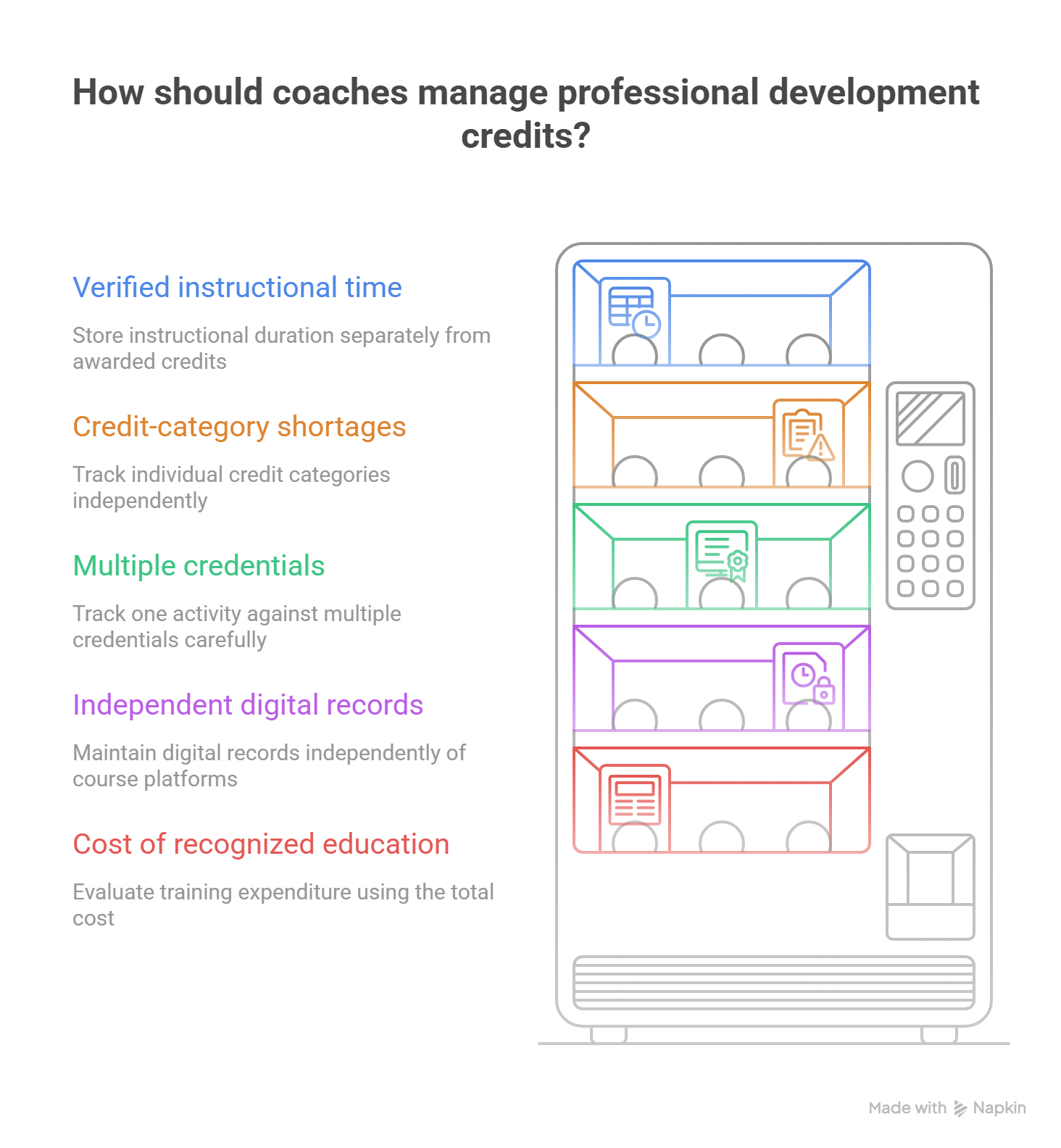
Store instructional duration separately from awarded credits.
For an activity measured in clock hours, a spreadsheet can convert eligible instructional minutes into decimal hours.
If cell F2 contains instructional minutes, use:
=F2/60
A 90-minute activity produces 1.5 instructional hours. A 45-minute activity produces 0.75 instructional hours.
Credentialing organizations may impose different calculations or award specific credits independently of the total advertised course duration. Use the officially recognized credit value when reporting activities.
Exclude breaks, networking periods, administrative introductions, and other unsupported components where the applicable credit rules require their exclusion.
Identify hidden credit-category shortages
Consider a PCC coach preparing for ICF credential renewal with:
22 Core Competency credits, including one Ethics credit.
20 Resource Development credits.
42 total credits.
Despite exceeding the overall 40-credit threshold, the coach still requires two qualifying Core Competency credits specifically in Coaching Ethics.
Completing those two Ethics credits would satisfy both the Core Competency and Ethics shortages, assuming all other requirements are met.
This example illustrates the importance of tracking individual credit categories independently.
Relevant education in coaching ethics, confidentiality, duty of care, and professional boundaries should receive particular attention when addressing ethics-related learning gaps.
Track one activity against multiple credentials carefully
Suppose a coach holds both an ICF PCC credential and the NBC-HWC certification.
A six-hour motivational interviewing course may satisfy both organizations' educational requirements when it has appropriate recognition under each system.
Create one master activity record with separate fields for:
ICF eligibility and credit classification.
NBHWC eligibility and approved credit value.
Relevant completion dates and renewal cycles.
Supporting documentation required by each organization.
Submission status for each credential.
This prevents duplicate claims within the same renewal calculation while allowing legitimate recognition across different credentials where permitted.
Understanding ICF versus NBHWC requirements becomes especially important for professionals expanding into corporate health coaching and specialized health coaching careers.
Maintain digital records independently of course platforms
Learning platforms may discontinue courses, restrict access after subscriptions expire, or change certificate-download procedures.
Download your supporting evidence immediately after completion. Maintain a separate, appropriately secured archive containing original certificates and related documentation.
A practical system combines:
A master CPD spreadsheet or dedicated tracking application.
Secure document storage.
Multifactor authentication.
Regular backups.
Restricted access permissions.
A renewal calendar.
Periodic testing of document accessibility.
Practices using AI and digital coaching tools should exclude confidential client information from inappropriate automated processing.
Administrative automation can support reminders, document organization, and credit tracking while leaving eligibility decisions subject to professional review.
Calculate the true cost of recognized education
Evaluate training expenditure using the total cost of obtaining qualifying credits.
For example, an educational program costing $300 and awarding 12 recognized credits has a direct cost of $25 per credit.
Another course costing $180 may appear more affordable. If only four credits qualify toward your remaining renewal requirements, its effective cost becomes $45 per usable credit.
Consider educational quality, relevance, and professional development value alongside this calculation.
Coaches assessing the return on coaching education or developing sustainable coaching business revenue models can use this method to allocate training budgets strategically.
5. Preparing an Audit-Ready CPD Portfolio and Recovering Missing Documentation
A professional development audit can expose weaknesses that remain invisible in a simple credit tracker. Unsupported claims, missing certificates, ambiguous instructional dates, and incorrectly classified activities may require additional verification.
Maintaining an audit-ready portfolio throughout the renewal cycle reduces reliance on historical reconstruction and protects professional credibility.
This process reflects the principles of professional accountability, ethical conduct, reflective supervision, and accurate qualification representation.
Conduct a structured pre-renewal audit
Review every activity against five verification criteria.
Identity: Does the supporting evidence identify the professional claiming the education?
Completion: Does it establish successful participation or completion?
Duration: Does it identify the instructional hours or awarded credits?
Recognition: Does the activity satisfy the credentialing organization's requirements?
Timing: Was the activity completed within the applicable renewal period?
Assign an exception status to any record with unresolved issues.
For example, a certificate containing your name, provider, and course title but omitting instructional hours may require supplementary provider confirmation before the credits can be substantiated.
Professionals studying certification program quality should examine documentation quality alongside curriculum quality and provider credibility.
Recover missing certificates through structured provider requests
When an educational provider remains operational, request a replacement certificate or formal completion confirmation.
Include the following information:
Your name at the time of enrollment.
Course title and approximate completion date.
Enrollment or registration identification number.
Available payment or attendance references.
Required educational hours or credit category.
Specific certification body for which documentation is needed.
A practical provider request could read:
Subject: Request for Replacement CPD Completion Documentation
I completed your professional development course on the date indicated below and am currently preparing my coaching credential renewal. Please provide a replacement completion certificate or formal confirmation identifying my name, course title, completion date, instructional duration, and applicable continuing education credit classification.
Thank you for your assistance in verifying my professional development records.
Retain the provider's response and any supplementary evidence with the original activity record.
Correct historical documentation without compromising integrity
Coaches may discover that previous professional development records contain estimated hours, incorrect categories, or incomplete educational details.
Reconstruct historical entries using original records and document the basis of every correction.
A correction history should identify the original entry, revised information, amendment date, supporting evidence, and reason for the change.
When a provider has permanently closed or supporting evidence remains unavailable, consult the credentialing organization about acceptable alternatives. Maintain sufficient additional verified education to reduce reliance on disputed activities.
This approach reinforces ethical professional practice and responsible professional conduct management.
Implement a 90-day CPD certification readiness plan
Days 1–15: Inventory existing professional development
Identify completed courses, webinars, mentor coaching sessions, supervision activities, and other potentially eligible education. Locate all available supporting records.
Days 16–30: Verify credit recognition
Confirm provider approvals, credit classifications, completion dates, and permitted learning activities. Identify unsupported claims and educational shortages.
Days 31–45: Recover missing evidence
Request replacement certificates, transcripts, curriculum details, and appropriate professional confirmations.
Days 46–60: Address remaining competency gaps
Complete suitable education aligned with actual renewal deficiencies. Prioritize recognized training in areas such as professional ethics, coaching agreements, and inclusive coaching practices.
Days 61–75: Reconcile all documentation
Verify activity totals, category allocations, evidence links, completion dates, and official tracker entries.
Days 76–90: Finalize renewal preparation
Prepare the applicable submission, verify outstanding administrative requirements, and securely preserve the final evidence portfolio.
Activities requiring a minimum duration, particularly certain mentor coaching arrangements, should begin earlier when necessary.
Build an annual professional development strategy
A three-year renewal cycle becomes easier to manage when education is distributed throughout the period.
For ICF renewal, an illustrative annual target could involve 14 recognized CCE credits in year one, 14 in year two, and 12 in year three. Track ethics and mentor coaching requirements independently.
For NBHWC recertification, completing 12 eligible CE credits annually would distribute the 36-credit requirement evenly.
Add a modest buffer when appropriate to account for possible eligibility disputes or changes in professional plans.
The strongest annual development strategies address actual practice weaknesses. A coach struggling with client engagement might prioritize accountability coaching, client motivation management, or habit formation.
A professional experiencing difficulties with boundaries might concentrate on coaching versus therapy, professional scope, and coaching power dynamics.
Attaching documentation to established professional routines through habit stacking can transform CPD recordkeeping into a sustainable practice rather than a periodic administrative crisis.
6. Frequently Asked Questions About Effective Documentation for CPD Certification
-
Coaches should maintain completion certificates, education transcripts, provider confirmations, course syllabi, credit approval details, attendance records, and applicable assessment results.
Reflective learning summaries and professional development plans provide additional evidence of learning application. Mentor coaching and supervision activities may require practitioner information, engagement dates, and verified hours.
Supporting records should satisfy the relevant credentialing organization's requirements and follow appropriate confidentiality standards, professional ethics, and continuing professional development principles.
-
Retention requirements depend on the certification organization, applicable audit arrangements, professional responsibilities, and relevant legal obligations.
At minimum, retain supporting documentation throughout the applicable renewal cycle and any required subsequent verification period. Keeping previous renewal portfolios securely can provide valuable evidence of professional development history.
Coaches should establish a defined retention policy consistent with their professional duty of care, professional indemnity insurance, and information-management responsibilities.
-
These activities may qualify depending on the credentialing organization's recognition policies.
Online courses and webinars often require verified completion, recognized educational hours, and appropriate approval. Independent reading may qualify under certain professional development categories, subject to applicable restrictions.
For ICF renewal, non-accredited or self-paced education may require supplementary evidence of competency alignment and learning assessment to qualify under particular categories.
Before purchasing education, investigate training provider quality and verify the course's suitability for your professional credentialing pathway.
-
Contact the educational provider and request replacement documentation containing your name, course title, completion date, awarded credits, and applicable classification.
Where a replacement certificate is unavailable, investigate whether official transcripts, formal provider correspondence, or other evidence may satisfy the credentialing organization's requirements.
Maintain a documented history of reconstruction efforts and exclude unsupported claims from conservative renewal-readiness calculations.
Accurate professional qualification representation and consistent ethical accountability should guide every correction.
-
A single educational activity may contribute toward both credentials when it independently satisfies each organization's requirements.
Verify the recognized credit amount, category, applicable completion period, and approval conditions separately. Maintain distinct tracking fields for each professional credential.
Coaches pursuing multiple qualifications should understand ICF and NBHWC credential differences and evaluate their broader health coaching certification pathway before investing in continuing education.
-
Maintain a centralized learning register, assign unique activity identifiers, preserve original completion evidence, verify credit eligibility, and reconcile your records regularly.
Include reflective summaries demonstrating practical learning application where appropriate. Establish annual education targets and monitor category-specific shortages throughout the renewal cycle.
Combining SMART professional development goals, sustainable accountability systems, reflective coaching supervision, and continuous competency development creates a defensible documentation system that supports certification renewal and long-term professional excellence.
