
Online Continuing Professional Development (CPD) courses allow coaches to strengthen professional competencies, maintain credentials, develop specialist expertise, and respond to evolving client expectations. However, purchasing poorly structured courses can waste substantial time and money while leaving critical competency gaps unresolved. An effective approach to continuing professional development combines professional coaching ethics, practical behavior change strategies, and reflective coach supervision. This guide explains how coaches can evaluate online CPD providers, satisfy credential renewal requirements, maximize educational return on investment, and translate professional learning into measurable improvements in coaching practice.

1. Understanding Online CPD Courses and Their Importance for Professional Coaches
Continuing Professional Development encompasses structured educational activities that help practitioners maintain, refine, and expand their professional capabilities throughout their careers.
For coaches, effective CPD addresses weaknesses that initial certification training may leave unresolved. These can include managing emotionally complex conversations, facilitating behavioral change, handling ethical dilemmas, and establishing sustainable accountability systems.
Training in emotional agility, constructive feedback, coaching power dynamics, and cultural competence can address recurring difficulties that become apparent only after working with real clients.
Understanding CPD, CCE, and CE credits
Professional development terminology varies between credentialing organizations.
CPD — Continuing Professional Development: An umbrella term covering ongoing professional learning and competency development.
CCE — Continuing Coach Education: The terminology used by the International Coaching Federation (ICF) for qualifying educational activities.
CE — Continuing Education: The terminology used by the National Board for Health & Wellness Coaching (NBHWC) for recertification education.
A general CPD certificate does not automatically establish eligibility for ICF or NBHWC renewal. Coaches comparing ICF and NBHWC certification pathways should investigate the approval status of each course before making a purchase.
How different online learning formats support coaching development
Self-paced courses provide flexibility for professionals managing demanding schedules. They are particularly suitable for theoretical learning involving the ADKAR change model, positive psychology, or the Wheel of Life coaching tool.
Live workshops provide opportunities for discussion, supervised practice, peer feedback, and clarification of complex professional situations.
Hybrid courses combine asynchronous learning with interactive sessions. This format can be particularly valuable when developing communication skills, applying transactional analysis, and strengthening competency in emotional intelligence coaching.
Why professional development should address actual coaching weaknesses
A coach whose clients regularly abandon their commitments may need targeted education in accountability coaching, habit formation, and client expectation management.
A practitioner struggling with client disclosures may benefit more from professional development covering duty of care and referral procedures.
Identifying these weaknesses before purchasing training ensures that educational spending addresses operational challenges, protects client welfare, and contributes to professional growth.
| CPD Course Topic | Best Learning Format | Professional Challenge Addressed | Competency Developed | Suggested Application Target |
|---|---|---|---|---|
| Motivational interviewing | Live workshop and supervised practice | Client ambivalence toward change | Reflective listening and intrinsic motivation | Identify and respond to change talk accurately |
| Advanced active listening | Recorded demonstrations and live practice | Missing underlying client concerns | Meaning-focused listening | Improve accuracy of reflective summaries |
| Professional coaching ethics | Case-based self-paced course | Complex ethical dilemmas | Ethical decision-making | Resolve simulated confidentiality conflicts |
| Coaching agreements | Interactive workshop | Unclear client expectations | Contracting and boundary management | Revise client onboarding agreements |
| Behavior change psychology | Hybrid course | Repeated failure to implement goals | Behavioral barrier identification | Develop individualized behavioral experiments |
| Habit formation | Self-paced course with assignments | Inconsistent client routines | Habit design and maintenance | Build realistic environmental cues |
| Client accountability | Practical workshop | Low commitment completion | Collaborative accountability | Introduce client-owned tracking methods |
| Emotional intelligence | Live facilitated training | Relationship and communication difficulties | Emotional awareness and responsiveness | Recognize emotional patterns during sessions |
| Trauma-informed coaching awareness | Specialist-led interactive course | Managing sensitive client disclosures | Safety awareness and appropriate referral | Develop procedures for maintaining professional boundaries |
| Cultural competence | Discussion-based cohort | Cultural assumptions and communication barriers | Inclusive coaching practice | Adapt questioning to individual cultural contexts |
| Positive psychology coaching | Self-paced course with practical exercises | Excessive focus on client weaknesses | Strengths-based exploration | Incorporate strengths identification into sessions |
| Stress management coaching | Hybrid specialist course | Clients struggling with competing demands | Nonclinical stress-related behavior support | Help clients identify manageable coping routines |
| Burnout awareness | Expert-led webinar and case studies | Persistent professional exhaustion | Boundary awareness and contextual exploration | Recognize concerns requiring additional support |
| Executive coaching | Live case-based program | Complex organizational responsibilities | Leadership development | Support client-owned leadership objectives |
| Team coaching | Facilitated group practice | Collective performance challenges | Team dynamics and facilitation | Establish collaborative team agreements |
| Group coaching | Live online cohort | Uneven participation among clients | Group facilitation and inclusion | Improve equitable participation |
| Coaching supervision | Individual or group supervision | Recurring professional blind spots | Reflective and ethical practice | Develop strategies for complex cases |
| Mentor coaching | Individual and eligible group sessions | Observable competency weaknesses | Professional coaching performance | Demonstrate improvement against competency feedback |
| Digital coaching technology | Software demonstrations and workshops | Fragmented virtual service delivery | Digital practice management | Implement secure client workflows |
| Artificial intelligence ethics | Case-based online training | Privacy and automation risks | Responsible technology adoption | Establish an AI usage and consent policy |
| Health literacy | Self-paced educational course | Difficulty understanding general health information | Accessible information exchange | Support informed discussions within coaching scope |
| Lifestyle medicine foundations | Specialist-led online program | Limited knowledge of lifestyle-related health | Evidence-informed wellness education | Support appropriate client and clinician-defined goals |
| Sleep health coaching | Self-paced course and case exercises | Inconsistent sleep-related routines | Nonclinical behavioral support | Help clients develop sustainable sleep habits |
| Nutrition coaching boundaries | Expert-led ethics workshop | Requests for individualized dietary treatment | Scope awareness and referral | Create an appropriate nutrition referral process |
| Metabolic health foundations | Evidence-informed specialist course | Complex health-related client goals | Health behavior support | Improve collaboration with qualified healthcare professionals |
| Coaching through transitions | Case-based live training | Client uncertainty during major life changes | Adaptability and values exploration | Support realistic transition plans |
| Advanced goal setting | Interactive practical course | Vague or unrealistic client objectives | Collaborative goal development | Establish measurable client-defined milestones |
| Conflict management | Role-play workshop | Difficult professional conversations | Communication and perspective-taking | Rehearse respectful conversation strategies |
| Coaching documentation | Template-based online course | Incomplete or inconsistent client records | Professional record management | Standardize secure session documentation |
| Confidentiality and data protection | Scenario-based compliance course | Inappropriate information sharing | Privacy and ethical judgment | Review data retention and access procedures |
| Outcome measurement | Applied workshop | Difficulty demonstrating coaching progress | Evaluation and performance measurement | Establish client-specific baseline indicators |
| Coaching business development | Project-based online course | Unpredictable client acquisition | Business strategy and positioning | Develop a clearly defined service offer |
| Discovery call techniques | Live role-play training | Low conversion of qualified prospects | Ethical sales communication | Improve discovery call qualification |
| Micro-coaching | Short-session practice workshop | Limited client availability | Focused questioning and session structure | Deliver focused sessions with defined outcomes |
| Evidence-based coaching research | Academic-style online course | Reliance on unsupported coaching claims | Critical appraisal and research literacy | Evaluate evidence before adopting new methodologies |
2. How to Choose Accredited Online CPD Courses That Meet ICF and NBHWC Renewal Requirements
One of the most financially damaging CPD mistakes involves completing education that fails to satisfy the intended renewal requirement. A provider may advertise international accreditation, professional recognition, or certification without explaining which credentialing organization accepts its courses.
Professionals should apply the same scrutiny used when identifying health coaching certification program red flags, recognizing certification scams, and avoiding professional misrepresentation.
Understand ICF continuing education requirements
ICF requires ACC, PCC, and MCC credential holders to complete 40 CCE credits during each three-year renewal cycle.
The standard allocation includes:
At least 24 Core Competency credits.
Three coaching ethics credits within those 24 credits.
Sixteen remaining credits in Core Competencies or Resource Development.
Ten mandatory mentor coaching hours for ACC holders, included within the Core Competency requirement.
For an ACC coach, an online course bundle awarding 40 education credits may still leave the mentor coaching requirement outstanding.
Training related to the CLEAR coaching model, OSCAR coaching framework, T-GROW methodology, and SMART goals may support competency development when the educational activity meets ICF's applicable criteria.
Verify the specific credit classification rather than relying on the subject alone.
Understand NBHWC continuing education requirements
National Board Certified Health & Wellness Coaches must complete 36 qualifying continuing education hours every three years and satisfy applicable recertification and annual fee requirements.
NBHWC-approved education can include training in professional communication, behavioral science, wellness knowledge, ethics, and other relevant areas of health coaching.
Courses covering holistic coaching, lifestyle medicine, metabolic health coaching, and preventive health coaching may provide relevant specialist knowledge.
Check the individual course against NBHWC's approved continuing education directory. Confirm the approval number, eligible hours, completion requirements, and applicable approval period.
Can one online CPD course count toward both ICF and NBHWC renewal?
A course may qualify under both organizations when it satisfies their respective requirements. Each organization evaluates educational eligibility independently.
For example, an appropriately approved motivational interviewing course could contribute toward both credentials, provided the coach meets the relevant completion, documentation, and reporting requirements.
Dual-credentialed professionals should prioritize courses covering behavior change, emotional intelligence, and client-centered accountability when these subjects address overlapping developmental needs.
Verify accreditation before paying
Request the following information from every CPD provider:
The organization approving or accrediting the specific course.
The exact course title and identification or approval number.
The number and classification of eligible credits.
The provider's current approval status.
Required assessments, assignments, or attendance.
Whether asynchronous learning qualifies.
A sample completion certificate.
Refund policies and certificate issuance fees.
Verify the information independently through the appropriate credentialing organization.
Coaches should also understand how professional education influences credential credibility and distinguish supplementary training from the requirements for obtaining an entirely new health coaching qualification.
Recognize documentation requirements for non-accredited education
ICF permits certain non-accredited educational activities to contribute toward credential renewal when the applicable documentation requirements are satisfied.
For self-paced learning claimed under Core Competencies or coaching ethics, ICF requires verification of learning and appropriate evidence of course content, including competency alignment and instructional hours.
Independent professional reading may qualify as Resource Development when properly documented.
Educational materials covering the immunity to change model, positive intelligence, or self-actualization coaching can provide meaningful professional insights even when their credit classification differs from the coach's initial expectations.
Keep the original curriculum, assessment results, completion certificate, and provider correspondence to support potential verification.
3. Best Practices for Evaluating Online CPD Course Quality Before Enrollment
Accreditation establishes an important educational eligibility criterion. Course selection also requires evaluating instructional quality, professional relevance, learning assessment, and opportunities for practical application.
Coaches investing in professional development should assess whether training strengthens their ability to create a safe coaching environment, navigate client expectations, and deliver effective constructive feedback.
Evaluate the instructor's qualifications and experience
Review whether the instructor has professional credentials, relevant experience, subject-specific expertise, and a demonstrated understanding of coaching boundaries.
A general life coaching qualification may provide insufficient preparation for teaching advanced clinical topics, trauma-related concerns, or therapeutic nutrition.
Coaches considering specialist training should understand the differences between therapists and life coaches, health coaches and dietitians, and the professional limitations surrounding nutrition coaching.
Evaluate instructors according to the actual subject they teach rather than the number of credentials displayed in their biographies.
Examine the quality of learning objectives
Effective learning objectives specify what participants should be able to demonstrate after completing a course.
A weak objective might promise that participants will understand client motivation.
A stronger objective would require participants to distinguish ambivalence from discord, identify different forms of change talk, and demonstrate appropriate reflective responses during simulated sessions.
Similar competency-based objectives should guide courses in accountability coaching, emotional agility, self-confidence coaching, and transformational coaching.
Clear objectives allow coaches to assess whether training produces transferable professional capabilities.
Apply a 100-point CPD course evaluation framework
Before purchasing expensive training, score the course using the following suggested framework:
Credential eligibility — 25 points: Verified approval, appropriate classification, and suitability for your renewal requirements.
Professional relevance — 20 points: Direct alignment with current competency weaknesses or specialist objectives.
Practical application — 20 points: Demonstrations, case studies, exercises, role-play, or supervised practice.
Instructor expertise — 15 points: Relevant qualifications, coaching experience, and subject knowledge.
Assessment quality — 10 points: Meaningful verification of learning and opportunities for feedback.
Financial accessibility — 5 points: Transparent pricing and reasonable total participation costs.
Documentation quality — 5 points: Appropriate completion records and accessible course materials.
A suggested purchasing benchmark is 80 points or above. For courses purchased specifically to satisfy renewal requirements, verified eligibility should operate as a mandatory prerequisite regardless of the total score.
Investigate the evidence behind coaching methodologies
Courses promising immediate transformation, guaranteed client results, or universal behavioral solutions deserve careful scrutiny.
Emerging subjects such as epigenetics in coaching, detoxification coaching, and food sensitivity coaching require particularly careful examination of scientific evidence and professional scope.
Evaluate whether instructors distinguish established findings, preliminary research, theoretical mechanisms, and unsupported commercial claims.
An evidence-informed course should openly discuss limitations, contraindications where relevant, referral responsibilities, and the circumstances under which particular interventions may be inappropriate.
Evaluate learning accessibility and technical requirements
Check whether a course offers captions, downloadable resources, accessible assessments, flexible deadlines, and adequate technical support.
International practitioners should also examine time-zone compatibility, language requirements, payment restrictions, and access expiration dates.
Coaches increasingly relying on digital coaching technology should prioritize educational providers that demonstrate responsible information management and clearly explain recording practices, platform limitations, and learner privacy.
4. How to Maximize the Return on Investment From Online CPD Courses
Professional development generates value through improved competency, reduced professional risk, stronger service delivery, and access to suitable career opportunities.
Coaches assessing health coaching income potential, life coaching revenue models, and coaching niche profitability should evaluate educational spending against specific professional objectives.
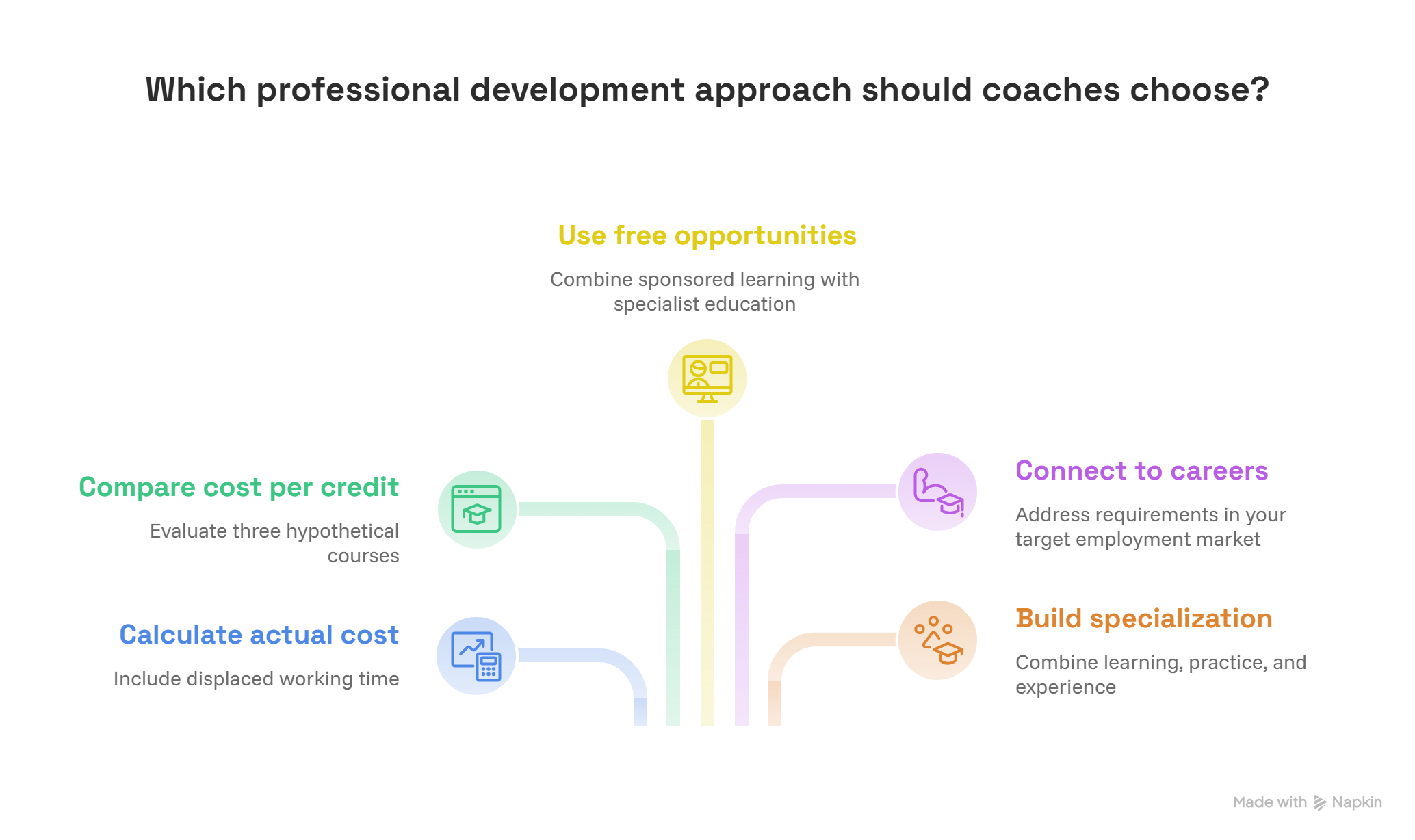
Calculate the actual cost of professional development
Consider an illustrative online coaching course costing $400 and requiring 20 hours of participation.
Additional expenses might include:
Course enrollment: $400.
Supplementary learning materials: $50.
Certificate or assessment fees: $25.
Twenty hours of potentially displaced paid work valued at $50 per hour: $1,000.
The total estimated economic cost would be $1,475, including the value assigned to displaced working time.
Actual opportunity costs depend on whether the course replaces paid appointments or uses otherwise available time.
Suppose the training enables the coach to deliver a higher-value service and generate an additional $50 in contribution margin per applicable appointment. Approximately 30 such appointments would recover the illustrative economic cost.
Practitioners evaluating health coaching pricing or life coaching package rates should establish realistic financial assumptions before expecting training to generate additional revenue.
Compare cost per qualifying education credit
Consider three hypothetical courses:
Course A costs $120 and awards six eligible credits: $20 per credit.
Course B costs $300 and awards 20 eligible credits: $15 per credit.
Course C costs $80 and awards four eligible credits: $20 per credit.
Course B provides the lowest cost per credit. Its professional relevance, instructor quality, assessment methods, and credit classification still require evaluation.
Purchasing business development training while lacking mandatory ethics credits can increase renewal expenses unnecessarily.
Use free and low-cost CPD opportunities strategically
ICF provides a complimentary online ethics course that awards three ethics credits toward credential renewal.
Active NBC-HWCs can also access complimentary NBHWC-sponsored continuing education events and on-demand learning opportunities. Under current rules, up to 18 credits from these sponsored events may contribute toward the 36-hour recertification requirement per three-year cycle.
Combining these opportunities with carefully selected specialist education can reduce expenditure.
Coaches developing expertise in habit stacking, self-care coaching, and preventive health should investigate relevant approved webinars before purchasing extensive specialist packages.
Connect professional development to career opportunities
Choose training that addresses identifiable requirements within your target employment market.
Coaches pursuing corporate health coaching roles may benefit from education in organizational communication, group facilitation, confidentiality, and outcome reporting.
Professionals targeting remote health coaching jobs may prioritize virtual service delivery, digital communication, motivational interviewing, and multidisciplinary collaboration.
Independent practitioners building an online coaching business may need training addressing client acquisition, ethical marketing, retention, and service design.
Review actual job descriptions and client requirements before committing to specialist education. A course addressing a documented employment requirement provides a clearer investment rationale than training purchased solely because its subject appears commercially popular.
Distinguish genuine specialization from certificate accumulation
Completing multiple short courses can broaden knowledge while leaving practitioners with limited depth in any particular area.
A stronger development strategy might combine foundational learning, advanced instruction, supervised practice, and documented professional experience within one specialization.
For instance, coaches pursuing leadership coaching could combine training in conscious leadership, public speaking coaching, and emotional intelligence.
Professionals should represent their training accurately. Supplementary CPD education cannot independently confer regulated clinical qualifications or establish authorization to deliver services beyond an existing professional scope.
5. Building a Sustainable CPD Learning Plan and Applying Knowledge to Real Coaching Sessions
A structured professional development plan connects learning activities with measurable improvements in professional performance.
Without an implementation system, coaches may accumulate certificates while continuing to experience familiar problems with client accountability, behavioral transformation, and client motivation.
Step 1: Conduct a professional competency audit
Review recent coaching experiences and identify situations where additional knowledge or skills could improve service delivery.
Ask yourself:
Which client challenges repeatedly leave me uncertain?
Where do my coaching conversations lose direction?
Which professional boundaries require greater clarity?
What feedback have clients, mentors, or supervisors provided?
Which skills are required for my intended career progression?
Where do I rely heavily on personal assumptions?
A coach frequently struggling with clients who report inconsistent routines could prioritize habit formation, habit stacking, and motivational interviewing.
A practitioner encountering difficult emotional disclosures may require development in emotional crisis support and mental health coaching boundaries.
Step 2: Create a three-year professional development schedule
A manageable ICF renewal plan for a PCC or MCC coach could distribute 40 credits across three years.
Year 1 — Foundational refinement
Complete three ethics credits, seven additional Core Competency credits, and three Resource Development credits.
Total: 13 credits.
Focus on professional ethics, informed consent, and coaching agreements.
Year 2 — Applied competency development
Complete eight Core Competency credits and five Resource Development credits.
Total accumulated credits: 26.
Use this period to strengthen emotional intelligence, coaching feedback techniques, and advanced questioning.
Year 3 — Specialization and consolidation
Complete six Core Competency credits and eight Resource Development credits.
Final total: 40 credits, including 24 Core Competency credits and 16 Resource Development credits.
ACC holders should incorporate their ten mandatory mentor coaching hours within the Core Competency allocation while meeting the applicable mentoring duration and provider eligibility requirements.
NBC-HWCs could distribute their 36 qualifying CE hours across three years, targeting 12 hours annually.
Step 3: Apply the 30-day learning-to-practice framework
After completing an online CPD course, establish a structured implementation period.
Days 1–7: Extract actionable knowledge
Identify two or three techniques relevant to your practice. Summarize their purpose, appropriate applications, limitations, and required professional safeguards.
Days 8–14: Rehearse and receive feedback
Practice through peer coaching, simulated scenarios, or qualified supervision. Examine whether your application reflects the underlying methodology.
Days 15–21: Implement with appropriate clients
Introduce the selected techniques collaboratively. Adapt their application to individual circumstances and professional boundaries.
Days 22–30: Evaluate and refine
Review client feedback, your own observations, and competency assessments. Identify circumstances where the technique was effective, ineffective, or required modification.
This process supports the practical integration of the CLEAR model, OSCAR framework, SMART goals, and other structured coaching methodologies.
Step 4: Measure professional improvement
Useful indicators of CPD effectiveness include:
Client commitment completion: The proportion of agreed actions completed.
Coaching competency improvement: Changes identified through observed practice and mentor feedback.
Goal clarity: The consistency with which sessions conclude with client-defined objectives.
Client-reported usefulness: Feedback regarding session relevance and practical application.
Referral appropriateness: Recognition of concerns requiring other qualified professionals.
Documentation quality: Accuracy and consistency of professional records.
Client independence: The ability to manage recurring challenges without excessive reliance on coaching.
Coaches using micro-coaching techniques can additionally examine whether shorter interventions support meaningful behavioral implementation.
Use baseline measurements and follow-up assessments to evaluate changes while recognizing that client outcomes are influenced by numerous factors beyond professional training.
Step 5: Establish an audit-ready CPD documentation system
Maintain a centralized professional development archive containing:
Course title and provider.
Completion date.
Approval or accreditation number.
Total education hours.
Eligible credit classifications.
Completion certificate or transcript.
Assessment results.
Relevant curriculum documentation.
Reflective learning notes.
Evidence of professional application.
Credential renewal deadline.
For ICF renewal, supporting documentation may be requested through random audits. ICF recommends retaining relevant records for at least six months following renewal submission.
Coaches should protect confidential client information when using recordings, case studies, or session documentation for learning purposes. Appropriate informed consent, professional confidentiality agreements, and duty of care remain applicable throughout professional development.
Step 6: Review professional development priorities quarterly
Client populations, technology, professional standards, and business objectives can change during a three-year credential cycle.
Review your education priorities every three months. Evaluate progress against existing learning objectives and identify emerging competency gaps.
For example, increasing adoption of AI health coaching tools may introduce new training needs involving privacy, information security, professional accountability, and responsible automation.
Practitioners expanding into specialized services should also review their professional indemnity insurance and ensure that new activities remain within their qualifications and coverage arrangements.
A quarterly review ensures that educational investment remains relevant to current professional responsibilities and long-term development goals.
6. Frequently Asked Questions About Online CPD Courses for Coaches
-
Online courses can contribute toward credential renewal when they satisfy the respective organization's eligibility, educational, and documentation requirements.
ICF requires 40 CCE credits every three years, including at least 24 Core Competency credits and three ethics credits. ACC coaches must additionally satisfy mandatory mentor coaching requirements within their credit allocation.
NBHWC requires 36 qualifying CE hours every three years.
Professionals comparing ICF and NBHWC credentials should independently verify course eligibility for each credential. A certificate labeled CPD alone provides insufficient evidence of acceptance.
-
Self-paced courses are particularly suitable for theoretical learning, structured reading, methodological knowledge, and flexible revision. Live workshops provide opportunities for observed practice, immediate feedback, and interactive exploration of difficult scenarios.
For communication-intensive competencies such as emotional intelligence coaching and constructive feedback, combining self-paced study with practical exercises and qualified feedback may provide a stronger learning experience.
Effectiveness depends on instructional quality, assessment methods, opportunities for practice, and the learner's ability to apply the material.
-
ICF offers a complimentary online ethics course that satisfies its three-credit ethics requirement.
Additional qualifying opportunities may be available through professional associations, chapter events, educational webinars, and approved training providers.
Active NBC-HWCs can access complimentary sponsored continuing education events and on-demand courses, subject to the applicable 18-credit limit per three-year cycle for sponsored education.
Before enrolling, confirm the course's approval status and documentation requirements. Free educational resources can strengthen professional development, although credential-specific credit acceptance requires separate verification.
-
A practical illustrative education budget could range from $200 to $1,000 annually, depending on mandatory requirements, access to free education, specialist training objectives, employer reimbursement, and mentoring expenses.
Advanced qualifications or extensive supervised training may require significantly larger investments.
Coaches should compare expenditure against their coaching business revenue, current service pricing, and outstanding renewal requirements.
This range represents a suggested planning estimate rather than a verified industry average.
-
Relevant CPD can strengthen professional credibility, improve service quality, expand appropriate specialist knowledge, and help coaches meet employer or organizational contracting requirements.
Commercial results depend on how practitioners communicate and apply their expertise.
Coaches experiencing difficulties with client acquisition should assess whether their challenges involve service quality, unclear positioning, insufficient visibility, or weak discovery call conversion.
Select professional development according to the specific business or competency problem. Additional certificates alone cannot guarantee client acquisition or higher earnings.
-
Begin with a competency audit, identify a clearly defined learning objective, select relevant education, and establish a structured implementation period.
Practice new techniques through simulated coaching, peer feedback, and appropriate professional supervision. Apply them collaboratively with clients while maintaining a clearly defined scope of practice.
Measure professional improvements using observed competency development, client-reported usefulness, behavioral implementation, ethical decision-making, and reflective practice.
The greatest long-term value of online CPD comes from developing professional capabilities that improve the quality, safety, accessibility, and sustainability of every coaching relationship.
