
Preparing for the National Board for Health and Wellness Coaching (NBHWC) examination can trigger persistent worry, concentration difficulties, sleep disturbances, and uncertainty about professional readiness. Effective anxiety management combines structured preparation with emotional agility, sustainable habit formation, practical stress management strategies, and deliberate self-confidence development. Candidates who develop these capabilities can improve their ability to retrieve information, interpret complex scenarios, and make informed decisions under examination pressure. This guide provides evidence-informed techniques, realistic examination simulations, targeted revision methods, and a comprehensive preparation framework designed to help aspiring NBC-HWCs approach certification with greater confidence and psychological resilience.

1. Understanding NBHWC Exam Anxiety and Its Impact on Performance
Examination anxiety involves cognitive, emotional, physiological, and behavioral responses associated with concerns about academic or professional evaluation. For NBHWC candidates, these concerns can become particularly intense because certification represents a considerable investment in education, supervised practice, examination fees, and future career opportunities.
Candidates pursuing health coaching employment, transitioning toward corporate wellness careers, competing for remote coaching positions, or evaluating the long-term value of NBHWC certification may attach substantial financial and professional significance to their examination results.
Recognizing the Four Dimensions of Examination Anxiety
Understanding how anxiety manifests helps candidates choose interventions that address their specific difficulties.
Cognitive anxiety: Persistent thoughts about failure, difficulty recalling information, excessive answer reconsideration, and reduced concentration.
Physiological anxiety: Increased heart rate, sweating, muscular tension, nausea, or uncomfortable breathing.
Emotional anxiety: Feelings of dread, frustration, helplessness, embarrassment, or fear of professional inadequacy.
Behavioral anxiety: Avoiding mock examinations, procrastinating, repeatedly reviewing familiar material, or sacrificing recovery time for excessive studying.
Candidates experiencing these patterns can draw upon emotional intelligence development, self-care coaching principles, positive intelligence practices, and evidence-informed behavioral transformation strategies.
How Anxiety Interferes With Knowledge Retrieval
Excessive worry can compete with the attention and working memory required to interpret examination questions. Candidates may understand a concept during ordinary revision but struggle to retrieve or apply that knowledge under timed conditions.
For example, a candidate familiar with professional coaching ethics, informed consent, coaching agreements, and scope of practice might misinterpret an ethical scenario because they become preoccupied with the consequences of selecting an incorrect answer.
Repeatedly practicing knowledge retrieval under gradually increasing time pressure helps candidates become familiar with these examination demands.
Distinguishing Knowledge Deficits From Anxiety-Related Performance Problems
Complete two comparable sets of unfamiliar practice questions under different conditions. Begin with an untimed assessment, followed by a timed assessment covering similar competencies.
Compare accuracy, confidence, completion time, and the types of mistakes made.
Strong untimed performance combined with significantly weaker timed performance may indicate difficulties involving pacing, concentration, or examination pressure. Poor performance across both conditions may indicate substantial knowledge gaps requiring additional revision. Differences in question difficulty can also influence the results.
Use SMART goal setting, accountability strategies, constructive feedback, and realistic expectation management to develop a preparation plan based on observed performance rather than perceived inadequacy.
What Research Reveals About Managing Exam Anxiety
A 2019 meta-analysis examining 44 randomized controlled trials involving 2,209 university students found that test-anxiety interventions reduced anxiety and improved academic performance compared with control conditions.
Behavioral interventions received particularly strong support, while cognitive-behavioral approaches and study-skills training also demonstrated promise. Limitations included publication bias, inconsistent reporting, and uncertainty surrounding some long-term outcomes.
Although these studies did not specifically examine NBHWC candidates, their findings support combining psychological preparation with deliberate examination practice and structured learning techniques.
2. Reducing Anxiety by Mastering the NBHWC Exam Structure and Content
Uncertainty about examination duration, question distribution, professional standards, and scoring can amplify anticipatory anxiety. Familiarity with these requirements allows candidates to direct preparation toward identifiable competencies and realistic performance objectives.
Understand the Five NBHWC Examination Content Areas
The official 2026 NBHWC examination framework distributes assessed content across five categories:
Coaching Presence, Relationships, and Sessions: 25%.
Theories, Models, and Approaches to Behavior Change: 15%.
Skills, Tools, and Strategies: 25%.
Ethics and Professional Practice: 15%.
Health and Wellness: 20%.
Candidates should use the official Content Outline to identify specific learning objectives within each category. Those trained before 2026 should also review the published crosswalk identifying competency updates.
Relevant supplementary preparation includes professional coaching relationships, health behavior change, culturally competent coaching, and professional ethics.
Allocate Study Time According to Examination Weight and Personal Weaknesses
Candidates with 40 available study hours could initially allocate 10 hours to coaching presence and relationships, six hours to behavioral theories, 10 hours to coaching skills, six hours to ethics, and eight hours to health and wellness.
Adjust this distribution following diagnostic assessments. A candidate repeatedly confusing nutrition coaching boundaries, professional duty of care, coaching scope restrictions, and professional misrepresentation should redirect additional preparation toward ethical judgment.
This allocation represents a personal study framework rather than an official NBHWC preparation requirement.
Become Familiar With Examination Timing and Section Restrictions
The 2026 NBHWC Board Exam is a computerized multiple-choice assessment administered through approved Prometric testing centers. Its published structure includes:
150 questions divided into two sections of 75 questions.
112 minutes of answering time per section.
A maximum 15-minute break between sections.
Separate tutorial and post-examination survey periods.
Approximately four and a half hours for the overall examination experience.
Once a section closes, candidates cannot return to its questions. Unused answering time from the first section does not transfer to the second.
These restrictions make realistic pacing practice essential. Candidates preparing for subsequent examination cycles should confirm the structure in the information packet applicable to their testing window.
Develop a Realistic Examination Pacing Strategy
Each 75-question section provides an average of approximately 90 seconds per question. Reserving 12 minutes for review leaves 100 minutes for the initial answering phase.
A possible pacing schedule is:
Question 15 completed within 20 minutes.
Question 30 completed within 40 minutes.
Question 45 completed within 60 minutes.
Question 60 completed within 80 minutes.
Question 75 completed within 100 minutes.
Final 12 minutes reserved for reviewing uncertain answers.
Practice these checkpoints using principles drawn from SMART goals, accountability coaching, micro-coaching, and client expectation management.
Flexible checkpoints protect against excessive time expenditure on difficult items while accommodating individual differences in question complexity.
Recognize the Limits of Practice Examination Scores
NBHWC offers 50-question practice assessments and a 150-question examination simulation. The full-length simulation combines questions from its three shorter assessments.
Candidates who have already completed those shorter versions will encounter familiar material in the full simulation. Improved scores may therefore reflect question familiarity alongside genuine learning.
Use independent, unfamiliar questions to supplement official practice materials. Review persistent mistakes through constructive feedback, professional development, and structured coach supervision where appropriate.
Official practice assessment results serve educational purposes and cannot reliably establish an individual candidate's probability of passing the board examination.
3. Evidence-Informed Psychological Techniques for Controlling NBHWC Exam Anxiety
Anxiety-management strategies become more useful when candidates identify the underlying pattern responsible for their distress. Different techniques address excessive worry, physical discomfort, avoidance, perfectionism, and impaired concentration.
Use Cognitive Reframing to Challenge Catastrophic Predictions
Catastrophic thinking occurs when candidates interpret an uncertain outcome as an overwhelming threat. A single difficult practice question may trigger predictions about examination failure, wasted educational expenses, or permanent career limitations.
Use a structured four-stage reflection:
Identify the specific feared outcome.
Examine the available evidence supporting that prediction.
Identify evidence that challenges its certainty.
Develop a balanced statement focused on manageable actions.
For example, replace “I failed this practice assessment, so I will never become certified” with “My assessment identified weaknesses in two competency areas, and I have a plan to improve them.”
This technique complements emotional agility, positive psychology, self-confidence coaching, and reflective practices associated with positive intelligence.
Practice Comfortable Breathing Before High-Pressure Study Sessions
Gentle breathing exercises may help reduce perceived physiological arousal and provide a structured method for redirecting attention.
Try inhaling comfortably for approximately four seconds and exhaling gently for approximately six seconds. Continue for one to two minutes if the rhythm feels natural. Avoid forced deep breaths or prolonged breath-holding, and discontinue the exercise if dizziness or discomfort develops.
Integrate this practice into an existing preparation routine using habit stacking, self-care strategies, stress management techniques, and holistic wellness principles.
During the actual examination, a shorter moment of comfortable breathing may help restore attention without consuming substantial answering time.
Reduce Examination Avoidance Through Graduated Practice
Avoiding timed assessments can provide immediate emotional relief while maintaining unfamiliarity with examination conditions. Candidates can gradually increase practice difficulty through manageable steps.
Begin with 10 untimed questions, progress to 15 timed questions, complete a 30-question mixed assessment, and eventually attempt an entire 75-question section.
Record anxiety before and after each activity alongside actual performance.
This approach draws upon behavioral transformation strategies, habit formation, the exploration of resistance through Immunity to Change, and structured ADKAR change principles.
Candidates experiencing severe distress during practice may benefit from professionally guided psychological interventions rather than increasing difficulty independently.
Manage Perfectionism and Compulsive Answer Reconsideration
Perfectionistic candidates may spend disproportionate time searching for absolute certainty. This becomes particularly problematic when examination questions contain several plausible responses.
Establish an evidence-based answer-changing rule: reconsider an answer when you identify a previously overlooked detail, recognize a specific competency mismatch, or recall relevant professional knowledge.
General discomfort with uncertainty provides limited justification for repeatedly changing responses.
For difficult coaching scenarios, review power dynamics, ethical decision-making, client autonomy, and professional coaching boundaries to strengthen the reasoning underlying your selections.
Establish a Personal Anxiety and Performance Tracker
After each practice session, record your anxiety level on a personal scale from zero to ten, percentage of correct answers, number of unanswered questions, and time spent reconsidering responses.
The relationship between these variables can reveal useful patterns.
A candidate might initially report anxiety at eight out of ten and achieve 62% accuracy. Following several structured practice sessions, anxiety may decline to five out of ten while accuracy improves to 78%.
These hypothetical figures illustrate progress tracking. Individual improvement varies, and successful preparation can occur even when some anxiety remains present.
The primary objective is developing reliable performance despite ordinary examination discomfort.
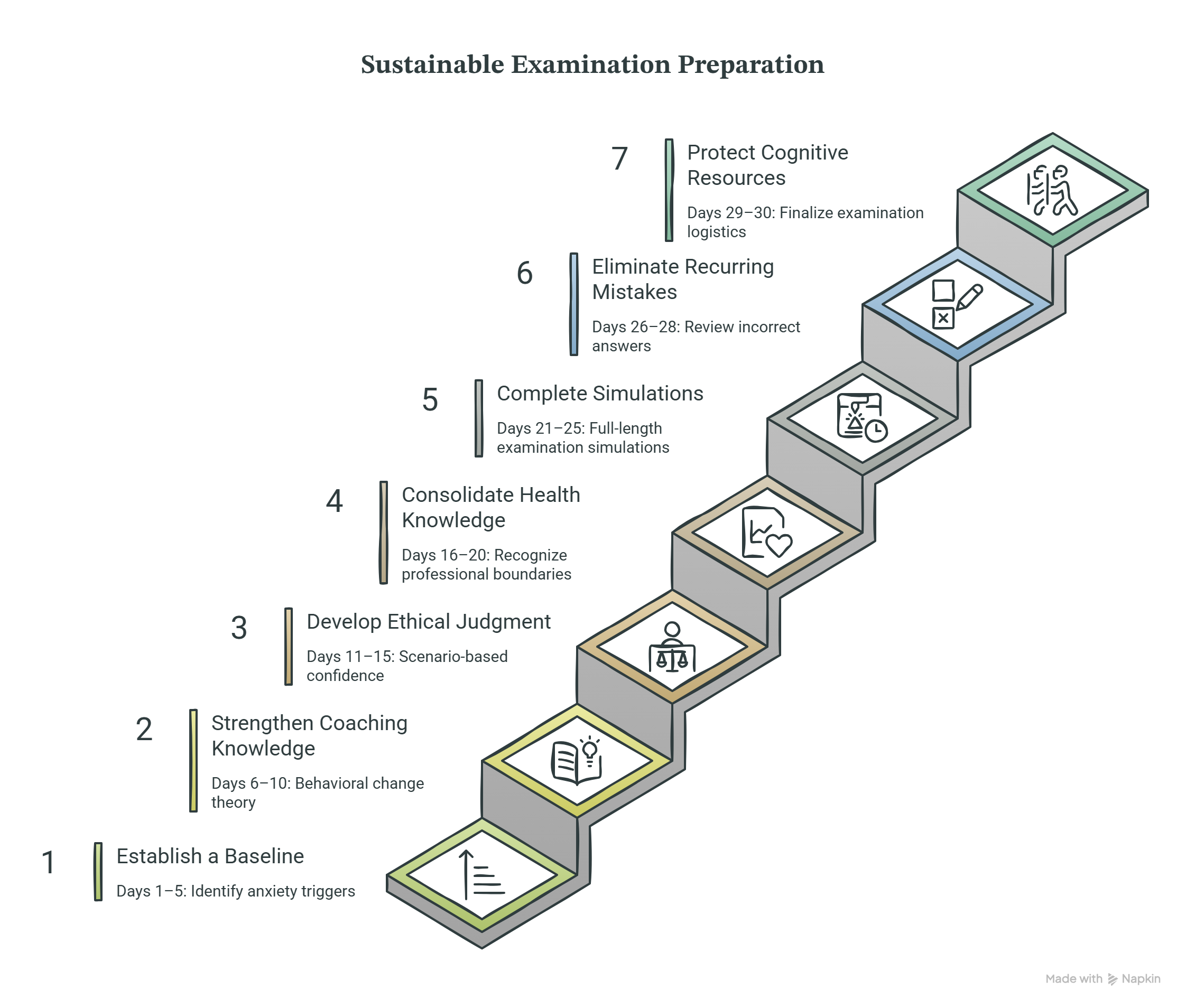
4. A 30-Day NBHWC Exam Preparation Plan That Minimizes Stress and Burnout
A sustainable preparation system combines deliberate knowledge development, realistic performance measurement, graduated examination practice, and protected recovery time.
The following framework can be adapted according to existing knowledge, available study hours, professional responsibilities, and examination readiness.
Days 1–5: Establish a Baseline and Identify Anxiety Triggers
Complete an unfamiliar diagnostic assessment covering all five examination content areas. Identify knowledge gaps and record the circumstances associated with increased anxiety.
Potential triggers include unfamiliar medical terminology, complicated ethical scenarios, declining time availability, or uncertainty about behavioral theories.
Use principles from the Wheel of Life assessment, holistic coaching, SMART goal development, and accountability coaching to establish priorities.
Preparation objective: Develop an individualized study schedule addressing specific weaknesses and observable anxiety triggers.
Days 6–10: Strengthen Behavioral Change Theory and Coaching Knowledge
Prioritize the official behavioral theories and coaching approaches listed in the Content Outline. Practice explaining how different frameworks address motivation, ambivalence, readiness, self-efficacy, and behavioral maintenance.
Supplement official study materials with relevant applications of health behavior change, habit stacking, positive psychology, and transformational coaching.
Focus on distinguishing similar concepts through examples. For instance, explain how a reflective statement differs from an exploratory question and identify circumstances where each response would be appropriate.
Preparation objective: Explain unfamiliar behavioral scenarios using the applicable theories without relying on memorized answer patterns.
Days 11–15: Develop Ethical Judgment and Scenario-Based Confidence
Study professional dilemmas involving confidentiality, client autonomy, conflicts of interest, professional referrals, and scope limitations.
Pay particular attention to informed consent, professional duty of care, coaching contract responsibilities, and professional misrepresentation.
For every original practice scenario, identify the central concern, relevant professional standard, appropriate coach response, and reasoning behind eliminating alternative options.
Preparation objective: Establish consistent ethical reasoning that reduces uncertainty during complex examination questions.
Days 16–20: Consolidate Health and Wellness Knowledge
Health-related examination questions can intimidate candidates who enter coaching without clinical qualifications. Review the health and wellness knowledge specified in the official outline while maintaining a clear distinction between understanding health concepts and practicing medicine.
Relevant supplementary topics include metabolic health, lifestyle medicine, preventive health coaching, and health coach versus dietitian responsibilities.
Create short retrieval exercises covering relevant terminology, general health concepts, and circumstances requiring referrals to qualified healthcare professionals.
Preparation objective: Demonstrate reliable foundational health knowledge and recognize appropriate professional boundaries.
Days 21–25: Complete Full-Length Examination Simulations
Schedule a realistic examination simulation under conditions resembling the actual testing environment.
Complete two 75-question sections, allowing 112 minutes for each and up to 15 minutes for the scheduled break. Avoid consulting notes or communicating with other people during the simulation.
Evaluate accuracy across both sections, time management, anxiety intensity, and changes in concentration.
If second-section performance declines considerably, investigate possible contributors such as fatigue, insufficient preparation, excessive initial pacing, or uncomfortable recovery routines.
Use self-care principles, stress management, burnout prevention, and constructive performance feedback to adjust subsequent practice.
Preparation objective: Complete the entire assessment with manageable pacing and relatively consistent concentration.
Days 26–28: Eliminate Recurring Mistakes and High-Confidence Errors
Review incorrect answers from previous assessments, prioritizing questions answered incorrectly despite strong confidence.
These mistakes may reveal established misconceptions, misunderstandings about professional standards, or excessive reliance on familiar coaching preferences.
Discuss persistent difficulties with qualified educators or through appropriate coach supervision. Consult trusted professional development resources and verify concepts against official NBHWC documentation.
Preparation objective: Reduce repeated mistakes and strengthen reasoning across previously challenging content areas.
Days 29–30: Protect Cognitive Resources and Finalize Examination Logistics
Reduce intensive new learning and concentrate on concise competency summaries, selected retrieval exercises, and established coping strategies.
Verify your scheduling permit, government-issued photo identification, testing-center location, appointment time, and applicable examination instructions.
Maintain familiar meals, adequate sleep, comfortable hydration, and manageable activity levels.
Apply habit formation strategies, emotional agility, client expectation management principles, and self-confidence development to manage the transition from preparation to examination performance.
Preparation objective: Arrive at the examination rested, familiar with testing procedures, and equipped with a practiced response to ordinary anxiety.
5. NBHWC Exam-Day Stress Management, Recovery Strategies and Professional Support
Examination-day performance depends on managing uncertainty, maintaining concentration, following testing requirements, and responding effectively to unexpected difficulties. A rehearsed operational plan can reduce unnecessary decision-making during stressful circumstances.
Establish a Predictable Pre-Examination Routine
The evening before testing, organize your identification, scheduling permit, clothing, transportation arrangements, and any approved personal items.
Avoid experimenting with unfamiliar supplements, sleep aids, energy drinks, or unusually large amounts of caffeine. Maintain established health routines wherever possible.
The morning routine should allow sufficient time for breakfast, transportation, and required testing-center check-in procedures.
This approach combines self-care coaching, preventive wellness, lifestyle medicine principles, and sustainable habit stacking.
Apply a 60-Second Recovery Protocol When Your Mind Goes Blank
An unexpected memory lapse can trigger escalating concern about subsequent questions. Establish a concise recovery process during practice so it becomes familiar before examination day.
First 10 seconds: Recognize the concentration difficulty and release unnecessary muscular tension.
Next 15 seconds: Breathe comfortably and redirect attention toward the question.
Next 20 seconds: Identify the central issue, relevant content area, and available answer choices.
Final 15 seconds: Select the strongest available answer or flag the item for later review within the same section.
This strategy draws upon emotional intelligence, emotional agility, positive intelligence techniques, and micro-coaching principles.
The suggested timing is flexible. Candidates should use the shortest effective reset and protect their remaining answering time.
Use a Structured Decision-Making Process for Challenging Scenarios
Consider an original practice question:
A client with a diagnosed metabolic condition asks their health coach to recommend specific changes to their prescribed medication because they are concerned about side effects.
The available responses are:
A: Recommend reducing the medication dosage temporarily.
B: Explore the client's concerns and encourage discussion with the prescribing healthcare professional.
C: Recommend replacing the medication with a nutritional supplement.
D: Ignore the concern and continue discussing exercise goals.
Correct answer: B.
This response recognizes the client's concerns, supports informed participation in their healthcare, and maintains the coach's professional boundaries.
Candidates can strengthen comparable reasoning through scope of practice, professional duty of care, metabolic health coaching, and health coaching without a clinical nutrition qualification.
Systematic reasoning reduces dependence on intuition when uncertainty increases.
Use the Scheduled Examination Break Strategically
The scheduled break between the examination sections provides an opportunity to recover attention and address ordinary physical needs.
Use the available time to visit the restroom, hydrate or eat if permitted in designated areas, relax muscular tension, and prepare mentally for the next section.
Avoid spending the break reconstructing previous questions. The first section will already be closed, and continued rumination can consume attention needed for subsequent items.
Under standard NBHWC testing rules, exceeding the permitted break can consume time from the second section. Emergency interruptions during an active testing section generally allow the examination clock to continue running.
Understand When to Request NBHWC Examination Accommodations
Candidates with documented disabilities affecting examination performance may qualify for reasonable testing accommodations under applicable NBHWC and NBME procedures.
Potential accommodations include extended testing time, enlarged examination content, and permission to use approved assistive devices.
Eligibility depends on documentation and individualized assessment. Accommodation requests must be submitted with the required supporting materials by the applicable application deadline.
Candidates should investigate these procedures early, particularly when anxiety-related conditions, attention difficulties, or other documented disabilities substantially affect functioning.
Understanding inclusive coaching principles, professional duty of care, psychological safety, and appropriate mental health referral boundaries can help candidates approach support requirements constructively.
Recognize When Examination Anxiety Requires Professional Treatment
Professional assessment becomes particularly important when anxiety causes recurrent panic attacks, persistent insomnia, substantial avoidance, severe distress, or significant interference with daily responsibilities.
Qualified mental health professionals can assess contributing factors and recommend individualized interventions, including cognitive-behavioral treatment when appropriate.
Candidates should distinguish general mental health coaching from clinical psychological treatment, understand appropriate responses to emotional crises, and recognize the limits established by professional scope of practice.
Seek immediate medical assistance for severe or unfamiliar physical symptoms, particularly significant breathing difficulty, fainting, or chest pain.
Manage Anxiety While Waiting for NBHWC Examination Results
NBHWC examination results are generally anticipated approximately eight weeks after the testing window closes, although delays can occur.
During this period, establish a limited schedule for checking official communications. Resume ordinary professional activities, maintain recovery routines, and avoid sharing or reconstructing confidential examination questions.
Candidates can use this period to explore health coaching career opportunities, investigate profitable coaching specializations, evaluate health coaching pricing strategies, and plan future continuing professional development.
Maintain accurate credential representation until certification has been officially awarded.
6. Frequently Asked Questions About NBHWC Exam Stress and Anxiety
-
Some anticipatory anxiety is common during high-stakes professional examinations. Candidates may experience worry, physical tension, sleep difficulties, and uncertainty about readiness. Structured preparation, graduated timed practice, emotional agility techniques, and realistic stress management strategies can help manage ordinary examination concerns. Severe, persistent, or disabling symptoms warrant assessment by a qualified mental health professional.
-
Develop reliable retrieval skills through active recall, spaced repetition, unfamiliar practice questions, and realistic timed assessments. If a memory lapse occurs, use a brief attention reset, identify the question's central issue, eliminate unsuitable options, and revisit the item later if necessary within the active section. Combining habit formation with self-confidence development can support more consistent preparation.
-
A practical preparation target might include several short mixed-question assessments, two or three timed 75-question sections, and at least one full-length simulation. Adjust this schedule according to your knowledge, endurance, available resources, and anxiety levels. Prioritize unfamiliar questions and meaningful error analysis. NBHWC practice scores cannot guarantee examination success, and repeated questions may produce artificially reassuring results.
-
Candidates with documented disabilities may qualify for testing accommodations, including extended time, following individualized review. An anxiety diagnosis alone does not automatically establish accommodation eligibility. Submit the required documentation before the applicable application deadline and follow NBHWC and NBME instructions. Consult an appropriately qualified healthcare professional for assessment and supporting documentation when necessary.
-
Candidates can apply for another examination attempt, subject to applicable eligibility, fees, and retake policies. Under the published 2026 rules, candidates who exhaust three unsuccessful or incomplete attempts must obtain additional qualifying training before becoming eligible to test again.
Use available performance feedback to distinguish knowledge gaps from pacing and anxiety-related difficulties. A remediation plan combining constructive feedback, accountability strategies, emotional agility, and professional psychological support when appropriate can strengthen subsequent preparation.
-
Readiness involves consistent performance on unfamiliar questions, accurate competency recognition, reliable ethical judgment, manageable examination pacing, and the ability to recover from unexpected difficulties. Evaluate progress across all five content areas and observe performance during full-length simulations.
Use SMART preparation objectives, professional development strategies, and realistic expectation management to establish individualized readiness criteria.
Effective NBHWC examination preparation builds the ability to apply professional knowledge under pressure while maintaining emotional flexibility, ethical judgment, and sustained concentration. Candidates who develop these capabilities establish valuable professional skills that extend beyond certification into the everyday responsibilities of effective health and wellness coaching.
