
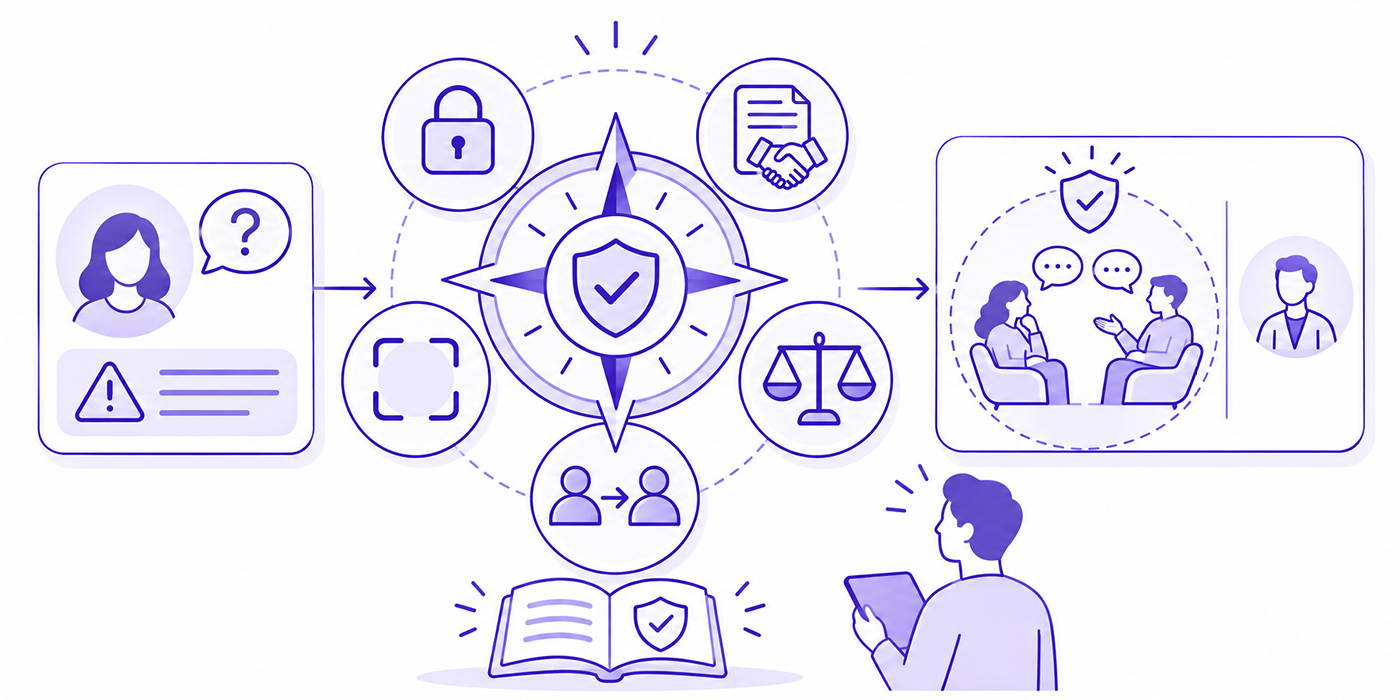
Ethical decision-making is a critical component of the National Board for Health & Wellness Coaching (NBHWC) examination, particularly when scenarios involve competing responsibilities, sensitive disclosures, medical boundaries, and client safety. Candidates must understand how professional standards influence real coaching decisions, including scope of practice, informed consent, duty of care, and professional conduct. With Ethics and Professional Practice accounting for 15% of the updated examination content outline, developing sound ethical judgment can strengthen examination readiness while preparing candidates to handle complex professional situations confidently and responsibly.
1. Understanding the NBHWC Ethics and Professional Practice Exam Requirements
Ethical examination questions can become particularly challenging when every available response appears compassionate or professionally reasonable. Candidates must determine which intervention respects the client's circumstances, preserves professional boundaries, addresses potential harm, and satisfies relevant ethical obligations.
Under the NBHWC examination content outline applicable from 2026 through 2030, Ethics and Professional Practice carries a 15% weighting. Ethical responsibilities also influence decisions across coaching relationships, communication, and health-related scenarios.
Candidates preparing for NBHWC certification should distinguish its professional standards from other credentialing systems, particularly when comparing ICF and NBHWC qualifications and evaluating coaching education quality.
The four areas of ethical competency assessed by NBHWC
The updated examination outline organizes Ethics and Professional Practice into four principal competency areas.
4.1. Ongoing professional development
Candidates should understand reflective practice, evidence evaluation, professional collaboration, personal wellbeing, and the importance of maintaining competence through continuing professional development and coach supervision.
4.2. Scope of practice
This area assesses understanding of professional limitations, appropriate information sharing, healthcare referrals, and the distinction between coaching and services requiring additional qualifications.
Studying health coaching versus dietetics and coaching versus psychotherapy helps candidates recognize these distinctions.
4.3. Code of Ethics
Preparation should address privacy, conflicts of interest, equitable treatment, professional boundaries, intellectual property, truthful credential representation, and technology-related responsibilities.
Particular attention should be given to cultural competence, coaching power dynamics, and professional misrepresentation.
4.4. Legal responsibilities
Candidates should recognize applicable privacy regulations, secure information-handling practices, documented permission for data collection, and legal reporting obligations.
Ethical principles that guide examination reasoning
Several foundational principles provide a useful analytical framework for interpreting ethical coaching scenarios:
Autonomy: Respect the client's authority over personal decisions.
Beneficence: Support actions that serve the client's wellbeing.
Nonmaleficence: Avoid interventions that introduce unnecessary harm.
Justice: Provide equitable and respectful professional treatment.
Fidelity: Honor agreements and professional commitments.
Veracity: Communicate honestly about qualifications, services, and limitations.
Confidentiality: Safeguard personal information within applicable ethical and legal requirements.
These principles complement client-centered health behavior change, collaborative accountability coaching, and the development of safe coaching environments.
The following 30-scenario ethical decision-making guide helps candidates translate abstract professional standards into practical examination reasoning.
| Ethical Scenario | Primary Concern | Appropriate Coaching Response | Response to Avoid | Exam Competency |
|---|---|---|---|---|
| Client asks whether to stop blood pressure medication | Medical scope of practice | Refer medication concerns to the prescribing clinician and explore barriers to following the treatment plan | Recommending medication discontinuation | 4.2 Scope of practice |
| Client requests interpretation of laboratory results | Medical data interpretation | Encourage consultation with a qualified healthcare professional and help prepare questions | Diagnosing a condition from laboratory values | 4.2 Scope of practice |
| Client requests a personalized meal plan | Nutrition practice boundaries | Refer to an appropriately qualified nutrition professional and support agreed behavioral goals | Prescribing individualized dietary requirements | 4.2 Scope of practice |
| Client requests supplement recommendations | Treatment and supplementation boundaries | Direct the client to a qualified healthcare professional | Recommending specific products or dosages | 4.2 Scope of practice |
| Client requests an individualized exercise prescription | Exercise instruction boundaries | Refer to an appropriately qualified exercise professional | Prescribing exercise intensity or rehabilitation routines | 4.2 Scope of practice |
| Client asks to process unresolved childhood trauma | Psychological treatment boundaries | Acknowledge the concern and facilitate referral to a qualified mental health professional | Attempting trauma-focused psychotherapy | 4.2 Scope of practice |
| Client communicates an immediate intention to harm themselves | Immediate safety and confidentiality limits | Activate emergency procedures and contact appropriate emergency support | Continuing routine motivational coaching | 4.2 Referral and 4.4 Legal |
| Client asks for general evidence-based sleep information | Appropriate educational support | Share credible general resources with permission and explore their relevance | Diagnosing a sleep disorder | 4.2 Information sharing |
| Coach holds an additional active clinical credential | Dual professional roles | Clarify and document each role and its boundaries before providing services | Silently switching between coaching and clinical treatment | 4.2 Professional boundaries |
| Employer requests employee coaching notes | Sponsor confidentiality | Review agreed disclosure permissions and share only authorized information | Assuming payment grants unrestricted access | 4.3 Privacy |
| Client's spouse requests progress information | Unauthorized disclosure | Protect client confidentiality and obtain specific authorization where appropriate | Sharing details because of the family relationship | 4.3 Privacy |
| Coach receives a legally valid disclosure order | Legal confidentiality exceptions | Verify the legal requirement and disclose information as required | Automatically refusing every legally required disclosure | 4.4 Legal |
| Coach receives commission from product sales | Financial conflict of interest | Disclose the financial relationship and maintain professional boundaries | Presenting financially motivated recommendations as impartial coaching | 4.3 Conflicts of interest |
| Coach receives payment for client referrals | Referral compensation | Disclose anticipated third-party compensation to relevant parties | Concealing referral incentives | 4.3 Conflicts of interest |
| Client declines to purchase additional services | Commercial pressure | Deliver the agreed coaching quality and quantity independently of additional purchases | Reducing existing support to pressure the client | 4.3 Professional conduct |
| Client wishes to terminate coaching | Autonomy and contractual rights | Respect the decision and follow agreed termination procedures | Using guilt or coercion to retain the client | 4.3 Professional boundaries |
| Coach develops romantic feelings toward a current client | Relationship boundaries | Maintain professional boundaries, seek consultation and arrange appropriate termination or referral if necessary | Pursuing a romantic relationship during coaching | 4.3 Professional boundaries |
| Client's cultural beliefs differ from the coach's | Cultural humility | Explore the client's perspective respectfully and examine personal assumptions | Imposing the coach's cultural preferences | 4.3 Diversity and respect |
| Client cannot afford a suggested wellness resource | Equity and accessibility | Explore affordable alternatives consistent with the client's priorities | Interpreting financial barriers as poor commitment | 4.3 Equity |
| Coach advertises guaranteed reversal of chronic disease | Misrepresentation and treatment claims | Describe coaching services and reasonably expected outcomes accurately | Making unsupported medical guarantees | 4.3 Credential representation |
| Graduate claims NBC-HWC status before passing the board exam | Credential misrepresentation | Describe completed training and actual credential status accurately | Advertising an unearned board certification | 4.3 Credential representation |
| Coach copies another professional's workbook | Intellectual property | Obtain required permission and provide appropriate attribution | Rebranding copyrighted material without authorization | 4.3 Attribution |
| Coach wants to upload client notes to generative AI | Client data protection | Use synthetic, non-client examples instead of actual client data | Entering client records into generative AI tools | 4.4 Data confidentiality |
| Coach introduces AI-assisted service delivery | Technology transparency | Disclose the technology and explain relevant privacy implications | Concealing the use of AI from clients | 4.3 Emerging technology |
| Coach wants to record a session | Informed consent | Explain recording purpose, access and retention, then obtain documented permission | Recording automatically without agreement | 4.4 Data confidentiality |
| Client records are stored on a shared unsecured computer | Information security | Move records to appropriately secured, access-controlled storage | Allowing unrestricted access to confidential information | 4.4 Data security |
| Confidential email is accidentally sent to the wrong person | Data incident management | Contain the incident and follow applicable notification and reporting requirements | Concealing the incident or assuming deletion resolves everything | 4.4 Legal |
| Coach experiences burnout affecting service quality | Professional fitness to practice | Seek support, assess capacity and adjust professional commitments when necessary | Continuing impaired practice without intervention | 4.1 Ongoing development |
| Coach encounters unsupported health claims online | Evidence-based information | Evaluate source credibility before sharing information with clients | Repeating claims based solely on popularity | 4.1 Evidence evaluation |
| Coach observes a colleague repeatedly violating professional boundaries | Professional accountability | Address the concern appropriately and refer unresolved issues to NBHWC | Ignoring misconduct to protect professional relationships | 4.3 Ethical accountability |
2. Mastering Scope of Practice and Referral Decisions for the NBHWC Exam
Candidates with backgrounds in nursing, nutrition, fitness, psychology, or other health professions may find scope-related questions particularly challenging because their existing professional instincts can influence their interpretation of coaching scenarios.
The NBHWC examination requires candidates to distinguish knowledge of health and wellness from authorization to deliver specialized services.
Understanding nutrition coaching boundaries, health coaching qualifications, and lifestyle medicine coaching provides useful context for recognizing these distinctions.
Differentiate education, coaching and clinical intervention
Imagine a client recently diagnosed with type 2 diabetes who feels overwhelmed by recommendations from their healthcare team.
A coach can explore the client's readiness to make changes, identify barriers to following professional recommendations, and help develop realistic behavioral commitments. Appropriate general educational resources may also support the client's understanding.
The coach crosses professional boundaries by independently interpreting glucose measurements, changing treatment recommendations, prescribing therapeutic diets, or suggesting medication adjustments.
Candidates studying metabolic health coaching, preventive health strategies, and sustainable habit stacking should practice separating behavioral support from individualized medical advice.
A useful distinction involves asking whether the proposed intervention requires specialized clinical judgment or simply helps the client implement an existing, professionally established recommendation.
Recognize when referral becomes the priority
Ethical referrals protect clients while allowing coaches to continue appropriate support when circumstances permit.
Consider three levels of referral urgency:
Routine referral: A client requests individualized nutrition guidance, exercise instruction, or medical interpretation. Arrange suitable professional support and continue coaching within established boundaries.
Timely clinical referral: A client describes persistent psychological distress, concerning symptoms, or difficulties that require assessment by a qualified healthcare professional.
Immediate emergency response: A client presents an imminent risk of serious harm or describes a potential medical emergency. Prioritize immediate safety and activate appropriate emergency procedures.
These distinctions are especially important when studying mental health coaching, emotional crisis support, and client anxiety and stress.
An examination response that demonstrates empathy can still be inadequate when immediate protective action is necessary.
Understand dual-credential responsibilities
A registered dietitian, licensed therapist, nurse, or other appropriately credentialed professional may also become an NBC-HWC.
Additional qualifications can authorize separate professional services within their respective legal and professional limits. Clear documentation and communication are essential when operating in multiple roles.
For example, a registered dietitian working as a health coach should explain when nutritional services fall under the dietetic role and how those services differ from coaching.
Reviewing coaching agreements, informed consent, professional indemnity insurance, and ethical representation helps candidates understand the responsibilities accompanying dual practice.
Avoid interpreting client permission as expanded professional authority
A client may explicitly ask their coach to recommend a supplement, interpret a laboratory result, or design a treatment plan. Their request does not expand the coach's professional scope.
A suitable response acknowledges the client's concern, explains the relevant limitation, and facilitates access to appropriate professional guidance.
This approach preserves trust while supporting the autonomy emphasized in holistic coaching, client-centered accountability, and transformational coaching.
3. Confidentiality, Informed Consent, HIPAA and Digital Ethics
Privacy questions become more complicated when multiple stakeholders participate in a coaching relationship. Employers, healthcare providers, family members, platform administrators, and financial sponsors may all request access to information.
Candidates must understand how professional confidentiality agreements, informed consent procedures, ethical professional standards, and duty of care interact in these circumstances.
Manage confidentiality when another organization pays for coaching
Consider an employer-sponsored wellness program in which a manager requests detailed information about an employee's personal health challenges.
The appropriate response depends on the reporting arrangements established in the coaching agreement, the employee's specific permissions, and applicable law.
An organization may receive attendance data or appropriately authorized progress information when the agreement permits disclosure. Access to sensitive session discussions requires separate justification.
Professionals pursuing corporate health coaching or remote health coaching employment should understand how institutional reporting expectations can create ethical pressure.
Strong professional reasoning protects confidentiality while honoring legitimate contractual responsibilities.
Understand when confidentiality may require an exception
Candidates should recognize circumstances involving immediate safety concerns, legally required reporting, and valid legal disclosure requirements.
A structured response involves establishing the relevant facts, identifying applicable obligations, consulting appropriate professionals when feasible, and documenting the action taken. Urgent protective action should proceed promptly whenever circumstances require it.
The applicable confidentiality limits should be explained during onboarding through informed consent and reinforced through the development of safe coaching relationships.
Avoid promising absolute confidentiality. Such guarantees can conflict with legal responsibilities and emergency safety procedures.
Understand HIPAA without overgeneralizing its application
The Health Insurance Portability and Accountability Act establishes federal privacy and security requirements for relevant healthcare information in the United States.
A coach working for a covered healthcare organization or performing qualifying services as a business associate may have specific HIPAA responsibilities. Independent coaching practices must assess their circumstances, contractual relationships, and other applicable privacy laws.
Candidates exploring health coaching insurance reimbursement and health coach employment opportunities should recognize how institutional settings influence information-handling obligations.
Regardless of HIPAA applicability, NBHWC ethical responsibilities require responsible protection of client information.
Prepare for artificial intelligence and digital privacy questions
Technology-related ethics deserves dedicated study under the updated examination outline.
One particularly important NBHWC competency, 4.4.1.5, directs coaches to keep client data out of generative AI use.
A coach may use synthetic scenarios to generate educational exercises or develop generic program materials. Actual client notes, recordings, health information, and personal disclosures should remain outside such workflows.
Coaches must also communicate relevant AI usage transparently when incorporating technology into service delivery.
Candidates examining AI health coaching, the digital transformation of coaching, and online coaching business systems should evaluate technology through privacy, transparency, security, and professional accountability.
Establish practical data-security safeguards
An ethical digital coaching practice should incorporate:
Documented authorization for collecting and retaining client information.
Restricted access to sensitive records.
Multifactor authentication on relevant accounts.
Secure storage and communication systems.
Defined retention and disposal procedures.
Appropriate incident-response arrangements.
Regular reviews of staff permissions and third-party integrations.
A platform's convenience provides limited justification when its information-handling practices expose clients to preventable risks.
These operational safeguards reinforce professional accountability and protect the client trust necessary for sustainable professional relationships.
4. Applying Ethical Decision-Making to Complex NBHWC Exam Scenarios
Memorizing ethical terminology provides a foundation for examination preparation. Complex questions require candidates to prioritize responsibilities when several interventions could benefit the client.
Effective reasoning combines emotional intelligence, awareness of professional power dynamics, cultural humility, and the reflective discipline developed through coach supervision.
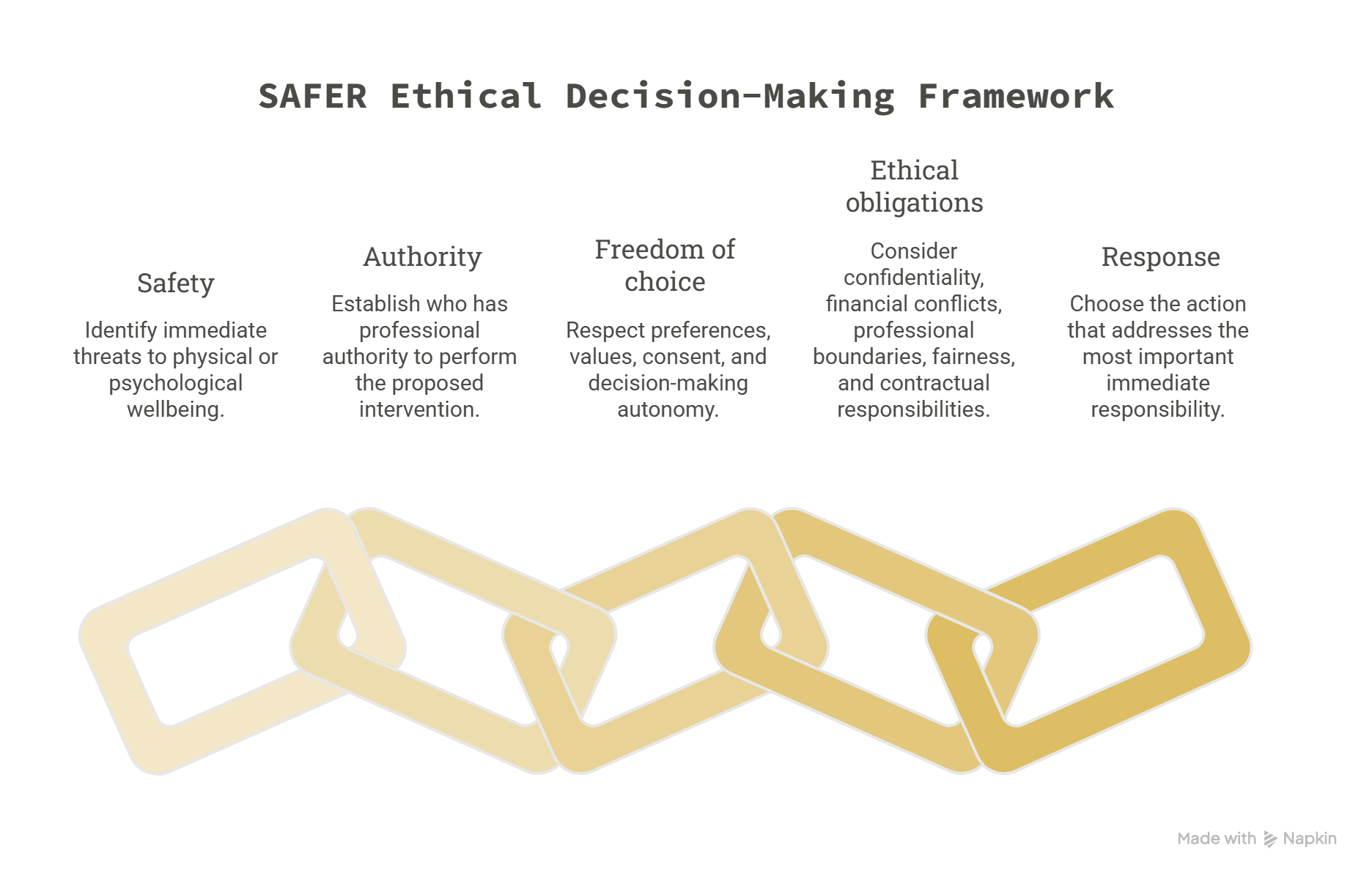
Use the SAFER ethical decision-making framework
The following independent study framework helps candidates evaluate unfamiliar ethical scenarios systematically.
S — Safety
Identify immediate threats to physical or psychological wellbeing. Determine whether urgent professional or emergency intervention is required.
A — Authority
Establish who has professional authority to perform the proposed intervention. Review the coach's qualifications, role, and scope.
F — Freedom of choice
Determine whether the response respects the client's preferences, values, consent, and decision-making autonomy.
E — Ethical obligations
Consider confidentiality, financial conflicts, professional boundaries, fairness, and contractual responsibilities.
R — Response
Choose the action that addresses the most important immediate responsibility while preserving professional integrity.
This framework is particularly useful for distinguishing between persuasive interventions and appropriate behavioral change support, collaborative SMART goal setting, and effective client expectation management.
Practice scenario 1: Financial conflicts and supplement sales
A health coach operates an affiliate business selling nutritional supplements. During a session, a client expresses frustration about persistent fatigue and asks whether a supplement could help.
Which response is most appropriate?
A. Recommend the highest-rated supplement available through the affiliate store.
B. Recommend a product after explaining the commission arrangement.
C. Explain the professional limitation, disclose the relevant financial relationship, and encourage consultation with an appropriately qualified healthcare professional.
D. Suggest that supplements are unnecessary for every individual.
Correct answer: C.
This scenario contains two independent concerns: the financial conflict and the request for individualized supplementation advice. Disclosing compensation addresses one concern, while professional referral addresses the other.
Candidates studying detoxification coaching, food sensitivity coaching, and nutrition coaching boundaries should practice recognizing scenarios where commercial incentives and healthcare limitations overlap.
Practice scenario 2: Employer pressure and client confidentiality
An employer sponsors a coaching program for employees. Following several sessions, a manager asks the coach to identify employees experiencing mental health difficulties.
Which response best satisfies professional responsibilities?
A. Provide the requested names because the employer finances the program.
B. Review the agreed reporting arrangements and explain that confidential information requires appropriate authorization or legal justification.
C. Provide information verbally to avoid creating written records.
D. End the entire employer-sponsored program immediately.
Correct answer: B.
The appropriate initial action protects sensitive information and establishes which reporting activities are authorized. Sponsorship arrangements should be carefully defined during contracting.
Reviewing corporate wellness coaching, conscious leadership, and career burnout coaching can help candidates understand why employees may feel particularly vulnerable in sponsored coaching relationships.
Practice scenario 3: Cultural assumptions and lifestyle recommendations
A client explains that shared family meals carry significant cultural importance. The coach believes the client's family traditions interfere with their wellness objectives.
Which response demonstrates appropriate professional judgment?
A. Encourage the client to avoid family meals until their health improves.
B. Explore how the client wishes to balance cultural values, family participation, and self-selected wellness goals.
C. Explain that cultural traditions should become secondary to health objectives.
D. Avoid discussing the subject because cultural differences are sensitive.
Correct answer: B.
This approach creates space for the client's values and circumstances while supporting practical exploration.
Principles from holistic coaching, emotional agility, life visioning, and positive psychology coaching can support respectful exploration of competing personal priorities.
Practice scenario 4: Coach wellbeing and professional competence
A coach experiencing severe personal stress notices declining concentration, missed commitments, and reduced patience during client sessions.
Which action is most appropriate?
A. Increase client numbers to improve professional motivation.
B. Explain personal problems in detail to every client.
C. Seek appropriate professional support, assess the impact on coaching quality, and modify commitments when necessary.
D. Continue existing arrangements until a client formally complains.
Correct answer: C.
Professional accountability requires recognizing circumstances that impair service quality and addressing them proactively.
Candidates should review self-care coaching, professional supervision, and constructive feedback to understand how reflective practice protects professional competence.
5. Creating a Targeted Study Strategy for the NBHWC Ethics Exam
Candidates preparing for board certification often invest considerable time in memorizing behavioral theories and health-related information while leaving ethical preparation until the final days. This creates avoidable weaknesses because ethical judgment influences the interpretation of numerous coaching scenarios.
A structured preparation system should incorporate SMART learning objectives, sustainable habit formation, professional continuing education, and measurable accountability practices.
Follow a 21-day ethics preparation plan
Days 1–4: Establish professional foundations
Read the current NBHWC Code of Ethics and identify responsibilities toward clients, sponsors, employers, colleagues, students, and the wider profession.
Create a one-page summary of ethical obligations organized by stakeholder. Include examples involving professional conduct, coaching contracts, and ethical credential representation.
Days 5–8: Strengthen scope-of-practice recognition
Complete original scenarios involving medical advice, supplements, exercise prescription, nutrition services, and mental health treatment.
Classify each situation as permissible coaching, appropriate educational support, specialist referral, or emergency intervention.
Review health coaching versus nutrition practice, psychotherapy boundaries, and professional scope limitations.
Days 9–12: Master confidentiality and legal responsibilities
Study sponsor disclosures, privacy exceptions, information security, consent documentation, and appropriate technology use.
Practice identifying what information can be shared, with whom, under which authorization, and for what purpose.
Use informed consent principles, digital coaching technology, and responsible AI integration as supplementary learning areas.
Days 13–16: Practice complex ethical judgment
Work through scenarios involving dual credentials, commercial incentives, cultural differences, impaired professional performance, and competing stakeholder interests.
Explain why each incorrect response introduces a professional problem. Discuss difficult cases with a qualified mentor or study partner through structured constructive feedback and reflective coaching supervision.
Days 17–21: Complete timed assessments
Use unfamiliar practice questions covering all four Ethics and Professional Practice competency areas.
Record accuracy, recurring misconceptions, confidence ratings, and time spent evaluating complex questions.
Employ stress-management strategies and positive intelligence techniques to strengthen concentration under examination conditions.
Maintain an ethical reasoning error register
For every incorrectly answered practice question, document:
Applicable NBHWC competency.
Primary ethical responsibility.
Your original answer.
Reasoning behind your selection.
Professional risk introduced by that response.
Appropriate corrective action.
Confidence level before answering.
Performance on a subsequent unfamiliar scenario.
Pay particular attention to high-confidence incorrect answers. They often expose misconceptions that ordinary revision fails to uncover.
For example, repeatedly choosing confidentiality over emergency intervention may indicate misunderstanding of duty of care. Selecting advice-based responses may indicate difficulty distinguishing professional coaching from consulting or clinical practice.
Candidates can use principles from the Immunity to Change model and emotional agility to investigate assumptions influencing their reasoning.
Develop measurable examination readiness indicators
Consider a candidate completing 100 independently developed ethics practice questions:
Ongoing development: 17 correct out of 20.
Scope of practice: 24 correct out of 30.
Code of Ethics: 25 correct out of 30.
Legal responsibilities: 12 correct out of 20.
The overall practice accuracy is 78%. Legal responsibilities present the clearest initial weakness at 60%, followed by scope of practice at 80%.
A targeted preparation cycle should concentrate on confidentiality exceptions, data security, technology requirements, and reporting obligations while maintaining stronger knowledge areas.
Candidates can set an independent preparation target of at least 85% accuracy across three fresh question sets, supported by defensible explanations of their answers. This is a recommended study benchmark rather than an official NBHWC passing threshold or prediction of examination performance.
Evaluate the reliability of your study materials
An older preparation course may focus heavily on confidentiality and traditional coaching boundaries while overlooking expanded technology-related competencies.
Candidates trained under previous content outlines should compare their education against the updated NBHWC outline and its crosswalk.
Check whether your resources adequately cover generative AI restrictions, cultural humility, emerging digital technologies, evidence evaluation, professional wellbeing, and legal responsibilities.
Understanding certification program red flags, coaching education misrepresentation, and the relationship between certification and professional credibility can prevent unnecessary expenditure on outdated or misleading preparation resources.
6. Frequently Asked Questions About Ethical Coaching Practices for the NBHWC Exam
-
Ethics and Professional Practice accounts for 15% of the NBHWC examination content outline applicable from 2026 through 2030. Preparation should cover ongoing professional development, professional scope, ethical conduct, and legal responsibilities.
Ethical considerations also influence coaching scenarios involving client accountability, behavioral change, and professional boundaries. Candidates should therefore practice applying ethical reasoning across different examination content areas.
-
Sharing health information involves presenting appropriate general educational resources from credible authorities, with permission or when requested. Individualized medical advice involves professional judgments concerning diagnosis, treatment, or clinical management.
A coach can help a client identify barriers to implementing an established treatment plan and develop self-directed behavioral goals. Requests involving individualized nutrition prescriptions, laboratory interpretation, or treatment adjustments require appropriately qualified professionals.
Understanding lifestyle medicine coaching and health coaching versus dietetics is especially valuable for these questions.
-
The appropriate response depends on urgency and the nature of the concern. Coaches should acknowledge the client's experience, recognize professional limitations, and facilitate access to qualified mental health support. Imminent danger requires immediate safety procedures and appropriate emergency assistance.
Candidates should distinguish everyday emotional exploration from specialized psychological treatment by studying mental health coaching, emotional crisis management, and therapist versus coach boundaries.
-
Coaches can use AI for appropriate activities such as generating synthetic practice scenarios, developing generic educational resources, and organizing non-client administrative materials.
The updated NBHWC content outline specifically directs coaches to exclude client data from generative AI use. Relevant AI-assisted service delivery also requires transparent disclosure and consideration of privacy implications.
Studying AI coaching ethics, coaching technology, and informed consent helps candidates prepare for these increasingly important professional responsibilities.
-
Identify the most important responsibility in the specific scenario. Consider whether the client faces immediate danger, whether the proposed intervention falls within professional scope, and whether the response preserves autonomy and confidentiality.
Pay close attention to what the question asks the coach to do first. Consultation, referral, clarification, and exploratory questioning can all be appropriate under different circumstances.
Practicing professional power management, coaching agreements, and ethical duty of care helps candidates prioritize competing responsibilities accurately.
-
Begin with the current official NBHWC Code of Ethics and Professional Conduct, Health & Wellness Coach Scope of Practice, examination content outline, and authorized examination preparation materials.
Candidates trained under older competency frameworks should review the official crosswalk and obtain additional education covering newly expanded topics.
Supplement reading with original ethical case studies, structured practice questions, qualified mentorship, and professional supervision. Combining these resources with continuing professional development and deliberate accountability strategies strengthens examination preparation and long-term ethical competence.
