
Documenting coaching experience is one of the most consequential responsibilities when pursuing an International Coaching Federation (ICF) credential. Missing client information, incorrectly classified sessions, insufficient paid hours, and incomplete consent records can undermine months of professional work. An effective documentation system combines accurate experience tracking, ethical coaching practices, documented informed consent, and comprehensive coaching agreements. Whether pursuing ACC, PCC, or MCC credentials, coaches need a reliable process that protects client confidentiality, demonstrates professional integrity, supports career development, and prepares them for potential credentialing audits.
1. Understanding ICF Coaching Experience Requirements Before You Start Documenting Hours
Many aspiring coaches discover documentation problems only when preparing their credential application. By that point, former clients may be unreachable, payment records may be missing, and distinguishing eligible coaching from other professional activities becomes increasingly difficult.
Understanding ICF credentialing pathways, professional scope of practice, and certification credibility helps coaches build their experience records around the correct requirements from the beginning.
ICF experience requirements for ACC, PCC and MCC
As of November 2026, ICF specifies the following client coaching experience thresholds:
Associate Certified Coach (ACC):
Minimum total coaching experience: 100 hours.
Minimum paid coaching experience: 75 hours.
Minimum number of clients: Eight.
Recent experience: At least 25 hours during the 18 months preceding application submission.
Professional Certified Coach (PCC):
Minimum total coaching experience: 500 hours.
Minimum paid coaching experience: 450 hours.
Minimum number of clients: 25.
Recent experience: At least 50 hours during the 18 months preceding application submission.
Master Certified Coach (MCC):
Minimum total coaching experience: 2,500 hours.
Minimum paid coaching experience: 2,250 hours.
Minimum number of clients: 35.
Applicants must also satisfy the PCC prerequisite and other MCC credentialing requirements.
These experience thresholds represent separate components of eligibility. Coaches must also satisfy the applicable education, mentor coaching, assessment, and examination requirements.
When comparing coaching certification programs, evaluate how their training supports professional competence, coach supervision, and long-term continuing professional development.
Establish your eligible experience start date
Record your qualifying coach-specific education start date before calculating experience totals. ICF currently identifies eligible initial education using a 30-hour course threshold, including at least 24 hours aligned with its Core Competencies.
Retain enrollment confirmations, course descriptions, completion certificates, and relevant curriculum documentation. Coaches pursuing training through non-accredited providers should anticipate potential education review under the Portfolio Path.
Clear education records reduce uncertainty surrounding historical experience and support accurate representation of your qualifications under professional ethical standards.
Distinguish coaching experience from related professional activities
Eligible experience involves actual, synchronous client coaching. Activities such as teaching, consulting, mentoring, supervision, and administrative work belong in separate professional records.
This distinction becomes particularly important for professionals combining leadership coaching, lifestyle medicine education, mental health coaching, and other professional services.
The following documentation framework covers 40 common situations, including eligibility decisions, supporting records, and preventable errors.
2. How to Build an Accurate ICF Coaching Experience Log
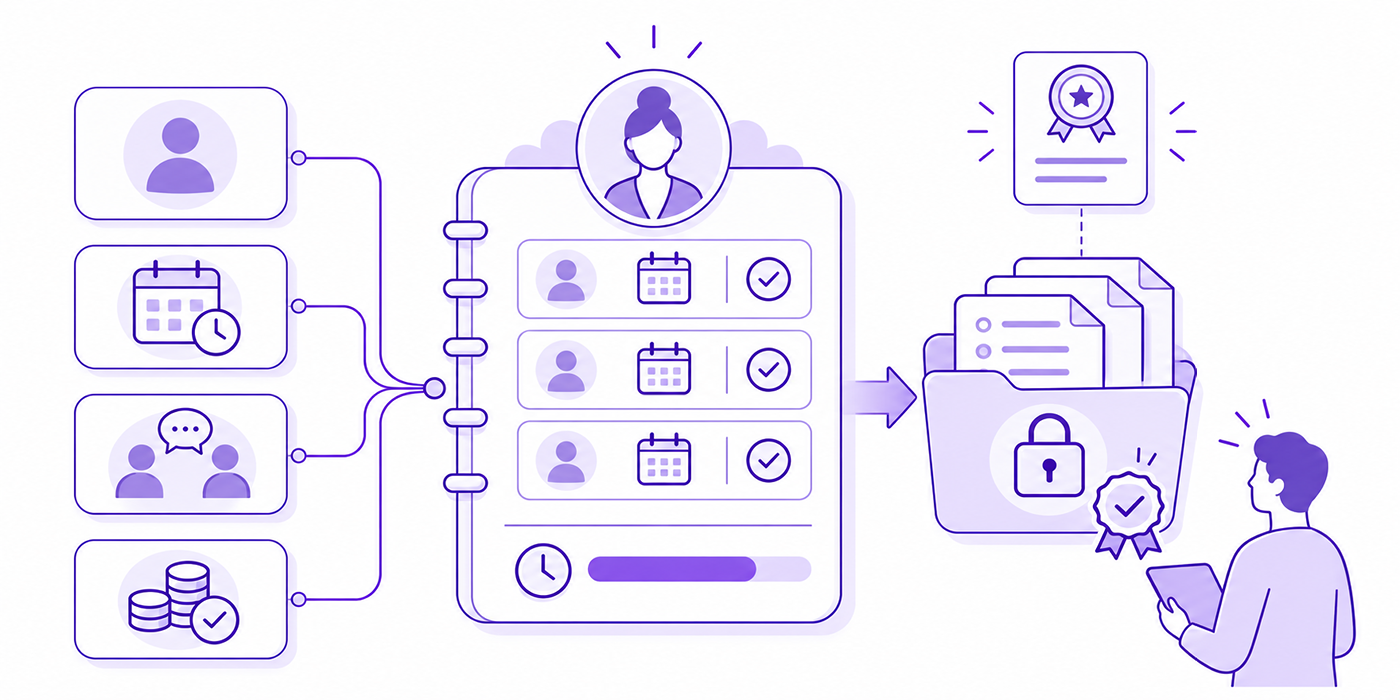
A reliable coaching experience log should allow you to reconstruct your professional activity without exposing unnecessary client information. Build your documentation system around individual engagements, session transactions, consent records, and credential eligibility calculations.
Effective coaching technology, structured client agreements, responsible information handling, and clear professional boundaries provide the foundation for this system.
Maintain a master client register
Create one permanent identifier for each coaching client, such as C001, C002, or C003. Your secure client register should contain:
Unique client identifier.
Client name and authorized contact information.
Coaching relationship start and end dates.
Engagement type.
Consent status and date.
Cumulative paid coaching hours.
Cumulative pro bono coaching hours.
Organizational sponsor, where applicable.
Reference to supporting documentation.
ICF's official coaching log template provides a starting point. Additional internal fields can strengthen reconciliation and evidence management.
Use documented informed consent before adding identifiable information. Your register should contain only information necessary for legitimate professional purposes, consistent with your duty of care.
Create a session-level experience register
Maintain a separate entry for every completed coaching session. Recommended fields include:
Session identification number.
Unique client identification number.
Session date.
Actual coaching duration in minutes.
Paid or pro bono classification.
Individual, group, internal, or third-party engagement type.
Eligibility status.
Supporting evidence reference.
Date the entry was created or amended.
This register should support automatic aggregation of each client's experience totals. Coaches providing brief micro-coaching sessions, ongoing accountability coaching, or structured transformational coaching programs benefit particularly from session-level tracking.
Use spreadsheet formulas to prevent calculation errors
Store actual coaching minutes in your spreadsheet and calculate decimal hours automatically.
For example, if cell E2 contains eligible coaching minutes, use:
=E2/60
A 20-minute session produces approximately 0.3333 hours, while a 50-minute session produces approximately 0.8333 hours. Preserve the underlying precision and round only displayed totals.
If column F contains calculated hours and column G contains payment classifications, calculate paid experience using:
=SUMIF(G2:G1000,"Paid",F2:F1000)
Calculate unpaid experience using:
=SUMIF(G2:G1000,"Pro Bono",F2:F1000)
These formulas assume the underlying register contains only eligible completed sessions. If it also contains excluded activities, add an eligibility condition through SUMIFS.
This approach supports accurate monitoring of professional milestones alongside SMART goal planning and systematic career development.
Reconcile your experience records every month
Set aside approximately 30 minutes monthly to compare coaching entries against appointments, payment records, organizational reports, and consent documentation.
Investigate discrepancies such as completed appointments missing from the experience register, duplicate session entries, inconsistent payment classifications, and missing client identifiers.
This regular review applies the same principles of accountability and habit formation that coaches encourage clients to adopt.
3. Documenting Paid, Pro Bono, Group and Corporate Coaching Experience Correctly
Payment classification can become particularly complicated when coaches operate multiple service models, accept package payments, or work through corporate contracts.
Understanding coaching revenue models, service pricing, and professional contracting practices helps prevent classification errors.
Document paid coaching without creating artificial experience
Direct compensation, legitimate barter arrangements, qualifying internal coaching, and organization-sponsored coaching can satisfy ICF's paid-experience classification.
Preserve evidence showing the commercial or reciprocal relationship. Appropriate records may include invoices, package agreements, employment descriptions, and written peer-coaching arrangements.
For coaches exploring health coaching pricing or developing their first coaching business, establish payment terms before delivery. Avoid retroactive arrangements created solely to manipulate credential eligibility.
Professional honesty remains fundamental to avoiding ethical misrepresentation.
Track the paid-hour threshold independently
An ACC applicant with 110 total hours, including 65 paid and 45 pro bono hours, still requires 10 additional eligible paid hours.
Similarly, a PCC applicant with 520 total hours and 440 paid hours remains 10 paid hours below the required threshold.
A spreadsheet that displays only cumulative experience creates a dangerous blind spot. Maintain independent progress indicators for:
Total eligible hours.
Eligible paid hours.
Distinct clients.
Recent experience hours, where required.
These indicators should guide client acquisition strategies, offer development, and discovery call improvements.
Apply group coaching rules accurately
Maintain distinct records for team and group engagements. Document group size, engagement dates, paid and unpaid coaching time, and an appropriately consented participant contact.
For example, six one-hour qualifying sessions delivered to the same group of 12 people produce six coaching hours and potentially 12 distinct clients, assuming all individuals qualify and have participated appropriately.
Group size restrictions and co-coaching time allocations also affect eligibility. Follow current ICF rules when designing larger programs.
Use CLEAR coaching principles, appropriate coaching power dynamics, and inclusive coaching practices to maintain genuine participant-led coaching.
Secure corporate coaching verification before contracts end
Professionals delivering corporate health coaching, conscious leadership development, or career burnout coaching frequently encounter organizational confidentiality restrictions.
Where these restrictions prevent standard client documentation, arrange an appropriate signed verification letter on organizational letterhead.
Establish who will authorize the letter, when it will be issued, and how the organization will calculate your coaching experience. Request confirmation periodically during long-term contracts rather than relying exclusively on former employers or sponsors.
4. Protecting Client Confidentiality While Maintaining Verifiable Coaching Records
Credential preparation creates a sensitive professional responsibility. Coaches need verifiable experience records while respecting the privacy commitments underlying their client relationships.
Strong informed consent procedures, clearly communicated coaching contracts, professional duty of care, and responsible coaching ethics help manage these obligations.
Obtain specific consent for experience documentation
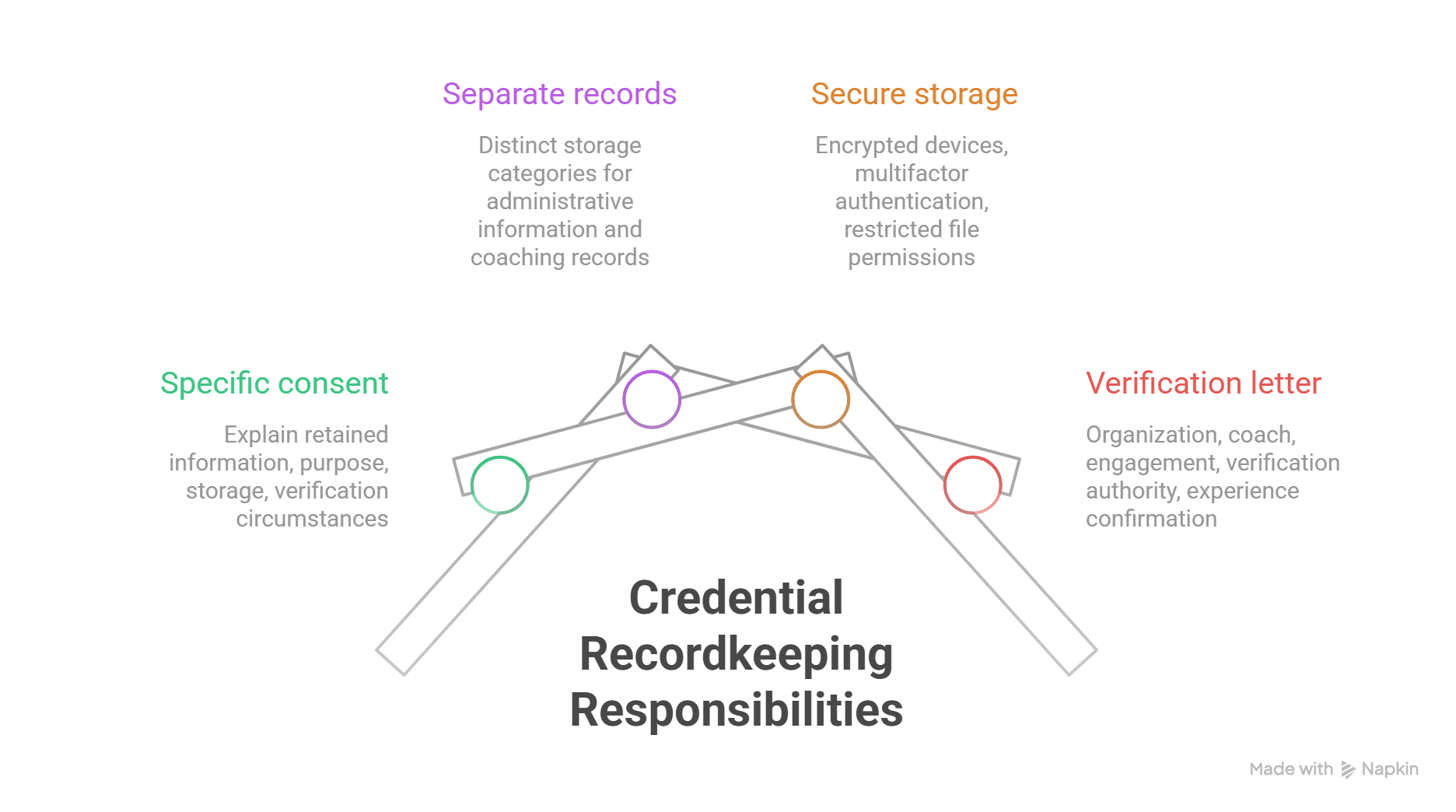
Include credential-related recordkeeping information in your client onboarding process. Explain the information being retained, its intended purpose, storage arrangements, and potential verification circumstances.
An illustrative consent provision could read:
"I understand that my coach maintains professional experience records for credentialing purposes. I consent to the secure retention of my name, authorized contact details, coaching engagement dates, and coaching duration for this purpose. Any permitted verification or disclosure will follow applicable confidentiality and data protection requirements."
Adapt this wording to applicable laws, organizational policies, and actual information-handling practices.
Clients participating in sensitive services such as mental health coaching, couples coaching, and emotional development coaching may require particularly careful explanations.
Respect consent refusals. Maintain a conservative approach to credential readiness when experience cannot be verified appropriately.
Separate credentialing records from confidential coaching notes
Create distinct storage categories for credential-related administrative information and detailed coaching records.
An experience register generally needs engagement identifiers, dates, contact information, and duration. Sensitive discussions about personal relationships, health concerns, financial circumstances, or emotional challenges belong in appropriately protected coaching records when retaining them serves a legitimate purpose.
This separation supports psychologically safe coaching environments, appropriate therapeutic boundaries, and responsible emotional crisis management.
It also reduces the amount of sensitive information potentially exposed during routine administrative access.
Establish secure storage and access controls
Protect your documentation through:
Encrypted devices and appropriately secured storage services.
Multifactor authentication.
Restricted file permissions.
Secure backup procedures.
Documented retention and disposal policies.
Periodic reviews of third-party integrations.
Access removal when employees or contractors leave.
Review technology providers' privacy terms before processing identifiable client information. This is increasingly important as AI coaching technologies become integrated into professional workflows.
Your professional indemnity insurance arrangements and applicable privacy obligations may also influence recordkeeping decisions.
Prepare an organizational verification letter template
A practical reference letter framework for restricted corporate engagements should contain:
Organization: Company name and official letterhead.
Coach: Full professional name.
Engagement: Description of the coach's role and employment or contractual relationship.
Verification authority: Representative's name, position, responsibilities, and contact details.
Experience confirmation: Eligible coaching hours, client count, and delivery period.
Confidentiality statement: Explanation of the organization's policy restricting individual client disclosure.
Authorization: Representative's signature and date.
Request that the organization distinguish eligible coaching from training, consulting, employee supervision, and other professional duties.
These arrangements should form part of your initial coaching agreement, particularly when your work includes leadership coaching or institutional wellness services.
5. Preparing for an ICF Coaching Experience Audit and Correcting Documentation Gaps
An audit-ready system allows a coach to demonstrate the accuracy of their credential application through organized, ethically maintained evidence.
ICF currently uses experience attestation during the application process and may request verification through its audit procedures. Maintain your underlying records securely and follow the specific instructions provided if selected for verification.
Professional accountability, accurate qualification representation, and ongoing coach supervision support a stronger verification process.
Conduct a pre-application eligibility review
Before applying, establish whether every required experience threshold has been independently satisfied.
Consider an ACC candidate with:
108 total eligible hours.
78 paid hours.
30 pro bono hours.
Nine distinct clients.
32 hours within the applicable recent-experience period.
This candidate satisfies the numerical ACC experience thresholds, assuming the hours and clients meet ICF's eligibility requirements.
However, discovering that six of the recorded paid hours were classroom training would reduce eligible experience to 102 total hours and 72 paid hours. The candidate would require three additional paid hours.
This illustrates why numerical progress must be reviewed alongside professional activity classifications.
Use principles from the OSCAR coaching model and T-GROW coaching model to establish corrective milestones and address genuine experience gaps.
Reconstruct historical records using reliable evidence
Coaches who failed to maintain contemporaneous logs can begin reviewing historical documentation systematically.
Useful sources may include appointment histories, dated invoices, original coaching agreements, platform activity reports, organizational records, and authorized client confirmations.
Assign reconstructed entries an evidence-quality classification:
Verified: Duration and engagement details supported by reliable records.
Partially verified: Some details remain uncertain.
Unverified: Insufficient evidence exists to substantiate the claimed experience.
Retain the date and method of reconstruction. Exclude uncertain hours from conservative application-readiness calculations until adequately resolved.
This process aligns with professional ethical conduct and protects credibility when pursuing additional coaching certifications.
Use a 30-day documentation recovery plan
Days 1–5: Inventory your evidence. Identify existing calendars, client agreements, payment records, and educational documentation.
Days 6–10: Reconstruct client relationships. Establish unique client identifiers, engagement periods, and consent status.
Days 11–15: Classify historical sessions. Separate paid, unpaid, eligible, and excluded activities.
Days 16–20: Resolve verification gaps. Contact former clients or authorized organizational representatives where appropriate.
Days 21–25: Recalculate credential eligibility. Compare verified totals against the relevant requirements.
Days 26–30: Implement a permanent documentation workflow. Establish session-level logging, monthly reconciliation, and secure backups.
Applying habit stacking to this process makes documentation easier to sustain. Attach recordkeeping directly to your existing post-session routine.
Calculate your remaining experience and realistic completion timeline
Suppose a PCC applicant has accumulated:
370 eligible total hours.
315 paid hours.
22 distinct clients.
The applicant requires another 130 total hours, at least 135 paid hours, and three additional distinct clients.
Because the paid-hour gap exceeds the overall experience gap, completing 135 additional eligible paid hours would bring the candidate to 505 total hours and 450 paid hours.
At six paid coaching hours weekly, this requires approximately 23 productive coaching weeks, assuming no cancellations or interruptions.
Coaches facing experience shortages can explore client acquisition channels, appropriate coaching niche opportunities, and realistic first-client timelines.
Maintain a reasonable scheduling buffer for cancellations, delayed enrollment, and verification difficulties.
Prevent documentation problems from recurring
Allocate several minutes immediately after every coaching session to complete your experience entry. Reconcile payment classifications monthly and review credential progress quarterly.
Keep a dated history of corrections to significant entries. Record the original value, corrected value, reason for amendment, and supporting evidence.
This approach creates a reliable professional system supported by behavior change principles, consistent accountability practices, and structured continuing professional development.
6. Frequently Asked Questions About Documenting Coaching Experience for ICF
-
ICF currently requires applicants to attest to their qualifying coaching experience and report relevant totals. Maintain your detailed records privately and follow any subsequent verification instructions. Current ICF guidance indicates that even during experience audits, coaching logs are kept from direct submission to ICF. Appropriate confidentiality practices remain essential.
-
Eligible client coaching can accumulate after the qualifying education start date, including during an ongoing training program. Keep independently delivered client coaching separate from classroom practice and educational credits. Carefully evaluate your coach training program and its documentation.
-
Experience completed before your qualifying coach-specific education begins falls outside ICF's experience requirement. Maintain these historical records separately for professional purposes and calculate credential eligibility using the appropriate start date.
Accurate representation of coaching qualifications protects your professional integrity.
-
Historical records can be reconstructed using reliable documentation. Review original appointments, agreements, payment information, and authorized confirmations. Preserve evidence supporting reconstructed entries and identify unresolved uncertainties. Professional coaching ethics require truthful reporting throughout the credentialing process.
-
A genuine qualifying pro bono engagement can contribute toward total experience. Maintain separate paid and unpaid totals to ensure you meet the credential's paid-experience minimum. Free introductory sales conversations require particular care when distinguishing business development from actual client coaching.
Developing stronger discovery call techniques can help clarify this distinction.
-
Shorter and longer qualifying sessions are converted into actual hours. A 15-minute session contributes 0.25 hours, while a 75-minute session contributes 1.25 hours. Document actual coaching time, especially when delivering micro-coaching or brief accountability interventions.
