
Passing an International Coaching Federation (ICF) credentialing exam requires candidates to demonstrate sound professional judgment under realistic coaching conditions. Scenario-based questions challenge coaches to navigate ethical dilemmas, confidentiality concerns, client resistance, emotional disclosures, and competing professional responsibilities. Mastering the coaching code of conduct, understanding scope of practice, recognizing power dynamics in coaching, and applying effective behavioral coaching strategies provide essential foundations. This guide presents original practice case studies, detailed answer rationales, decision-making frameworks, and a structured preparation strategy to help aspiring coaches approach ICF examinations with greater confidence.

1. Understanding Scenario-Based ICF Questions and the Updated Credentialing Exam Format
Scenario-based ICF questions assess how effectively candidates apply professional coaching principles when multiple responses appear reasonable.
Candidates must recognize subtle differences between supportive questioning, premature advice, inappropriate intervention, ethical misconduct, and genuine client-centered partnership.
Understanding these distinctions requires familiarity with professional coaching ethics, coaching agreements, and the professional boundaries separating coaching from psychotherapy.
Understanding the updated ICF examination structure
The ICF introduced its updated PCC-MCC Exam on November 10, 2026. During the transition period ending March 31, 2027, eligible PCC and MCC candidates may choose between the previous credentialing exam and the updated examination.
From April 1, 2027, the updated PCC-MCC Exam becomes the required written examination for these credential levels.
The updated examination includes:
80 examination items in total.
44 situational judgment questions.
36 knowledge-based questions.
150 minutes of scheduled examination time, including an optional 10-minute break.
A passing scaled score of 460, within a scoring range of 200–600.
Assessment based on the 2025 ICF Core Competencies and 2025 Code of Ethics.
The ACC Exam follows a separate knowledge-based multiple-choice format. As of November 2026, ICF identifies the 2019 Core Competencies and 2020 Code of Ethics as its ACC examination references.
Candidates comparing ICF and NBHWC credentialing pathways or evaluating coaching certification requirements should confirm which examination and competency versions apply to their specific applications.
The eight competencies behind scenario-based questions
The ICF competency framework organizes professional coaching around eight essential competencies:
Demonstrates Ethical Practice: Maintains integrity, confidentiality, professional boundaries, and ethical accountability.
Embodies a Coaching Mindset: Demonstrates curiosity, adaptability, reflection, and awareness of personal assumptions.
Establishes and Maintains Agreements: Collaborates with clients to define objectives, responsibilities, and expectations.
Cultivates Trust and Safety: Builds respectful relationships where clients feel comfortable expressing themselves.
Maintains Presence: Responds thoughtfully to emerging needs, emotions, and uncertainty.
Listens Actively: Recognizes meaning, patterns, emotions, and contextual information.
Evokes Awareness: Facilitates new perspectives, self-discovery, and meaningful reflection.
Facilitates Client Growth: Helps clients convert insights into independently owned decisions and actions.
These competencies intersect with practical methods such as the CLEAR coaching model, OSCAR coaching framework, T-GROW model, and SMART goal-setting methodology.
A strong candidate understands when these tools are appropriate and how to adapt them to the client's individual circumstances.
2. How to Identify the BEST and WORST Answers in Scenario-Based ICF Questions
The greatest difficulty in situational judgment questions arises when several options appear professionally acceptable.
Candidates must evaluate each response according to the immediate circumstances, ethical obligations, client autonomy, and the likely consequences of the intervention.
Effective preparation incorporates principles from informed consent, duty of care, cultural competence, and the management of client expectations.
Apply the five-filter decision framework
Use these five filters to evaluate competing examination responses.
Filter 1: Ethical compliance
Determine whether an option compromises confidentiality, exceeds professional competence, conceals a conflict of interest, or disregards informed consent.
Ethical violations often provide strong evidence for identifying the worst available response.
For example, a coach sharing private session information with an employer without appropriate authorization creates a serious professional concern.
Filter 2: Client ownership
Identify which response protects the client's authority over personal decisions.
Approaches grounded in life purpose coaching, self-actualization coaching, and life visioning techniques depend on understanding the client's priorities before developing interventions.
Responses that substitute the coach's preferred solution for the client's judgment generally weaken autonomy.
Filter 3: Timing and sequence
Evaluate whether the response addresses the most immediate issue.
A client expressing uncertainty about the coaching objective may require agreement clarification before action planning. A client experiencing significant emotional distress may require space, acknowledgment, or referral before goal-setting.
Understanding emotional agility, client anxiety and stress, and coaching through major change helps candidates recognize the importance of timing.
Filter 4: Quality of exploration
Consider whether the response demonstrates genuine curiosity or simply disguises advice as a question.
For example, asking, “Wouldn't you feel better if you left your job?” contains an implied recommendation.
A more exploratory question would be, “What would you need to understand before deciding whether to stay or leave?”
Techniques associated with the immunity to change model and positive intelligence coaching can strengthen candidates' understanding of underlying assumptions.
Filter 5: Professional consequences
Consider the potential impact of each response on trust, safety, independence, and the coaching agreement.
A directive intervention may produce an immediate action while weakening long-term client ownership. A poorly timed observation may damage rapport even when its content is accurate.
Understanding constructive feedback techniques, emotional intelligence coaching, and safe coaching environments helps distinguish professional responses from superficially helpful alternatives.
Recognize the four common distractor patterns
Exam candidates should practice identifying responses containing these recurring weaknesses:
Premature problem-solving: Introducing solutions before understanding the client's circumstances.
Unjustified reassurance: Dismissing concerns through positive statements without meaningful exploration.
Rigid methodology: Applying a coaching framework despite evidence that the client's needs have changed.
Professional overreach: Providing clinical, legal, nutritional, or financial recommendations outside appropriate competence.
The correct response depends on the complete scenario. Open-ended questioning, silence, referral, direct observation, and agreement clarification can each be appropriate under different circumstances.
3. Seven Detailed ICF Practice Case Studies With BEST and WORST Answer Explanations
Complete each original practice question before reviewing its rationale. Choose both the best and worst response from the four available options.
This exercise develops applied judgment across ethical practice, coaching relationships, behavioral accountability, and professional development.
Case Study 1: Confidentiality versus corporate sponsorship
Scenario: An executive coach is working with a senior manager through an employer-sponsored coaching program. The company's HR director requests detailed session notes to evaluate the manager's leadership weaknesses. The original agreement permits sharing attendance and agreed progress indicators only.
Possible responses:
A. Provide the notes because the organization is funding the coaching.
B. Explain the confidentiality agreement and discuss permissible reporting options with the relevant parties.
C. Ignore the HR director's request without providing an explanation.
D. Offer a verbal summary of confidential session discussions instead of written notes.
BEST answer: B
The coach protects the client's confidentiality while addressing the sponsor's legitimate reporting interests through the established agreement.
WORST answer: A
Providing detailed confidential records exceeds the agreed disclosure boundaries.
Option D also compromises confidentiality. Its informal format provides no ethical justification for unauthorized disclosure.
This case illustrates the practical importance of contracting in coaching, informed consent, and leadership coaching responsibilities.
Case Study 2: Client requests direct career advice
Scenario: A client considering a career transition asks, “You have worked with hundreds of professionals. Should I accept the new job or stay where I am?”
Possible responses:
A. Recommend the new position because career progression usually requires risk.
B. Share a generic list of career advantages and disadvantages without exploring the client's circumstances.
C. Explore the client's values, concerns, available options, and criteria for making the decision.
D. Tell the client that career decisions are entirely their responsibility and change the subject.
BEST answer: C
This response helps the client develop a personally meaningful decision-making process.
WORST answer: A
The coach imposes a recommendation using generalized assumptions about career progression.
Candidates should recognize the difference between helping clients evaluate decisions and deciding for them. This distinction is fundamental to career burnout coaching, self-confidence coaching, and life visioning.
Case Study 3: Emotional disclosure during a coaching session
Scenario: A client discussing workplace performance unexpectedly begins crying while describing feelings of inadequacy. They remain engaged and appear comfortable continuing the conversation.
Possible responses:
A. Allow space, acknowledge the emotion, and ask what would be helpful at this moment.
B. Introduce a productivity exercise to redirect attention toward performance.
C. Immediately diagnose the client with an anxiety disorder.
D. Offer general reassurance and return to the original agenda.
BEST answer: A
The coach demonstrates presence and responsiveness while allowing the client to determine how to proceed.
WORST answer: C
Clinical diagnosis exceeds the competence of a coach acting solely in a coaching capacity.
Emotional expression can be part of ordinary coaching. Clinical symptoms, significant impairment, or safety concerns may require professional referral.
Review the boundaries of mental health coaching, emotional crisis support, and therapy versus life coaching.
Case Study 4: Repeated failure to complete commitments
Scenario: A health coaching client has missed their agreed exercise commitments for three consecutive weeks. They express frustration and describe themselves as lazy.
Possible responses:
A. Establish stricter targets and demand evidence of completion.
B. Explore the circumstances surrounding the missed commitments and collaborate on a realistic adjustment.
C. Remove all accountability measures permanently.
D. Explain that meaningful results are impossible with their current attitude.
BEST answer: B
Exploring contextual barriers helps the coach distinguish unrealistic planning, environmental obstacles, competing demands, and changes in motivation.
WORST answer: D
The response reinforces the client's negative self-assessment and undermines trust.
Candidates can strengthen their understanding of this scenario through health behavior change, habit stacking, habit formation, and accountability coaching.
Case Study 5: Coaching beyond professional scope
Scenario: A health coaching client recently received abnormal laboratory results and asks their coach to recommend supplements and adjust their prescribed medication.
Possible responses:
A. Recommend supplements based on personal research.
B. Explain the limits of the coaching role, encourage consultation with the treating clinician, and offer appropriate behavioral support.
C. Avoid discussing the request and continue with unrelated lifestyle goals.
D. Recommend discontinuing the medication until the client improves their diet.
BEST answer: B
The response maintains professional boundaries while preserving opportunities to support the client's implementation of an appropriate care plan.
WORST answer: D
Unauthorized medication recommendations introduce significant health risks.
This distinction is particularly important within metabolic health coaching, lifestyle medicine coaching, and preventive health coaching.
Coaches should understand the professional boundaries between health coaches, dietitians, and nutritionists.
Case Study 6: A client changes the session objective
Scenario: A client initially requests support with time management. During the session, they reveal that an upcoming difficult conversation with their manager is their most pressing concern.
Possible responses:
A. Continue discussing time management because it was the original objective.
B. Immediately switch topics without confirming what the client wants to accomplish.
C. Explore whether the client wants to revise the session agreement and clarify the desired outcome.
D. Refuse to discuss the manager and require the client to purchase another session.
BEST answer: C
The coach remains flexible while maintaining a collaboratively defined session purpose.
WORST answer: D
The response imposes an unnecessary commercial barrier and disregards the client's emerging priorities.
Candidates can practice adapting the CLEAR coaching framework, OSCAR model, and T-GROW coaching approach when new information changes the direction of a session.
Case Study 7: Technology, artificial intelligence, and client confidentiality
Scenario: A coach discovers an AI application that automatically transcribes sessions and creates personalized action plans. The coach wants to begin using it with existing clients.
Possible responses:
A. Activate the tool without informing clients because it improves efficiency.
B. Review the tool's privacy practices, assess relevant risks, explain its use, and obtain appropriate client authorization.
C. Upload previously recorded sessions to test the application's accuracy without checking existing permissions.
D. Avoid reviewing the privacy arrangements because the vendor advertises professional-grade security.
BEST answer: B
The coach considers confidentiality, transparency, technology-related risks, and informed client participation before introducing the tool.
WORST answer: C
Uploading historical recordings without checking authorization may expose extensive confidential information beyond the original purpose for which it was collected.
As technology transforms coaching and AI-assisted coaching services become more widespread, candidates should examine how existing ethical principles apply to emerging digital practices.
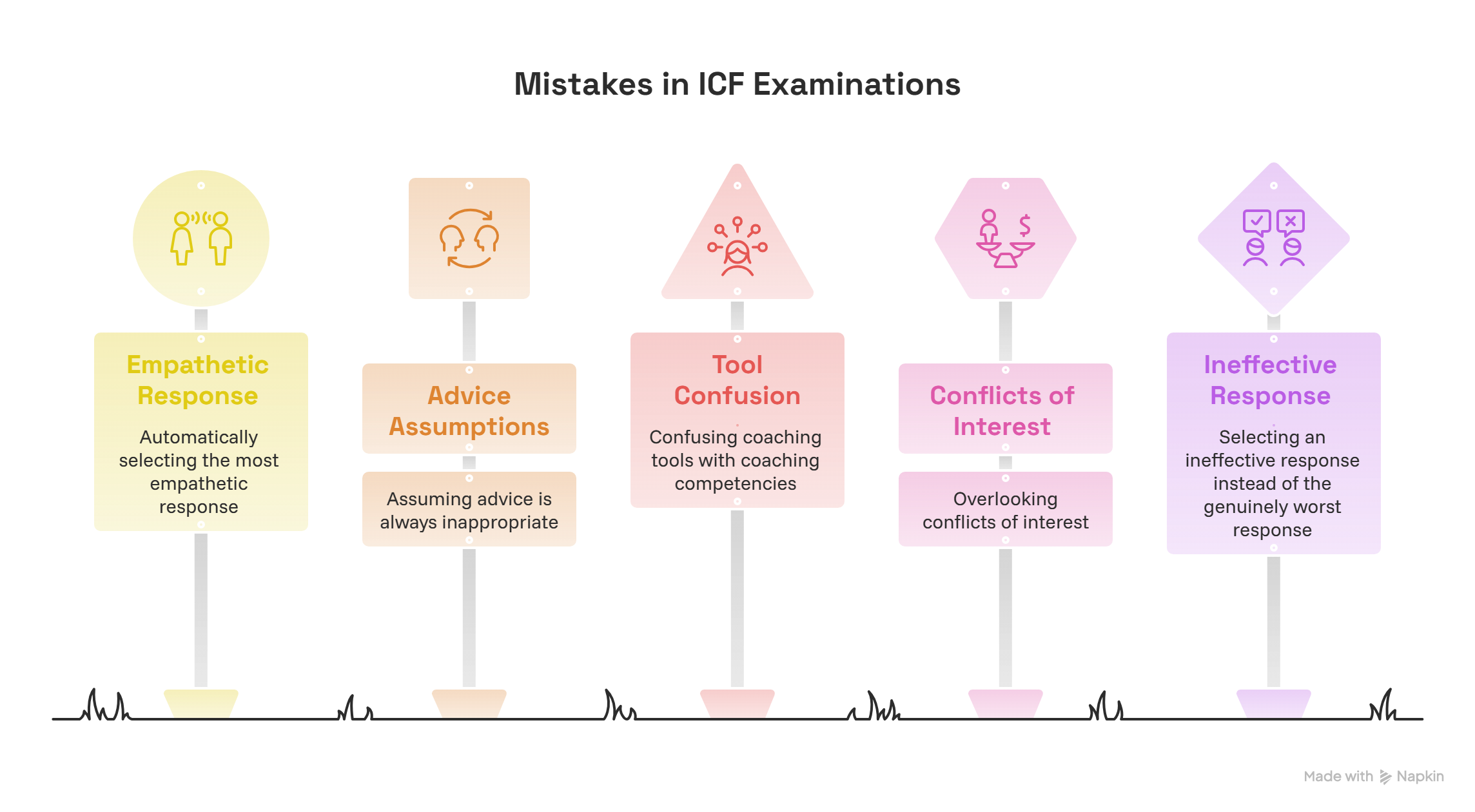
4. The Most Common ICF Scenario-Based Exam Mistakes and How to Avoid Them
Experienced practitioners can struggle with ICF examinations when their established working habits differ from competency-based assessment principles.
Candidates benefit from examining their assumptions through coach supervision, reflective practice, and continuing professional development.
Mistake 1: Automatically selecting the most empathetic response
Empathy supports trust, but some scenarios require immediate action, ethical clarification, or professional referral.
When a client discloses a credible imminent safety risk, selecting a compassionate exploratory question while overlooking emergency responsibilities can demonstrate inadequate professional judgment.
Review duty of care and emotional crisis procedures to understand when safety obligations take priority.
Mistake 2: Assuming advice is always inappropriate
Coaches may appropriately share observations, knowledge, or resources when these contributions support the agreed coaching purpose and preserve client autonomy.
The key considerations include relevance, professional competence, permission, transparency, and how the information influences the client's independent judgment.
This is particularly important for professionals combining coaching with other qualifications or considering nutrition coaching boundaries and health coaching scope requirements.
Mistake 3: Confusing coaching tools with coaching competencies
A candidate may recognize the Wheel of Life, ADKAR change model, or transactional analysis and immediately favor an option mentioning that methodology.
Evaluate whether the tool addresses the client's current objective and whether its introduction respects the coaching agreement.
Mistake 4: Overlooking conflicts of interest
Conflicts may emerge through referral commissions, multiple professional roles, personal relationships, corporate sponsorship, and financial incentives.
An apparently useful recommendation may become ethically problematic when the coach conceals a personal financial benefit.
Review misrepresentation in coaching and professional indemnity considerations to understand broader professional responsibilities.
Mistake 5: Selecting an ineffective response instead of the genuinely worst response
A weak question may provide limited value. Another option may actively violate confidentiality or expose a client to harm.
When selecting the worst response, compare consequences rather than simply identifying the least impressive coaching technique.
Maintaining awareness of coaching power dynamics and professional ethical standards helps candidates recognize the severity of different mistakes.
5. A 30-Day ICF Exam Preparation Plan Using Case Studies and Timed Practice
A structured preparation program should develop knowledge retrieval, ethical interpretation, scenario analysis, and examination pacing.
Candidates evaluating certification program quality or trying to avoid coaching certification overpromises should prioritize resources that explain answer rationales and provide competency-based feedback.
Days 1–7: Establish competency mastery
Dedicate the first week to reviewing the applicable versions of the ICF competencies and ethics standards.
For every competency, create four revision entries:
A plain-language explanation.
Three examples of appropriate coaching behavior.
Three examples of inappropriate behavior.
One scenario where another competency creates a competing consideration.
Use relevant topics such as trust-building through professional credibility, positive psychology, and transformational coaching to deepen your understanding of client-centered practice.
Days 8–14: Practice scenario discrimination
Complete eight to ten original practice scenarios daily.
For each question, write down:
The central coaching dilemma.
The primary competency being assessed.
The best response and its justification.
The worst response and its potential consequences.
Why the remaining alternatives are comparatively weaker.
Maintain an error journal that categorizes mistakes into ethical boundaries, agreement management, listening, emotional responsiveness, awareness, and accountability.
Discuss difficult scenarios through professional supervision or mentor coaching. Use feedback to identify recurring assumptions instead of memorizing answer letters.
Days 15–21: Conduct peer-coaching simulations
Arrange practice conversations with peers who can deliberately introduce challenging circumstances.
Possible simulations include:
A client requesting direct professional advice.
A sponsor demanding additional information.
A client changing their coaching objective.
A disagreement concerning accountability.
An emotional disclosure that requires careful judgment.
A conversation involving cultural differences.
Peer feedback should evaluate observable coaching behaviors, including interruptions, leading questions, assumptions, agreement clarification, and the extent to which clients retain ownership.
These exercises strengthen practical skills associated with conscious leadership, emotional intelligence, and constructive feedback.
Days 22–26: Complete timed examination simulations
For the updated PCC-MCC examination, practice answering 22 situational judgment questions within 46 minutes and 18 knowledge-based questions within 20 minutes.
Use separate practice blocks to identify whether reading comprehension, competency knowledge, or indecision creates the greatest time pressure.
Track the accuracy of your best and worst selections independently. A candidate who consistently identifies effective responses but misses ethical violations requires a different revision strategy from someone who struggles with client-centered alternatives.
Aim for improving consistency across multiple practice sets. Your raw practice percentage cannot directly establish an official ICF scaled score.
Days 27–30: Target weaknesses and finalize examination readiness
Review every recurring error from your practice journal.
Create a one-page revision sheet covering:
Confidentiality and disclosure exceptions.
Professional scope and referral responsibilities.
Conflicts of interest.
Coaching agreement revisions.
Client autonomy.
Cultural awareness and personal bias.
Appropriate technology use.
Client-led accountability.
Continue reviewing relevant principles from informed consent, cultural competence, client expectation management, and scope of practice.
During the final preparation period, prioritize adequate rest, familiarity with examination procedures, and targeted review of persistent weaknesses.
The objective is to develop professional judgment that remains reliable when examination scenarios differ from previously practiced examples.
6. Frequently Asked Questions About Scenario-Based ICF Exam Preparation
-
Scenario-based questions present realistic coaching situations followed by four possible responses. PCC and MCC candidates identify the best and worst actions according to the applicable ICF Core Competencies, ethical standards, and professional coaching principles.
-
The updated PCC-MCC Exam contains 44 situational judgment questions and 36 knowledge-based questions, totaling 80 items. This format became available on November 10, 2026, and becomes the required PCC-MCC examination from April 1, 2027.
-
The ACC examination uses knowledge-based multiple-choice questions, including questions that may involve applied coaching situations. Its format differs from the PCC-MCC best-and-worst response structure. Candidates should review their applicable examination requirements when comparing professional coaching credential pathways.
-
ICF uses a scaled scoring range of 200–600, with 460 as the passing score. Dividing 460 by 600 does not establish the raw percentage of questions required to pass because scaled scoring involves a statistical conversion.
-
The suitability of an open-ended question depends on the circumstances. Some situations require confidentiality protection, agreement clarification, referral, or immediate safety intervention. Understanding ethical responsibilities helps candidates recognize these differences.
-
Identify which response addresses the most immediate coaching need while protecting professional boundaries and client autonomy. Examine whether the alternatives introduce premature advice, unnecessary assumptions, ineffective timing, or insufficient collaboration.
