
Fulfilling the International Coaching Federation’s (ICF) coaching hours requirements is one of the most challenging stages of becoming a credentialed coach. Many candidates complete their education but struggle to attract paying clients, distinguish eligible coaching sessions, and maintain accurate experience records. Successfully navigating this process requires strategic client acquisition, transparent coaching agreements, appropriate professional boundaries, and sustainable coaching business development. Whether you are pursuing ACC, PCC, or MCC credentials, understanding how to accumulate, classify, document, and verify your experience can prevent unnecessary application delays and establish a stronger professional practice.
1. Understanding ICF Coaching Hours Requirements for ACC, PCC, and MCC
The International Coaching Federation establishes different client coaching experience requirements for its three primary individual credentials. Candidates evaluating the value of coaching certification should understand these requirements before committing to a training program.
The experience requirements operate independently of coach-specific education, mentor coaching, and other credentialing components. Understanding these distinctions helps candidates avoid common coaching certification red flags and make informed decisions when comparing ICF and NBHWC credentialing pathways.
Associate Certified Coach (ACC) Requirements
The ACC credential provides an entry-level professional credentialing pathway for developing coaches.
Candidates must complete:
At least 100 client coaching experience hours.
At least 75 paid coaching hours.
Coaching experience with at least eight clients.
At least 25 coaching hours within the 18 months preceding application submission.
At least 60 hours of qualifying coach-specific education.
Applicable mentor coaching, performance evaluation, and examination requirements.
For aspiring coaches developing their first client acquisition strategy, ACC provides a manageable initial target while establishing professional credibility.
At exactly 100 experience hours, a candidate can include up to 25 pro bono hours while meeting the paid-hour requirement. Additional unpaid experience remains permissible, provided all credentialing minimums are satisfied.
Professional Certified Coach (PCC) Requirements
The PCC credential requires substantially greater client experience and demonstrated professional competence.
Candidates must complete:
At least 500 client coaching hours.
At least 450 paid coaching hours.
Experience with at least 25 clients.
At least 50 coaching hours within the 18 months preceding application submission.
At least 125 hours of qualifying coach-specific education.
Applicable mentor coaching, performance evaluation, and examination requirements.
Meeting these requirements becomes significantly easier through sustainable coaching revenue models, effective client retention strategies, and specialization within commercially viable life coaching niches.
A candidate who has accumulated 100 eligible hours while pursuing ACC can generally apply those qualifying hours toward the 500-hour PCC threshold. Maintaining accurate records throughout your career protects the value of earlier experience.
Master Certified Coach (MCC) Requirements
The MCC credential represents an advanced level of coaching experience and demonstrated proficiency.
Candidates must complete:
At least 2,500 client coaching hours.
At least 2,250 paid coaching hours.
Experience with at least 35 clients.
At least 200 hours of qualifying coach-specific education.
The applicable PCC prerequisite, mentor coaching, assessment, and examination requirements.
ICF's published MCC experience requirements do not specify the same 18-month recency threshold used for ACC and PCC applications.
Reaching this level requires sustained professional practice, ongoing coach supervision, and commitment to continuing professional development.
When Can You Start Accumulating ICF Coaching Hours?
Eligible client experience can begin after starting qualifying coach-specific education. For this purpose, ICF identifies qualifying education as a course containing at least 30 hours, including at least 24 hours focused on ICF Core Competencies.
Non-accredited education may qualify, subject to ICF review under the applicable application pathway.
Candidates should investigate certification program quality, understand the importance of professional coaching credentials, and establish a documented education start date before counting client sessions.
The following reference guide explains which activities qualify, how they should be classified, and where candidates commonly make costly mistakes.
2. What Counts as Paid, Pro Bono, and Eligible ICF Coaching Experience?
Understanding experience classification can save candidates months of unnecessary work. Completing hundreds of sessions provides limited credentialing value when substantial portions consist of teaching, consulting, mentoring, or other excluded activities.
A clear understanding of coaching scope of practice, professional ethics, informed consent, and misrepresentation in coaching helps candidates classify experience accurately.
What Qualifies as a Paid Coaching Hour?
Paid coaching experience can arise through several compensation arrangements.
Direct client payments: Individuals compensate you for professional coaching sessions or packages.
Internal employment: Coaching employees forms part of your compensated organizational responsibilities, excluding your direct reports.
Third-party arrangements: An organization pays you to coach its employees, customers, members, or beneficiaries.
Barter arrangements: You receive another service, product, or reciprocal coaching in exchange for your coaching services.
These options are particularly valuable for candidates exploring coaching careers beyond private practice, corporate wellness opportunities, and coaching employment versus entrepreneurship.
ICF does not establish a universal minimum session price for paid experience. Candidates can develop affordable introductory offers using appropriate coaching pricing strategies while maintaining genuine commercial arrangements.
What Qualifies as Pro Bono Coaching?
Pro bono coaching involves providing professional coaching without compensation or an exchange of services.
Suitable opportunities include nonprofit partnerships, community initiatives, career transition programs, and accessibility-focused coaching services.
Candidates can combine these opportunities with inclusive coaching practices, life purpose coaching, and self-confidence coaching to develop experience across diverse client populations.
A common mistake involves accumulating 100 pro bono hours and subsequently discovering that ACC requires at least 75 paid hours. Track paid and unpaid experience separately from the beginning.
How Group and Team Coaching Hours Are Calculated
Group coaching creates opportunities to increase client reach and fulfill the minimum client-count requirement efficiently.
For example, a qualifying one-hour group coaching session with ten participants contributes one coaching experience hour and potentially ten individual clients toward the client-count requirement.
Repeating the session with those same ten participants increases experience hours while the unique client count remains unchanged.
ICF generally limits qualifying groups to 15 participants unless a co-coach is present. Co-coaching time must be allocated between coaches according to applicable rules.
Candidates developing leadership coaching services, conscious leadership programs, and transformational coaching experiences must maintain participant-driven agendas rather than delivering predetermined lessons.
Distinguishing Mentor Coaching From Client Experience
For ACC and PCC credentialing, the applicable mentor coaching requirement generally involves ten hours distributed across at least three months, including at least three hours of individual mentor coaching.
These sessions develop your coaching competencies through professional feedback. Client experience hours measure your delivery of qualifying coaching services.
Maintaining separate records for coach supervision, mentor coaching, continuing professional development, and client delivery prevents accidental duplication.
Candidates should also clarify whether their education pathway already incorporates mentor coaching and performance evaluation requirements.
3. How to Accumulate ICF Coaching Hours Faster Without Compromising Quality
The strongest experience-building strategy combines recurring coaching relationships, diversified acquisition channels, and realistic weekly delivery targets.
Candidates struggling with coaching client acquisition often rely excessively on isolated sessions. Structured engagements create more predictable experience accumulation while supporting sustained client development.
Strategy 1: Create a Structured Founding Client Offer
Develop a coaching package around a clearly defined client challenge, such as career transitions, leadership development, confidence building, or lifestyle consistency.
An eight-session founding-client package provides greater continuity than repeatedly searching for one-time appointments.
For example, enrolling ten clients into eight one-hour sessions produces a potential 80 paid coaching hours.
Use niche selection frameworks to identify your audience, effective discovery calls to qualify prospects, and coaching contracts to establish expectations.
Founding-client offers should reflect your current qualifications and avoid guaranteed transformation claims.
Strategy 2: Join Reciprocal Peer Coaching Programs
ICF's Reciprocal Peer Coaching program provides eligible members with opportunities to exchange coaching services and accumulate qualifying paid experience.
Independent reciprocal arrangements may also qualify when they involve genuine coaching relationships and legitimate exchanges outside classroom training.
Peer coaching provides opportunities to practice the CLEAR coaching model, T-GROW coaching model, and OSCAR coaching model.
Record only the time you spend delivering qualifying coaching. Time spent receiving coaching belongs in separate records.
Strategy 3: Establish Internal Coaching Opportunities
Professionals already employed in human resources, organizational development, wellness, or talent management may have access to eligible internal coaching opportunities.
Present a structured proposal describing the intended audience, coaching objectives, voluntary participation, confidentiality safeguards, and expected delivery schedule.
This approach complements leadership coaching, career burnout coaching, and organizational change coaching.
For example, coaching six eligible employees for one hour every two weeks produces approximately 12 hours per four-week period.
Maintain separation between coaching relationships and supervisory authority, following appropriate power dynamics principles.
Strategy 4: Partner With Organizations Serving Your Target Audience
Professional associations, nonprofit organizations, educational institutions, and wellness providers may require coaching support for their communities.
A partnership proposal should identify:
The specific client population you support.
The problem your coaching engagement addresses.
Your qualifications and professional boundaries.
The proposed number and duration of sessions.
Confidentiality and experience verification procedures.
Whether the arrangement involves paid or pro bono services.
Candidates specializing in preventive health coaching, holistic coaching, or emotional intelligence coaching can develop partnerships aligned with their expertise.
Secure clear verification arrangements before delivering substantial coaching volumes.
Strategy 5: Build a Predictable Referral System
Satisfied clients can introduce prospective clients who face similar challenges. Establish a voluntary referral process after meaningful coaching milestones.
Use principles from client accountability, constructive feedback, and managing client expectations to strengthen the quality of existing engagements.
Explore diversified coaching lead-generation channels instead of depending exclusively on social media inquiries.
Request referrals without pressuring clients or disclosing confidential coaching information.
4. Practical Timelines and Experience-Building Plans for ACC, PCC, and MCC
Credentialing timelines depend on actual session delivery, compensation classification, unique client counts, and client retention. Establishing weekly targets through the SMART goals framework and applying accountability coaching principles to your professional development can make the process more predictable.
The following plans provide illustrative targets rather than guaranteed completion timelines.
A 20-Week Plan to Complete 100 ACC Coaching Hours
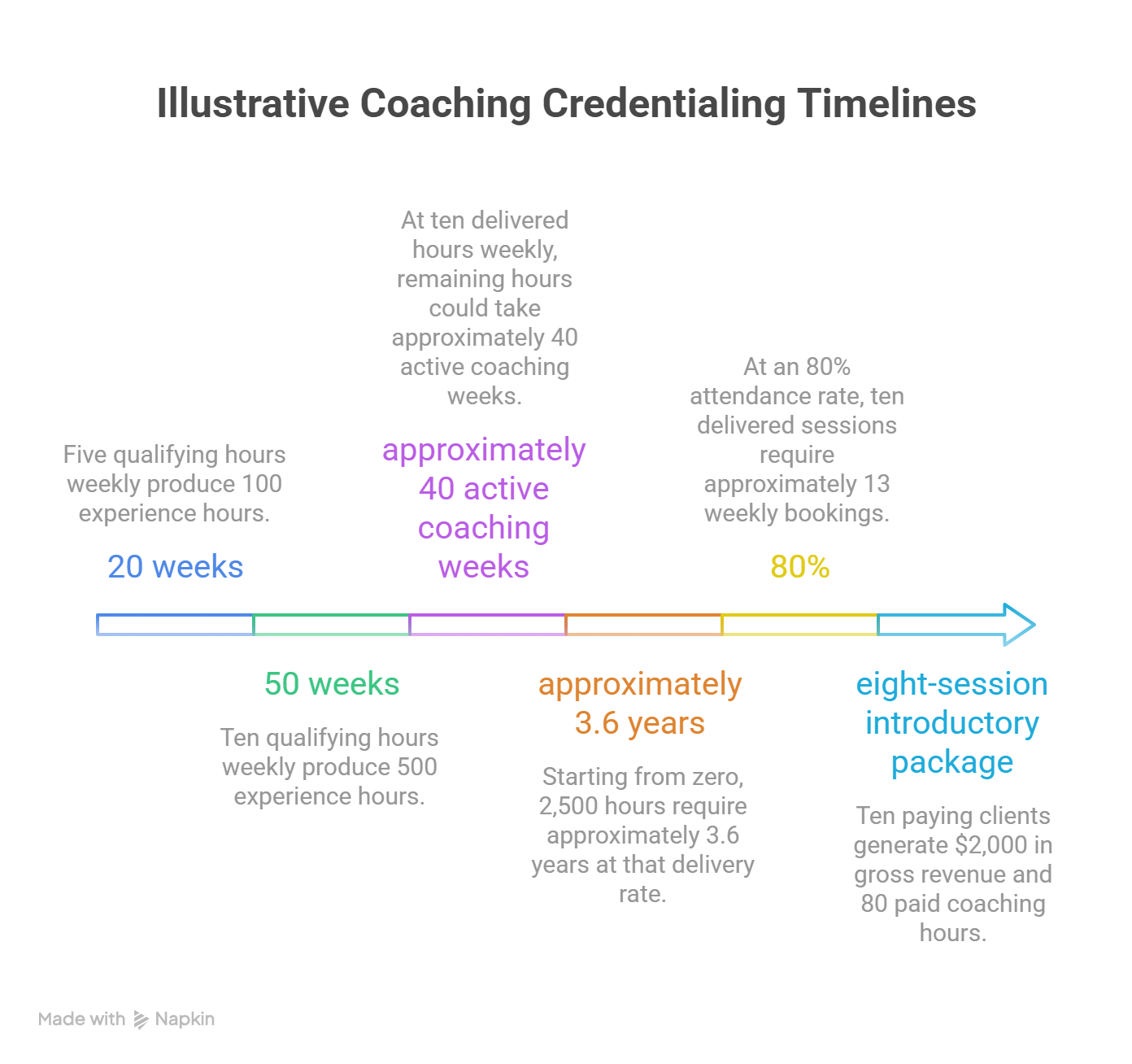
Delivering five qualifying coaching hours per week for 20 weeks produces 100 experience hours.
A possible client portfolio consists of:
Ten paying clients completing eight one-hour sessions each: 80 paid hours.
Five pro bono clients completing four one-hour sessions each: 20 unpaid hours.
Total experience: 100 hours.
Total unique clients: 15.
This structure exceeds the ACC minimum paid-hour and client-count requirements.
Candidates can improve engagement through habit formation strategies, positive psychology coaching, and emotional agility techniques.
Allow additional time for cancellations, client acquisition, education completion, mentor coaching, and application preparation.
A 50-Week Plan to Complete 500 PCC Coaching Hours
Delivering ten qualifying hours per week for 50 weeks produces 500 experience hours.
One potential portfolio includes 30 paying clients completing 15 hours each, generating 450 paid hours, alongside ten pro bono clients completing five hours each.
Coaches progressing from ACC with 100 existing eligible experience hours may require approximately 400 additional hours, subject to their paid-hour totals, unique client counts, and recency requirements.
At ten delivered hours per week, those remaining hours could take approximately 40 active coaching weeks.
Maintaining this workload requires sustainable coaching business economics, appropriate session pricing, and effective client relationship management.
A Multi-Year Plan to Complete 2,500 MCC Coaching Hours
Experienced practitioners accumulating 15 eligible hours per week across 46 working weeks annually generate approximately 690 coaching hours each year.
Starting from zero qualifying experience, 2,500 hours would require approximately 3.6 years at that delivery rate.
A PCC holder with 500 eligible experience hours would need approximately 2.9 additional years at the same pace, assuming the remaining credentialing conditions are fulfilled.
Advanced practitioners can strengthen their development through transformational coaching methodologies, coach supervision, and continuing professional development.
These calculations represent experience accumulation only. Credentialing assessments and other prerequisites may extend the overall timeline.
Calculate Your Weekly Booking Target Using Actual Attendance
Scheduled coaching sessions frequently exceed delivered coaching hours because of cancellations, rescheduling, and client discontinuation.
If your target is ten delivered one-hour sessions weekly and your historical attendance rate is 80%, you need approximately 13 weekly bookings.
Track your actual attendance rate rather than adopting a generic industry estimate.
Use coaching technology to automate scheduling, client accountability frameworks to establish attendance expectations, and effective contracting to communicate cancellation policies.
Cancelled sessions generate zero experience hours, even when the client pays a cancellation fee.
Generate Revenue While Accumulating Experience
An ACC candidate could offer an eight-session introductory package priced at $200. Delivering this package to ten paying clients generates $2,000 in gross revenue and 80 paid coaching hours.
The resulting gross revenue equals $25 per delivered coaching hour before administration, marketing, preparation, taxes, and other expenses.
Candidates should use realistic health coaching revenue frameworks and professional pricing principles to ensure introductory pricing remains financially manageable.
Once experience, competence, and demand increase, reassess pricing and service delivery capacity.
5. How to Document, Verify, and Protect Your ICF Coaching Hours
An extensive coaching history becomes difficult to verify when client records, payment classifications, and session dates are scattered across multiple platforms.
Establishing reliable documentation practices reflects the same professional standards underpinning informed consent, duty of care, and the coaching code of conduct.
Build an ICF-Compatible Coaching Experience Log
Maintain a secure spreadsheet or appropriate client management system containing the information necessary to calculate and verify qualifying experience.
For individual clients, record:
Client name, subject to documented consent.
Appropriate client contact information.
Coaching relationship start and end dates.
Individual session dates.
Actual coaching duration in minutes.
Paid or pro bono classification.
Cumulative eligible coaching hours.
Unique client identifier for internal tracking.
Relevant verification information.
Individual session dates provide additional support for calculating the ACC and PCC 18-month recency requirements.
The official ICF coaching log template provides a useful starting point for organizing experience records.
Apply appropriate coaching technology practices and transparent coaching agreements when introducing digital documentation systems.
Calculate Experience Hours Using Actual Coaching Minutes
Convert completed coaching minutes into decimal hours by dividing the number of minutes by 60.
A candidate who completes six 45-minute sessions accumulates 4.5 coaching hours. Ten 30-minute sessions contribute five hours.
This distinction becomes particularly important for practitioners delivering micro-coaching sessions and shorter accountability coaching engagements.
Maintain minute-level records to minimize cumulative rounding errors.
Document Group and Team Coaching Separately
For qualifying group coaching engagements, maintain records of participant count, engagement dates, paid and unpaid hours, and the name and email address of one consenting participant.
Where organizational confidentiality policies apply, an appropriate verification letter may replace identifying client information.
Avoid counting a 60-minute session with 12 participants as 12 coaching hours. The participant count and coaching duration belong in separate calculations.
This practice is particularly relevant to leadership coaching and organizational programs built around conscious leadership.
Obtain Organizational Verification Letters
Internal and third-party coaching arrangements may involve confidentiality policies that restrict access to individual client information.
Where applicable, obtain a signed verification letter on organizational letterhead containing:
Your name and professional role.
The authorized representative's name, role, and contact information.
Confirmation of the organization's confidentiality policy.
The period during which you delivered coaching.
The verified number of clients coached.
The verified number of coaching hours completed.
Request this documentation before leaving an employer or terminating a platform arrangement. Organizational changes can make historical verification difficult.
Understanding professional indemnity considerations and maintaining appropriate professional boundaries further strengthens organizational coaching arrangements.
Protect Client Confidentiality During Documentation
Obtain documented client consent before recording identifiable information for credential verification purposes.
Store records securely, restrict access, and collect only information necessary for legitimate professional purposes. Sensitive coaching conversations, medical histories, and detailed personal disclosures generally have no place in experience verification logs.
ICF advises candidates to omit identifying information where clients withhold consent, recognizing that such experience may become difficult to verify during an audit.
These precautions support creating a safe coaching environment and responsible management of coaching power dynamics.
Prepare for Potential ICF Credentialing Audits
ICF generally requires applicants to attest to their qualifying experience totals rather than submit a detailed client coaching log.
Selected applicants may undergo additional verification according to ICF's audit instructions. Its current guidance states that applicants will not be asked to submit coaching logs directly to ICF, even during an audit.
Before submitting your application, independently reconcile:
Total qualifying experience hours.
Total paid coaching hours.
Total pro bono coaching hours.
Number of unique eligible clients.
Experience completed within the applicable recency window.
Qualifying coach-specific education start date.
Availability of appropriate verification documentation.
Maintain accurate representations of your credentials and experience in accordance with professional coaching ethics and safeguards against misrepresentation.
6. Frequently Asked Questions About ICF Coaching Hours Requirements
-
ACC requires 100 client coaching hours, including 75 paid hours. PCC requires 500 hours, including 450 paid hours. MCC requires 2,500 hours, including 2,250 paid hours.
Each credential also has minimum client counts and additional requirements. Candidates should evaluate the overall coaching certification investment before selecting their pathway.
-
Yes. Qualifying experience can begin after starting eligible coach-specific education. ICF defines the relevant education threshold as a course containing at least 30 hours, with at least 24 hours focused on its Core Competencies.
Review training program accreditation and quality and document your qualifying start date.
-
ACC requires at least 75 paid coaching hours. A candidate accumulating 100 entirely unpaid hours would still need 75 qualifying paid hours.
Develop affordable introductory coaching packages, legitimate reciprocal arrangements, or organizational partnerships to meet the paid requirement.
-
Genuine reciprocal peer coaching can qualify as paid experience through barter or service exchange. Classroom exercises and coaching counted toward educational credits are excluded.
Document the independent coaching relationship and establish appropriate coaching agreements before recording the experience.
-
Such engagements may qualify when the individual genuinely engages you in a professional coaching capacity and all applicable eligibility conditions are satisfied.
Existing relationships introduce potential conflicts of interest. Establish clear ethical boundaries, obtain informed consent, and seek ICF clarification for ambiguous circumstances.
-
ICF counts qualifying coaching time proportionally. A 15-minute session equals 0.25 hours, a 30-minute session equals 0.5 hours, and a 45-minute session equals 0.75 hours.
Practitioners using micro-coaching approaches should record actual completed minutes.
