
Clients rarely abandon coaching because they lack information. They often disengage when progress becomes invisible, daily commitments feel repetitive, and initial motivation fades. Gamification in coaching addresses these challenges by introducing meaningful rewards, personalized challenges, progress tracking, and interactive experiences into the coaching journey.
By combining health behavior change, positive psychology coaching, accountability coaching, and habit formation, coaches can create engaging programs that encourage consistent participation, strengthen client ownership, and make personal development more rewarding. The greatest opportunity lies in designing experiences that gradually develop sustainable, independent motivation.
1. What Is Gamification in Coaching and Why Does It Work?
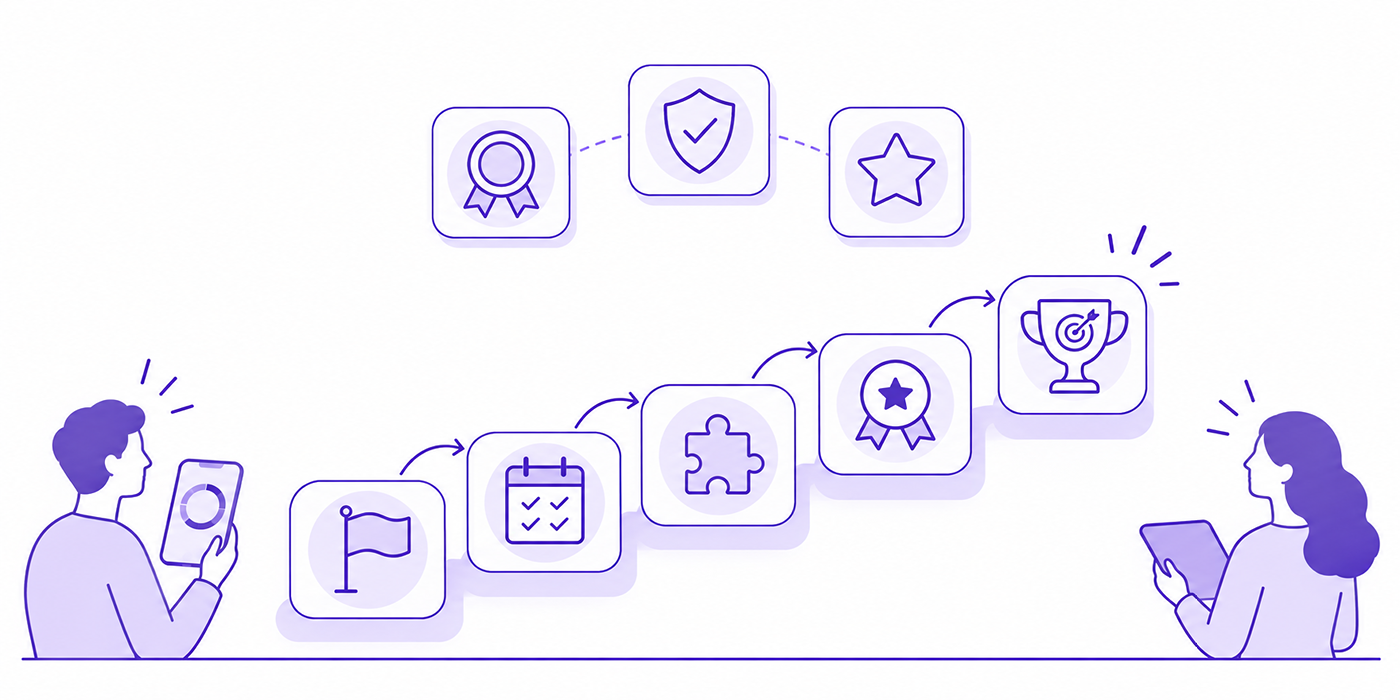
Gamification in coaching involves applying game design elements to professional coaching experiences to encourage participation, reinforce desirable behaviors, and make progress more tangible.
These elements include experience points, achievement badges, personalized missions, progress bars, milestone rewards, interactive challenges, and collaborative goals.
Effective gamification draws upon established principles of transformational coaching, emotional agility, and client motivation management.
Its purpose is to strengthen the connection between everyday actions and personally meaningful outcomes.
The Psychology Behind Gamified Coaching
Self-determination theory identifies three fundamental psychological needs that can influence motivation:
Autonomy: Clients experience ownership over their choices and actions.
Competence: Clients recognize improvements in their abilities.
Relatedness: Clients experience meaningful connection and social support.
Gamified programs can address these needs through personalized quests, visible skill development, and cooperative challenges.
Combining these mechanics with self-confidence coaching, self-actualization coaching, and positive intelligence helps coaches develop motivational systems that respect individual values and preferences.
Why Traditional Coaching Programs Lose Client Engagement
Many coaching businesses experience declining participation after the initial excitement of enrollment. Clients begin missing check-ins, postponing assignments, and attending sessions without completing agreed commitments.
Common underlying problems include delayed feedback, unrealistic expectations, overwhelming assignments, and insufficient recognition of incremental progress.
A carefully designed gamification system addresses these barriers through immediate feedback and achievable challenges. Integrating habit stacking, SMART goals, constructive feedback, and micro-coaching creates opportunities to demonstrate progress throughout the coaching relationship.
What Does Research Say About Gamification and Behavior Change?
Systematic reviews of randomized controlled trials suggest that gamification can produce improvements in physical activity, particularly when integrated into structured digital behavior change interventions.
Research also indicates potential benefits for learning engagement and participation. However, average improvements vary, and evidence supporting sustained outcomes after rewards are removed remains less established.
Coaches should treat gamification as a complementary intervention within broader behavior change strategies, holistic coaching, and accountability frameworks.
The following implementation framework identifies 30 practical gamification techniques, their ideal applications, and the outcomes coaches should measure.
2. How Gamification Transforms Health, Life, Leadership and Group Coaching
Different coaching niches require different game mechanics. A competitive challenge that motivates a sales professional could create unnecessary pressure for a client recovering from burnout.
Effective implementation begins with identifying the specific behavioral barrier preventing progress.
Health and Wellness Coaching: Building Sustainable Habits
Health coaching clients frequently struggle with consistency because their routines compete with employment demands, family obligations, unpredictable schedules, and environmental barriers.
Gamification can simplify behavioral commitments into achievable daily or weekly missions.
For example, a client pursuing a personally appropriate movement goal could complete three weekly walking commitments, track consistency privately, and review environmental barriers during coaching sessions.
Combining habit stacking, preventive health coaching, lifestyle medicine principles, and self-care coaching helps establish flexible programs that accommodate real-world limitations.
Coaches should reward appropriate behavioral consistency while avoiding competitive weight loss, excessive exercise targets, restrictive eating challenges, and other potentially harmful incentives.
Life Coaching: Turning Personal Development Into Tangible Progress
Personal development goals frequently lack observable milestones. Clients may describe wanting greater confidence, fulfillment, or purpose without knowing how to recognize meaningful improvement.
Gamification provides a structure for translating abstract aspirations into achievable experiences.
A confidence-building program could include progressive missions such as expressing a preference, initiating a conversation, communicating a boundary, and completing a personally meaningful professional challenge.
The Wheel of Life, life visioning techniques, life purpose coaching, and self-confidence development offer foundations for creating individualized progression pathways.
Achievements should reflect demonstrated behavior and client-defined growth rather than arbitrary personality scores.
Executive and Leadership Coaching: Developing Observable Competencies
Leadership coaching benefits from skill-based gamification because managerial competencies can often be translated into observable workplace behaviors.
A new manager could progress through a leadership skill tree covering delegation, active listening, constructive feedback, conflict resolution, and strategic decision-making.
Each level could require a practice exercise, real-world application, and reflective evaluation.
Integrating leadership coaching, conscious leadership, emotional intelligence, and constructive feedback techniques provides a comprehensive competency-development framework.
Corporate buyers can assess improvements through agreed behavioral indicators, participant reflections, and appropriately consented workplace feedback.
Career Coaching: Making Professional Development Actionable
Job seekers frequently become discouraged when application outcomes remain outside their control. Gamification can redirect attention toward constructive activities that clients can influence.
A career progression system could recognize networking conversations, portfolio improvements, interview rehearsals, and targeted applications.
Practitioners can combine career burnout coaching, public speaking coaching, and the T-GROW coaching model to help clients navigate rejection and uncertainty constructively.
Quality-adjusted achievements prevent participants from pursuing meaningless application volume simply to accumulate points.
Group Coaching: Using Collaboration to Increase Participation
Group coaching programs often experience uneven participation, with highly engaged members dominating conversations while quieter participants gradually withdraw.
Cooperative game mechanics can distribute opportunities for meaningful contribution.
Examples include shared weekly missions, rotating discussion roles, peer recognition, and collective problem-solving exercises.
Practitioners developing group programs through online coaching business models should incorporate cultural competence, safe coaching environments, and balanced coaching power dynamics.
Group success criteria should accommodate different abilities, schedules, communication styles, and personal circumstances.
3. How to Design a Gamified Coaching Program That Produces Measurable Results
Successful gamification requires a behavioral strategy, an understandable reward system, measurable progress indicators, and a deliberate transition toward independent motivation.
Coaches can use the following seven-step implementation framework.
Step 1: Identify the Behavior Preventing Client Progress
Start by examining where the client repeatedly encounters difficulty.
A missed commitment may reflect scheduling conflicts, insufficient skills, competing responsibilities, emotional resistance, or an unrealistic goal.
The Immunity to Change model, CLEAR coaching framework, and OSCAR coaching model can help uncover these barriers before introducing game mechanics.
Rewarding a behavior whose underlying barriers remain unresolved can create frustration and disengagement.
Step 2: Establish a Behavioral Baseline
Observe the target behavior for an appropriate period before launching a challenge.
For example, a client who completes two of five planned weekly actions has an initial completion rate of 40%.
The coach and client could agree on a manageable improvement target while adjusting the number and difficulty of commitments.
Integrating SMART goal development, behavior change coaching, and client accountability provides a meaningful foundation for evaluating subsequent progress.
Step 3: Select Game Mechanics According to Client Preferences
Different clients respond to different motivational experiences.
Achievement-oriented clients may enjoy levels and mastery badges.
Socially motivated clients may prefer cooperative missions.
Reflective clients may appreciate journals and discovery exercises.
Autonomy-oriented clients may prefer flexible, choice-based challenges.
Clients experiencing pressure or burnout may benefit from private progress tracking and recovery milestones.
Personalization reflects the principles of holistic coaching, emotional agility, and managing client expectations.
Allow clients to change or discontinue mechanics that feel uncomfortable.
Step 4: Create a Simple Points and Reward System
Consider an illustrative weekly scoring model:
Completing an agreed behavioral commitment: 10 points.
Completing a meaningful reflection: 5 points.
Identifying and addressing a practical barrier: 10 points.
Resuming a routine after a setback: 15 points.
Completing an agreed developmental milestone: 25 points.
Points should recognize useful actions, including recovery and adaptive problem-solving.
This approach complements positive psychology coaching and accountability coaching by emphasizing constructive engagement.
Avoid negative balances, punitive resets, artificial scarcity, and financial penalties that undermine client autonomy.
Step 5: Build an Eight-Week Progression Roadmap
An illustrative gamified coaching program could follow this sequence:
Week 1: Discovery. Establish goals, preferences, and baseline behaviors.
Week 2: Activation. Introduce one achievable daily or weekly mission.
Week 3: Consistency. Reinforce appropriate routines with immediate feedback.
Week 4: Reflection. Evaluate barriers and adjust challenge difficulty.
Week 5: Skill development. Introduce a more advanced, relevant exercise.
Week 6: Real-world application. Apply newly developed skills outside the program.
Week 7: Independence. Gradually reduce points and external reminders.
Week 8: Graduation. Assess outcomes and establish a maintenance plan.
Coaches can draw upon habit formation, the ADKAR model, and change management coaching when supporting clients through these stages.
Step 6: Establish a Feedback Loop
Feedback should explain what worked, why progress occurred, and which strategies clients can reproduce independently.
For example, recognizing that a client completed a task because they prepared the necessary materials the previous evening provides more developmental value than awarding a badge alone.
Integrate constructive coaching feedback, mental fitness techniques, and transformational behavioral strategies to strengthen learning.
Step 7: Measure Performance After Removing External Rewards
The ultimate test involves examining whether clients continue meaningful behaviors when points, badges, and reminders gradually disappear.
Conduct follow-up assessments approximately 30 and 90 days after program completion where appropriate.
Evaluate behavioral maintenance, perceived autonomy, confidence, and the client's ability to navigate setbacks independently. These measurements can support more credible program improvements and future coaching case studies.
4. The Business Opportunity: How Gamification Can Improve Coaching Revenue, Retention and Scalability
Gamification offers commercial advantages when it improves the client experience, strengthens program completion, and reduces the administrative burden associated with repetitive accountability tasks.
Coaches should evaluate these opportunities against acquisition costs, delivery expenses, client satisfaction, and independently measured outcomes.
Creating Premium Gamified Coaching Packages
A structured progression system can help prospective clients understand what they will receive throughout a coaching program.
Instead of selling an undefined series of appointments, coaches can develop milestone-based packages with clear developmental pathways.
Potential offerings include:
Eight-week habit mastery program: Personalized wellness missions and weekly progress reviews.
Leadership level-up accelerator: Competency-based professional development.
Career advancement challenge: Interview practice, networking missions, and portfolio development.
Confidence development journey: Graduated communication and assertiveness exercises.
Corporate wellbeing challenge: Inclusive, cooperative activities with confidential individual coaching.
Resources addressing health coaching niche profitability, premium life coaching niches, and coaching specialization strategies can help practitioners identify commercially appropriate audiences.
Understanding the Financial Impact of Client Retention
Consider an illustrative coaching business enrolling 40 clients monthly into a $250 recurring program.
Assume the monthly churn rate decreases from 20% to 12% following several program improvements, including gamification.
Across a comparable group of 40 active clients, that difference represents approximately 3.2 additional retained clients per monthly renewal cycle, equivalent to $800 in expected additional monthly renewal revenue.
If the gamification system costs $150 monthly, the illustrative incremental contribution is $650 before additional delivery expenses, taxes, and coach compensation.
Actual results require careful evaluation because retention improvements may also reflect changes in pricing, client selection, service quality, or other factors.
Practitioners should incorporate these calculations into broader health coaching revenue models, life coaching business economics, and coaching package pricing.
Choosing Technology Without Creating Unnecessary Expenses
Coaches can initially implement gamification using spreadsheets, digital journals, progress dashboards, client portals, and community platforms.
More sophisticated coaching software may offer automated challenges, custom badges, progress visualization, integrations, and client segmentation.
Evaluate potential technology according to:
Customizable progress and reward mechanics.
Client accessibility across devices.
Secure data storage and export options.
Private participation and tracking controls.
Automation flexibility.
Ability to disable competitive features.
Subscription and per-client costs.
Data portability when changing platforms.
Practitioners exploring technology's impact on coaching, AI-assisted coaching, and online coaching business development should prioritize technology that resolves demonstrated operational problems.
Using Gamification as a Client Acquisition Strategy
Short, voluntary challenges can introduce prospective clients to a coach's methodology before they purchase a comprehensive program.
A leadership coach might offer a five-day communication challenge, while a wellness coach could provide a seven-day routine exploration experience.
Participants should receive practical value and transparent information about subsequent paid services.
Integrating these experiences with coaching lead generation, effective discovery calls, and first-client acquisition strategies creates a coherent customer journey.
Track challenge completion, qualified inquiries, conversion rates, and subsequent client outcomes to determine commercial viability.
Scaling Corporate Coaching Through Cooperative Challenges
Corporate coaching programs can incorporate team-based missions targeting communication, sustainable routines, leadership capabilities, and collaborative problem-solving.
A six-week manager development program could include one weekly workplace application challenge, a structured reflection exercise, and confidential coaching feedback.
Coaches pursuing corporate health coaching, remote coaching opportunities, and professional coaching career development can differentiate their offerings through measurable learning objectives.
Employers should receive only agreed reporting information, with appropriate protections for personal health information and confidential coaching discussions.

5. Measuring Gamification Success, Avoiding Ethical Risks and Building Long-Term Motivation
A coaching program can generate impressive engagement statistics while producing limited meaningful development.
Coaches need evaluation systems capable of identifying genuine behavioral improvements, unintended consequences, and opportunities to strengthen program design.
The Most Important Gamification KPIs for Coaches
Track a combination of participation, behavioral, psychological, and commercial indicators.
Action completion rate: Completed agreed actions divided by planned actions.
Challenge participation rate: Participating clients divided by eligible enrolled clients.
Program completion rate: Clients completing the program divided by the starting cohort.
Behavioral improvement: Change in personally relevant behaviors from baseline.
Recovery rate: Proportion of clients successfully resuming commitments after setbacks.
Client autonomy: Self-reported ownership and independence in pursuing goals.
Post-program maintenance: Continued target behaviors after incentives are reduced.
Client retention: Eligible clients continuing services during a defined renewal period.
Adverse experiences: Reported pressure, shame, compulsive tracking, or distress.
Combining these indicators with SMART goal evaluation, accountability strategies, and transformational coaching supports comprehensive evaluation.
Interpret performance alongside client circumstances and qualitative feedback.
Preventing External Reward Dependency
Excessive reliance on points and prizes can encourage clients to pursue external recognition while neglecting the personal meaning of their goals.
Coaches should gradually shift attention toward functional benefits, personal satisfaction, increased confidence, and alignment with individual values.
For example, a client initially motivated by routine completion points might later identify improved scheduling confidence and greater control over daily commitments as personally meaningful rewards.
This transition aligns with self-actualization coaching, positive psychology, and life purpose exploration.
Avoiding Shame, Comparison and Punitive Competition
Leaderboards can disadvantage clients with disabilities, unpredictable work schedules, caregiving responsibilities, and other circumstances influencing participation.
Public rankings may also intensify perfectionism or create embarrassment when sensitive personal goals become visible.
Ethical alternatives include personal-best tracking, optional private challenges, cooperative objectives, and recognition of individualized improvement.
Coaches should draw upon inclusive coaching practices, professional duty of care, and safe coaching environments.
Any competitive feature should remain voluntary, transparent, and appropriate to the client population.
Maintaining Professional Boundaries and Data Privacy
Gamified health and wellness programs may collect sensitive information involving physical activity, emotional wellbeing, eating behaviors, sleep, and personal circumstances.
Coaches must establish clear agreements describing data collection, access permissions, reporting purposes, retention periods, and client withdrawal options.
Professional responsibilities involving informed consent, coaching contracts, ethical codes of conduct, and scope of practice remain applicable regardless of delivery technology.
Avoid presenting game-generated scores as medical diagnoses, psychological assessments, or validated health risk indicators.
Testing Whether Gamification Actually Adds Value
Coaches can pilot gamification with a small group of consenting clients while comparing outcomes with a previous program or a comparable nongamified group.
Where feasible, maintain similar coaching frequency, target behaviors, and participant eligibility.
Record completion rates, client-reported experiences, behavioral progress, support requirements, and post-program maintenance.
Practitioners should review findings through professional coach supervision and continuing professional development.
Small internal pilots can guide business decisions. Stronger causal claims require more rigorous evaluation and should be communicated carefully to avoid professional misrepresentation.
The Future of AI-Powered Gamification in Coaching
Artificial intelligence could support adaptive challenge difficulty, personalized progress summaries, context-sensitive reminders, and individualized learning pathways.
Wearable technology may also provide additional feedback for consenting wellness clients pursuing appropriate behavioral objectives.
These developments create opportunities for more responsive coaching programs, particularly when integrated with micro-coaching and emerging coaching technologies.
Human professional judgment remains essential for interpreting data, understanding personal circumstances, protecting autonomy, and ensuring that automated recommendations remain within appropriate ethical boundaries.
6. Frequently Asked Questions About Gamification in Coaching
-
Gamification in coaching is the application of game design elements, including personalized challenges, points, achievement badges, progress tracking, and collaborative missions, to support client engagement and behavioral development.
It complements established health behavior change techniques by providing more visible feedback and structured opportunities for participation.
-
Research suggests that gamification can improve engagement and certain behavioral outcomes, particularly physical activity. Effectiveness depends on the population, program design, intervention duration, and selected game mechanics.
Coaches should combine gamification with accountability frameworks and evaluate whether improvements continue after external rewards are reduced.
-
Personalized habit challenges, private progress trackers, flexible streaks, reflection exercises, and achievable milestones are useful starting points.
These techniques work alongside habit stacking and self-care coaching while accommodating individual limitations and appropriate health goals.
-
Adult clients can benefit from competency-based progression, real-world challenges, decision simulations, personal scorecards, and structured milestone recognition.
Executive programs should connect game mechanics to relevant professional capabilities through established leadership coaching principles.
Professional language and meaningful performance criteria help maintain credibility.
-
Use terminology appropriate to the client's developmental objectives. Progress pathways, competency milestones, performance challenges, and mastery levels may resonate more strongly with professional audiences than cartoon avatars or decorative rewards.
Integrating game mechanics with the CLEAR coaching model helps preserve a structured professional experience.
-
Gamification may support retention by making progress more visible, encouraging participation, and creating structured opportunities for feedback.
Coaches should measure retention alongside client satisfaction and actual behavioral outcomes. Effective client expectation management remains an important component of sustained engagement.
