
Online group coaching is transforming how coaches deliver personalized support, build sustainable businesses, and serve more clients without exhausting their calendars. Digital platforms combine live sessions, automated onboarding, progress tracking, community engagement, and recurring payments into scalable coaching ecosystems. For professionals struggling with inconsistent income, expensive client acquisition, and limited one-to-one capacity, group coaching creates opportunities to increase revenue while preserving meaningful client relationships. Success depends on selecting technology that strengthens behavior change, reinforces client accountability, supports coaching business development, and delivers measurable outcomes.
1. Why Online Group Coaching Is Becoming a Scalable Business Model
Traditional one-to-one coaching creates a fundamental capacity constraint: every additional client requires additional professional time. Coaches eventually encounter a revenue ceiling determined by their available working hours, session prices, and ability to maintain service quality.
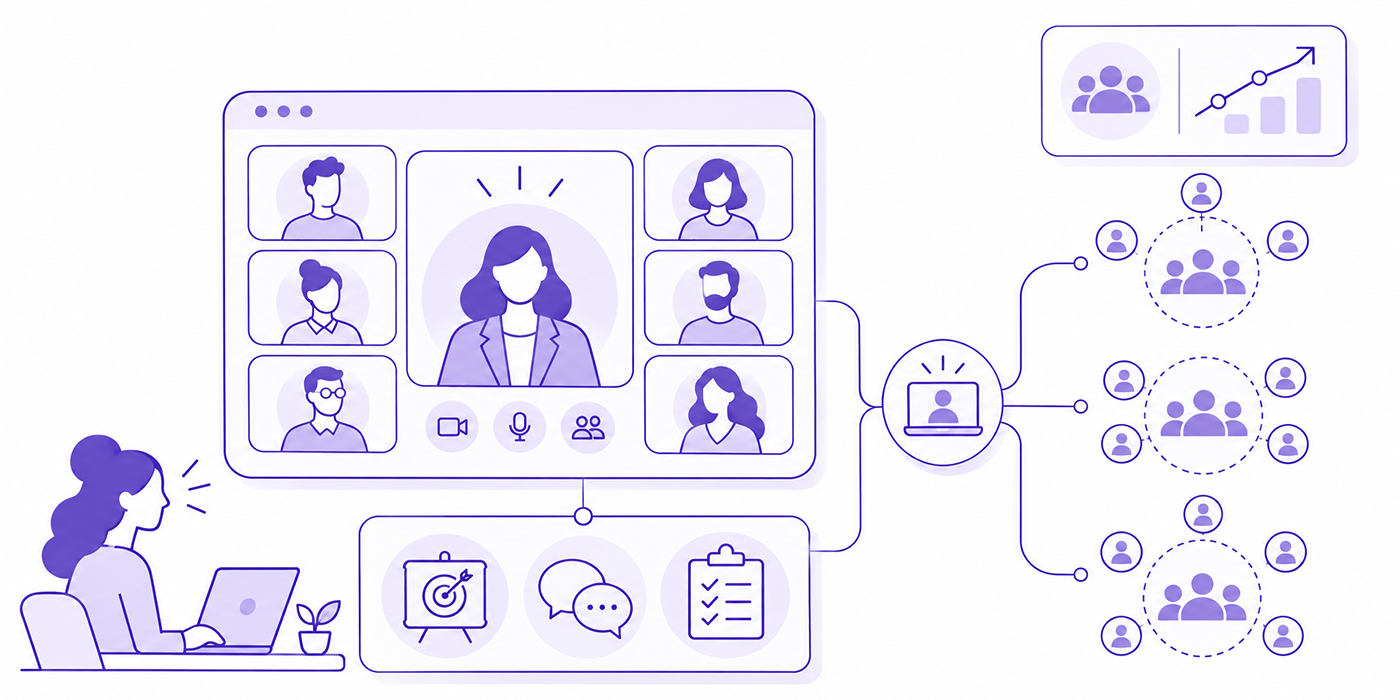
Online group coaching changes this economic structure by allowing multiple clients with compatible objectives to participate in a shared coaching experience. When combined with effective accountability coaching, structured SMART goals, and targeted coaching niches, group delivery can create substantially greater revenue capacity.
Understanding the economics of group coaching
Consider a coach charging $100 for an individual session and conducting 20 sessions weekly. This generates $2,000 in gross weekly revenue before business expenses.
Alternatively, the coach could operate four groups containing 12 participants each, with every participant paying $200 monthly. This produces $9,600 in monthly gross revenue from 48 clients and four weekly group sessions.
The remaining working hours can support onboarding, individual feedback, client acquisition, program development, and continuing professional development.
These illustrative calculations highlight why understanding health coaching business revenue models and life coaching client loads becomes increasingly important during expansion.
Group coaching creates additional sources of client value
A professionally facilitated group introduces mechanisms that individual coaching cannot easily replicate at the same scale:
Peer accountability: Participants reinforce commitments through shared progress reviews.
Collective problem-solving: Members discover alternative strategies through other participants' experiences.
Social learning: Clients observe how others overcome comparable behavioral barriers.
Community continuity: Support continues between scheduled coaching sessions.
Accessible pricing: Participants receive structured professional support at a potentially lower individual cost.
Shared achievement: Group milestones reinforce motivation and belonging.
These mechanisms complement positive psychology coaching, emotional intelligence development, and sustainable habit formation.
The strongest group programs organize participants around compatible needs. A group of professionals recovering from occupational burnout, for example, can benefit from shared discussions about workload boundaries, recovery routines, and workplace expectations through structured career burnout coaching.
Choosing the right group coaching delivery model
A fixed-duration cohort works particularly well for measurable objectives with a defined progression. Membership communities suit ongoing development, while premium small-group programs accommodate participants requiring more individualized attention.
Coaches should align their delivery model with their expertise, niche demand, available resources, and realistic client expectations.
The following framework identifies 32 technologies and operational systems that can support a scalable online group coaching business.
2. How Digital Platforms Remove the Operational Barriers to Coaching Business Growth
Many coaching businesses experience operational breakdowns when client numbers increase. Welcome emails become inconsistent, payment follow-ups consume productive hours, client commitments disappear into scattered messages, and coaches struggle to remember who requires additional support.
Effective implementation of coaching technology addresses these problems through centralized workflows while protecting the relationship-building skills underlying successful client transformations.
Automating enrollment without sacrificing client suitability
An effective enrollment system moves qualified prospects through a predetermined sequence:
A prospective participant submits an application.
The coach assesses suitability and identifies potential referral needs.
The participant receives the program agreement and payment instructions.
Successful enrollment triggers a welcome email.
The participant receives platform access, session dates, and preparation materials.
A baseline assessment establishes individual priorities.
The coach reviews participants requiring additional accommodations or support.
Automating administrative steps allows coaches to spend more time practicing effective discovery call techniques, implementing appropriate coaching agreements, and obtaining informed consent.
Retain human oversight of suitability decisions, sensitive disclosures, and referral requirements.
Building reusable coaching infrastructure
A reusable curriculum can include foundational educational videos, reflection exercises, goal-setting templates, weekly challenges, and progress assessments.
Coaches delivering a lifestyle improvement program might organize educational content around holistic coaching, self-care practices, and practical habit stacking.
Participants complete foundational material independently, allowing live coaching time to focus on obstacles, decisions, reflection, and personalized behavioral strategies.
This structure reduces repeated explanations while accommodating different learning speeds. Coaches can further strengthen implementation through the T-GROW coaching model and the outcome-focused OSCAR coaching model.
Choosing a platform around your actual business bottleneck
Purchasing an expensive all-in-one platform before validating demand can create unnecessary financial pressure.
Evaluate technology according to the problem currently limiting growth:
When attendance is inconsistent, prioritize reminders and calendar integration.
When participants disengage between sessions, prioritize private communities and check-ins.
When onboarding consumes excessive time, prioritize automated enrollment workflows.
When acquiring clients is difficult, prioritize lead nurturing and enrollment systems.
When client outcomes are inconsistent, prioritize goal tracking and personalized feedback.
This approach protects profitability while supporting realistic coaching practice development.
Calculate each platform's total cost, including transaction fees, subscription increases, staff access, migration expenses, integration requirements, and administrative time. A lower subscription price can conceal significant operational costs as enrollment expands.
3. Designing Online Group Coaching Programs That Deliver Measurable Results
The effectiveness of group coaching depends heavily on program design. Participants require enough shared structure to create collective momentum and enough flexibility to address their individual circumstances.
Combining transformational coaching strategies with emotional agility helps coaches manage this balance.
Build cohorts around compatible problems
Grouping participants solely according to demographic characteristics can produce inconsistent engagement. A more effective approach involves screening for compatible objectives, readiness for change, availability, and support requirements.
Examples of focused programs include:
Eight-week burnout prevention coaching for working professionals.
Twelve-week healthy habit development programs.
Leadership development cohorts for newly promoted managers.
Confidence-building groups for professionals returning to employment.
Sustainable lifestyle improvement programs for busy adults.
Specialization supports stronger positioning through life coaching niche selection, leadership coaching, preventive health coaching, and self-confidence development.
Establish an eight-week coaching framework
A structured eight-week program could follow this progression:
Week 1: Baseline and personal objectives. Use the Wheel of Life or another suitable assessment to establish priorities and identify barriers.
Week 2: Behavioral awareness. Help participants identify recurring patterns, environmental triggers, and assumptions through principles of the Immunity to Change model.
Week 3: Sustainable action planning. Establish small, repeatable behaviors using practical habit formation techniques.
Week 4: Managing setbacks. Introduce strategies for emotional regulation, realistic expectations, and stress management.
Week 5: Environmental support. Identify social relationships, routines, and practical resources that reinforce progress.
Week 6: Personalized problem-solving. Use constructive feedback to address persistent obstacles and revise commitments.
Week 7: Building independence. Develop self-monitoring skills and reduce excessive reliance on external accountability.
Week 8: Outcomes and maintenance. Compare baseline progress, establish a maintenance plan, and identify appropriate next steps.
The sequence can incorporate the ADKAR change management model to address awareness, motivation, capability, and reinforcement throughout the program.
Structure live sessions for meaningful participation
A 60-minute session for a small coaching group could allocate:
Five minutes for arrival and emotional check-ins.
Ten minutes for reviewing previous commitments.
Fifteen minutes for targeted coaching discussions.
Fifteen minutes for facilitated peer exercises.
Ten minutes for personalized action planning.
Five minutes for commitment confirmation.
Rotate focused coaching opportunities across sessions and offer alternative participation methods for quieter members. Principles from the CLEAR coaching model, cultural competence, and balanced coaching power dynamics help preserve equitable participation.
Monitor progress between sessions
Weekly attendance alone provides limited information about client development. Combine attendance with action completion, self-reported confidence, individual milestone attainment, and qualitative feedback.
Short micro-coaching interventions can address emerging obstacles before participants disengage entirely.
4. Pricing, Monetization and Profitability Strategies for Online Group Coaches
Group coaching profitability depends on enrollment capacity, delivery costs, client retention, and the ability to acquire participants at sustainable prices.
Coaches developing their offers should study health coaching pricing strategies and life coaching package economics before establishing their pricing structure.
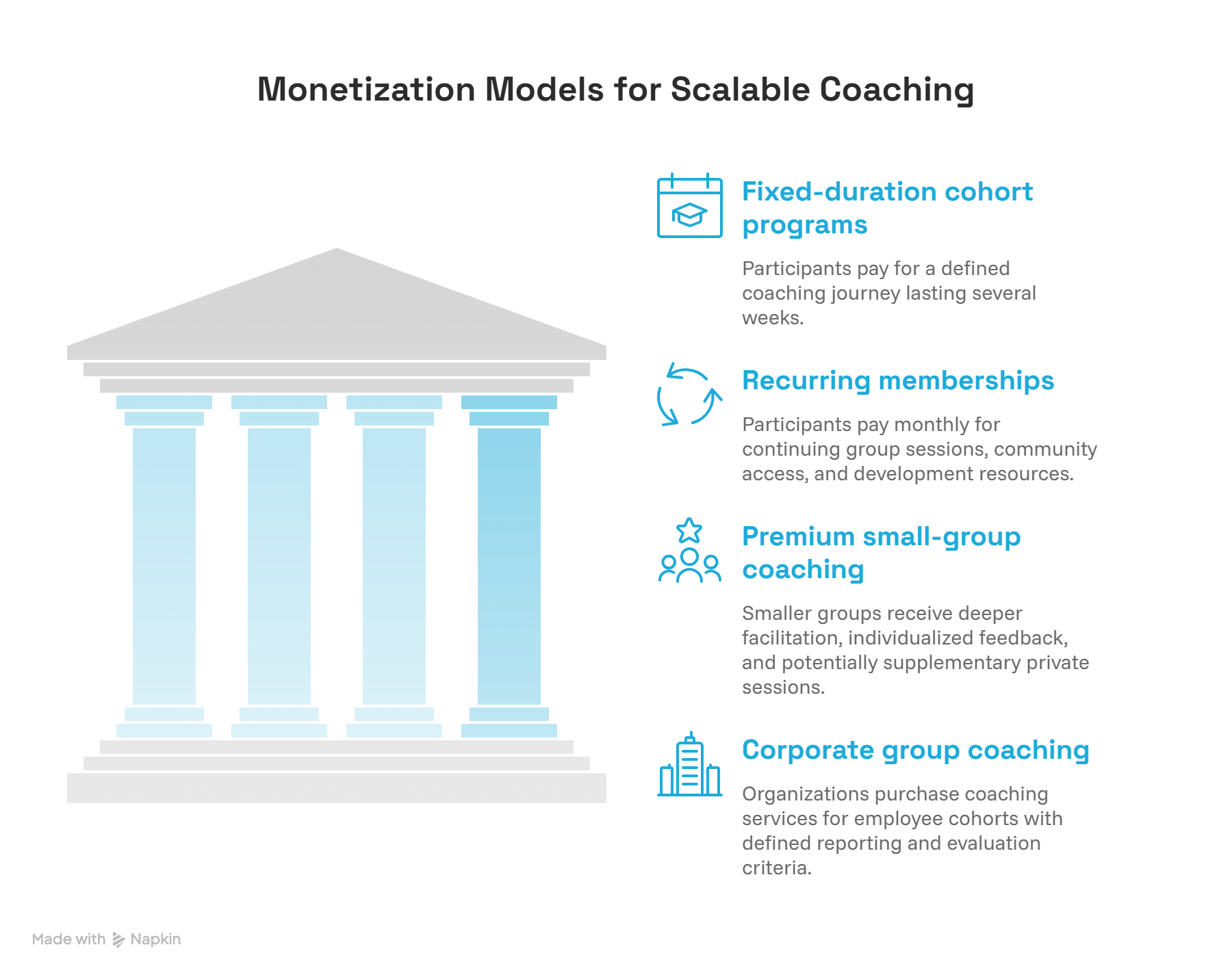
Four monetization models for scalable coaching businesses
Fixed-duration cohort programs
Participants pay for a defined coaching journey lasting several weeks. This model supports outcome-focused marketing, predictable delivery schedules, and clear completion milestones.
An eight-week cohort charging $399 per participant and enrolling 20 clients generates $7,980 in gross program revenue.
Recurring memberships
Participants pay monthly for continuing group sessions, community access, and development resources. This model requires consistent engagement and ongoing relevance.
A community with 80 paying members at $79 monthly generates $6,320 in monthly gross recurring revenue.
Premium small-group coaching
Smaller groups receive deeper facilitation, individualized feedback, and potentially supplementary private sessions. This model works particularly well for specialized executive coaching, life purpose coaching, and professional development programs.
Corporate group coaching
Organizations purchase coaching services for employee cohorts. Contracts may include multiple groups, defined reporting requirements, and agreed evaluation criteria.
Understanding corporate health coaching opportunities helps coaches identify potential institutional buyers.
Calculate your break-even enrollment
Consider an illustrative eight-week program charging $350 per participant.
The coach budgets:
Platform expenses: $200.
Marketing expenses: $600.
Coaching and preparation time: $1,600.
Administrative support: $400.
Resources and contingency: $200.
Total budgeted costs equal $3,000. Assuming combined payment and platform transaction fees of 4%, each enrollment contributes approximately $336 toward those costs.
The program requires nine paying participants to cover its budgeted expenses. At 20 participants, gross revenue reaches $7,000, leaving approximately $3,720 after the assumed transaction fees and budgeted costs, before taxes.
This calculation incorporates compensation for the coach's delivery time, preventing an inflated impression of profitability. It also supports more realistic decisions about building a sustainable coaching career.
Develop a client acquisition system before expanding capacity
Start by validating the offer through conversations with prospective participants. Identify their recurring obstacles, previous unsuccessful solutions, purchasing concerns, and preferred support formats.
Build marketing around those insights and develop a structured enrollment pathway through educational content, webinars, referrals, and qualified discovery calls.
Research into first-client acquisition timelines, coaching market saturation, and client trust in coaching qualifications can help inform positioning.
Track qualified leads, enrollment conversion, acquisition costs, and refunds for each campaign. Expansion becomes considerably easier when the coach understands which acquisition channels reliably produce suitable clients.
Increase lifetime value through appropriate continuation offers
Graduating participants may benefit from maintenance memberships, advanced cohorts, alumni workshops, or individualized support.
Base continuation recommendations on client needs and informed choice. Transparent coaching ethics and responsible client expectation management protect trust while supporting sustainable recurring revenue.
5. Scaling Group Coaching While Protecting Personalization, Ethics and Client Retention
A rapidly expanding coaching business can lose credibility when participants feel anonymous, confidentiality becomes difficult to maintain, and automated systems replace meaningful professional attention.
Growth requires operational safeguards grounded in duty of care, a clearly defined scope of practice, and consistent professional supervision.
Establish a personalization layer within every cohort
Each participant should have an individual coaching objective, documented commitments, and appropriate opportunities to discuss personal barriers.
A scalable personalization system may include:
Individual onboarding assessments.
Private progress check-ins.
Rotating focused coaching opportunities.
Goal-specific resources.
Optional private conversations where appropriate.
Personalized completion summaries.
Coaches can combine these mechanisms with constructive feedback strategies and emotional intelligence coaching.
Determine maximum group size according to the amount of meaningful participation each client requires. Eight to twelve participants can provide a practical starting point for interactive cohorts, while larger groups may require breakout activities, additional facilitators, or a more educational delivery format.
Detect disengagement before clients cancel
Declining participation often becomes visible before a client formally withdraws.
Establish internal intervention triggers, such as two consecutive missed sessions, repeated incomplete check-ins, declining confidence scores, or stalled personal commitments.
A private conversation can explore whether workload, technology barriers, mismatched expectations, accessibility challenges, or discomfort within the group are preventing engagement.
Effective intervention combines accountability techniques, safe coaching environments, and appropriate emotional crisis support.
Protect confidentiality across digital platforms
Group confidentiality requires additional precautions because participants gain access to information shared by other members.
Coaching agreements should explain confidentiality expectations, recording permissions, communication boundaries, information handling, and circumstances requiring professional referral or disclosure.
Participants should understand that peer confidentiality cannot be guaranteed completely.
For health-focused programs, assess platform privacy terms, data retention policies, access controls, and applicable privacy requirements. HIPAA obligations depend on the business's role and circumstances, including whether it operates as a covered entity or business associate.
Combine digital safeguards with sound informed consent practices, appropriate professional indemnity insurance, and awareness of ethical misrepresentation.
Use artificial intelligence responsibly
AI tools can assist with administrative planning, generic educational material, reminder preparation, and anonymized feedback analysis.
Sensitive disclosures, individualized coaching judgments, and health-related decisions require appropriate human oversight. Obtain suitable permissions before processing client information through third-party systems.
The growing discussion surrounding AI health coaching and human coaches highlights the continuing importance of empathy, contextual judgment, relationship management, and professional boundaries.
Track the metrics that determine sustainable growth
A monthly coaching business review should evaluate:
Enrollment conversion rate: The percentage of qualified prospects becoming paying participants.
Customer acquisition cost: Marketing and sales expenditure divided by acquired clients.
Attendance rate: Attended sessions divided by expected participant attendance.
Action completion rate: Completed commitments divided by agreed commitments.
Program completion rate: Participants completing the program divided by enrolled participants.
Goal attainment rate: Participants achieving their predefined objectives.
Membership churn: Lost members divided by members at the beginning of the measurement period.
Program contribution: Revenue remaining after directly attributable delivery costs.
Coach utilization: Professional time spent delivering and supporting coaching relative to available capacity.
Review these metrics alongside qualitative feedback. High attendance with poor goal attainment indicates a potential curriculum or implementation problem. Strong outcomes alongside weak profitability may indicate underpricing or excessive delivery costs.
Investing in continuing professional development and regularly evaluating client transformation strategies can help maintain quality during expansion.
6. Frequently Asked Questions About Online Group Coaching
-
The appropriate platform depends on your delivery model. Zoom can support live interactive sessions, Circle and Mighty Networks can accommodate community-centered programs, and Kajabi can suit businesses combining educational products with marketing workflows. Dedicated coaching management platforms may provide stronger administrative and client accountability features. Evaluate your requirements using principles of technology-enabled coaching before committing to a subscription.
-
Eight to twelve participants can provide a manageable starting point for highly interactive coaching. Educational workshops and community memberships may accommodate considerably larger audiences. Consider session duration, individual attention requirements, participant needs, and facilitator experience. Maintaining a safe coaching environment becomes increasingly important as group size increases.
-
A business with 50 active members paying $175 monthly would generate $105,000 in annual gross revenue if membership remained stable throughout the year. Actual earnings depend on enrollment, churn, platform costs, marketing expenditure, staffing, refunds, and taxes. Developing a realistic understanding of coaching income models is essential before making expansion commitments.
-
A new coach can begin with video conferencing, secure client administration, payment processing, and a simple educational resource library. Validate demand through a paid pilot before investing in complex automation. Coaches struggling with early enrollment should prioritize acquiring their first coaching clients before increasing fixed technology expenses.
-
Use individual goals, private check-ins, rotating coaching opportunities, personalized feedback, and flexible action plans. Shared curriculum should accommodate different readiness levels and practical circumstances. The OSCAR coaching framework provides one approach to structuring outcome-focused individual conversations within broader programs.
-
Create achievable weekly commitments, meaningful progress reviews, accessible communication channels, and opportunities for peer support. Identify disengagement early and privately investigate its causes. Combining positive psychology coaching with practical accountability systems can strengthen continued participation.
