
The future of coaching is increasingly shaped by precision, accessibility, and timely intervention. Micro-coaching, a focused approach built around short, outcome-driven conversations, addresses growing demand for personalized support without lengthy appointments. By combining health behavior change, structured accountability coaching, and practical habit formation strategies, coaches can help clients overcome immediate obstacles while developing sustainable independence. As technology transforms the coaching profession, micro-coaching represents a compelling opportunity for professionals entering 2027-2028 to improve client engagement, diversify service delivery, and build businesses around measurable progress.
1. What Is Micro-Coaching and Why Is Demand Expected to Accelerate in 2027-2028?
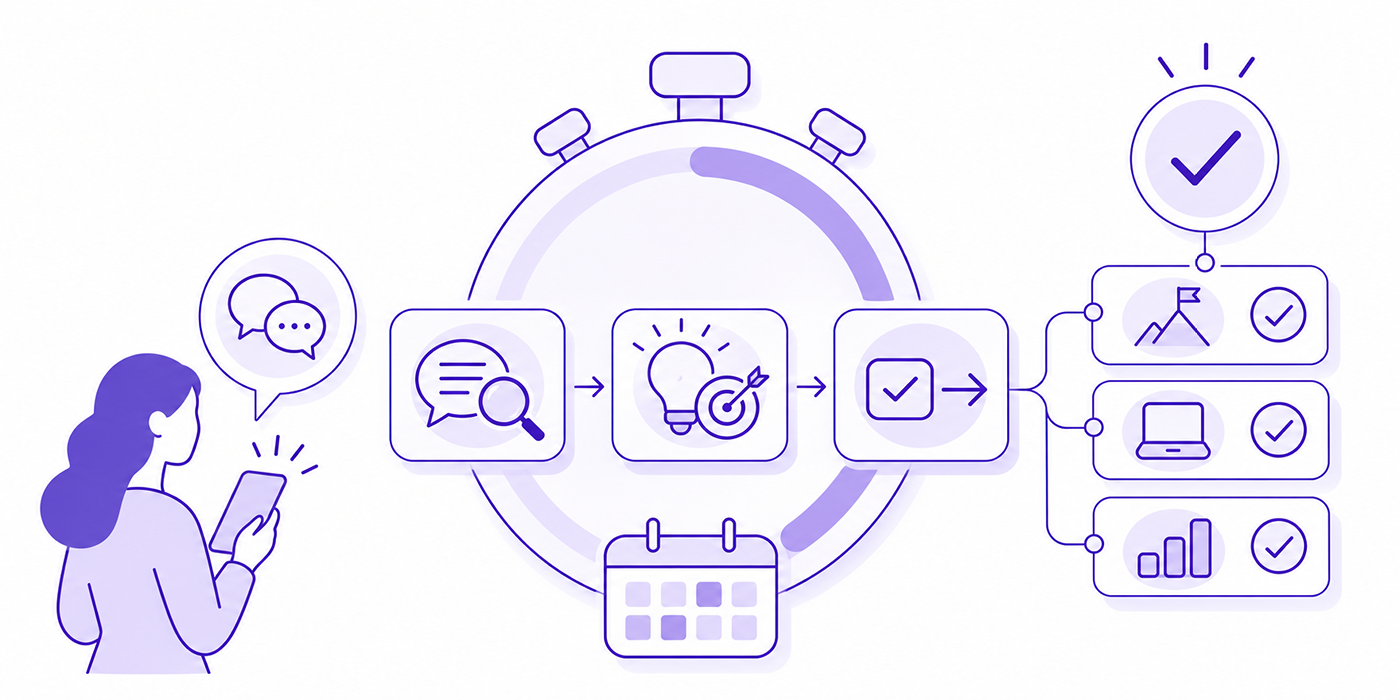
Micro-coaching is a structured coaching intervention typically lasting between 5 and 20 minutes, designed to address a specific challenge, decision, behavioral obstacle, or performance objective.
Its effectiveness depends on narrowing the conversation to an achievable outcome. A client struggling with several lifestyle challenges might dedicate one session exclusively to overcoming the environmental barriers preventing consistent morning exercise.
The format draws from established approaches, including the OSCAR coaching model, T-GROW coaching framework, and SMART goal-setting methodology.
The growing problem of delayed coaching intervention
A client may experience a motivational setback on Tuesday while their next scheduled coaching appointment falls on Friday. During those intervening days, frustration can develop into avoidance, disengagement, and abandonment of previously established commitments.
Micro-coaching provides an opportunity to intervene while the problem remains specific and manageable.
Consider a professional participating in a career burnout coaching program. A focused conversation immediately before a difficult workplace discussion could help them identify a realistic boundary, rehearse their communication, and establish a follow-up commitment.
This responsiveness strengthens the practical application of emotional agility and coaching for emotional intelligence.
Why shorter coaching engagements are becoming commercially attractive
For 2027-2028, several developments make micro-coaching an attractive service model:
Lower scheduling friction: Clients can integrate appointments into demanding professional and family schedules.
Contextual support: Conversations address challenges close to the moment they occur.
Accessible entry-level services: Prospective clients can experience coaching through smaller financial commitments.
Flexible corporate delivery: Organizations can introduce coaching without repeatedly removing employees from productive work.
Technology-enabled continuity: Digital check-ins support ongoing progress between scheduled conversations.
These opportunities are particularly relevant to professionals exploring corporate health coaching, developing an online coaching business, or competing for remote health coaching opportunities.
Research supporting brief coaching interventions provides encouraging foundations, although the relative effectiveness of different micro-coaching session lengths requires further investigation. Coaches should therefore validate their own delivery models using client-specific outcome measurements.
2. The Psychology Behind Micro-Coaching: How Short Conversations Create Meaningful Behavioral Change
Micro-coaching becomes valuable when its frequency, timing, and conversational structure support the client's capacity to translate intention into action.
A lengthy conversation can generate numerous insights while leaving clients uncertain about implementation. A narrowly defined intervention reduces the number of competing decisions and directs attention toward an achievable behavioral experiment.
This principle supports transformational coaching strategies and complements the practical application of positive psychology coaching.
Reducing the intention-action gap
Clients frequently understand their objectives while struggling to act consistently because of environmental friction, competing priorities, or unrealistic expectations.
Effective micro-coaching examines the circumstances surrounding unsuccessful attempts.
For example, a client repeatedly missing morning exercise may benefit from exploring their evening preparation routine, available time, and preferred activity intensity. Through habit stacking, the coach can help them attach a realistic movement commitment to an established morning behavior.
Using insights from the immunity to change model, coaches can also investigate competing commitments that make apparently desirable changes difficult.
Building a rapid feedback loop
Micro-coaching creates opportunities for a continuous learning cycle:
Identify a specific behavioral obstacle.
Establish a small experiment.
Attempt the behavior in its real-life context.
Review the result during a subsequent interaction.
Adjust the strategy according to observed evidence.
This process makes accountability in coaching more informative because conversations examine implementation rather than relying exclusively on subjective motivation.
When combined with constructive coaching feedback, unsuccessful attempts become useful information about what the client requires to succeed.
Developing self-efficacy through achievable commitments
Clients who repeatedly miss ambitious targets may gradually lose confidence in their ability to change. Smaller commitments create opportunities to accumulate evidence of competence.
A coach specializing in self-confidence development might help a client progress from preparing one contribution before a meeting to participating in increasingly challenging workplace discussions.
The progression should follow the client's readiness, using techniques drawn from positive intelligence coaching and careful management of client expectations.
Successful micro-coaching ultimately develops transferable problem-solving skills that clients can apply independently when new challenges emerge.
3. How to Conduct a High-Impact Micro-Coaching Session in 15 Minutes
Delivering effective coaching under tight time constraints requires disciplined listening, accurate questioning, and careful management of conversational priorities.
Coaches can adapt elements of the CLEAR coaching model into the following five-stage session structure.
Minutes 0-2: Establish the outcome
Begin by asking:
“What would make these next 15 minutes genuinely useful to you?”
The response should identify a problem sufficiently narrow for meaningful exploration. A broad concern such as career dissatisfaction could become a specific objective of preparing for an upcoming performance review.
Effective contracting in coaching gives both participants a shared understanding of the session's boundaries.
Minutes 2-5: Identify the immediate obstacle
Explore the conditions preventing progress through targeted questions:
What have you already attempted?
When does this problem become most difficult?
What assumption might be influencing your decision?
Which part of the situation remains within your control?
Coaches working with sensitive personal concerns should maintain a safe coaching environment while applying appropriate cultural competence.
Minutes 5-9: Develop practical alternatives
Help the client generate two or three realistic options. Compare each against their available resources, willingness, constraints, and previous experiences.
Techniques associated with transactional analysis in coaching can help explore recurring communication patterns, while the ADKAR change model offers a useful way to consider whether awareness, desire, knowledge, ability, or reinforcement is missing.
Minutes 9-12: Create an implementation commitment
Translate the chosen option into a specific action.
For example:
“After my Wednesday team meeting, I will spend five minutes preparing the delegation request and send it before lunch.”
Include the behavioral trigger, expected action, timing, and foreseeable obstacle. For complex goals, the Wheel of Life coaching tool can be used during a separate planning session to identify competing priorities.
Ask the client to rate their confidence in completing the commitment from zero to ten. A low rating creates an opportunity to redesign the action before the session concludes.
Minutes 12-15: Establish accountability and closure
Ask the client to summarize their own next step and determine how progress will be reviewed.
Document the agreed action, review date, and relevant barriers while maintaining appropriate confidentiality.
The coach's ability to manage power dynamics is especially important here. Client ownership should remain central, even when limited time creates pressure to offer immediate solutions.
4. The Most Profitable Micro-Coaching Business Models and Pricing Strategies
Micro-coaching introduces opportunities to diversify revenue while addressing the affordability concerns that frequently prevent prospective clients from purchasing traditional coaching packages.
However, sustainable pricing requires understanding the complete service workload, including preparation, documentation, scheduling, client communication, and administrative responsibilities.
Professionals evaluating health coaching income potential or the economics of full-time life coaching should consider the following illustrative business models.
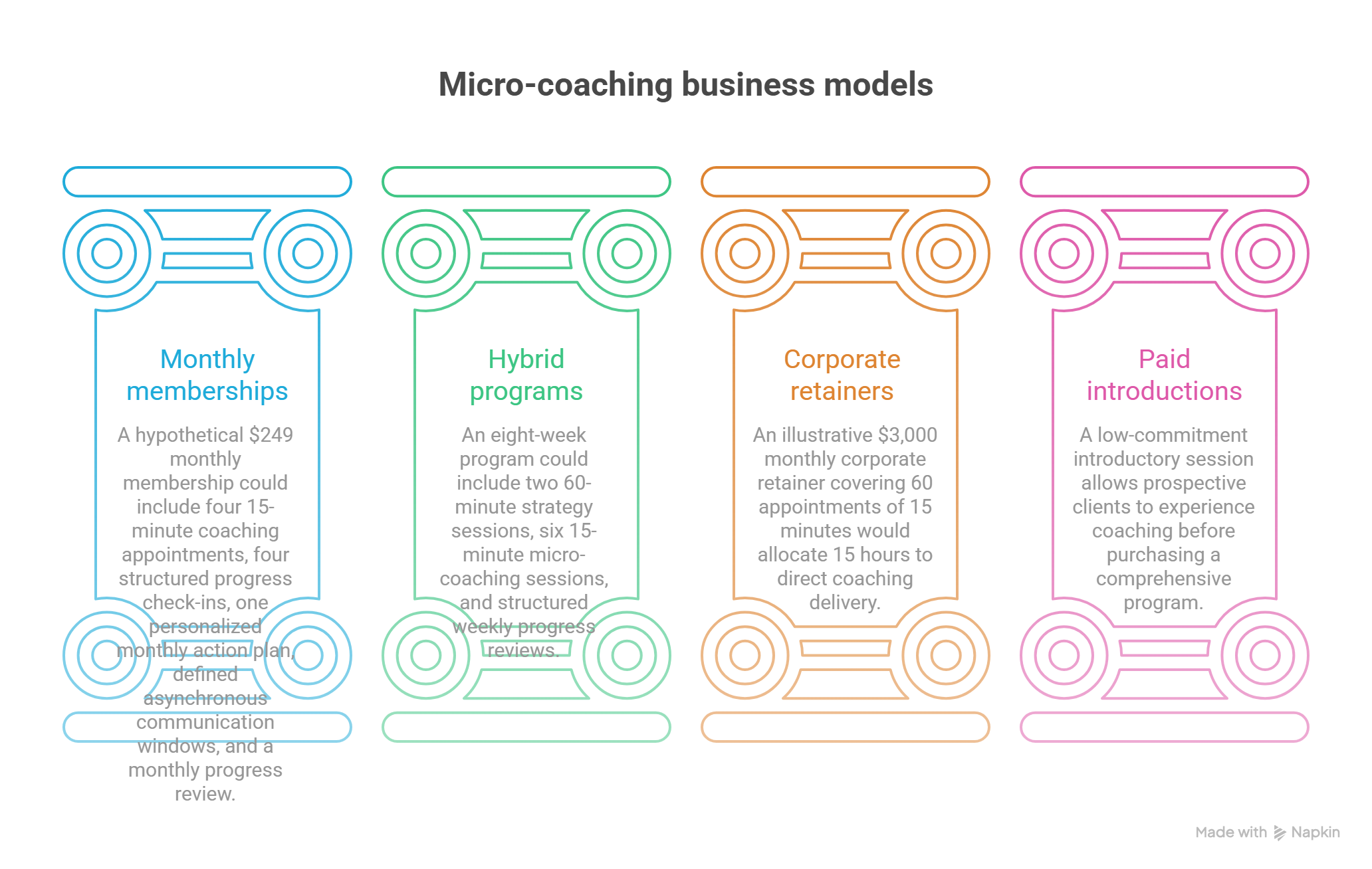
Model 1: Monthly micro-coaching memberships
A hypothetical $249 monthly membership could include:
Four 15-minute coaching appointments.
Four structured progress check-ins.
One personalized monthly action plan.
Defined asynchronous communication windows.
A monthly progress review.
With 25 members, this model would generate $6,225 in gross monthly revenue before operating expenses, taxes, refunds, and acquisition costs.
The scheduled sessions require 25 hours monthly. Allowing additional time for documentation, check-ins, and administration could bring total delivery time to approximately 50 hours.
This produces an illustrative gross revenue rate of $124.50 per delivery hour.
Coaches should compare these economics against their existing health coaching pricing strategy and realistic client acquisition timelines.
Model 2: Hybrid transformation programs
Hybrid programs combine comprehensive appointments with shorter interventions between sessions.
For example, an eight-week program could include two 60-minute strategy sessions, six 15-minute micro-coaching sessions, and structured weekly progress reviews.
This format is particularly relevant to holistic coaching, lifestyle medicine coaching, and preventive health coaching, where comprehensive goal development and ongoing implementation support serve different purposes.
Model 3: Corporate micro-coaching retainers
Organizations can purchase a defined number of coaching appointments for employees, managers, or leadership development participants.
An illustrative $3,000 monthly corporate retainer covering 60 appointments of 15 minutes would allocate 15 hours to direct coaching delivery.
Contracts should account for additional administration, scheduling coordination, anonymized reporting, and organizational stakeholder meetings.
Coaches specializing in leadership development, conscious leadership, and public speaking coaching can package focused interventions around identifiable workplace objectives.
Model 4: Paid introductory coaching
A low-commitment introductory session allows prospective clients to experience coaching before purchasing a comprehensive program.
The session should deliver standalone value through a narrowly defined outcome, regardless of whether the participant becomes a paying long-term client.
This can address challenges involving coaching discovery call conversions, coaching certification credibility, and the positioning mistakes that leave certified coaches struggling to find clients.
Avoid making introductory appointments dependent on aggressive sales conversations. Establish transparent pricing and allow clients to evaluate the service independently.
5. How to Scale Micro-Coaching Without Sacrificing Client Outcomes, Ethics, or Professional Quality
The primary operational risk of micro-coaching emerges when increasing session volume creates fragmented client histories, insufficient preparation, and weak professional boundaries.
Sustainable delivery requires infrastructure supporting both continuity and client autonomy.
Build a minimal technology ecosystem
A practical micro-coaching technology stack should include:
Secure appointment scheduling with buffer periods.
Video or audio communication appropriate to client privacy requirements.
Protected client records and progress documentation.
Structured pre-session questionnaires.
Secure asynchronous check-in capabilities.
Billing and membership management.
The increasing availability of AI-assisted coaching tools creates opportunities to reduce administrative work, although sensitive client information requires careful protection.
Explain technology usage through appropriate informed consent procedures, including recording practices, information processing, and relevant privacy limitations.
Measure outcomes instead of counting appointments
Session volume provides an incomplete picture of coaching quality. Coaches should establish measurements that reflect meaningful implementation and independence.
Useful performance indicators include:
Action completion rate: Completed commitments divided by total agreed commitments.
Time to action: The interval between establishing a commitment and attempting it.
Behavioral consistency: Frequency of the target behavior across an agreed observation period.
Recovery time: How quickly clients resume their intended behavior following setbacks.
Client independence: The proportion of challenges clients resolve without requesting additional intervention.
Goal attainment: Progress against individually established outcome criteria.
For professionals exploring health coaching niches or developing specialized life coaching services, these measurements can also inform service positioning and program improvement.
Report individual results transparently and avoid attributing every observed improvement exclusively to coaching.
Establish explicit availability boundaries
Micro-coaching can create unrealistic expectations of immediate availability when coaches offer vaguely defined access.
Every agreement should specify booking limits, communication response times, rescheduling policies, emergency exclusions, and procedures for concerns requiring additional professional support.
These safeguards reinforce the principles of duty of care and a professional coaching code of conduct.
Review whether your professional indemnity insurance covers your specific digital delivery arrangements and relevant client jurisdictions.
Recognize situations requiring longer sessions or referrals
Complex emotional distress, suspected eating disorders, significant psychological symptoms, medical concerns, and recurring unresolved conflicts may require different forms of support.
Coaches must understand the professional distinctions between a therapist and life coach and between a health coach, dietitian, and nutritionist.
Maintain a clearly defined scope of practice, establish referral pathways, and prepare procedures for supporting clients during emotional crises.
Regular coach supervision and continuing professional development help practitioners identify recurring delivery weaknesses and strengthen their professional judgment.
Implement a 30-day micro-coaching pilot
Before converting your entire practice, test the model with a small group of existing clients.
Week 1: Establish eligibility criteria, baseline measurements, service boundaries, and session objectives.
Week 2: Deliver focused interventions and document action commitments.
Week 3: Review completion rates, recurring obstacles, satisfaction, and administrative workload.
Week 4: Compare outcomes, evaluate profitability, and identify which client challenges require longer appointments.
Use the results to refine your coaching niche and positioning strategy while avoiding misrepresentation in coaching marketing.
6. Frequently Asked Questions About Micro-Coaching
-
A practical starting duration is 10-15 minutes for clearly defined objectives. Five-minute sessions may accommodate accountability reviews, while 20-minute appointments provide additional space for decision-making and communication rehearsal. Select the duration according to the complexity of the goal and the client's individual needs.
-
Micro-coaching can be valuable for behavioral implementation, immediate problem-solving, and accountability. Comprehensive coaching remains particularly useful for complex goal development, relationship building, and deeper exploration. Current research supports various brief coaching approaches, but universal superiority or equivalence across all session lengths remains unestablished. A hybrid model can combine the advantages of both formats.
-
Yes. Appropriately trained coaches can incorporate short sessions into their professional services while respecting their competencies and applicable scope-of-practice requirements. Understanding health coach certification pathways and the differences between ICF and NBHWC credentials can help professionals select suitable training.
-
An illustrative starting price might range from $25 to $75, depending on specialization, qualifications, market positioning, and preparation requirements. These figures represent possible pricing experiments rather than verified industry averages. Apply a sustainable life coaching pricing framework to calculate the minimum rate required to cover your total delivery costs.
-
Habit development, accountability, professional communication, leadership, workplace performance, and decision-making are particularly suitable when objectives can be clearly defined. Specialized services such as metabolic health coaching and self-care coaching can incorporate short behavioral support sessions within appropriate professional boundaries.
-
It may improve retention by reducing scheduling friction and providing support during implementation difficulties. Coaches should measure renewal rates alongside behavioral outcomes and client independence. Reviewing the factors contributing to health coaching market saturation can help practitioners build a differentiated service rather than relying exclusively on frequent contact.
