
The Ultimate Guide to Getting Health & Life Coaching Certification in Pakistan: Everything You Need to Know in 2026-2027
Health and life coaching in Pakistan is entering a credibility era. Clients are tired of motivational noise, vague wellness advice, and “coach” labels with no visible training behind them. A serious coach now needs health coach certification, life coach credential clarity, ethical coaching standards, and a client experience that proves real transformation through structure, safety, and follow-through.

1. Why Health & Life Coaching Certification Matters in Pakistan in 2026-2027
Pakistan has a growing audience for coaching, but that audience is also skeptical. Many clients have already tried gym plans, diet charts, motivational videos, productivity hacks, spiritual advice, and family pressure disguised as guidance. They need someone who can help them turn goals into behaviour without shame, confusion, or dependency. That is where coaching integrity, client trust, behaviour change science, and accountability coaching become business assets.
Certification matters because Pakistani clients often need proof before they pay. A Lahore executive, a Karachi founder, an Islamabad professional, a Multan parent, or an overseas Pakistani client may ask what makes your advice different from free content. Your answer should include training, ethics, coaching hours, scope, process, and results. Without that foundation, even good intentions can look risky. A professional pathway gives you language for coaching boundaries, safe coaching environments, client expectation management, and client feedback systems.
Pakistan also has a strong remote coaching opportunity. Clients can work with coaches through video calls, WhatsApp check-ins, forms, portals, and digital accountability tools. The federal health ministry has also highlighted telemedicine as a major digital-health direction, which shows how familiar online support models are becoming in the broader health ecosystem. For coaches, this strengthens the need for coaching technology, video conferencing best practices, interactive goal tracking, and coaching dashboards.
2. Pick the Right Certification Route for Your Pakistani Coaching Career
Your first decision is simple but serious: decide what type of client problem you want to be trusted with. Health coaching usually fits clients who need lifestyle behaviour support around routines, stress, energy, sleep, prevention mindset, exercise consistency, or nutrition habits. Life coaching usually fits clients working through confidence, decision-making, career direction, relationships, self-leadership, emotional resilience, or personal transitions. A hybrid path can work well in Pakistan when your offer is clear, your coaching toolkit is focused, your communication skills are strong, your ethical responsibilities are visible, and your client boundaries are firm.
ICF is one of the strongest international pathways for life coaching, executive coaching, leadership coaching, career coaching, and broader professional coaching. ICF’s ACC credential requires 60+ hours of education and 100+ hours of coaching experience, while PCC requires 125+ hours of education and 500+ hours of coaching experience. Pakistan-based coaches who want corporate, executive, overseas Pakistani, or international clients can benefit from pairing ICF preparation with ICF application guidance, ICF exam mistake prevention, ICF credentialing skills, and life coach exam preparation.
For health coaching, NBHWC is a major board-certification route internationally. NBHWC states that applicants must complete an NBHWC Approved Training Program before applying for the board exam, and approved programme status means a programme has demonstrated compliance with NBHWC educational standards and requirements. This pathway is valuable for coaches who want stronger health-and-wellness credibility, especially when paired with NBHWC practice exam preparation, NBHWC coaching competencies, NBHWC communication training, and NBHWC exam pitfalls.
EMCC can also be useful for coaches who want a European-style professional identity around coaching, mentoring, and supervision. EMCC Global describes itself as a membership organisation for coaching, mentoring, supervision, accreditation, and professional development, and its Individual Accreditation recognises practice quality, continuing professional development, reflective learning, and supervision. Pakistani coaches targeting international remote clients, organisational coaching, or leadership development can strengthen this route with coaching mastery, professional standards, coaching supervision habits, and trust-based practice.
The biggest mistake is choosing a certification because it sounds impressive without asking how it fits your market. A coach in Pakistan who wants to support diabetes-adjacent lifestyle habits, women’s wellbeing, stress eating, or sleep routines needs a different proof stack than someone coaching CEOs, students, relationship patterns, or career transitions. Choose your credential after mapping your audience, offer, pricing, referral network, and delivery style. Use certification differentiation, online health coach certification options, online life coach certification reviews, and CPD-accredited coaching pathways before committing.
3. Build Eligibility, Practice Hours, and Skill Proof Without Wasting Time
Your certification plan should begin with a spreadsheet, not a payment receipt. List your chosen credential, programme requirements, education hours, mentor or supervision expectations, practice-hour rules, exam dates, application documents, renewal duties, and total cost. This one document protects you from a painful mistake: finishing a course and then discovering it does not support the credential you actually wanted. Keep your credentialing resources, certification portfolio, credentialing mistake checklist, and certification interview prep close from day one.
Practice hours should be treated like professional evidence. Record the date, client type, session length, coaching focus, paid or pro bono status where required, client consent, and your skill reflection. Pakistani coaches often start with friends, relatives, colleagues, wellness communities, students, gym clients, or workplace contacts, but those early sessions still need structure. Without records, you lose proof. Without reflection, you repeat the same mistakes. Use session recording tools, client journaling tools, feedback tools, and case-study templates to turn practice into progress.
Your study schedule should include real Pakistani client scenarios. Practise coaching someone who keeps breaking diet plans because family meals are shared, someone who cannot sleep because work messages continue late at night, someone whose parents pressure every career decision, someone who uses religious guilt against themselves, someone who wants a coach to “fix” motivation, and someone who needs a therapist more than a coach. These moments test emotional consent, stress coaching strategies, emotional-crisis boundaries, and difficult client handling.
A strong six-month path can look like this: month one for credential selection, ethics, intake design, and basic coaching structure; months two and three for practice sessions, feedback, and competency study; months four and five for deeper behaviour-change work, recorded sessions, case reflections, and mock assessments; month six for exam preparation, application documents, client testimonials, and launch planning. This pace is realistic for many working adults because it blends study with business building. Support it with quick health coaching certification guidance, life coach certification timing, goal tracking systems, and coaching automation.
4. Study the Skills Pakistani Clients Actually Need
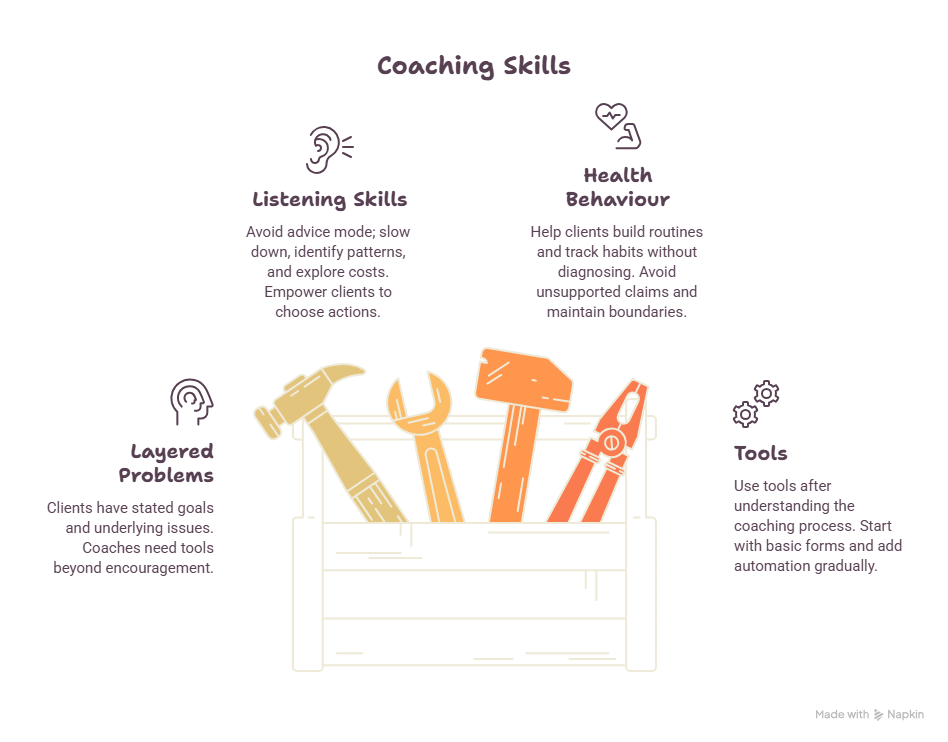
A Pakistani coaching client often comes with a layered problem. The stated goal may be weight loss, confidence, career clarity, marriage readiness, better discipline, or stress control. The real work may involve family expectations, late-night routines, inconsistent meals, self-criticism, financial pressure, comparison culture, or fear of disappointing others. A certified coach needs more than cheerful encouragement. You need behaviour change tools, inner critic techniques, solution-focused coaching, and appreciative inquiry.
Study listening as a professional skill. Many beginner coaches in Pakistan fall into advice mode because advice feels helpful, fast, and culturally familiar. A better coach slows the conversation, identifies the client’s pattern, explores the cost of staying the same, and helps the client choose a next action they can actually complete. That approach requires effective coaching communication, constructive feedback, client empowerment, and breakthrough coaching techniques.
Study health behaviour without pretending to be a doctor, therapist, or dietitian. You can help clients build routines, track habits, prepare questions for healthcare providers, reduce friction, design accountability, and notice barriers. You should avoid diagnosing, prescribing, treating, or making claims you cannot support. This distinction protects you and the client. It also makes your practice look mature. Strengthen that boundary with health coaching ethics, coaches avoiding dangerous traps, non-negotiable standards, and career mistake prevention.
Study tools only after you understand the coaching process. A client portal, tracker, AI assistant, CRM, email sequence, or habit app can improve results, but tools cannot rescue weak coaching. Start with one intake form, one session note template, one weekly check-in, one progress tracker, and one testimonial form. Then add automation when your process is already working manually. Use coaching tech transformation, best coaching apps, CRM tools, and automated email sequences with restraint.
5. Turn Certification Into a Paid Coaching Practice in Pakistan
Certification becomes valuable when clients can understand your offer in one sentence. “I help busy Pakistani professionals reduce stress, rebuild routines, and stay accountable for 12 weeks” is stronger than “I am a certified health and life coach.” “I help women rebuild confidence and self-care without guilt” is stronger than a long list of modalities. Your market needs a promise, process, proof, and safe scope. Build that using high-ticket coaching offers, exceptional client experiences, client retention strategies, and financial forecasting.
Your first offer should solve one painful, common problem. For health coaching, this could be a habit reset for professionals, a sleep-and-stress routine, a consistency programme for weight-management behaviours, or a family-friendly wellness plan. For life coaching, it could be career confidence, emotional resilience, decision clarity, self-worth, or productivity with boundaries. Each offer should include intake, weekly sessions, between-session support, progress tracking, and review points. This structure connects habit formation, goal tracking, accountability systems, and client engagement.
Marketing in Pakistan should sound local, specific, and honest. Write about stress eating after late work nights, exercise routines during extreme heat, family pressure around career choices, self-care guilt for mothers, confidence after career gaps, founder burnout, student overwhelm, and overseas Pakistani identity stress. This kind of content builds trust because it reflects real lives. Support it with SEO tools for coaching websites, YouTube growth for coaches, digital marketing tools, and client testimonial capture.
Referral relationships can accelerate trust faster than social media alone. Build relationships with gyms, physiotherapists, doctors who understand coaching boundaries, dietitians, therapists, HR teams, universities, women’s communities, and corporate wellness managers. Explain what you do, what you do not do, who you help, and when you refer out. This level of clarity makes you easier to recommend. Use networking strategy, joint ventures for coaches, coaching business automation, and profitable scaling as your growth foundation.
The final step is proof. Track client baselines, progress markers, barriers, wins, and reflection notes. A strong testimonial should show the client’s starting struggle, what changed, what support helped, and what they can now do differently. Avoid exaggerated promises around disease, weight loss, income, relationships, or mental health. Specific proof sells better than loud claims. Build this proof through case-study creation, client feedback growth, coaching dashboards, and trust-based coaching.
6. FAQs About Health & Life Coaching Certification in Pakistan
-
The best certification depends on your client type. For life coaching, leadership coaching, executive coaching, and career coaching, ICF is one of the strongest international options. For health and wellness coaching, an NBHWC-aligned route can provide stronger health-specific credibility. For coaching, mentoring, and supervision with a European professional orientation, EMCC can also be relevant. Choose after comparing your niche, budget, required hours, exam format, supervised practice, and business goal. Start with which certification is right for you, health coach certification credentials, online life coach certification, and credentialing resources.
-
Yes, online certification can work well when the programme has strong standards, live practice, assessment, feedback, ethics training, and clear credential alignment. The risk is choosing a cheap course that gives you videos and a certificate but little coaching ability. Before enrolling, check whether the programme includes real practice, mentor feedback, competency evaluation, and support for your chosen credential route. Then build proof through online health coach certification programmes, quick certification guidance, continuous coaching education, and certification portfolio planning.
-
A coach should stay inside coaching scope. You can support habits, motivation, environment design, consistency, tracking, self-awareness, and questions clients may discuss with qualified healthcare professionals. You should avoid diagnosing, treating, prescribing, or replacing medical, mental health, nutrition, or therapy care. This boundary actually builds trust because clients can see you understand professional limits. Strengthen your practice through ethical responsibilities, coaching boundaries, safe coaching environment design, and career-ending mistake prevention.
-
Start with carefully framed practice coaching. Offer a limited number of structured sessions to peers, colleagues, wellness communities, students, relatives outside emotionally complicated dynamics, or beta clients. Tell them clearly that this is coaching practice, explain confidentiality, set boundaries, and ask for feedback. Use every session to improve your questions, listening, goal-setting, and accountability structure. Capture progress ethically through surveys and feedback tools, client journaling tools, case-study templates, and testimonial capture.
-
Income depends on niche, proof, pricing, audience, delivery format, city, language, referral network, and whether you sell single sessions, packages, group programmes, corporate workshops, or online coaching. A coach with one clear offer, strong testimonials, and consistent marketing usually has a better chance than someone with many scattered services. Build your model around structured packages and measurable client progress. Use health coach salary insights, high-ticket coaching offers, payment systems, and financial forecasting.
-
Start with one niche, one offer, one landing page, one intake form, one progress tracker, and one testimonial system. Publish content that speaks directly to your Pakistani audience’s real pains: family pressure, inconsistent routines, work stress, self-care guilt, emotional eating, low confidence, burnout, and decision paralysis. Book discovery calls, improve your process after every client, and build referral relationships slowly. Use must-have coaching tools, digital marketing tools, client retention strategies, and scaling your coaching practice to turn certification into a real business.
