
Neuroscience-based coaching applies scientific insights into neuroplasticity, emotional regulation, motivation, memory, and behavioral adaptation to help clients achieve sustainable transformation. By understanding the mechanisms behind health behavior change, coaches can identify why clients repeatedly abandon goals, resist unfamiliar behaviors, or struggle under pressure. Combining neuroscience with transformational coaching strategies, emotional intelligence development, and habit formation techniques creates a more personalized framework for overcoming behavioral obstacles. This approach helps coaches translate scientific knowledge into practical interventions that strengthen client autonomy, improve consistency, and support meaningful progress beyond individual coaching sessions.
1. Understanding the Neuroscience Behind Successful Coaching Outcomes
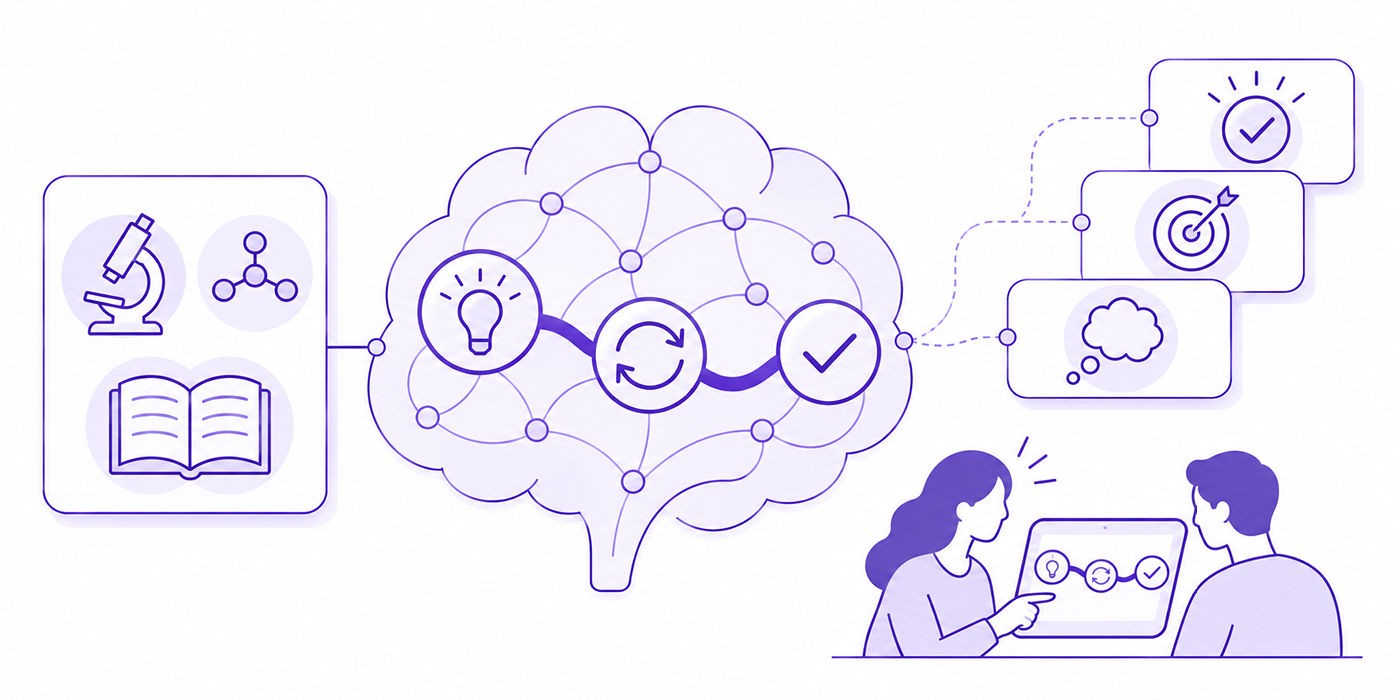
Neuroscience-based coaching begins with understanding how previous experiences, environmental conditions, emotional states, and learned behavioral patterns influence present decisions. A client repeatedly missing exercise sessions may experience competing priorities, environmental friction, anticipatory discomfort, or established avoidance habits. Identifying these mechanisms enables coaches to combine emotional agility with holistic coaching, creating interventions that address the circumstances sustaining unwanted behaviors. This also strengthens accountability coaching and provides greater precision when applying the Immunity to Change coaching model.
Neuroplasticity: Understanding the Brain's Capacity for Adaptation
Neuroplasticity describes the nervous system's capacity to change its functioning and organization in response to experience, learning, and environmental demands. For coaches, its practical significance lies in helping clients repeatedly practice desirable behaviors under manageable conditions.
Five principles guide its application:
Repetition: Consistent practice supports learning and behavioral familiarity.
Specificity: Practicing a particular skill primarily strengthens capabilities related to that skill.
Feedback: Timely feedback helps clients identify discrepancies between intended and actual performance.
Recovery: Adequate rest supports attention, learning, and memory processes.
Progressive difficulty: Gradually increasing challenges allows clients to develop competence without unnecessary overwhelm.
These principles complement habit stacking, structured SMART goal development, personalized constructive feedback, and targeted micro-coaching interventions.
Executive Function and Client Decision-Making
Executive functions support planning, working memory, inhibitory control, and flexible thinking. Stress, inadequate sleep, competing responsibilities, and demanding environments can interfere with these capabilities. Consequently, an elaborate action plan may become difficult to execute during a particularly demanding week.
Coaches can integrate career burnout coaching, stress management strategies, self-care coaching, and the Wheel of Life assessment to identify competing demands before increasing behavioral expectations.
Reward Learning and Motivation
Motivation involves multiple interacting psychological and neurological processes, including reward learning, anticipated outcomes, personal values, and perceived competence. Dopamine contributes to learning and motivated behavior through several neural systems.
Coaches can support motivation by connecting actions with personally meaningful goals, creating achievable milestones, and making progress visible. Integrating positive psychology coaching, self-actualization coaching, life purpose exploration, and life visioning helps clients develop personally relevant reasons for maintaining new behaviors.
2. How Neuroscience-Based Coaching Overcomes Resistance and Behavioral Stagnation
Behavioral resistance frequently develops when desired outcomes conflict with immediate priorities, established routines, emotional concerns, or perceived risks. Coaches working with resistant clients benefit from identifying these competing influences before introducing additional interventions.
Recognizing the Protective Function of Existing Behaviors
Consider a professional who continually avoids pursuing a promotion despite expressing strong career ambitions. Their avoidance could reflect anticipated rejection, concerns about additional responsibilities, previous workplace experiences, or uncertainty about their capabilities.
Through self-confidence coaching, leadership development, transactional analysis, and careful examination of power dynamics in coaching, practitioners can help clients explore what their existing behavior accomplishes and what makes alternative responses challenging.
Useful diagnostic questions include:
What happens immediately before you avoid this action?
What immediate benefit do you receive from postponing it?
Which consequences concern you most?
Under what circumstances have you successfully completed similar actions?
What would make the first step feel manageable?
These questions generate testable behavioral hypotheses that guide subsequent coaching sessions.
Reducing Cognitive Overload Before Increasing Accountability
Assigning additional tasks to overwhelmed clients can create further competition for attention and working memory. Effective coaching reduces unnecessary complexity through written action plans, environmental reminders, realistic priorities, and manageable behavioral commitments.
The T-GROW coaching model helps structure these conversations, while the OSCAR coaching model supports actionable choices. Incorporating client expectation management and an appropriate coaching accountability framework further ensures that performance expectations reflect the client's actual circumstances.
A practical adjustment might involve replacing five simultaneous lifestyle commitments with one priority behavior practiced four times weekly. Additional commitments can follow once the client demonstrates sufficient capacity and confidence.
Building Behavioral Automaticity Through Repeated Contextual Practice
Research by Lally and colleagues found considerable variation in the time required for habits to approach their estimated maximum automaticity, ranging from 18 to 254 days among modeled participants.
This finding challenges rigid habit-development timelines and supports personalized coaching programs that accommodate different behaviors and circumstances. Health coaches integrating lifestyle medicine, preventive health coaching, metabolic health coaching, and habit formation principles should assess behavioral consistency before assuming that a new routine has become established.
Track three distinct stages of habit development:
Initiation: The client remembers and starts the intended behavior.
Consistency: The behavior occurs regularly under relevant conditions.
Automaticity: Initiating the behavior begins to require less conscious deliberation.
A client may achieve consistent performance while continuing to rely heavily on reminders. Recognizing this distinction helps coaches determine when external support should be maintained or gradually reduced.
Using Implementation Intentions to Close the Intention-Action Gap
Implementation intentions connect a recognizable situation with a predetermined response. Their if-then structure helps clients anticipate when and how to execute their intentions.
For example:
If my afternoon meeting ends, I will take a five-minute walking break.
If I miss my planned morning routine, I will complete its shorter version after lunch.
If I feel uncertain before a presentation, I will review my opening statement.
This technique complements the CLEAR coaching model, ADKAR change management, positive intelligence practices, and behavioral transformation strategies.
3. Applying Neuroscience-Based Coaching Across High-Demand Specializations
Neuroscience-informed techniques can strengthen multiple coaching specializations when practitioners adapt their interventions to the client's objectives, circumstances, and professional scope.
Health and Wellness Coaching
Health coaching provides opportunities to apply behavioral science to physical activity, everyday food-related routines, recovery habits, and adherence to professionally established health plans.
A coach supporting a client interested in metabolic wellness might help them identify environmental barriers affecting their daily movement. Practitioners working within food sensitivity coaching or exploring the scientific claims surrounding detoxification coaching must carefully distinguish behavioral support from medical assessment.
Understanding the boundaries of health coaching without a nutrition degree protects clients while allowing practitioners to develop sustainable lifestyle support programs.
Practical application: Help a client identify why an intended walking routine repeatedly disappears during busy weeks, then establish a shorter alternative that remains achievable under similar conditions.
Executive and Leadership Coaching
Leadership decisions often involve ambiguity, competing priorities, interpersonal pressure, and substantial cognitive demands. Neuroscience-informed executive coaching addresses these challenges through reflective practices, structured decision preparation, and deliberate communication rehearsal.
Coaches combining conscious leadership, public speaking coaching, emotional intelligence, and culturally competent coaching can tailor interventions to the organizational environments influencing leadership behavior.
For example, a manager who frequently reacts defensively to criticism can rehearse alternative conversational responses, establish a deliberate response routine, and evaluate subsequent workplace interactions using self-reflection and appropriate stakeholder feedback.
Life and Personal Development Coaching
Clients pursuing major life transitions frequently encounter competing values, uncertainty about unfamiliar roles, and entrenched patterns of decision-making. Neuroscience-informed practices can support gradual experimentation and increased behavioral flexibility.
Combining the Kübler-Ross Change Curve as a flexible discussion framework with couples coaching, money mindset coaching, and life purpose coaching allows practitioners to explore how established beliefs influence current choices.
The coaching objective should emphasize observable capabilities, such as improved communication, independent decision-making, or consistent completion of meaningful actions. Mental health symptoms and suspected psychological disorders require assessment by appropriately qualified professionals.
4. An Eight-Week Neuroscience-Based Coaching Framework for Sustainable Results
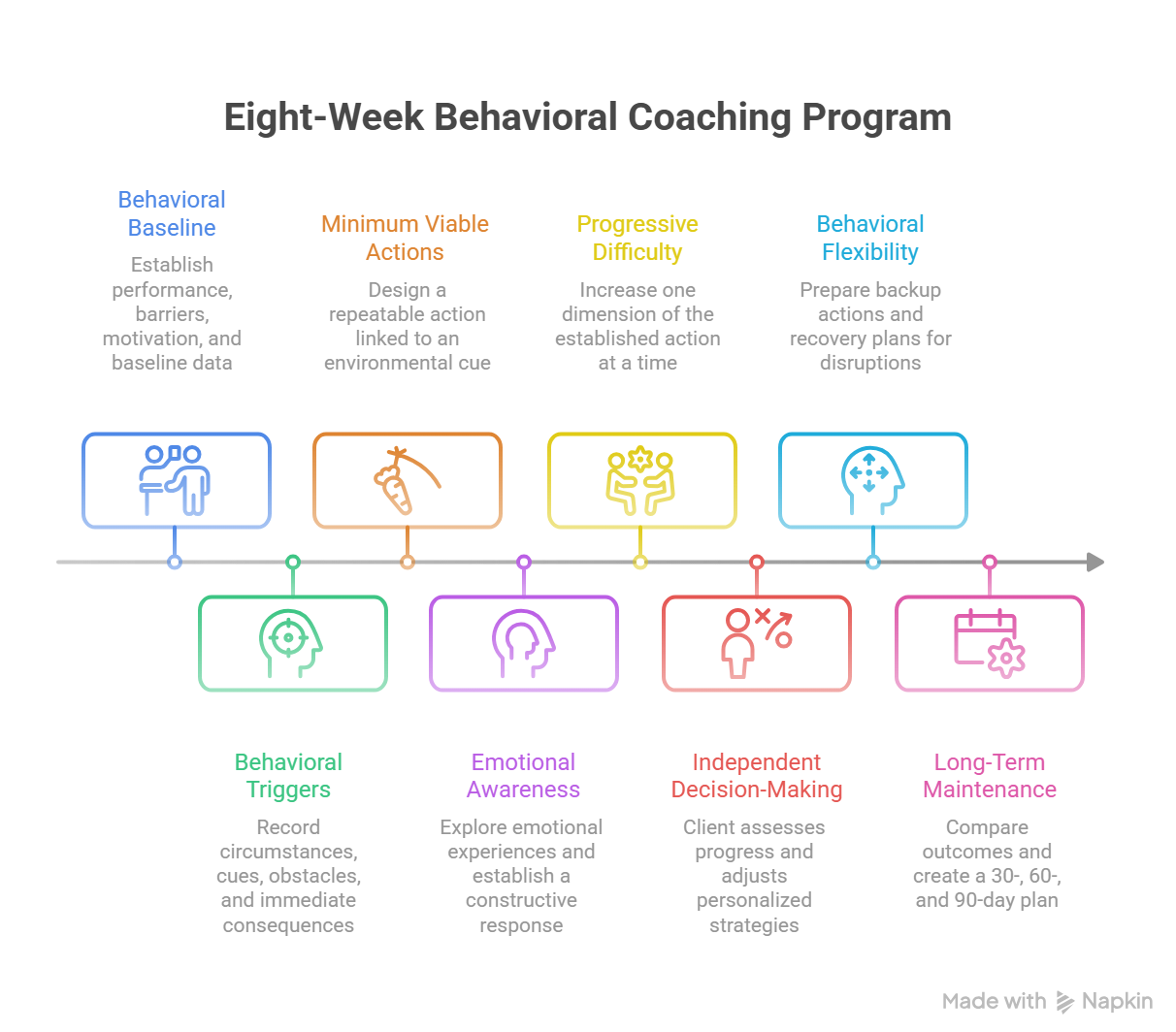
A structured eight-week program allows coaches to translate neuroscience-informed principles into progressive behavioral experiments. Individual timelines should remain flexible according to client needs, readiness, and progress.
Week 1: Behavioral Baseline and Context Assessment
Begin by establishing the client's current performance, environmental barriers, competing responsibilities, motivation, and previous attempts at behavioral change. Document the frequency of the target behavior before introducing interventions.
Use the Wheel of Life coaching tool to identify competing priorities, establish clear coaching agreements, obtain appropriate informed consent, and clarify expectations through a professional coaching code of conduct.
Deliverable: One clearly defined behavioral objective supported by measurable baseline data.
Week 2: Identify Behavioral Triggers and Competing Rewards
Ask clients to record the circumstances surrounding repeated unwanted behaviors. Include the time, location, emotional state, preceding event, action, and immediate consequence.
For example, repeatedly postponing an evening task may provide temporary relief from perceived demands. Identifying that consequence helps the client design a smaller action that remains manageable without reinforcing avoidance.
Deliverable: A behavioral trigger map identifying recurring cues, obstacles, and possible alternative responses.
Week 3: Introduce Minimum Viable Behavioral Actions
Design a version of the target behavior that the client can reasonably perform during demanding circumstances. Integrate micro-coaching techniques and habit stacking strategies to support consistent practice.
Examples include writing one paragraph, preparing one meeting agenda item, or taking a brief movement break.
Deliverable: A repeatable action linked to a recognizable environmental cue.
Week 4: Strengthen Emotional Awareness and Response Flexibility
Explore emotional experiences accompanying successful and unsuccessful behavioral attempts. Establish a voluntary reflection routine that helps clients recognize situations where they benefit from changing their response.
Practitioners should prioritize psychologically safe coaching environments, maintain professional duty of care, understand appropriate responses to client emotional crises, and recognize therapist versus life coach boundaries.
Deliverable: One constructive response strategy for an ordinary recurring emotional or situational challenge.
Week 5: Increase Behavioral Difficulty Progressively
When foundational behaviors become reasonably consistent, collaboratively increase the challenge. Extend the duration, complexity, independence, or frequency of the established action.
Change one dimension at a time so the coach and client can evaluate which adjustments affect performance.
Deliverable: A revised action plan with an achievable progression target and a fallback option.
Week 6: Develop Self-Monitoring and Independent Decision-Making
Transfer responsibility for progress assessment to the client. Ask them to identify successful strategies, adjust unrealistic commitments, and evaluate which environmental conditions improve their performance.
Use constructive coaching feedback and accountability-based coaching to strengthen independent behavioral management.
Deliverable: A client-led progress review and personalized strategy adjustment.
Week 7: Test Behavioral Flexibility Under Changing Conditions
Help the client prepare for foreseeable disruptions, including travel, workload increases, scheduling changes, or temporary reductions in available resources.
Introduce backup actions and realistic recovery plans. A successful maintenance strategy should accommodate ordinary disruptions while protecting the client's broader objective.
Deliverable: At least two contingency plans for predictable obstacles.
Week 8: Establish a Long-Term Maintenance Strategy
Compare baseline and current outcomes, identify remaining barriers, and determine the appropriate level of continuing support. Gradually reduce unnecessary reminders while assessing independent performance.
Coaches can use insights from successful client transformation case studies and coaching technology applications to develop proportionate follow-up systems.
Deliverable: A 30-, 60-, and 90-day maintenance plan with defined progress indicators and optional follow-up sessions.
5. Measuring Neuroscience-Based Coaching Effectiveness and Building a Credible Practice
Coaches establish professional credibility by demonstrating meaningful client progress through transparent measurement, realistic claims, and ethically designed programs. Neuroscience terminology alone provides limited information about intervention effectiveness.
Measure Behavioral Outcomes Using Five Core Indicators
A useful outcome measurement framework includes:
Behavioral adherence: Completed actions divided by planned opportunities, expressed as a percentage.
Behavioral automaticity: Client-reported ease of initiating an established action.
Setback recovery: Time required to resume the intended behavior after disruption.
Independent self-management: Frequency of successful actions completed without external prompting.
Goal attainment: Progress toward individually defined outcomes established during onboarding.
For example, a client completing two of seven planned actions at baseline achieves approximately 29% adherence. Increasing performance to six of seven represents approximately 86% adherence, an improvement of 57 percentage points.
This provides a more transparent outcome than an unsupported claim about neural transformation. Combining measurable outcomes with client trust and coaching certification, effective niche positioning, health coaching specialization, and life coaching specialization supports credible professional differentiation.
Avoid Neuroscience Myths That Undermine Professional Credibility
Several popular neuroscience claims substantially oversimplify human behavior. Professional coaches should avoid presenting the following as established scientific facts:
Every habit can be permanently established within 21 days.
Individuals use only 10% of their brains.
Personality can be reliably classified through left-brain or right-brain dominance.
Dopamine operates exclusively as a pleasure chemical.
Visualization guarantees neurological changes equivalent to physical practice.
Coaching conversations can permanently eliminate trauma within a predetermined number of sessions.
Understanding the evidence surrounding these claims supports ethical coaching representation, responsible discussion of emerging fields such as epigenetics in coaching, compliance with professional scope of practice, and appropriate consideration of professional indemnity insurance.
Develop a Commercially Viable Neuroscience-Informed Coaching Offer
A clearly positioned coaching offer should define its audience, primary behavioral challenge, intervention structure, measurement methods, and professional boundaries.
An executive coaching package might focus on decision-making under pressure, while a wellness coaching package could concentrate on establishing sustainable activity and recovery routines.
When designing pricing, evaluate the resources required for preparation, personalized feedback, client monitoring, and maintenance support. Explore health coaching pricing strategies, life coaching package pricing, coaching discovery call frameworks, and coaching client acquisition strategies to develop a financially sustainable practice.
Invest in Evidence-Based Professional Development
A credible neuroscience-informed coach requires foundational coaching competence, behavioral science literacy, critical research appraisal, practical intervention skills, and ethical judgment.
When evaluating training, examine instructor qualifications, supervised practice opportunities, scientific references, assessment methods, and the accuracy of credentialing claims.
Review health coaching certification red flags, life coaching certification warning signs, and relevant health coaching certification pathways. Continued participation in professional development and coach supervision can strengthen professional judgment as scientific evidence and client requirements evolve.
6. Frequently Asked Questions About Neuroscience-Based Coaching
-
Neuroscience-based coaching integrates knowledge of brain functioning, learning, motivation, emotional regulation, and behavioral adaptation into professional coaching practices. Its purpose is to help clients develop practical strategies for pursuing meaningful goals and sustaining behavioral improvements. It draws upon established coaching competencies and relevant research from psychology, neuroscience, and behavioral science.
-
Research supports several individual techniques used within neuroscience-informed coaching, including implementation intentions, contextual habit formation, and structured behavioral practice. Evidence also supports coaching effectiveness for certain outcomes and populations. Direct research establishing the superiority of neuroscience-branded coaching over other competent coaching approaches remains limited. Practitioners should evaluate specific interventions and outcomes rather than relying on neuroscience branding.
-
Clients may experience increased awareness or improved planning during early sessions. Behavioral consistency and automaticity typically develop over longer, highly individualized periods. Coaches can use client expectation management and structured goal-setting methods to establish realistic milestones without promising fixed neurological transformation timelines.
-
Coaches can support everyday stress management, personal organization, goal-directed behavior, and general well-being within their competencies. Diagnosing anxiety disorders, processing psychological trauma, and providing mental health treatment require appropriately qualified professionals. Understanding mental health coaching and maintaining clear clinical referral boundaries are essential safeguards.
-
A neuroscience degree is generally unnecessary for applying evidence-informed behavioral strategies within a professional coaching role. Appropriate coaching education, foundational scientific literacy, supervised practice, and ethical competence remain important. Individuals should compare ICF and NBHWC credentialing pathways according to their intended specialization and employment objectives.
-
Personalized interventions, realistic commitments, visible progress, and collaborative feedback may improve client engagement and perceived coaching value. Retention also depends on affordability, service quality, client circumstances, and goal achievement. Practitioners can integrate these principles into a sustainable online coaching business model while encouraging clients to develop independent capabilities.
