
Traditional coaching often leaves clients facing a frustrating gap between understanding what they should do and actually doing it. Metaverse coaching addresses this challenge through immersive environments where clients can rehearse decisions, develop communication skills, explore behavioral patterns, and practice challenging scenarios before encountering them in real life.
Combining transformational coaching, emotional intelligence, health behavior change, and advances in coaching technology, virtual reality creates new opportunities for coaches to deliver experiential services, differentiate their businesses, and help clients translate personal development into measurable real-world performance.
1. What Is Metaverse Coaching and Why Does It Matter?
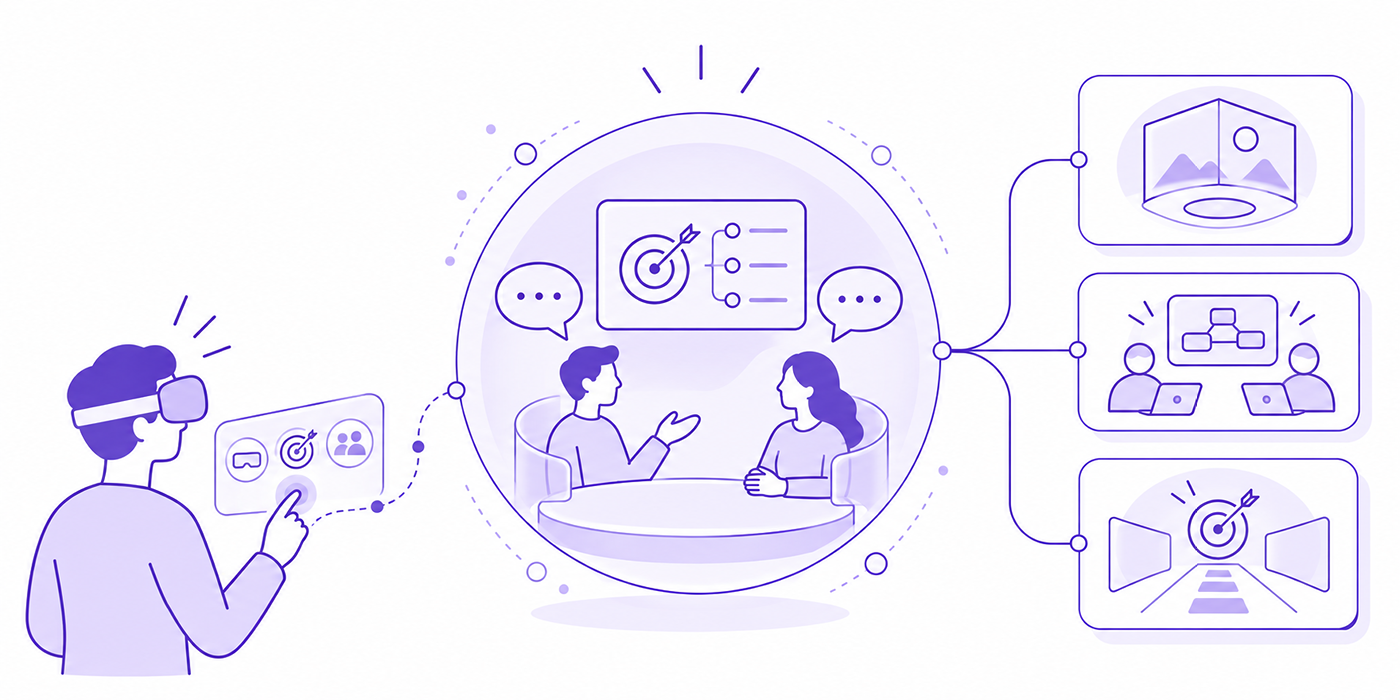
Metaverse coaching is a technology-enabled approach in which coaches and clients interact through immersive digital environments, three-dimensional simulations, virtual avatars, and computer-generated scenarios.
Clients can enter simulated workplaces, conference rooms, wellness environments, public speaking venues, and collaborative spaces designed around specific coaching objectives.
The approach builds upon established principles of emotional agility, positive psychology coaching, self-actualization coaching, and experiential behavioral transformation.
Its greatest commercial and developmental potential lies in making difficult experiences repeatable, observable, and adjustable.
How Metaverse Coaching Works
A conventional coaching session might involve discussing an upcoming presentation, identifying confidence barriers, and establishing an action plan.
An immersive coaching session could include:
Entering a simulated auditorium.
Practicing a presentation before a virtual audience.
Responding to simulated audience questions.
Reviewing communication patterns with a coach.
Repeating challenging sections with adjusted difficulty.
Establishing a real-world presentation commitment.
This process strengthens public speaking coaching by introducing structured rehearsal while supporting self-confidence development, constructive feedback, and client accountability.
Understanding the Technology Behind Immersive Coaching
Coaches should distinguish between four technologies before investing in immersive services:
Virtual reality (VR): Fully simulated environments accessed through compatible headsets.
Augmented reality (AR): Digital information superimposed onto physical surroundings.
Mixed reality (MR): Digital objects integrated with and responsive to physical environments.
Metaverse platforms: Shared virtual spaces supporting avatar-based interactions, collaboration, and immersive experiences.
Desktop-accessible virtual environments provide an additional entry point for clients who cannot use headsets.
Selecting the appropriate technology depends on the client's developmental objectives, accessibility requirements, technical confidence, and budget. Principles of holistic coaching, cultural competence, and creating safe coaching environments should guide these decisions.
Why Immersive Learning Creates New Coaching Opportunities
Virtual environments allow coaches to introduce contextual cues that ordinary conversations may struggle to reproduce. Workplace interruptions, audience reactions, competing priorities, and simulated interpersonal disagreements can reveal practical skill-development opportunities.
Research into immersive professional training suggests promising applications across communication, knowledge acquisition, and procedural learning. However, results vary considerably according to instructional design, participant characteristics, and the skills being developed.
Coaches should therefore combine immersive experiences with SMART goal setting, accountability coaching, and managing client expectations to establish meaningful performance measures.
The following framework identifies 30 practical opportunities for integrating immersive technology into professional coaching.
2. How Virtual Reality Is Transforming Different Coaching Niches
Immersive technology offers different advantages depending on the problems clients are paying coaches to help them solve. The strongest applications generally involve observable behaviors, difficult conversations, environmental decision-making, and repeatable performance exercises.
Executive and Leadership Coaching
Leadership clients frequently understand management principles but struggle to apply them during uncomfortable employee interactions.
Virtual simulations can introduce resistant employees, conflicting stakeholder expectations, difficult performance reviews, and competing organizational priorities.
An executive coach can integrate leadership coaching, conscious leadership, power dynamics, and the ADKAR change management model into these exercises.
For example, a manager struggling with delegation could enter a simulated meeting and practice defining responsibilities, communicating deadlines, checking understanding, and establishing follow-up expectations.
Performance can subsequently be evaluated against comparable behaviors in actual workplace meetings.
Health and Wellness Coaching
Health coaches can use immersive environments to explore the everyday circumstances influencing clients' behavioral choices.
A virtual supermarket might reveal how convenience, time pressure, budgeting, and personal preferences influence shopping decisions. A simulated morning routine could help clients identify practical barriers preventing consistent activity or self-care.
Integrating habit stacking, lifestyle medicine principles, preventive health coaching, and self-care coaching helps clients connect simulated decisions with sustainable daily routines.
Health coaches must maintain appropriate professional boundaries. Virtual environments should support client-directed behavioral goals, with medical assessment, individualized treatment, and clinical nutrition interventions handled by appropriately qualified professionals.
Career and Professional Development Coaching
A client preparing for a promotion interview may spend weeks reviewing questions while struggling to communicate achievements under pressure.
Immersive interview practice allows clients to rehearse responses, identify communication weaknesses, and receive structured feedback.
Career coaches can also combine self-confidence coaching, career burnout coaching, life purpose exploration, and the T-GROW coaching model to support clients navigating professional transitions.
A structured interview rehearsal could measure answer relevance, specificity, verbal clarity, and the client's ability to explain measurable achievements.
Life Coaching and Personal Development
Life coaches can create virtual exercises that help clients examine competing priorities, practice assertive communication, and visualize alternative personal development pathways.
A client experiencing uncertainty about major life decisions could explore hypothetical future routines and evaluate how each aligns with personally identified values.
Combining life visioning, the Wheel of Life, the Immunity to Change model, and mental fitness principles provides a framework for translating these experiences into informed decisions.
Clients should leave each immersive session with a realistic action they can complete outside the virtual environment.
Corporate Wellness and Employee Development
Employers may find immersive coaching attractive when employees need repeatable skills practice across distributed teams.
Potential applications include leadership onboarding, employee communication, workload management, collaboration, and general workplace wellbeing.
Coaches exploring corporate health coaching, remote health coaching opportunities, and micro-coaching can develop short immersive modules supported by individualized follow-up.
Corporate agreements should clearly define what employers can access regarding participant performance and personal coaching information.
3. Building a Metaverse Coaching Practice: Technology, Training and Implementation
Many coaches hesitate to explore virtual reality because they anticipate expensive equipment, complicated software, and technical problems that undermine client trust.
A staged implementation strategy allows coaches to test commercial demand and learning effectiveness before committing substantial resources.
Step 1: Identify a High-Value Client Problem
Begin by selecting an existing client challenge that benefits from contextual rehearsal.
Potential starting points include presentation delivery, workplace communication, interview preparation, and habit implementation.
Resources addressing profitable life coaching niches, health coaching niche opportunities, coaching specialization, and coaching market saturation can help practitioners evaluate potential market positioning.
Choose one measurable problem for the initial pilot.
Step 2: Select an Appropriate Technology Stack
A basic immersive coaching setup may include:
A compatible standalone VR headset.
Desktop or browser-based virtual environment access.
Scenario-based training software.
Secure scheduling and communication tools.
A client progress documentation system.
Conventional video coaching as an accessibility alternative.
Secure storage for session records.
Evaluate platforms according to privacy controls, scenario customization, device compatibility, recording permissions, accessibility features, commercial licensing, and recurring subscription costs.
The principles behind technology-enabled coaching and building an online coaching business remain essential when selecting software.
Step 3: Develop Immersive Coaching Competencies
Effective facilitation requires familiarity with both coaching methodology and the virtual environment.
Practitioners should develop competencies in scenario design, virtual communication, technical troubleshooting, structured observation, accessibility, and post-simulation reflection.
The CLEAR coaching model, OSCAR coaching framework, continuing professional development, and professional coach supervision provide useful foundations for developing these capabilities.
Coaches should rehearse every scenario themselves before introducing it to paying clients.
Step 4: Establish a Repeatable Session Structure
A proposed 50-minute immersive coaching session could follow this structure:
Minutes 1–8: Review goals, readiness, and previous commitments.
Minutes 9–13: Introduce the virtual environment and exercise.
Minutes 14–23: Complete the initial simulated scenario.
Minutes 24–33: Remove the headset and reflect on observed behaviors.
Minutes 34–43: Repeat selected elements with revised strategies, if comfortable.
Minutes 44–50: Establish a real-world action plan and follow-up measure.
Actual headset duration should accommodate individual comfort, manufacturer guidance, and relevant health considerations.
Integrating constructive feedback techniques, accountability strategies, and habit formation ensures that each session produces an actionable commitment.
Step 5: Run a Small Pilot Program
Recruit five to ten willing clients and offer a clearly defined pilot program.
Collect baseline performance measures, client comfort ratings, technical support requirements, and real-world behavioral outcomes. Track how many clients complete their exercises and express interest in continuing.
Before expanding, evaluate whether immersive delivery provides sufficient additional value over conventional role-playing and video coaching.
The pilot should also inform client acquisition strategies, coaching discovery calls, and future service positioning.
4. The Business Potential of Metaverse Coaching: Pricing, Revenue and Client Acquisition
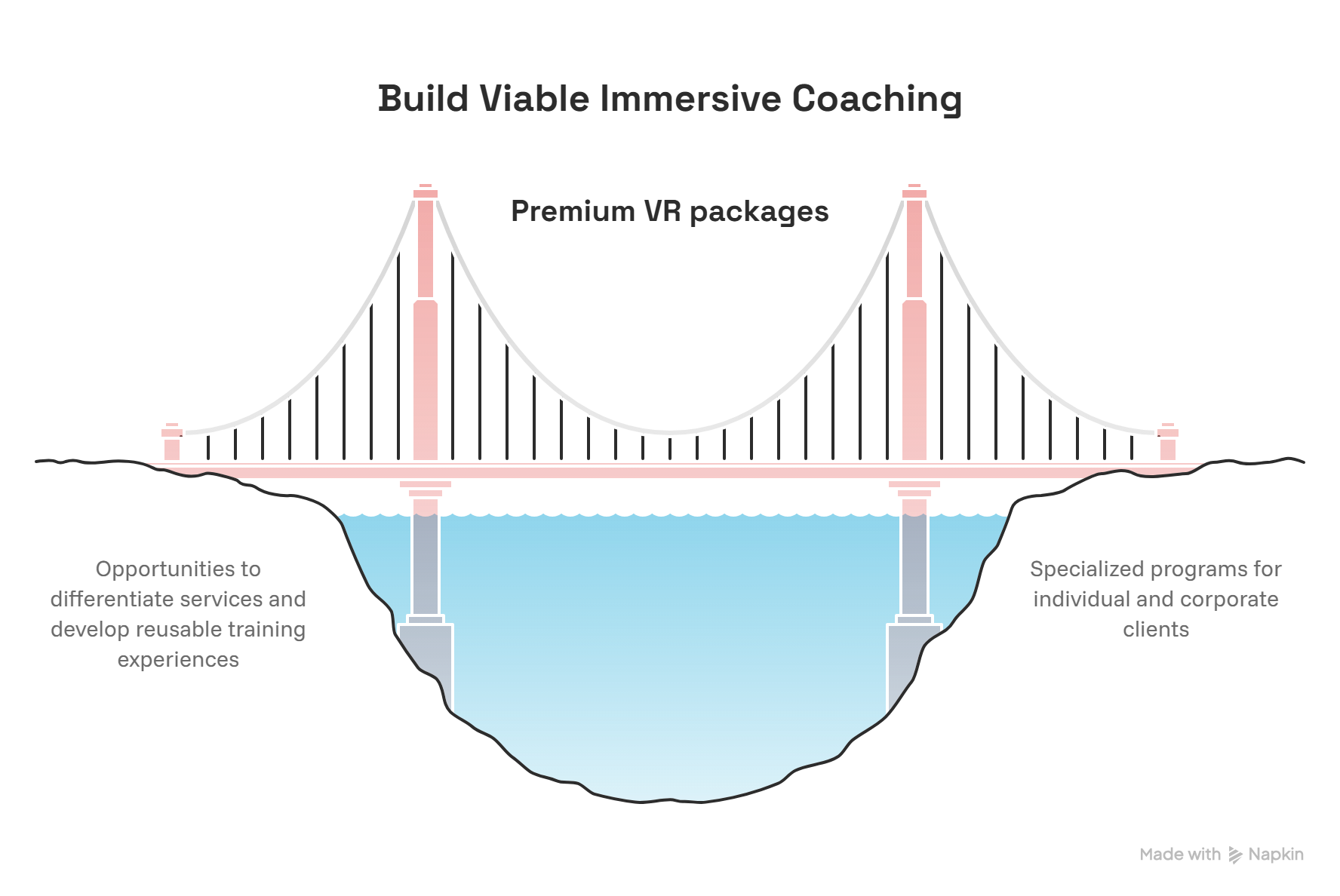
Immersive coaching creates opportunities to differentiate services, develop reusable training experiences, and offer specialized programs to individual and corporate clients.
The commercial challenge involves establishing whether customers value the additional outcomes enough to justify technology-related costs.
Developing Premium VR Coaching Packages
Coaches should price immersive services according to the complexity of the client problem, preparation requirements, professional expertise, and measurable deliverables.
Practitioners reviewing health coaching pricing strategies, life coaching package pricing, health coaching revenue models, and full-time life coaching income requirements can use their existing business economics to assess immersive service viability.
Potential package structures include:
VR confidence accelerator: Four individualized presentation or communication sessions.
Executive leadership simulator: Six sessions covering delegation, feedback, negotiation, and decision-making.
Immersive wellness program: Eight sessions combining habit rehearsal with accountability.
Corporate communication workshop: Facilitated group simulations with individual performance feedback.
Career interview accelerator: Three interview simulations supported by personalized preparation plans.
Each package should clearly identify its target audience, deliverables, participation requirements, and outcome measures.
Calculating the Financial Viability of VR Coaching
Consider an illustrative coaching practice with the following startup expenses:
VR equipment and accessories: $600.
Initial scenario development: $500.
Professional training and preparation: $400.
Monthly platform and administrative costs: $150.
This creates an assumed initial investment of $1,500.
If an immersive coaching package generates $600 in revenue and incurs $100 in variable delivery costs, its contribution margin is $500 before fixed expenses and coach compensation.
Four package sales would generate $2,000 in contribution, covering the assumed startup investment and one month of fixed expenses, with $350 remaining before compensation, taxes, and other expenses.
Actual costs vary by platform, commercial licensing requirements, equipment availability, and development complexity.
Attracting Clients to Immersive Coaching Services
Marketing should demonstrate a recognizable improvement that prospective clients can understand.
A leadership coach could demonstrate a simulated performance review. A career coach could provide a sample interview rehearsal. A wellness coach could showcase an exercise exploring obstacles to healthy routines.
Effective client acquisition combines coaching credibility, referral and marketing channels, first-client acquisition strategies, and transparent communication about expected results.
Offer short demonstrations that showcase the coaching process without collecting unnecessary client information.
Creating Scalable Corporate Coaching Programs
Corporate buyers generally require clear evidence that coaching services address organizational priorities.
Develop proposals around specific problems such as inconsistent manager feedback, ineffective employee communication, or leadership onboarding challenges.
A corporate pilot could compare baseline and post-program performance on a standardized scenario while collecting manager-reported workplace application after 30 days.
Coaches considering employment versus private practice and health coaching career opportunities may find enterprise partnerships particularly relevant.
Reusable scenarios can reduce preparation time, provided licensing permits reuse and individual coaching remains responsive to participant needs.
5. Ethical Challenges, Client Safety and the Future of Virtual Reality Coaching
Immersive coaching introduces professional responsibilities involving privacy, psychological safety, accessibility, data governance, and technological reliability.
Addressing these responsibilities before launch protects client trust and reduces avoidable business risks.
Protecting Client Privacy and Immersive Data
VR platforms may collect voice recordings, movement information, device identifiers, spatial information, interaction logs, and, where supported, eye-tracking data.
Coaches must understand which information is collected, why it is collected, who can access it, and how long it is retained.
Professional principles involving informed consent, coaching agreements, professional codes of conduct, and duty of care should guide platform configuration and data-handling procedures.
Before conducting sessions, establish:
Clear recording permissions.
Data retention and deletion procedures.
Secure client authentication.
Limits on third-party access.
A documented incident-response procedure.
Separate consent for using client information in AI systems.
Where applicable, obtain professional guidance concerning privacy legislation, health information requirements, and cross-border data transfers.
Maintaining Professional Scope of Practice
Immersive environments can resemble clinical interventions, particularly when scenarios involve fear, distress, interpersonal conflict, or health-related decisions.
Virtual reality exposure therapy, trauma treatment, and psychological disorder management require appropriate clinical qualifications.
Coaches should follow established scope-of-practice boundaries, understand therapy versus coaching distinctions, and recognize the limitations of mental health coaching.
Health coaches should similarly respect nutrition coaching boundaries when designing food-related or metabolic wellness simulations.
Appropriate referrals are necessary whenever client needs exceed the practitioner's qualifications.
Managing Physical and Psychological Safety
Immersive experiences can cause nausea, dizziness, visual discomfort, fatigue, disorientation, or emotional distress.
Begin with brief, low-intensity sessions and obtain ongoing client feedback. Establish a clear stopping procedure and provide conventional coaching alternatives whenever immersive technology becomes uncomfortable or unsuitable.
Practitioners working with client stress management, emotional crises, and safe coaching environments should establish referral and emergency-response protocols appropriate to their services.
Professional insurance arrangements should also be reviewed against professional indemnity insurance considerations to determine whether immersive and remote delivery methods are covered.
Measuring Real-World Behavioral Transfer
A client might perform confidently during a simulated meeting while continuing to struggle in actual workplace interactions.
Coaches can assess behavioral transfer by collecting three levels of evidence:
Simulation performance: Observable improvements within the virtual exercise.
Real-world application: Evidence that the client attempted the targeted behavior outside VR.
Sustained improvement: Evidence that the behavior continued over subsequent weeks.
Integrating SMART goals, client accountability, and behavior change principles helps coaches distinguish short-term enthusiasm from meaningful development.
Avoid advertising guaranteed psychological or behavioral outcomes. Transparent claims reduce the risk of professional misrepresentation.
How AI and Virtual Reality Could Shape the Future of Coaching
Artificial intelligence could expand immersive coaching through adaptive conversation simulations, personalized scenario difficulty, automated rehearsal opportunities, and structured feedback summaries.
Human coaches remain essential for contextual interpretation, ethical judgment, collaborative goal development, and responding to individual circumstances.
Practitioners examining AI coaching versus human coaching and the future of professional services can develop hybrid models combining independent rehearsal with human-led reflection.
The strongest long-term opportunities may emerge from specialized immersive experiences supported by credible coaching qualifications, responsible technology adoption, accessible alternatives, and documented client outcomes.
6. Frequently Asked Questions About Metaverse Coaching
-
Metaverse coaching involves delivering coaching services through shared virtual environments, avatars, simulations, and immersive technologies. Clients can practice communication, explore decisions, rehearse professional skills, and develop action plans within controlled digital scenarios.
It extends existing coaching technology applications by introducing experiential practice into the coaching relationship.
-
Coaches can begin with desktop-accessible virtual environments, avatar-based meetings, and browser-based simulations.
VR headsets provide greater immersion for exercises involving spatial awareness, simulated audiences, and environmental interactions. Technology selection should accommodate accessibility, client preferences, and the objectives established through holistic coaching.
-
Immersive training research indicates potential benefits for certain learning and performance objectives. Evidence establishing universal superiority over traditional coaching remains insufficient.
Effectiveness depends on scenario design, coaching competence, participant comfort, reflection quality, and real-world application. Established transformational coaching strategies remain fundamental to meaningful client development.
-
A small pilot could use an illustrative equipment and preparation budget of $500–$2,000, depending on existing resources and software requirements. Customized corporate simulations and multi-device deployments may require substantially greater investment.
Prepare a financial model using established coaching business revenue principles before purchasing expensive technology.
-
There is currently no universally required professional credential specifically for metaverse coaching. Applicable qualifications depend on the services offered, employer requirements, jurisdiction, and professional scope.
Coaches should establish credible foundational training and pursue additional competencies through continuing professional development, professional supervision, and immersive technology training.
-
Health coaches can use immersive exercises to support self-directed wellness goals, habit development, daily routine planning, and behavioral decision-making.
Activities should remain consistent with health coaching scope of practice. Clinical treatment, medical diagnoses, and individualized therapeutic interventions require appropriate professional qualifications.
