
The Ultimate Guide to Getting Health & Life Coaching Certification in Sweden: Everything You Need to Know in 2026-2027
Getting certified as a health and life coach in Sweden requires a smarter plan than simply buying the fastest online certificate. You need a credential that builds trust, a scope that respects Swedish healthcare boundaries, and a business model that turns coaching skills into paid outcomes. This guide connects health coach certification strategy, life coach certification planning, ethical coaching practice, and client transformation skills into one practical Sweden-focused roadmap.
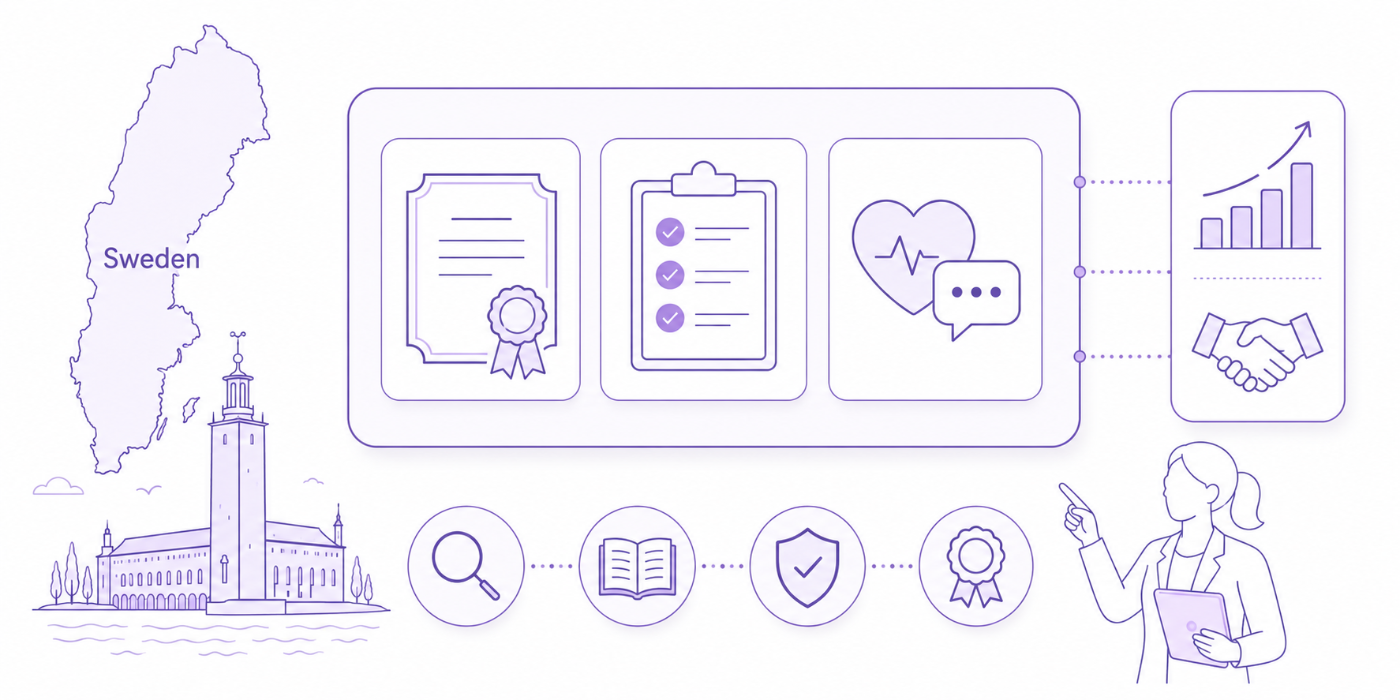
1. How Health & Life Coaching Certification Works in Sweden
The first Sweden-specific point is simple: your certification should make your role clearer, safer, and easier to trust. A coach working in Stockholm, Gothenburg, Malmö, Uppsala, or remotely across Europe needs more than a nice badge. You need proof that you understand coaching integrity, professional coaching standards, client communication, and behavior change well enough to avoid overpromising.
Sweden has a serious healthcare environment, and that makes wording extremely important. The Swedish National Board of Health and Welfare maintains the HOSP register for authorised healthcare professions, and official EU/Swedish guidance tells professionals to check whether a role is regulated before working under a protected title or regulated profession. A coaching certificate should be presented as a coaching qualification, while licensed healthcare titles require the correct Swedish authorisation route.
That distinction protects your reputation. If your page says “health coach,” your client should immediately understand that you support goals, habits, accountability, motivation, planning, and lifestyle follow-through. Your copy should avoid diagnosis, treatment claims, disease guarantees, and language that sounds like clinical care. Strong coaches use clear coaching boundaries, ethical responsibility frameworks, trust-building systems, and client expectation management before they ever sell a package.
In Sweden, certification also has a business function. It helps a new coach answer the hardest buying questions: Why should a client trust you? What exactly happens inside sessions? How will progress be measured? What happens when a client needs medical, psychological, nutritional, or crisis support outside your scope? A serious program should train goal tracking, feedback collection, case study documentation, and referral-aware coaching.
2. How to Choose the Right Certification Path for Sweden
The right certification depends on the role you want clients to hire you for. If your main promise is better routines, sleep hygiene, exercise adherence, meal planning support, stress habits, or long-term lifestyle change, start with a health coaching route that teaches habit formation, behavioral strategy, client accountability, and health coaching certification value.
If your main promise is confidence, life direction, transitions, burnout recovery planning, values, identity, career reinvention, or relationship patterns, a life coaching route should focus on online life coach certification, ICF credentialing skills, ICF exam preparation, and solution-focused coaching.
Many Sweden-based coaches need a hybrid path because real clients rarely arrive with tidy categories. A founder might want stress management and clearer decisions. A new parent might want energy, routines, confidence, and boundaries. A corporate professional might need sleep consistency, work-life structure, and emotional regulation. A strong hybrid coach studies positive psychology, inner critic management, strength-based coaching, and client anxiety support.
The strongest programs have five things: clear competencies, live practice, supervised feedback, ethics training, and business translation. A weak program gives you videos and a certificate. A serious program teaches you how to run intake, listen for readiness, handle resistance, create action plans, document progress, protect confidentiality, and close sessions with precise next steps. Before enrolling, compare fast certification options, busy professional programs, CPD-accredited life coaching, and certification exam mistakes.
3. What Swedish Clients, Employers, and Partners Will Actually Look For
A Swedish client who is comparing coaches will usually scan for clarity before charisma. They want to know who you help, what problem you solve, how your process works, how their information is handled, and what evidence you can show. Your website should connect your certification to practical outcomes: fewer abandoned goals, better routines, stronger follow-through, calmer decision-making, and better self-management. Use client engagement systems, custom coaching dashboards, weekly check-in tools, and case study proof to make progress visible.
Privacy is also a serious trust signal. Sweden’s data protection authority, IMY, explains that sensitive personal data receives stronger protection, and information about health is included in that category. Coaches collecting health goals, stress history, medication context, sleep patterns, weight goals, or emotional notes should treat privacy, consent, access, and retention as business essentials rather than admin afterthoughts.
That means your intake flow should ask only what you truly need. Your notes should stay minimal, secure, and useful. Your testimonial process should use clear permission. Your session recordings should require explicit consent. Your coaching agreement should explain limits, cancellation rules, data handling, referral triggers, and communication boundaries. This is where emotional consent, trust in coaching, safe coaching environments, and career-ending mistake prevention become conversion assets.
Employers and partners will look for a different kind of proof. A gym, wellness studio, HR team, private clinic, expat organization, or productivity community wants to see whether your coaching can integrate cleanly into their environment. Bring a one-page offer, session flow, outcome metrics, privacy statement, referral boundaries, and sample progress report. Build your offer with coaching resource hubs, client relationship CRM tools, payment systems, and benchmarking insights.
4. Step-by-Step Certification Roadmap for 2026-2027
Start with a 30-day positioning sprint. Write down the exact client you want to help, the problem they wake up with, the outcome they want, the behaviors that keep blocking them, and the support they have already tried. A Sweden-focused coach might choose stress-resilient routines for tech workers, health habit support for remote professionals, life transition coaching for expats, confidence coaching for career changers, or sustainable energy routines for parents. Use niche toolkit planning, client preference trends, future-proof practice ideas, and micro-coaching strategy to narrow the first offer.
During months two and three, compare programs against outcomes rather than logos. Ask whether the curriculum covers coaching presence, motivational interviewing-style conversations, habit design, ethics, scope, diversity, remote delivery, assessment, and client documentation. Ask whether you receive feedback on real practice. Ask whether the program helps you create a coaching agreement, intake form, case notes, client dashboard, and progress review. This is where essential certification resources, NBHWC exam pitfalls, ICF application navigation, and credentialing mistakes help you avoid a shiny but shallow choice.
During months four to six, study with implementation. After every lesson, create one asset: a better intake question, a cleaner session agenda, a referral rule, a privacy sentence, a client exercise, a follow-up email, a testimonial request, or a habit tracking template. Certification becomes powerful when every module produces client-facing infrastructure. Pair daily journaling prompts, life mapping, affirmation cards, and gratitude journal coaching with actual session goals.
During months seven to nine, run supervised or beta coaching with a small group. Choose five to ten clients, define one measurable coaching outcome, and track progress without turning the process into a clinical file. Ask what changed, what stayed stuck, what felt useful, what felt vague, and what action survived real life. Turn results into anonymized lessons and consent-based testimonials. Use client testimonials capture, coaching case study templates, constructive feedback methods, and exceptional client experience systems.
During months ten to twelve, launch one paid offer. Avoid twenty services. Build one clear package with a name, audience, problem, length, session structure, between-session support, progress review, and renewal path. Sweden-based coaches who plan to operate as independent businesses should also review official business registration, F-tax, invoicing, and tax steps; Skatteverket says new businesses should register through verksamt.se, and F-tax approval is commonly relevant for entrepreneurs operating as sole traders.

5. How to Turn Certification Into Paid Coaching Work in Sweden
Certification earns attention only when your offer removes a painful obstacle. “Health and life coaching” sounds broad. “A 10-week coaching program for overwhelmed remote professionals who need consistent energy, boundaries, and routines” is easier to buy. “Stress coaching for high-performing women returning from parental leave” has clearer urgency. “Healthy habit coaching for English-speaking expats adapting to Swedish work-life rhythms” gives your marketing a target. Build this with high-ticket coaching offers, client magnet positioning, digital marketing tools, and SEO tools for coaching websites.
A strong Sweden coaching offer needs three layers. The first layer is the visible promise: better routines, better follow-through, better stress management, better confidence, better decision-making, or better lifestyle consistency. The second layer is the coaching mechanism: assessment, reflection, habit design, weekly action, check-ins, and review. The third layer is the safety layer: scope, consent, privacy, referrals, and realistic claims. Blend radical simplicity, the world’s best coaching results, client empowerment, and coaching breakthrough techniques into every package.
Your first paid channels should be practical. Build a LinkedIn page with credential wording, publish five posts around one pain point, create one landing page, invite discovery calls, and offer a beta cohort with structured feedback. Partner with yoga studios, personal trainers, coworking spaces, HR consultants, expat communities, leadership trainers, and wellness newsletters. A certified coach who combines networking skills, joint venture strategy, YouTube growth, and automated email sequences can build demand faster than a coach waiting for referrals.
Technology can help, but it should never become the offer. Use scheduling automation for reliability, a CRM for follow-up, payment systems for ease, and dashboards for progress. Use AI carefully for planning, content drafts, reflection prompts, and admin support while keeping sensitive client information protected. Coaches who understand technology in coaching, AI client interactions, coaching automation, and future coaching models will look more prepared in 2026-2027.
Finally, measure business health. Track discovery calls, conversion rate, renewal rate, client completion, referral source, client-reported wins, and reasons clients drop off. If clients disappear after week three, your accountability system needs work. If calls do not convert, your offer language is vague. If renewals are low, your progress review may be weak. Use retention strategies, financial forecasting, state of coaching trends, and profitable scaling to turn certification into a real practice.
6. FAQs About Health & Life Coaching Certification in Sweden
-
A coaching certificate is best understood as professional credibility and skill training. Swedish healthcare authorisation is a separate issue for regulated healthcare professions, and coaches should verify role-specific rules before using any protected or regulated professional title. Keep your public copy clear: coaching supports goals, behavior change, accountability, and lifestyle follow-through. Use certification differentiation, ethical responsibilities, trust-building, and legal requirements for coaches as your starting framework.
-
Choose based on your client outcome. Health-focused coaches need behavior change, habit formation, lifestyle support, and health-boundary clarity. Life coaches need identity, goals, confidence, decision-making, and communication depth. ICF-style training can strengthen professional coaching skill, while NBHWC-style preparation can strengthen health coaching competency awareness. Compare online health coach programs, online life coach programs, ICF credentialing, and NBHWC competencies.
-
Remote coaching can work, especially for English-speaking clients, expats, corporate professionals, and international wellness audiences. You still need to consider business registration, tax, consumer terms, privacy, payment rules, and professional scope. Your safest first move is to create a transparent coaching agreement, a privacy-conscious intake process, and jurisdiction-aware business support. Study virtual coaching tools, client dashboards, payment systems, and coaching automation.
-
A coach can often support meal planning behavior, habit consistency, shopping routines, food awareness, and adherence to client-chosen goals. Clinical nutrition therapy, diagnosis, treatment, disease management, and protected healthcare work require much stronger caution and the proper professional route where applicable. Your safest language is behavior-based: “supporting healthier routines,” “building consistency,” and “helping clients follow their chosen plan.” Pair diet coaching support, habit formation, scope boundaries, and mistake prevention.
-
Many online programs can be completed in a few months, while deeper credentialing paths with practice hours, exams, supervision, and portfolio requirements can take longer. The better question is how long it takes to become client-ready. A coach who finishes fast but cannot run a strong intake, hold a focused session, manage boundaries, or sell a clear offer will struggle. Use quick health certification, quick life certification, certification portfolio building, and mastery planning.
-
List the credential name exactly, add the training provider, include completion date, and explain scope in plain language. Strong wording connects your certification to client outcomes: behavior change, accountability, stress routines, communication, goal setting, and ethical practice. Avoid inflated medical language. Add proof through case studies, testimonials, and measurable coaching outcomes. Build your wording with credential listing guidance, certification portfolio strategy, case study credibility, and client testimonials.
