
The Ultimate Guide to Getting Health & Life Coaching Certification in Norway: Everything You Need to Know in 2026-2027
Norway is a high-trust market, which makes certification powerful when it proves real skill, ethical scope, and client-ready structure. A strong credential helps you explain your method, price with confidence, and avoid sounding like another vague wellness profile. For Norwegian clients comparing health coach certification trends, life coach certification options, ethical coaching standards, and business-ready coaching skills, certification becomes the bridge between interest and trust.
1. What Health & Life Coaching Certification Means in Norway in 2026-2027
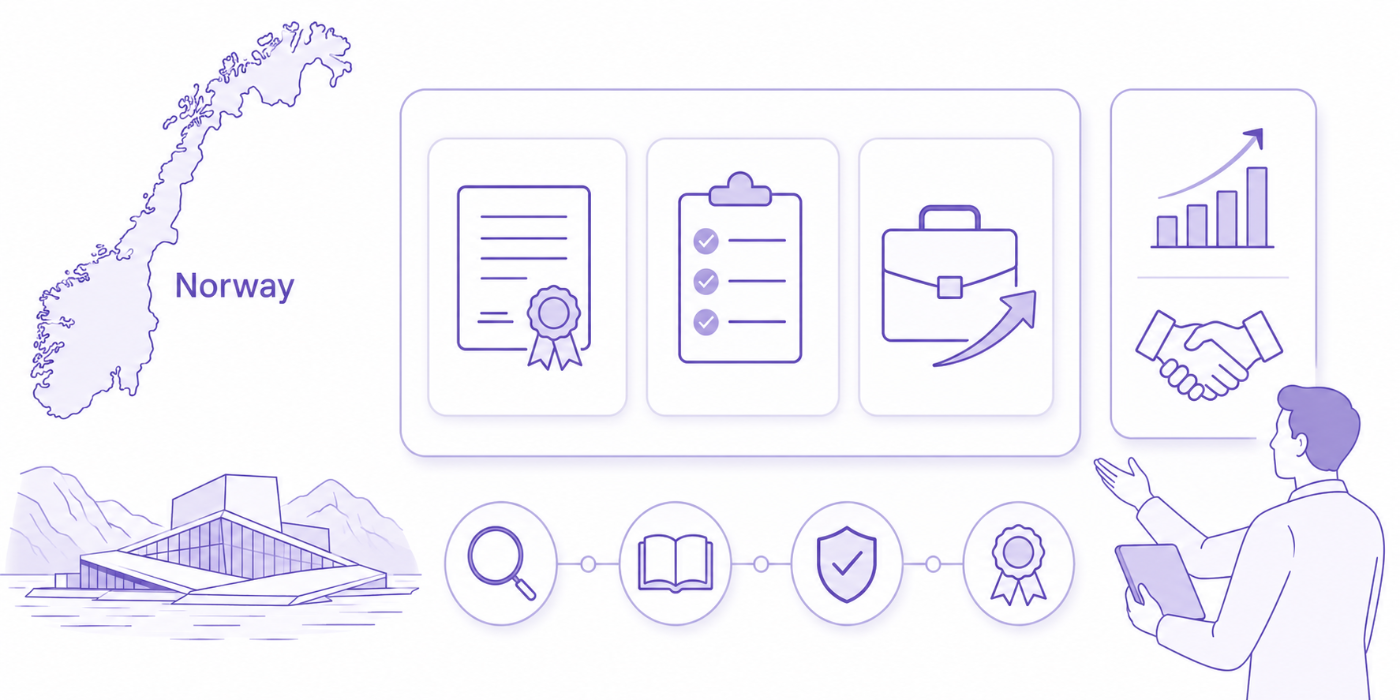
The first thing to understand is the difference between a private coaching credential and Norwegian health-profession authorisation. Norway’s official recognition framework focuses on regulated professions; HK-dir states that most professions or trades require no specific recognition before work begins unless the profession appears on the regulated list. Helsedirektoratet separately explains that health personnel who practise regulated health professions in Norway need authorisation or a licence.
That distinction shapes the whole strategy. A certification can help you build a credible coaching practice, strengthen your coaching certification portfolio, improve your coaching case study evidence, and communicate your ethical responsibilities as a health and life coach. Authorisation applies when you enter a protected healthcare role. Coaching should stay inside behavior change, goal setting, habits, motivation, lifestyle support, accountability, and referral when a client needs clinical care.
This is where many new coaches in Norway lose trust. They write “health expert” on a website, talk about hormones, burnout, obesity, trauma, or chronic illness, then offer a certificate with no scope statement. A Norwegian client may already have a GP, physiotherapist, psychologist, dietitian, or specialist. Your edge comes from being clear: you help clients turn health intentions into routines, decisions, meal planning, sleep hygiene, movement consistency, stress coping, and self-leadership. That clarity pairs well with NBHWC coaching competencies, ICF credentialing skills, effective coaching communication, and trust-building coaching integrity.
A smart Norway certification plan answers four questions before you pay for a program: Will this credential help clients trust me? Will it teach skills I can use in live sessions? Will it protect me from scope mistakes? Will it support my business model after graduation? A program that gives only PDFs, vague mindset lessons, and a pretty badge creates weak market leverage. A program with practice sessions, ethics, assessment, feedback, documentation, coaching psychology, motivational interviewing, habit design, and case-study building gives you something concrete to sell through client transformation case studies, client accountability systems, habit formation coaching tools, and goal tracking resources.
| Decision Area | What To Choose | Why It Matters In Norway | Best ANHCO Resource |
|---|---|---|---|
| Primary niche | Pick health habits, life direction, stress, career wellbeing, relationships, or preventive lifestyle | A broad “wellness coach” label weakens trust and makes pricing harder | which certification is right for you |
| Credential purpose | Use certification to prove skill, ethics, structure, and supervised practice | Norwegian clients value competence signals more than loud sales language | certification differentiates your coaching business |
| Health scope | Stay with education, behavior support, and referral boundaries | Clinical claims create avoidable credibility and compliance risk | ethical responsibilities as a coach |
| Life coaching route | Choose a program with live coaching labs and feedback | Clients can feel the difference between theory and coached presence | online life coach certification programs |
| Health coaching route | Prioritize behavior change, nutrition boundaries, lifestyle coaching, and outcomes | Norwegian clients often want practical routines, not abstract motivation | online health coach certification programs |
| Exam preparation | Use structured question practice and competency review | Certification confidence improves when you can explain your decisions | NBHWC practice exam questions |
| Resume positioning | List credential, scope, hours, competencies, and niche outcomes clearly | Vague initials after your name rarely convert on their own | list credentials on your resume |
| Ethics foundation | Build consent, confidentiality, referral, and record-keeping rules | Trust collapses when boundaries appear improvised | non-negotiable coaching standards |
| Communication skill | Train reflective listening, concise questions, and non-directive challenge | High-value clients pay for clarity, not motivational noise | successful coaching communication |
| Client anxiety | Learn support frameworks and referral language | Stress and anxiety show up often, even in non-clinical coaching | client anxiety and stress coaching |
| Habit change | Use triggers, environment design, tracking, and relapse planning | Clients judge coaching by what changes between sessions | habit formation in coaching |
| Business setup | Build offer, onboarding, payment, feedback, and renewal systems early | Certification without an operating system creates stalled income | tools for starting a coaching business |
| Legal awareness | Document scope, cancellation policy, privacy notice, and consumer-facing claims | Professionalism is visible before the first session begins | legal requirements for coaches |
| Client onboarding | Use intake forms, goals, consent, risk flags, and referral triggers | Strong onboarding prevents confused expectations later | safe coaching environment |
| Case studies | Capture baseline, action plan, obstacles, adjustments, and results | Norwegian prospects need proof that your method works in real life | case studies that boost credibility |
| Technology stack | Use simple scheduling, secure notes, habit tracking, and client dashboards | Too many apps overwhelm clients and reduce follow-through | best coaching apps |
| Automation | Automate reminders, check-ins, invoices, and renewal prompts | Consistency protects both client results and coach capacity | coaching automation tools |
| Marketing channel | Choose SEO, referrals, workshops, LinkedIn, YouTube, or employer wellness | Scattered posting drains energy without compounding authority | digital marketing tools for coaches |
| Website SEO | Build service pages around niche pain points, location, and proof | Search demand rewards specific problems more than generic coach bios | SEO tools for coaching websites |
| Pricing model | Sell packages with milestones instead of isolated single sessions | Norwegian buyers often need a clear value pathway before committing | high-ticket coaching offers |
| Retention | Design 30-, 60-, and 90-day progress reviews | Clients renew when progress becomes visible and specific | client retention strategies |
| Feedback system | Ask what helped, what blocked action, and what needs adjustment | Silent clients often leave before giving you the real reason | client feedback into business growth |
| Emotional consent | Ask permission before deep questions, sensitive reflection, or challenge | Respectful pacing builds safety and prevents overreach | emotional consent in coaching |
| Professional growth | Plan annual CPD around your niche and weak spots | The market keeps moving after your first certificate | continuous coaching education |
| Career niche | Consider mental health support, relationship coaching, financial coaching, or preventive health | A specific pathway makes offers easier to understand and refer | mental health coaching career guide |
| Outcome method | Use measurable behavior goals, self-reflection, and weekly experiments | Clients need evidence that sessions translate into action | science of behavior change |
| Client experience | Create welcome emails, recap notes, resources, and renewal timing | The experience around sessions often decides referrals | exceptional client experiences |
| International comparison | Compare Norway with nearby European certification markets | Cross-border online clients may ask how your credential fits globally | certification in the Netherlands |
| European expansion | Prepare English-language and local-market versions of your offer | Remote coaching makes region-specific trust signals more important | certification in Switzerland |
| Final program choice | Choose the program you can turn into sessions, proof, referrals, and income | The best certificate supports the whole practice, not only graduation | is certification worth it |
2. The Certification Pathway: From Beginner to Market-Ready Coach
Start with positioning before program shopping. A beginner in Norway should decide whether the offer will focus on weight-management behavior, sleep routines, stress resilience, executive wellbeing, preventive health, family habits, career transitions, or confidence and life direction. That decision determines whether you need a health-heavy program, a life coaching credential, a CPD-accredited life coach certification, a fast online health coach certification, or a broader coaching toolkit for every niche.
The second step is choosing a program with real practice. Look for observed coaching, mentor feedback, ethical case discussions, client intake design, session structure, documentation, behavior-change science, and business application. A certificate that teaches only “ask powerful questions” leaves you exposed when a client arrives with shame around food, inconsistent medication habits, sleep deprivation, grief, or chronic stress. You need structured competence from behavioral strategies for lasting change, constructive feedback clients listen to, managing client expectations, and coaching through emotional crises.
The third step is building proof while studying. Do not wait until graduation to think about clients. Create a practice log, collect anonymised themes, write reflection notes, build sample intake forms, design three signature packages, and draft a referral statement. This turns coursework into assets for client testimonials capture, session recording tools, surveys and feedback tools, and custom coaching dashboards.
The fourth step is creating your Norway-ready business foundation. If you operate as a sole proprietorship, Brønnøysund states that a sole proprietorship must be registered in the Central Coordinating Register for Legal Entities to receive an organisation number; it also notes that a business must have an address in Norway, while the owner generally must be 18. This is where certification connects with payment systems for coaching businesses, financial forecasting for coaches, tax planning for coaches, and scaling a coaching practice profitably.
3. What to Look for in a Health & Life Coaching Program for Norway
The best program for Norway should give you competence you can defend in plain language. That means every module should map to a client problem: lack of follow-through, emotional eating, low energy, unclear goals, stress loops, work-life overload, identity change, relapse after progress, or low confidence. A serious program teaches you how to assess readiness, design small commitments, handle resistance, and review outcomes. It should strengthen positive psychology coaching, solution-focused brief coaching, appreciative inquiry, and strength-based coaching techniques.
For health coaching, the program should teach nutrition conversation boundaries, habit architecture, sleep and stress basics, motivational interviewing, prevention-focused lifestyle support, and referral cues. A coach who says “I help clients build healthier routines around food, movement, energy, and stress” sounds safer and more useful than one who implies treatment. This is especially important when your content touches preventative health coaching, client diet change, behavior-change science, and client empowerment.
For life coaching, the program should develop emotional range. Clients bring procrastination, perfectionism, identity confusion, relationship patterns, money stress, career decisions, and confidence gaps. A strong life coaching certificate trains you to hold structure without becoming cold, challenge without shaming, and support without rescuing. Look for modules around inner critic management, life mapping, daily journaling prompts, and relationship coaching pathways.
The business layer deserves equal attention. Many coaches finish certification with courage and still have no offer, no intake process, no pricing logic, no follow-up system, and no referral pathway. Choose a program that helps you build a marketable practice through must-have coaching business tools, CRM tools for coaching clients, automated email sequences, and networking strategies for coaches.
4. Compliance, Privacy, and Scope Boundaries Norwegian Coaches Must Respect
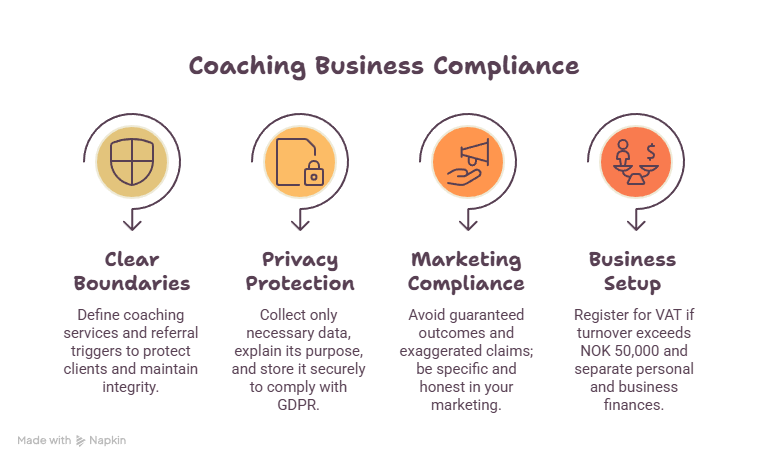
A Norway-ready coach needs clean boundaries in writing. Your website, intake form, agreement, session notes, and marketing copy should say what coaching includes: goal setting, education, accountability, habit design, reflection, decision support, and values-based planning. It should also define referral triggers: symptoms needing diagnosis, medication questions, eating disorder concerns, trauma treatment, severe depression, suicidal ideation, uncontrolled chronic conditions, or pain requiring clinical assessment. That boundary protects client safety and supports coaching integrity, career-ending mistake prevention, setting boundaries as a coach, and avoiding coaching traps.
Privacy deserves serious attention because health and life coaching often collects sensitive information. Datatilsynet directs organisations to GDPR guidance and highlights that a data protection impact assessment is required before processing personal data likely to create high risk for data subjects. For coaches, the practical standard is simple: collect only what you need, explain why you collect it, store it securely, limit access, avoid casual screenshots, and keep health-related notes out of messy personal tools. This fits naturally with client session recording tools, custom coaching dashboards, technology transforming coaching, and AI changing client interactions.
Marketing compliance also affects trust. The Norwegian Consumer Authority supervises markets, illegal marketing, unfair contract terms, and illegal commercial practices aimed at consumers. A coach should avoid guaranteed outcomes, exaggerated health claims, fake scarcity, hidden renewal terms, unclear cancellation policies, and testimonials that imply results everyone will get. Strong marketing can still be bold when it is specific: “12-week habit coaching for busy professionals who need sleep, meal planning, movement consistency, and weekly accountability.” That connects better with client preferences shaping coaching, future-proof coaching trends, state of the coaching industry, and benchmarking your coaching business.
If you invoice clients in Norway, your business setup and tax rules need attention. The Norwegian Tax Administration states that the VAT registration monetary limit is NOK 50,000 excluding VAT for enterprises and most organisations, measured over a 12-month period, and that VAT should be added only after registration. Coaches should track turnover early, separate personal and business finances, budget for tax, and use clear invoices. This turns certification into a real practice supported by payment systems, financial forecasting, legal setup basics, and business automation.
5. How to Turn Certification Into Clients, Income, and Long-Term Authority
The biggest certification mistake is treating graduation as the finish line. In Norway, the real value starts when you convert your training into a clear offer. Build one flagship package with a defined client, problem, duration, rhythm, and outcome pathway. For example: “12-week preventive health coaching for professionals who want better sleep, food structure, energy, and movement consistency.” That is easier to sell than “health and life coaching sessions.” It also aligns with high-ticket coaching offers, micro-coaching for rapid results, client engagement trends, and client retention strategy.
Your website should answer the questions prospects are afraid to ask. Can this coach help someone like me? Is this safe? How long does it take? What happens in sessions? What will I have to do between calls? What if I fail? What does the coach do with personal information? Answer those directly using service pages, FAQs, case studies, and simple diagrams. Build search pages around SEO tools for coaching websites, YouTube growth for coaches, digital marketing tools, and client testimonials.
A Norway-based coach can grow through four channels: local trust, professional referrals, employer wellbeing, and online authority. Local trust comes from workshops, community groups, clinics-adjacent networking, gyms, coworking spaces, and corporate lunch-and-learns. Professional referrals come from knowing exactly when to refer out and making yourself easy to recommend. Employer wellbeing works when your offer solves absenteeism-adjacent problems through routines, stress management, and sustainable productivity. Online authority grows when your content shows judgment, not recycled motivation. This is where joint ventures for coaches, social responsibility in coaching, gig economy coaching, and franchising your coaching method become useful.
Finally, build your authority around outcomes, not credentials alone. A certificate opens the door, while progress notes, follow-through systems, check-ins, data-light tracking, client language, renewal conversations, and case studies keep the business alive. Track what clients actually struggle with between sessions: missed routines, travel disruption, social pressure, decision fatigue, emotional eating, inconsistent sleep, and perfectionism after setbacks. Then design resources around those moments using gamification strategies, powerful journaling tools, gratitude journal coaching, and visualization and guided imagery.
6. FAQs About Health & Life Coaching Certification in Norway
-
A private coaching certificate is mainly a credibility, skills, and market-positioning asset. Norwegian health-profession authorisation applies when someone practises a regulated healthcare profession. For coaching, the safer path is to get certified, define your scope clearly, avoid clinical claims, and refer clients to authorised professionals when their needs move beyond coaching. Strengthen that foundation with ethical coaching responsibilities, coaching integrity, safe coaching environments, and professional standards.
-
The best certification is the one that matches your niche and gives you supervised practice, ethics, behavior-change tools, coaching labs, assessment frameworks, business support, and a credible credential story. Health-focused coaches should study programs with habit change, wellness behavior, nutrition boundaries, and outcome tracking. Life-focused coaches should prioritize live coaching skill, emotional consent, values work, and client transformation frameworks. Compare online health coach certification programs, online life coach certification programs, ICF exam preparation, and NBHWC competencies.
-
Online coaching can work well, especially for English-speaking clients, expats, professionals, and niche communities. The serious issues are consumer-facing claims, privacy, tax exposure, payment setup, client contracts, and local rules depending on where you and the client are based. Use clear terms, secure tools, and scope language. Build the remote practice through Zoom and video conferencing best practices, automated email sequences, client dashboards, and virtual retreat platforms.
-
Some online certificates can be completed quickly, while deeper credentials with supervised practice, exams, mentoring, and portfolio work may take several months or longer. The better question is how quickly you can become client-ready. A rushed certificate with weak practice can leave you nervous on sales calls and exposed in sessions. Build a timeline around training, practice clients, case studies, offer design, and launch. Use quick health coaching certification guidance, how quickly life coach certification can be earned, certification application planning, and credentialing mistake prevention.
-
Income depends on niche, language, pricing, client acquisition, referral network, corporate access, and whether coaching is full-time or part-time. A coach with a specific problem, clear package, proof, and retention system has stronger earning potential than a coach selling generic hourly support. Certification helps only when the market can see its value. Build earning power with health coach salary data, premium package selling, financial coaching career strategy, and profitable practice scaling.
-
Turn the credential into a working practice within 30 days. Create one flagship offer, one intake form, one coaching agreement, one privacy notice, one follow-up sequence, one testimonial process, and one case-study template. Then start outreach through referrals, LinkedIn, workshops, SEO, and partnerships. Keep improving with coaching resource hubs, continuous education, client experience systems, and future coaching models.
